
As at 15 August 2026. The CGT reforms announced in the 2026-27 Federal Budget (handed down 12 May 2026) are covered below. They are now law: the Treasury Laws Amendment (Tax Reform No. 1) Act 2026 (No. 49, 2026) received Royal Assent on 26 June 2026. They start on 1 July 2027, so for anything you sell before then, today's rules still apply. Plan around the rules as they stand now.
Capital gains tax is one of those topics most people skip over until the day they sell a property. Then it goes one of two ways. Either they get a tax bill from the ATO for tens of thousands of dollars they never saw coming, or they sell the home they've lived in and the whole profit lands in their account tax-free.
Which one happens to you comes down to a handful of rules, and most of them are simpler than they sound. This guide walks through what CGT actually is, whether you (as a first-home buyer) ever have to pay it, how to work it out with real numbers, the main residence exemption, the 6-year rule, the 50% discount, when you actually hand the money over, every legal way to bring the bill down, and exactly what changes on 1 July 2027.
One quick orientation point before we start, because it's the question people really want answered: on a gain of around $100,000, a typical investor who held the property more than 12 months pays tax on roughly $50,000 of it; on a $300,000 gain, roughly $150,000. The rest is wiped out by the discount, and the taxable half is added to your income and taxed at your marginal rate. We show the full maths further down.
Do I, a first-home buyer, ever pay CGT?
The home you live in is CGT-free. No other investment in Australia gets that treatment. If you buy a place, live in it, and sell it later for more than you paid, the profit is yours, and the ATO doesn't take a cut. That's the main residence exemption, and it's the single most valuable tax break ordinary Australians have.
So for most first-home buyers the honest answer is: probably never, as long as the property you own is the one you live in. You only step into CGT territory when you own property you don't live in: an investment unit, a holiday house you rent out, a place you moved out of and held onto past the limits we cover below.
If you're earlier in the journey and still working out what you can buy and where you sit, our step-by-step buyer journey and the first home buyer eligibility checker are the place to start. Then come back here when CGT actually becomes relevant to you, which, for a first home, may be a long way off.
What Is Capital Gains Tax (CGT)?
Capital gains tax is the tax on the profit you make when you sell an asset for more than you paid for it. With property, the gain is the gap between what you paid (your cost base) and what you sold it for, after taking off the costs you racked up along the way.
The thing that trips people up: CGT isn't a separate tax with its own rate. There's no "capital gains tax bracket" in Australia. Your net gain gets added to your normal taxable income in the year you sell, and the whole lot is taxed at your marginal rate. So how much CGT you pay depends partly on how much else you earned that year.
CGT applies to assets bought after 20 September 1985, the day the tax came in. Anything acquired before that date is a "pre-CGT asset" and exempt, though that's increasingly rare for residential property four decades on. For everything bought since, CGT rules apply unless an exemption gets you out of it.
And the big exemption, the main residence exemption, is the one that matters most for home buyers. We cover it next.
The Main Residence Exemption: Rules in 2026
The main residence exemption makes the home you live in completely CGT-free when you sell, with no cap on the profit. Sometimes called the principal place of residence (PPOR) exemption, it's the most generous tax concession available to everyday Australians, and the 2026 reforms haven't touched it.
Conditions for the full exemption
To get the full exemption, zero CGT on the entire gain, all of these need to be true:
- The property was your main residence for the whole time you owned it
- You didn't use it to produce income (renting out a room, listing it on Airbnb, running a business from a dedicated space)
- The land is under 2 hectares
- You weren't claiming the main residence exemption on another property over the same period
Meet all of those and the entire profit is tax-free, however big. Buy a home for $500,000, live in it for 20 years, sell it for $2 million, and the full $1.5 million is yours. Nothing else in the Australian tax system protects a gain like that, which is exactly why getting into your own home matters so much. If you're still saving, our guide to how much deposit you need to buy a house walks through the numbers.
Partial exemptions
If you lived in the place for part of the time and rented it out for the rest, or used part of the home to earn income, you'll usually get a partial exemption. The ATO splits the gain based on the proportion of time (or floor space) the property was genuinely your home versus income-producing.
Foreign residents and the main residence exemption
This one catches people out, so it's worth being precise. Foreign residents for tax purposes generally can't claim the main residence exemption at all for properties sold after 30 June 2020. The only way out is the narrow "life events test": you qualify only if you were a foreign resident for a continuous period of six years or less and something serious happened during that time: a terminal medical diagnosis for you, your spouse or your child; the death of your spouse or child; or a marriage or relationship breakdown. There's no general grace period for selling after you move overseas. If you're an Australian living abroad with a home back here, get advice before you sell. (Source: ATO, "Main residence exemption for foreign residents".)
The 6-Year Rule for CGT
The 6-year rule lets you keep treating a former home as your main residence, and keep it CGT-free, for up to six years after you move out, even if you rent it out in the meantime. It's there for people who relocate for work, travel, or move in with a partner but aren't ready to sell.
Two conditions make it work. First, during that six-year window you can't claim the main residence exemption on any other property, because you only get one main residence at a time, so if you buy and move into a new place you have to choose which one the exemption covers. Second, the clock resets: if you move back in before the six years are up, even briefly, you start a fresh six-year period the next time you move out.
A quick example. You buy a home, live in it for three years, then move interstate and rent it out. If you sell within six years of moving out, the whole gain is still CGT-free. Rent it for seven years before selling and you lose the exemption for the one year over the limit: roughly one-seventh of the gain becomes taxable, and six-sevenths stays exempt. (Source: ATO, "Treating a former home as your main residence".) Our full guide to the CGT 6-year rule works through the reset, the market-value cost base and a complete worked example.
The 50% CGT Discount, and What Replaces It in 2027
If you hold a property for more than 12 months before selling, you only include half the capital gain in your taxable income, but from 1 July 2027 this flat 50% discount is being replaced by an inflation-based system. Until then, the discount is the most valuable concession property investors have, and it still applies to everything sold before that date.
Here's how it works today. Hold an asset (including an investment property) for more than 12 months and only 50% of the gain is taxed. The other half is simply disregarded. You never pay tax on it.
Before any of this applies, how you hold the title decides whose gain it is: joint tenants split it equally, tenants in common split it by their registered shares. See joint tenants vs tenants in common for how each structure works and how to change it.
Example: you make a $200,000 gain on an investment unit held for three years. With the discount, only $100,000 goes onto your taxable income. At a 37% marginal rate that's $37,000 in tax instead of $74,000, a $37,000 saving for the sake of holding past the one-year mark. It's the reason investors almost never sell inside 12 months.
Who qualifies for the discount
- Australian resident individuals: the standard 50% discount applies
- Trusts: the 50% discount flows through to beneficiaries
- Complying super funds: get a 33.33% discount, not 50%
- Companies: get no discount at all, which is one reason most individual investors hold property in their own name or a trust rather than a company
- Foreign residents: can't claim the discount on the foreign-resident portion of a gain for assets acquired after 8 May 2012. An apportioned discount can still apply to the part of the gain that built up while they were an Australian resident; the government's further 'strengthening the foreign resident CGT regime' measure was deferred from its originally proposed 1 July 2025 start and, as at mid-2026, is still not law
The 50% discount is still in force until 1 July 2027. Anyone selling between now and then uses it in the calculation below, exactly as set out. From 1 July 2027 it's replaced, for individuals, trusts and partnerships, by a cost-base indexation system with a 30% minimum tax. We explain that next.
What the 2026 Budget Changed (1 July 2027 transition)
The 2026-27 Federal Budget, handed down on 12 May 2026, announced the biggest shake-up to capital gains tax in over two decades. Three changes land on the same day, 1 July 2027, and one important caveat sits over all of them.
This is now law. The Treasury Laws Amendment (Tax Reform No. 1) Act 2026 (No. 49, 2026) received Royal Assent on 26 June 2026, so the detail below is settled, not a proposal; only the 1 July 2027 start date is still ahead. One scope point worth getting right up front: the indexation method and the 30% minimum tax apply to all CGT assets held by individuals, trusts and partnerships, not just residential property, though the new-build election and the related negative gearing changes are property-specific. The rest of this section focuses on property, since that's what most readers are here for. (Source: budget.gov.au, "Tax reform"; ATO, "Tax reform, boosting home ownership".)
1. The 50% discount is replaced by cost-base indexation
From 1 July 2027 the flat 50% discount is replaced by indexation. Instead of halving the gain, the system lifts your cost base in line with inflation (CPI) over your hold period, so you're only taxed on the real gain, the bit above inflation. It's a return to roughly the method Australia used before the 50% discount came in back in 1999.
Whether you come out ahead depends entirely on inflation across your hold. Over short holds or in low-inflation years, indexation usually produces a bigger taxable gain than the old 50% discount. Over long holds in higher-inflation years it can be more generous. There's no universal winner. It swings both ways.
2. A 30% minimum tax on net capital gains
Also from 1 July 2027, net capital gains face a 30% minimum tax floor. If your marginal rate would tax the gain at less than 30%, the floor lifts your effective rate to 30%. If you're already on 30% or more, the floor doesn't bite, and you pay your marginal rate as usual. It mainly affects investors on lower or middle incomes who used to stack the 50% discount on top of a sub-30% marginal rate.
3. A transitional split for property owned before 1 July 2027
Own an investment property before 1 July 2027 and sell after it, and your gain is split:
- The gain that built up before 1 July 2027 uses the existing 50% discount
- The gain from 1 July 2027 onwards uses indexation and faces the 30% minimum tax
The split is worked out by valuing the property as at 1 July 2027. In practice, a market valuation on or close to 30 June 2027 becomes important paperwork for anyone holding across the transition.
4. New builds can choose
Investors who buy a qualifying newly built property get to elect: stay on the 50% discount, or move to indexation plus the 30% minimum tax. It's a deliberate lever to keep investor money flowing into new housing supply.
5. People on income support are spared the 30% floor
Recipients of means-tested income support, Age Pension, JobSeeker, Disability Support Pension and similar payments, are exempt from the 30% minimum tax for years in which they receive a payment. Note the exemption is from the floor only; the underlying indexation calculation still applies to them.
Super funds aren't affected
Complying super funds (including SMSFs) keep their existing CGT treatment, the 33.33% discount, and aren't moved onto indexation under this reform. They have their own concessional regime, which sits outside these changes.
Before vs after 1 July 2027, at a glance
| Feature | Now (until 1 July 2027) | From 1 July 2027 |
|---|---|---|
| Held more than 12 months | 50% of gain taxed | Cost base indexed to CPI; only the real gain taxed |
| Minimum tax | None, taxed at your marginal rate | 30% floor on the net gain |
| Applies to | Individuals, trusts (incl. property) | Individuals, trusts, partnerships, all CGT assets |
| New builds | 50% discount | Can elect 50% discount or the new method |
| Super funds | 33.33% discount | 33.33% discount (unchanged) |
| Your own home | CGT-free | CGT-free (unchanged) |
A worked comparison: old discount vs new indexation
Nobody else on the page does this maths, so here it is. Say you bought an investment property for $600,000 and sold it for $750,000, a $150,000 raw gain, having held it long enough to qualify under either system, and your marginal rate is 37%.
- Old 50% discount: half the gain is taxed. $150,000 × 50% = $75,000 taxable, taxed at 37% = $27,750 in tax.
- New indexation (illustrative): say CPI lifted your $600,000 cost base by 8% over the hold, to $648,000. Real gain = $750,000 − $648,000 = $102,000, taxed at 37% = $37,740 in tax (the 30% floor doesn't apply because 37% is already higher).
In this case the investor pays roughly $10,000 more under indexation, because inflation over the hold was modest. Run the same property through a decade of high inflation and the gap narrows or flips. The point: the new method is sensitive to inflation in a way the flat discount never was, and the only way to know your number is to run both. Our CGT calculator has a compare toggle that does exactly that with your own figures. The CPI figure above is illustrative. Your actual indexation uses the published CPI for your hold period.
What this means for first-home buyers and rentvesters
The main residence exemption is untouched. Your own home stays 100% CGT-free no matter which rules are in force when you sell. If you're a rentvester eyeing an established investment property, two reforms now point the same way: the negative gearing changes hit the income side (no offsetting losses against your salary on established properties bought after Budget night), and these CGT changes hit the exit side. Both steer investor money toward new builds, which keep the friendlier treatment. For the income side, see our negative gearing explained guide, and for the broader picture our 2026 budget breakdown for first-home buyers.
How to Calculate Capital Gains Tax on Property: Step by Step
If CGT applies, say you're selling an investment property, here's the sequence:
Prefer to skip the manual maths? The free NestPath CGT calculator runs all five steps for you, under both today's rules and the post-1-July-2027 rules.
Step 1: Work out your cost base
The cost base is everything you paid to buy, hold, improve and sell the property, not just the purchase price. It covers five categories of cost, which we break down in the next section.
Step 2: Calculate the capital gain
Sale price minus cost base = capital gain. If that comes out negative, you've made a capital loss, which you can carry forward to offset future capital gains (but you can't deduct it against your salary).
Step 3: Apply the 50% discount (if eligible)
Held the property more than 12 months? Multiply the gain by 50%. Only that discounted amount is taxable. (From 1 July 2027 this step changes to the indexation method above.)
Step 4: Add it to your taxable income
The net gain gets added to everything else you earned that year: salary, rent, dividends, the lot.
Step 5: Pay tax at your marginal rate
The combined total is taxed using the standard ATO brackets (see the rates table further down). Want to sanity-check what you could afford on an investment loan first? Our borrowing power calculator and mortgage repayment calculator do the heavy lifting.
Worked Example: Perth Investment Property ($550K)
Here's a realistic walk-through. The numbers are a worked example, not a forecast.
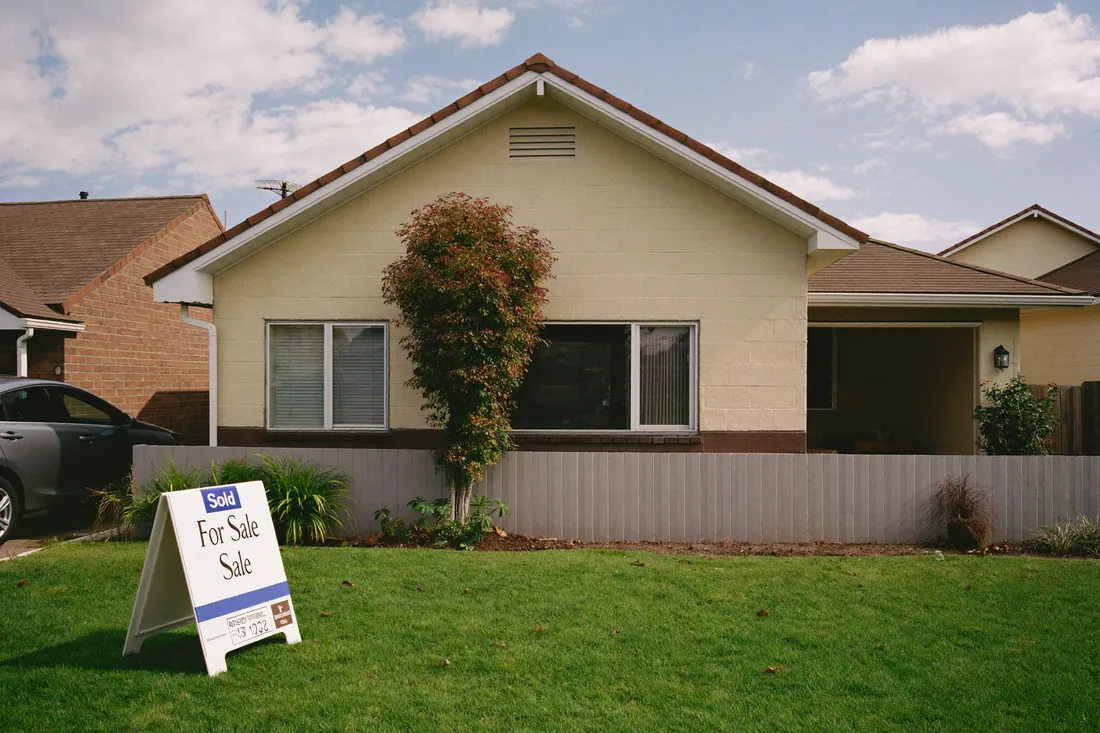
The situation: Sarah bought a 2-bedroom investment unit in Perth for $550,000 in July 2021. She sells it in April 2026 for $750,000. Her taxable salary in 2025-26 is $95,000.
Step 1: Calculate the cost base
| Cost base element | Amount |
|---|---|
| Purchase price | $550,000 |
| Stamp duty (WA) | $19,665 |
| Conveyancing fees (purchase) | $1,800 |
| Building & pest inspection | $650 |
| Bathroom renovation (2023) | $12,000 |
| New split-system air con (2024) | $3,200 |
| Conveyancing fees (sale) | $1,500 |
| Real estate agent commission (sale) | $15,750 |
| Advertising & styling (sale) | $2,500 |
| Total cost base | $607,065 |
The $19,665 stamp duty is an illustrative figure for this example, not a current quoted WA rate. Your actual duty depends on the price and any concessions. You can check your own number with our stamp duty calculator.
Step 2: Calculate the capital gain
$750,000 − $607,065 = $142,935
Step 3: Apply the 50% discount
Sarah held the property nearly five years, so she qualifies. $142,935 × 50% = $71,468 net capital gain.
Step 4: Add to taxable income
Salary $95,000 + net gain $71,468 = $166,468 total taxable income.
Step 5: Calculate the tax
Using 2025-26 rates:
- $0 to $18,200: nil
- $18,201 to $45,000: $4,288
- $45,001 to $135,000: $27,000
- $135,001 to $166,468: $31,468 × 37% = $11,643
Total tax on $166,468 = $42,931 + Medicare levy ($3,329) = $46,260.
Tax on her salary alone ($95,000) would be roughly $21,188 including Medicare. So the extra tax caused by the capital gain is about $25,072.
Without the discount Sarah would have been taxed on the full $142,935, about $56,779 in extra tax over her salary alone, versus $25,072 with the discount. So the discount saved her around $31,700. That's real money, and it's why understanding CGT before you invest pays for itself.
When Do You Actually Pay CGT?
You pay CGT when you lodge your tax return for the financial year you sold, and the year that counts is when you signed the contract of sale, not when settlement happened. There's no separate CGT bill in the post and no PAYG instalment for it. The gain simply rolls into your assessable income for that year, and any tax owing is part of your normal return.
The contract-date point matters at the end of a financial year. Sign a sale contract on 28 June and the gain falls into that financial year, even if the money doesn't change hands until settlement in August. If you have any control over timing, that quirk is worth knowing: pushing a contract a few days into the new financial year can move the whole gain into a different tax year.
Cost Base: The Five Categories You Can Include
Your cost base is the most important number in any CGT calculation, because every legitimate dollar you add to it shrinks your gain and your tax. The ATO recognises five categories.
1. Acquisition costs
The purchase price, plus stamp duty, conveyancing and legal fees on purchase, building and pest inspections, loan fees tied specifically to the purchase, and other costs directly tied to acquiring the property.
2. Incidental costs of buying and selling
Agent commission, advertising and marketing on sale, auctioneer fees, conveyancing and legal fees on sale, valuation costs where the transaction needs them, and the cost of transferring title.
3. Costs of owning the asset (non-deductible only)
This is where investors lose money. Only costs you didn't already claim as rental deductions can go into the cost base. If you've been claiming annual deductions for council rates, insurance, interest and property management on a rented property, you can't count them again here. But if you held a vacant block that produced no income, holding costs like rates and interest may be added to the cost base.
4. Capital improvement costs
Renovations and improvements that add value: a new kitchen, a bathroom reno, a deck, a split-system install, new flooring. These are capital costs, not repairs, and they go into the cost base. The line matters: replacing a broken window is a repair (deductible each year); fitting double-glazing throughout is a capital improvement (cost base).
5. Costs of preserving or defending title
Legal costs to establish or defend your ownership: boundary disputes, title defects, survey costs. Uncommon, but they can be large when they happen.
Tip: keep every receipt from the day you buy to the day you sell. Plenty of investors overpay CGT simply because they can't prove costs that would have lifted their cost base. A single folder, paper or digital, of property receipts will save you money at sale time.
Capital Gains Tax on Investment Property
Selling an investment property is the most common reason an individual Australian ends up paying CGT. The key points when you own one, or are weighing one up:
Rental deductions vs cost base
Costs you claim each year as rental deductions, interest, rates, insurance, property management, repairs, can't also go into your cost base. You get the annual deduction or the cost base inclusion, not both. Capital improvements you didn't claim annually can be added.
Depreciation and CGT
If you claim building depreciation (the capital works deduction under Division 43, typically 2.5% a year of the original construction cost), what you've claimed is subtracted from your cost base, which lifts your eventual CGT. Even so, the maths usually favours claiming it: the annual deductions at your full marginal rate generally beat the eventual CGT hit, which today is softened by the 50% discount.
Costs you can include when selling
When you sell an investment property, your cost base can include agent commission (often 2 to 2.5% of the sale price), conveyancing and legal fees, advertising and marketing, styling and photography, auctioneer fees, and any capital works done to prepare it for sale, capital works only, not cleaning or repairs.
Negative gearing and CGT
Many investors run an investment property at a rental loss each year, negative gearing, betting that capital growth will more than make up for it at sale. The CGT on exit is the "payback" for years of deductions. It works best when the property grows strongly, you hold past 12 months, and you're in a high bracket during the hold. Just note that for established properties bought after Budget night, the negative gearing rules tighten from 1 July 2027. Run your numbers with our borrowing power calculator, then talk to a broker about how to structure the loan.
How to Avoid or Minimise CGT on Property Legally
You can't make CGT on an investment property disappear, but several legitimate strategies bring it down a lot.
1. Hold for more than 12 months
The biggest lever there is, while the 50% discount stands. It halves your taxable gain. Never sell at 11 months if you can wait until 13. The saving is huge. (From 1 July 2027 the discount gives way to indexation, so the 12-month line still matters but the benefit changes shape.)
2. Maximise your cost base
Count every eligible cost: stamp duty, legal fees, inspections, capital improvements, agent commission, advertising, styling. A $20,000 higher cost base at a 37% marginal rate saves you around $3,700 in tax (or $7,400 without the discount).
3. Time the sale for a low-income year
If you can, sell in a year your other income is down: parental leave, study, between jobs, semi-retired. A lower base income means a lower marginal rate on the gain.
4. Offset gains with capital losses
Capital losses from other investments, shares, crypto, another property, can be set against your gain before tax is worked out. Losses carry forward indefinitely until you've got gains to use them on.
5. Consider the main residence exemption strategically
If you're a rentvester, moving into your investment property before selling might earn it a partial main residence exemption. This needs genuine residency, not just a change of postal address, and the ATO has specific rules. Talk to a tax professional before trying it.
6. Use the 6-year rule
If you move out of your home to travel or relocate, you can hold the main residence exemption for up to six years rather than rushing to buy a new PPOR. That can shield a big gain. See how the 6-year rule works in detail.
7. Hold into a lower-income retirement
Selling crystallises and taxes the gain. If you can hold the property until retirement, when your income, and marginal rate, is lower, the CGT bill is smaller.
8. Get a depreciation schedule
Depreciation is an annual deduction rather than a cost base item, and it cuts your taxable rental income each year. It does reduce your cost base for CGT (the "clawback"), but the annual savings usually outweigh the eventual CGT cost.
None of this is a substitute for advice on your own situation. A tax professional or a good conveyancer can flag the traps before you act. And for the income side of the equation, our negative gearing guide pairs naturally with this one.
Inherited Property and CGT
There's no CGT at the moment a property passes to you through a deceased estate. The transfer itself is tax-free. CGT only comes into play when you, the beneficiary, eventually sell.
If the property was the deceased's main residence, you generally have two years from their death to sell it CGT-free. Sell after that and CGT may apply on the gain from the date of death (the ATO can extend the two years in some circumstances). If the property was an investment, you inherit the deceased's original cost base, and CGT applies on the whole gain from their original purchase right through to your eventual sale. Inherited-property CGT gets fiddly fast. It's one of the clearest cases for getting tailored advice.
Capital Gains Tax Rates 2026
Remember: there's no separate "CGT rate." Your net gain is added to your income and taxed at your marginal rate. Here are the 2026-27 brackets:
| Taxable income | Tax rate | Tax on this bracket |
|---|---|---|
| $0 to $18,200 | 0% | Nil |
| $18,201 to $45,000 | 15% | $4,020 |
| $45,001 to $135,000 | 30% | $27,000 |
| $135,001 to $190,000 | 37% | $20,350 |
| $190,001+ | 45% | 45c per $1 over $190,000 |
Plus 2% Medicare levy on total taxable income.
What this means for CGT
If your salary is $90,000 (the 30% bracket) and you add a $60,000 net gain, your total taxable income becomes $150,000, pushing the top of it into the 37% bracket. The gain is effectively taxed at a blend of 30% and 37%, depending on how much falls in each. That's exactly why timing the sale for a lower-income year can save real money: at a $50,000 salary instead of $90,000, more of the gain stays in the 30% band.
CGT for different entity types
| Entity | CGT discount | Tax rate on gain |
|---|---|---|
| Individual (resident) | 50% | Marginal rate (0 to 45%) |
| Trust (distributed to individuals) | 50% | Beneficiary's marginal rate |
| SMSF / super fund | 33.33% | 15% (accumulation) / 0% (pension) |
| Company | None | 25% or 30% flat |
| Foreign resident (post 8 May 2012 acquisition) | None on foreign-resident portion | Marginal rate |
One thing the 2026 reform doesn't touch: complying super funds keep the 33.33% discount and stay outside the new indexation method. The 1 July 2027 changes apply to individuals, trusts and partnerships, not to super.
CGT and Your First Home: Why It Matters
Here's the bottom line for first-home buyers, and it's worth repeating because it's one of the most important money concepts you'll meet:
Your main residence is CGT-free. No other investment in Australia has that advantage.

Buy a $600,000 home today and watch it grow to $900,000 over ten years, and you pocket the full $300,000 tax-free when you sell. Buy a $600,000 investment property instead, renting it out while you keep renting where you live, and that same $300,000 gain is taxable. Even with the 50% discount, you could be looking at $50,000 or more in tax.
That's the strongest argument there is for getting into your own home before you invest. The CGT-free treatment of your main residence, stacked on top of government grants (up to $30,000 for new builds in some states), stamp duty concessions, and low-deposit guarantee schemes (as little as 2% to 5% deposit with no LMI via our LMI calculator), makes home ownership the most tax-advantaged way most Australians will ever build wealth.
Rentvesting, buying an investment property while you keep renting, has its place, but go in with eyes open on the CGT: the investment property is taxable when sold; the home you live in isn't. For most first-home buyers the maths leans toward buying your own place first. Track your savings with our deposit tracker, see where you stand with the borrowing power calculator, then talk to a broker about the right path for you.
Disclaimer: This guide is general information only and isn't personal tax or financial advice. CGT rules are complex and your circumstances may differ. Always check with a qualified tax professional or financial adviser before making decisions based on tax. Rates and rules are current as at 15 August 2026. The 1 July 2027 reforms described above are now law under the Treasury Laws Amendment (Tax Reform No. 1) Act 2026, which received Royal Assent on 26 June 2026, though they don't take effect until 1 July 2027.
Frequently Asked Questions
Do I pay capital gains tax on my first home?
No. If you buy your first home and live in it as your main residence, the profit when you sell is completely tax-free under the main residence exemption, with no cap on the amount. This holds however much the property has grown, as long as it was your main residence the whole time you owned it and you didn't use it to produce income (such as renting out rooms or running a business from a dedicated space).
How much capital gains tax will I pay on a $300,000 gain?
If you held the property more than 12 months, the 50% discount means only $150,000 of a $300,000 gain is taxable; that $150,000 is added to your income and taxed at your marginal rate. At a 37% marginal rate that's roughly $55,000 in tax on the gain, and at the top 45% rate around $67,000. Your exact figure depends on your other income that year. From 1 July 2027 the discount is replaced by inflation-based indexation, which changes the maths.
When do you pay capital gains tax in Australia?
You pay CGT when you lodge your tax return for the financial year in which you sold, and the relevant year is when you signed the contract of sale, not when settlement happened. There's no separate CGT bill and no PAYG instalment for it; the gain is simply rolled into your assessable income and any tax owing forms part of your normal return.
What is the 6-year rule for capital gains tax?
The 6-year rule lets you keep treating a former home as your main residence, and keep it CGT-free, for up to six years after you move out, even if you rent it out during that time. You can't claim the main residence exemption on another property over the same period, and the six-year clock resets if you move back in before selling.
How much is capital gains tax in Australia?
There's no single CGT rate. Capital gains are added to your taxable income and taxed at your marginal rate. For most Australians in 2025-26 that's 30% (for income $45,001 to $135,000) or 37% ($135,001 to $190,000), plus the 2% Medicare levy. If you held the asset more than 12 months you get the 50% discount, so only half the gain is taxed: a $100,000 gain on a property held two years is taxed on $50,000 at your marginal rate.
What is the 50% CGT discount?
If you hold a property (or any CGT asset) for more than 12 months before selling, only 50% of the gain is included in your taxable income. The other half is disregarded entirely. It applies to Australian resident individuals and trusts, but not companies, and only partly to foreign residents. From 1 July 2027 the flat discount is replaced by an inflation-based indexation system for individuals, trusts and partnerships.
How do I calculate capital gains tax on an investment property?
Subtract your cost base (purchase price + stamp duty + legal fees + capital improvements + selling costs) from the sale price to get your capital gain. If you held the property more than 12 months, apply the 50% discount, then add the net gain to your other taxable income for the year and pay tax at your marginal rate. Our worked example above runs this through with real numbers.
How do I avoid capital gains tax on property?
The cleanest way is to live in the property as your main residence: the main residence exemption makes that gain completely tax-free. You can't fully avoid CGT on an investment property, but you can cut it: hold for more than 12 months (50% discount), maximise your cost base, time the sale for a lower-income year, offset with capital losses, and use the 6-year rule where it applies. Never make a property decision on tax alone. The fundamentals come first.
What is included in the cost base for CGT?
The cost base spans five categories: acquisition costs (purchase price, stamp duty, legal fees, inspections); incidental costs of buying and selling (agent commission, advertising, conveyancing on sale); non-deductible ownership costs (only those not already claimed as rental deductions); capital improvements (renovations, additions, structural upgrades); and costs to preserve or defend title. Every dollar you legitimately add reduces your gain and your tax.
Is the CGT discount changing in 2026?
Yes, and it's now law. The 2026-27 Federal Budget announced that the flat 50% CGT discount will be replaced from 1 July 2027 by a cost-base indexation system, with a 30% minimum tax on net capital gains, for individuals, trusts and partnerships. The existing 50% discount still applies to gains that accrue before 1 July 2027, and for assets held across that date the gain is split: pre-1 July 2027 uses the discount, post-1 July 2027 uses indexation plus the 30% floor. New builds can elect between the two methods, income-support recipients are exempt from the 30% floor, and super funds are unaffected. The Treasury Laws Amendment (Tax Reform No. 1) Act 2026 received Royal Assent on 26 June 2026, so these changes are locked in; only the 1 July 2027 start date is still ahead.
What happens to CGT when you die?
There's no CGT when a property passes to a beneficiary through a deceased estate. The transfer itself is tax-free. CGT may apply when the beneficiary later sells. If it was the deceased's main residence, the beneficiary generally has two years to sell it CGT-free; after that, CGT can apply on gains from the date of death. If it was an investment, the beneficiary inherits the deceased's original cost base and CGT applies on the full gain from the original purchase to the eventual sale.
How much capital gains tax do I pay on a $100,000 gain?
If you held the property more than 12 months, the 50% discount means only about $50,000 of a $100,000 gain is taxable. That $50,000 is added to your income for the year and taxed at your marginal rate, so your exact bill depends on your other income. Your own home is different: the main residence exemption can make it free of CGT if it was your main residence the whole time and you did not use it to produce income. From 1 July 2027 the flat 50% discount is replaced by cost base indexation, which changes the maths.


