
We almost bought a house with $40,000 worth of termite damage hiding behind freshly painted walls. The listing photos looked immaculate and the open inspection was perfect. Then our building inspector found active termite trails in the subfloor and structural damage to three load-bearing walls. The seller had painted over the evidence and said nothing.
A $600 building and pest inspection saved us from a $40,000 problem. We wrote this so the next first home buyer knows the process before they make an offer, not after they've signed. We're not selling inspections. NestPath is free and independent, and every inspector in our directory is licensed, insured, separate from the selling agent, and works to Australian Standards AS 4349.1 and AS 4349.3. This guide covers the cost, what's checked, who pays, when to book, and how to read the report without your eyes glazing over.
How Much Does a Building and Pest Inspection Cost?
A combined building and pest inspection in Australia costs $450 to $900 in 2026 for a standard house, rising to $700 to $1,000+ for inner-Sydney properties. A building-only or pest-only inspection is cheaper, but as you'll see below, splitting them is almost never worth it. Here's what you'll pay by service type:
| Inspection type | Typical cost (2026) |
|---|---|
| Combined building + pest inspection | $450 to $900 |
| Building inspection only | $300 to $800 |
| Pest (timber) inspection only | From $350 |
| Apartment or small unit (combined) | $250 to $400 |
| Structural engineer report (specialist) | $1,500 to $2,200+ |
Price also tracks the property itself, which is what most people are actually trying to work out. As a rough 2026 guide:
- Apartment or unit: $250 to $400, usually cheaper, since there's no roof, subfloor or external structure to assess.
- Standard 3-bedroom house: $450 to $700 in most capitals.
- Larger 4-bed+ or two-storey home: $600 to $900+, because there's simply more to walk.
- Older home (pre-1990): add to the above, because they take longer and may need asbestos awareness.
Does the cost vary by state? Yes, noticeably. Adelaide runs cheapest at roughly $330 to $550, Melbourne metro tends to land around $440 to $700, and inner-Sydney houses commonly top $700 to $1,000. Regional areas across every state are usually cheaper than the capital. The pest (timber) component on its own starts around $350, and termite inspections sit in the same band, which is exactly why bundling matters.
Always book a combined building AND pest inspection. Pest damage, especially termite damage, is structural damage. A building-only inspection that misses active termites can leave you facing $30,000 to $100,000+ after settlement. The $100 to $200 you "save" by skipping the pest component is the worst false economy in property buying.
Get a free, fixed-fee quote from a licensed inspector through NestPath: every inspector we list is licensed in your state, holds professional indemnity insurance, and follows the Australian Standards. Buying an apartment? Budget another $250 to $500 for a strata report (separate from the inspection, more on that below).
Slot the inspection fee into your overall purchase costs alongside stamp duty, conveyancing and LMI. Our deposit savings plan shows where it all fits.
What Is a Building and Pest Inspection?
A building and pest inspection, sometimes called a pre-purchase inspection, is a professional assessment of a home's structural condition and any timber pest activity. It's really two inspections, almost always booked together as one combined service: a building inspection (structure, roof, plumbing, electrical, moisture) and a timber pest inspection (termites, borers, wood decay).
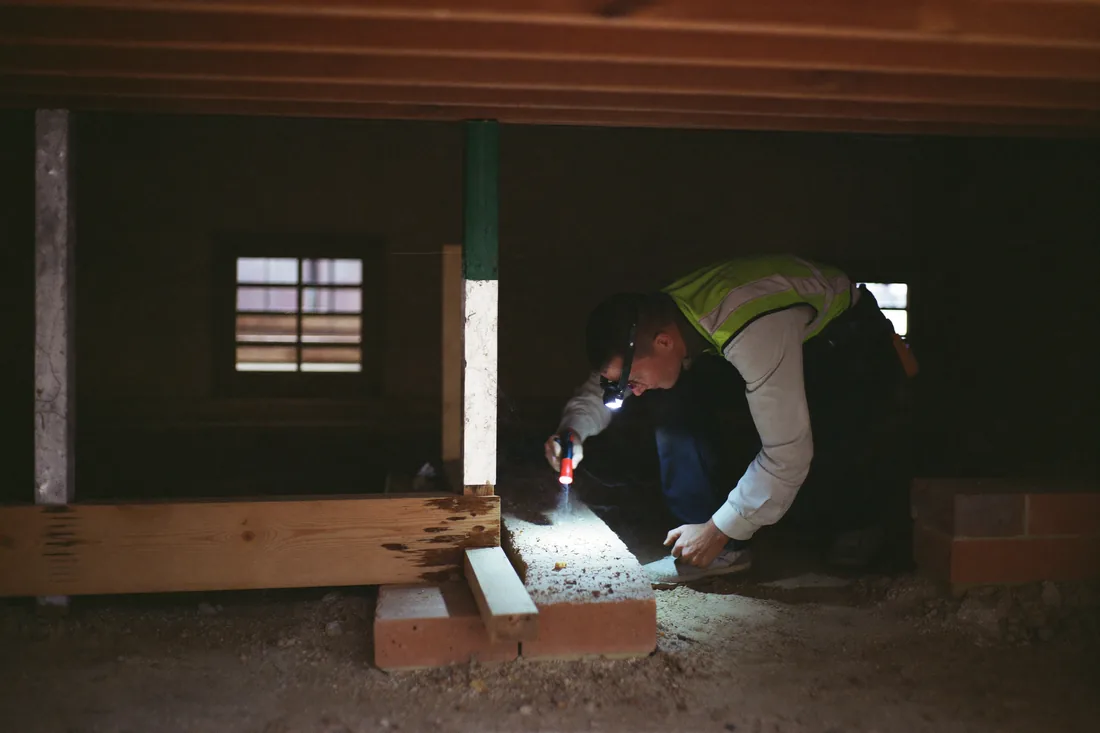
A licensed inspector goes over every reasonably accessible part of the property, roof cavity, subfloor, interior, exterior and grounds, then sends a written report, usually within 24 hours, listing major defects, minor defects, and anything that needs monitoring. Expect them on site for at least 2 hours on an average home, longer for older or larger places.
Two Australian Standards govern the work:
- AS 4349.1-2007: the standard for pre-purchase building inspections (a structural, visual assessment).
- AS 4349.3-2010: the standard for timber pest inspections (termites, borers, wood decay).
Defects are common. Inspectors routinely report that most homes they check turn up at least one, and on newer apartments the official numbers back that up: the most recent Building Commission NSW survey found 53% of recently-built apartment (strata) buildings had a serious common-property defect, with waterproofing the most frequent culprit. Some defects are trivial (peeling paint, worn seals); some are catastrophic (active termites, foundation movement, illegal structural work). You'll almost always find something. The question is what you do about it.
One distinction worth getting straight: a building and pest inspection is not the same as a valuation. The valuation, which your lender arranges separately, is about how much the property is worth. The inspection is about its condition. You need both: the valuation protects the lender, the inspection protects you.
And a "clear" report is not a warranty. This is the part most buyers misread. An inspection is a snapshot of the property on the day, limited to what's visible and accessible. The inspector won't drill walls, cut into linings, lift carpet or move your future furniture, and they can't see through a wall. A clear report means no visible evidence of a problem on the day, in the areas they could safely reach. It does not mean the house is termite-free, or that nothing will ever go wrong. Within those limits, though, it's the single best tool a buyer has to avoid inheriting someone else's expensive problem.
What Does a Building and Pest Inspection Cover?
A thorough building inspection under AS 4349.1 covers every reasonably accessible structural and non-structural element of the home. Use this as your building inspection checklist when you read a quote or a report. A competent inspector should be looking at every item below.
Structural integrity
- Foundations and footings: settlement, cracking, movement, heave.
- Load-bearing walls: cracking, bulging, leaning, separation from floor or ceiling.
- Beams, columns, lintels: deflection, decay, dodgy modifications.
- Floor structure: sagging, sloping, spring, soft spots.
Roof condition
- Roof covering: tiles, metal sheeting, membrane integrity, leaks.
- Gutters and downpipes: rust, blockages, correct falls, secure fixing.
- Flashings: around chimneys, valleys, penetrations, parapets.
- Roof space: timber framing, insulation, ventilation, sarking, moisture, vermin.
Plumbing (visible)
- Visible pipework, taps, toilets, water pressure.
- Hot water system age and condition.
- Wet-area waterproofing failures (bathroom, ensuite, laundry, kitchen).
Electrical (visible)
- Switchboard condition.
- Visible wiring (knob-and-tube, cloth, aged cabling).
- Safety switches and obvious hazards.
Moisture and drainage
- Rising damp, lateral damp, salt damp.
- Subfloor moisture and ventilation.
- Surface drainage, stormwater connections, grading away from the building.
- Water staining inside walls or ceilings.
Timber pests (AS 4349.3)
- Active termite infestation, live workers, fresh mud leads, damaged timber.
- Previous termite damage, tracks, scarring, hollowed timbers.
- Borers and wood decay fungi.
- Conditions conducive to attack, moisture, timber-to-ground contact, poor ventilation, mulch beds against external walls.
External areas
- Cladding, brickwork and render, cracks, efflorescence, debonding.
- Fencing and retaining walls, leaning, drainage failure.
- Driveways, paths, paving, cracking, trip hazards.
Safety hazards
- Asbestos indicators (common in pre-1990 homes).
- Loose handrails, stair compliance, smoke alarms.
- Pool fencing compliance (where applicable).
What it does NOT cover
- Inside walls (no destructive or invasive testing).
- Under concrete slabs or tiled areas.
- Anything the inspector can't reasonably and safely access on the day.
- Full electrical or plumbing tests: those need a licensed sparky or plumber.
Premium tools like thermal imaging and moisture meters can pick up leaks and termite activity behind walls that the naked eye misses. They add $50 to $150. For older homes, anything with a previous termite history, or a property near water, it's worth asking whether thermal imaging is included.
Who Pays for the Building and Pest Inspection?
The buyer pays for and arranges the building and pest inspection. It's part of your due diligence. You're paying for an independent opinion on a property you're about to commit hundreds of thousands of dollars to, so you commission it, you receive the report, and the findings are yours to act on. The seller has no obligation to organise or share one.
There's a little state-by-state nuance in when you do it (we cover that next), and your contract can be made conditional on a satisfactory inspection, but the bill is the buyer's either way. Your conveyancer can word the contract clause and tell you the local convention before you sign.
Pre-Purchase Building Inspection: When to Book
A pre-purchase building inspection is your inspection before you're locked into the purchase, and getting the timing right matters. Book too late and you're committed to a bad contract; book before the seller has accepted your offer and you may be paying for nothing. Here's when to book in each scenario, and it sits early in the wider buying sequence, which you can see laid out in your buying journey. Before you spend on the formal inspection, our property report gives you structured pre-offer checks on the specific property, handy for deciding whether it deserves the inspection fee.
Private sale (private treaty)
Book your inspector during the cooling-off period, but bear in mind it isn't the same length everywhere. NSW, QLD and the ACT give 5 business days, Victoria gives 3, and South Australia gives 2 clear business days, while Western Australia and Tasmania have no statutory cooling-off period at all (see our cooling-off periods by state guide). Try to book within 48 hours of your offer being accepted, because good inspectors book out 2 to 5 days ahead in a busy market. Get the report, go through it with your conveyancer, then decide whether to proceed, renegotiate or withdraw.
Your conveyancer can also add a "subject to satisfactory building and pest inspection" clause to the contract before you sign, important everywhere, and essential in WA and Tasmania where there's no cooling-off safety net.
Auction
Auctions have no cooling-off period in any Australian state. Once the hammer falls, you're unconditionally committed. So your building and pest inspection has to be done before auction day.
Yes, that means paying $450 to $900 on a property you might not win, and yes, it stings to lose the auction afterwards. But the alternative, buying blind and finding $40,000 of termite damage later, is far worse. Bid on two or three auctions over a few months and you might spend $1,500 to $2,500 on inspections. Budget for it.
New builds and house and land packages
For new builds, the standard is a "practical completion inspection" (PCI) before handover. Our house and land packages guide walks through the full handover process. The builder can't make you accept handover until an independent inspector has signed off, and any defects must be rectified before you take the keys.
Off-the-plan apartments
Off-the-plan buyers should book an independent defect inspection at practical completion, never just take the builder's own sign-off. It matters most for apartments, where shared walls, waterproofing and structural elements are easier to cut corners on. Pair the inspection with a strata report to understand the building's financial health. Our off-the-plan buying guide has the full pre-settlement checklist.
How to Read a Building Inspection Report
Your building inspection report turns up within about 24 hours and usually runs 30 to 60 pages. It can feel like a lot: photo after photo, descriptions, technical language. Here's how to read it so you can make a confident call.

Report structure
An AS 4349.1-compliant report includes these sections:
- Executive summary: the top-level overview of significant findings. Read this first.
- Property details: address, age, construction type, date and weather on the day.
- Scope and limitations: what was and wasn't assessed, and why.
- Major defects: significant issues needing attention.
- Minor defects: cosmetic or maintenance-level issues.
- Areas requiring monitoring: early signs that could become defects.
- Inaccessible areas: spaces the inspector couldn't examine, and why.
- Recommendations: next steps, specialist referrals, maintenance priorities.
How issues are categorised
- Major defects: structural problems, serious safety hazards, significant water damage, illegal work. These are the ones you negotiate hard on, or walk away over.
- Minor defects: cosmetic damage and ordinary wear that needs attention eventually. Budget to fix after settlement.
- Maintenance items: dirty gutters, overgrown vegetation, tired paint. Not deal-breakers; normal upkeep.
Using the report to negotiate
The report is leverage. The standard play: get written quotes for the repair work, hand them to the seller through your conveyancer, and ask for a price reduction matching the quotes. Sellers expect this, and most will negotiate.
As a rough sense of scale, and these are illustrative ranges, not a survey, price reductions off the back of a report often run anywhere from $5,000 to $50,000, depending on severity. Major findings like active termites, structural movement or illegal alterations can knock $50,000 to $100,000 off a contract, or be reason enough to walk.
Your mortgage broker can help you factor repair costs into your borrowing too. A $20,000 repair budget after settlement is $20,000 less you can put toward the deposit or stamp duty.
Findings that are usually deal-breakers
- Active termite infestation with structural damage: repairs commonly $30,000 to $100,000+.
- Significant foundation movement: underpinning $15,000 to $80,000, with no guarantee.
- Major waterproofing failure in wet areas or balconies, which leads to structural decay.
- Illegal or unapproved structural work: insurance headaches, council rectification orders.
- Asbestos requiring disturbance or removal: $3,000 to $15,000+ per area.
If the report flags any of these, the safest path is usually to withdraw, unless the seller agrees to a price reduction reflecting the full rectification cost plus a risk premium.
How to Find a Building Inspector Near You
Most people find their inspector by Googling "building and pest inspection near me", but the cheapest local result is rarely the right one. A $250 inspection that misses a $30,000 defect is the most expensive inspection you'll ever pay for.
What to look for
- Properly licensed in your state. NSW inspectors should hold a building consultant licence from NSW Fair Trading; QLD inspectors a completed-residential-building inspection licence from the QBCC; VIC inspectors should be a registered Building Inspector with the Victorian Building Authority. WA has no dedicated inspector licence, so there, verify credentials, AS-4349 compliance and PI insurance directly. Ask for the licence number and check it on your state regulator's site.
- Professional indemnity insurance. Non-negotiable, aim for $1M+ cover and ask for a current certificate of currency.
- Works to AS 4349.1 and AS 4349.3. The report should reference both standards by name.
- Independent of the selling agent. Never use the agent's recommended inspector. Their incentives aren't yours.
Questions to ask before booking
- Do you include thermal imaging and moisture readings? If not, what's the extra cost?
- How long will you spend on site? (Under 2 hours for a standard home is a red flag.)
- When will the written report be ready? (24 hours is standard.)
- Can I attend the inspection in person?
- Can I see a sample report?
- What's your fee, in writing, including any add-ons?
NestPath connects you with licensed building inspectors near you: fixed-fee quotes, a written report typically within 24 hours, and every inspector independently licensed and insured.
Once the pre-purchase inspection is done, you'll want a final pre-settlement inspection too, a separate walk-through in the week before settlement to confirm the property is in the same condition you bought it in. Our property settlement guide has that checklist and what to do if you find new damage before keys.
Do I Need a Building Inspection?
Short answer: yes, always. New build, apartment, immaculate-looking established home, doesn't matter. The only real exception is if you're buying to demolish and rebuild, and even then, book a pest inspection, because termite-infested mulch can spread to your replacement home.
For an established home, the defects you don't catch become the defects you pay for after settlement. A $600 inspection that surfaces $20,000 of issues is the best money you'll spend in the whole purchase. New builds aren't exempt either. The construction industry has well-documented quality problems from rushed timelines, subcontractor turnover and patchy supervision, so book a practical completion inspection before handover and a 12-month defect inspection before your warranty period ends (warranty periods are state-specific). If you're building, our guide to building a house in Australia sets out the stages and which inspection to book at each.
Apartments and off-the-plan need inspections just as much. Termites can travel up through shared walls, wet-area waterproofing failures are common, and a balcony defect can turn into a $50,000 special levy. Combine the building inspection with a strata report (separate from the inspection, usually $250 to $500) to see the building's finances, planned major works and any active disputes. Our off-the-plan guide and house and land packages guide cover the specific pre-settlement workflow for each.
Skipping the inspection to save $600 on a $700,000 purchase is one of the most expensive mistakes a first home buyer can make. Don't do it.
Frequently Asked Questions
How long does a building and pest inspection take?
A combined building and pest inspection takes 2 to 3 hours on site for an average three-bedroom house, with the written report usually delivered within 24 hours. Larger, older or more complex properties take longer, up to half a day. Expect a 30 to 60 page report with high-resolution photos and severity ratings.
Who pays for a building and pest inspection?
The buyer pays for and arranges the building and pest inspection. It's part of your due diligence. You're commissioning an independent opinion on a property you're about to buy, so the report (and the bill) is yours. The seller has no obligation to organise or share one.
How much does a building and pest inspection cost?
A combined building and pest inspection costs $450 to $900 in 2026 for a standard house, dropping to $250 to $400 for an apartment and rising to $700 to $1,000+ for inner-Sydney homes. Always book the combined service, the pest component adds little but covers termite damage that can cost tens of thousands to repair.
Does a 'clear' report mean there are no termites?
No. A clear report means there was no visible evidence of a problem on the day, in the areas the inspector could safely reach. Timber pest inspections under AS 4349.3 are non-invasive, no drilling, no cutting, no moving furniture, so a clear report is a snapshot, not a warranty that the home is termite-free.
Does home insurance cover termite damage?
Generally no. Standard Australian home insurance policies exclude termite and other timber-pest damage under "gradual deterioration" clauses, because the damage builds up slowly rather than from a sudden event. Always check your own Product Disclosure Statement (PDS), and treat a pest inspection as your real protection here, not your insurer.
Can I attend the building inspection?
Yes, and it's highly recommended. Being there lets you ask questions in real time, see issues for yourself, and understand the report when it lands. A good inspector will welcome you and walk you through the major findings on site. Plan to be there for at least the last hour.
What happens if the inspection finds major defects?
You have three options: negotiate a price reduction equal to the repair quotes (most common), ask the seller to fix the issues before settlement (riskier, they've no incentive to pay for quality work), or withdraw if your contract has a "subject to inspection" clause or you're still in the cooling-off period. Your conveyancer handles the negotiation.
Is a building inspection the same as a pre-settlement inspection?
No. A pre-purchase building inspection (this guide) checks the structural and pest condition of a property before you commit to buying. A pre-settlement inspection is a much shorter walk-through in the week before settlement, confirming the property is in the same condition and that agreed inclusions are still there. You need both, see our settlement guide for that checklist.
Can I use the inspection report to negotiate the price?
Yes, it's the most common use of the report. Get written quotes for the major repairs, present them to the seller through your conveyancer, and ask for a price reduction matching the quotes. Sellers expect this. Reductions of $5,000 to $50,000 are routine, and serious findings can knock $50,000 to $100,000 off a contract.
Don't skip the inspection. It's the highest-return spend in the whole home-buying process. Find a NestPath trusted inspector today, or start with our borrowing power calculator to know your budget first.


