
Buying your first home is the biggest and most confusing financial decision most Australians ever make. Part of what makes it confusing is that almost everyone explaining the process to you is also selling you something. So here's where we stand before we start: we don't lend, we're not paid by a bank, and we've got nothing to sell you. This first home buyer guide is just the honest order of operations, written by people who've watched thousands of first home buyers walk through it. It maps the whole process of buying a house, then points you at the free tools and people you'll actually need.
Be honest with yourself about what you're really chasing here. It isn't a property. It's the feeling of standing in a kitchen that's yours, deciding where the couch goes, knowing nobody can give you notice. The steps below are how you get there without paying the rookie tax along the way. Start with your journey map if you want the bird's-eye view first, or jump straight to the borrowing power calculator to see your real number.
The 9 steps to buying a house, at a glance
Here are the steps to buying a house in Australia, in the order they actually happen:
- Step 1. Work out what you can genuinely afford.
- Step 2. Check every grant and scheme you qualify for.
- Step 3. Find a mortgage broker.
- Step 4. Get pre-approved.
- Step 5. Find your property.
- Step 6. Book a building and pest inspection.
- Step 7. Hire a conveyancer.
- Step 8. Arrange home insurance.
- Step 9. Make an offer, exchange, and settle.
Most people go from "we should probably look into this" to keys in hand in three to six months. The rest of this guide takes each step one at a time, in plain English.
What buying a house actually costs in 2026
The purchase price is not the amount of money you need. On top of your deposit, you'll pay somewhere between 3% and 5% of the price in one-off costs, most of it due in the four to six weeks around settlement. Almost nobody budgets for this properly, and it's the single most common reason a purchase falls over at the last minute.
Here's what those costs usually look like in 2026:
- Deposit: 5% to 20% of the price (more on the low-deposit options below). When it's due: at exchange of contracts.
- Stamp duty: $0 to tens of thousands, depending heavily on your state and first-home concessions. Plenty of first home buyers pay little or nothing. Run your exact figure through the stamp duty calculator. When it's due: at or before settlement.
- Lenders Mortgage Insurance (LMI): $10,000 to $30,000, but only if your deposit is under 20% and you're not using a government guarantee. See what it'd cost you with the LMI calculator. When it's due: added to your loan at settlement.
- Conveyancing or solicitor fees: $1,000 to $2,500. When it's due: across the purchase, settled at the end.
- Building and pest inspection: $400 to $800 (more for older, larger, or hard-to-access homes). When it's due: before you commit, ideally before you sign.
- Title transfer and mortgage registration: $500 to $1,000. When it's due: at settlement.
- Loan application and valuation fees: $0 to $800. Plenty of lenders waive these. When it's due: at application or settlement.
- Home insurance: first year's premium upfront, often around $1,000 to $2,000. When it's due: before settlement.
- Removalist: $500 to $3,000 depending on distance and volume. When it's due: moving day.
To put a number on it: on a $650,000 home you're looking at roughly your deposit plus about 4% in costs on top. That's the cash that genuinely has to be on the table, not the headline price. The move-in cost calculator adds up the purchase costs beyond the deposit for you. The deposit tracker lets you set that full target and watch it tick down as you save, so settlement week doesn't catch you short.

Step 1: Know what you can afford
Before you look at a single property, you need two numbers: what a bank will lend you, and what you can comfortably afford to repay. They're almost never the same figure, and treating the first one as the second is how people end up house-poor.
Your borrowing capacity comes down to your income, your existing debts, your living expenses, and your deposit. Get your honest number from the free borrowing power calculator before you fall in love with anything. Then take that maximum loan and see what the monthly repayment actually feels like on the repayment calculator. If that number makes you wince, borrow less. Your future self, the one still wincing at it every month for 30 years, will thank you.
It's also worth a two-minute reality check on which schemes you qualify for before you go further, because they change your maths a lot. The eligibility checker tells you in plain terms what you can and can't use.
Step 2: Understand grants and schemes
Australian first home buyers have access to government schemes that can save tens of thousands of dollars. There are two layers: federal schemes that apply everywhere, and a First Home Owner Grant plus stamp duty concessions that change with every state and territory.
The First Home Owner Grant amount varies by state. Rather than quote a number here that'll be out of date by the time you read it, see the exact figure, eligibility and price thresholds on your state page: NSW, Victoria, Queensland, WA, SA, ACT. One live example worth flagging: Queensland's grant for new builds is $30,000, and the 2026-27 Queensland Budget (released 23 June 2026) confirmed it continues at $30,000 beyond the original 30 June 2026 deadline rather than reverting to $15,000 (for new homes valued under $750,000). If you're building in QLD, check your state page for the current cut-off.
The Australian Government 5% Deposit Scheme (the scheme formerly called the First Home Guarantee, FHBG) lets you buy with a 5% deposit and pay zero LMI, with the government guaranteeing the rest. Since 1 October 2025 it has unlimited places, no income caps, and higher property price caps (for example $1.5 million in Sydney, $1 million in Brisbane and Canberra, down to $700,000 in Hobart). For most first home buyers it's the most useful single scheme going.
Help to Buy is a newer shared-equity scheme, and applications are now open through CommBank and Bank Australia, with more lenders joining through 2026. The government takes an equity share of up to 40% of a new home or 30% of an existing one, which means you need a smaller loan and as little as a 2% deposit. Income caps are $103,000 for an individual and $165,000 for a couple or single parent (indexed each 1 July). You don't own the government's share, and you may repay it later or when you sell, so read the fine print, but for the right buyer it drops the bar a long way.
The First Home Super Saver Scheme (FHSS) lets you withdraw up to $50,000 per person from your superannuation toward your deposit, with the tax savings of having saved inside super. Couples can combine for up to $100,000.
Not sure which of these you're eligible for? Run the eligibility checker. It's free and takes a couple of minutes.
Can I buy a house in Australia with little or no deposit?
You can't truly buy a house in Australia with no money or no deposit, but you can get in with far less than the old 20% rule, and these are the routes people don't realise exist. If you've been searching "how to buy a house in Australia with no money" or "how to buy a house with no deposit in Australia", this is the section that answers it honestly.
Here's what's actually available in 2026:
- 5% deposit, no LMI via the Australian Government 5% Deposit Scheme. The big one for most people: a $600,000 home needs $30,000 saved instead of $120,000, and you skip the LMI bill entirely.
- 2% deposit via the Family Home Guarantee, designed for single parents and eligible single legal guardians, also with no LMI.
- 2% deposit via Help to Buy, where the government takes an equity share so your loan and deposit are both smaller.
- Your super via the First Home Super Saver Scheme, up to $50,000 per person, which can be most or all of a low-deposit purchase.
- From 2% in WA via Keystart, the WA Government lender that takes lower deposits with no LMI (subject to income and property price limits).
The honest catch: a smaller deposit means a bigger loan and bigger repayments, so the "comfortable repayment" test from Step 1 matters more, not less. Model it both ways. See what LMI you'd avoid with the LMI calculator, set your real target on the deposit tracker, check WA specifics on the WA grants page, and confirm which low-deposit schemes you qualify for with the eligibility checker.
Step 3: Find a mortgage broker
A good mortgage broker is usually the most valuable person on your first-home-buying team, and there's a concrete reason beyond "they're helpful". Since January 2021, mortgage brokers have been bound by a legal best-interests duty: when they recommend a loan, they have to put your interests first, not the lender's (this is set out by ASIC and explained plainly on MoneySmart). Brokers are paid a commission by the lender, so in the standard case the service costs you nothing.
The real edge is access. A bank can only offer its own products. A broker works across a panel of 30 or more lenders and knows which ones say yes to your specific situation, whether that's HECS debt, variable or casual income, a 5% deposit under the scheme, or buying off the plan. Those lending rules aren't published anywhere, so a broker finds the right lender first time instead of you collecting knock-backs.
You can also verify any broker on ASIC's register before you commit. Find a NestPath vetted mortgage broker, all licensed, independent, and reviewed by real Australian first home buyers. Before you apply, our best home loan rates guide shows the rate ranges you should be aiming at so you know a competitive offer when you see one.
Step 4: Get pre-approved
Pre-approval is a lender's written agreement, in principle, to lend you a specific amount, based on an assessment of your finances. It usually lasts three to six months and lets you make offers knowing the money is genuinely lined up rather than hoped for.
Read the full pre-approval guide for the exact documents you'll need, how long it takes, and the three most common reasons applications get declined.
One warning worth its own line: don't apply for pre-approval with several lenders at once. Every application leaves a mark on your credit file, and a cluster of them in a short window can dent your score. That's another reason to go through a broker, who matches you to the right lender once instead of shopping your file around town.
Step 5: Find your property
With pre-approval in hand, you can search with confidence instead of guessing. A few things most first home buyers learn the hard way:
Set your search budget 10% to 15% below your maximum borrowing capacity, because properties regularly sell above the asking price, especially at auction. Research suburbs before you inspect: median prices, growth trends, distance to work, schools, and transport. And go to plenty of inspections before you commit, because your eye genuinely sharpens with every home you walk through. If you want a method rather than a vibe, our framework for finding the right property walks through it.
It's also worth pricing the newer-build paths, because they change your grants and stamp duty. Buying off the plan often means lower stamp duty, access to the full First Home Owner Grant (established homes usually don't qualify), and a long settlement runway to keep saving. The trade-offs are real, so read the off-the-plan guide before signing anything.
The third path is building a house on a block, either as a house and land package or with your own builder on titled land. New builds attract the most generous first home buyer grants and stamp duty usually applies only to the land. Start with the guide to building a house in Australia for the 2026 cost breakdown and how construction loans differ, and if you haven't locked in a block, read the guide to buying land first, because zoning, easements and soil tests are where first-home builders most often get caught.
Step 6: Building and pest inspection
Before you commit to any established property, get an independent building and pest inspection. It costs $400 to $800 (more for older, larger, or hard-to-access homes) and it can save you from buying a house with structural cracks, hidden water damage, or termites that cost tens of thousands to fix. This is the one step the whole industry quietly agrees you should never skip.
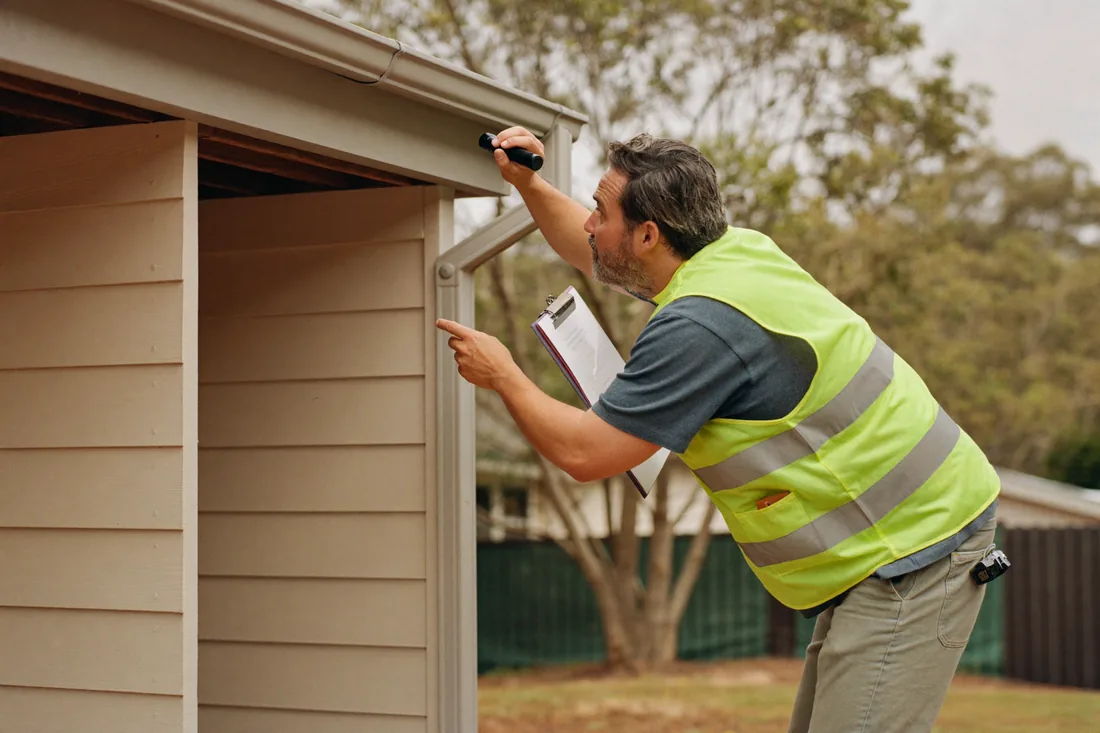
A qualified inspector checks the roof, walls, floors, plumbing, electrical, and structure, plus any sign of termites or moisture. You get a written report with photos flagging every issue, which you can use to renegotiate the price or to walk away with your deposit intact.
Read the full inspection guide for what a good report looks like, then find a licensed building and pest inspector in your state. Every inspector in the directory is qualified and insured. We'll say it once, plainly: do not skip this.
Step 7: Hire a conveyancer
A conveyancer (or a solicitor, if you'd rather) is the licensed professional who handles the legal transfer of ownership from the seller to you. They review the contract of sale, check the title, search for easements and encumbrances, confirm rates and land tax are settled, hold the deposit, and coordinate settlement with your lender. Fees typically run $1,000 to $2,500 depending on complexity.
Engage your conveyancer before you make an offer, not after. Contracts of sale carry clauses that can make or break a purchase: cooling-off periods, subject-to-finance and subject-to-inspection conditions, and special conditions about what's actually included (the dishwasher, the blinds, the light fittings). In some states the contract comes with a vendor's statement, such as Victoria's Section 32, that your conveyancer reads for the landmines. Amending any of this after you've signed is far harder than getting it right the first time.
Find a NestPath vetted conveyancer, licensed in your state, experienced with first home buyer transactions, and upfront about fees.
Step 8: Get home insurance
Your lender will require building insurance to be in place from settlement, and some require it from the day of exchange. The reason is simple: the moment you're on the hook for the property, the bank wants its security protected.
Shop around, because premiums for identical cover can vary by hundreds of dollars a year between insurers. What drives your premium: the property's age, whether it's brick or weatherboard, flood and bushfire risk, security features, and claims history. A lot of first home buyers bundle building and contents for a discount.
Compare home insurance options built for first home buyers, with cover that can start before you get your keys.
Step 9: Make an offer, exchange, and settle
This is the home stretch, and it splits into three distinct moments.
Making the offer. By private treaty you submit a written offer that can carry conditions (subject to finance, subject to inspection). At auction you bid in public and the contract is unconditional the moment the hammer falls, so only bid if you already have pre-approval and your inspection done.
Exchange of contracts. Exchange is the point where both parties sign and swap contracts and you're legally committed to the purchase. You pay a deposit, usually 5% to 10%, and from here you can't simply change your mind without losing money. Don't sign until your conveyancer has read the contract.
Settlement. Settlement is the day legal ownership transfers to you, typically four to six weeks after exchange. Your conveyancer handles the legal transfer, your lender prepares the loan, and you organise the move. Do a final inspection the day before to confirm the home is in the same state it was when you signed. On settlement morning your conveyancer attends the online settlement, the funds move, ownership changes hands (usually by mid-afternoon), and then you get your keys. For an hour-by-hour walk-through, read the property settlement guide.
Two jobs for the final week: connect electricity, gas and internet for the settlement date, and book a removalist at least two weeks out, because weekend slots in the capitals book solid.
Common mistakes first home buyers make
Every year thousands of Australian first home buyers lose $10,000 to $30,000 to mistakes that were entirely avoidable. The expensive ones are predictable: bidding unconditionally at auction with no pre-approval, skipping the building and pest inspection, signing a contract before a conveyancer has seen it, underestimating stamp duty and buying costs, and firing off pre-approval applications to five lenders at once and tanking your own credit score.
See the full list of first home buyer mistakes, with what each one actually costs and how to sidestep it. The cheapest insurance against all of them is starting in the right order: run the borrowing power calculator, then talk to a vetted broker for free before you do anything else.
Keep your loan competitive after you buy
Here's the move almost everyone forgets, so diarise it for two to three years after you settle: check that your home loan is still competitive. Lenders tend to quietly charge existing customers more than new ones, often by a few tenths of a percent (the RBA has documented a gap of around 0.5%, and the ACCC found older loans drifting further still). On a $500,000 loan, a roughly 0.5% cut from a simple refinance could save you in the order of $200 a month, give or take. That's an illustration, not a promise, but on a loan that size even half a percent adds up to a few thousand dollars a year, and it's the kind of saving most homeowners leave on the table because they never check.
Buying a house in Australia: capital city guides
The nine steps above are national. But how you actually buy a house in Australia shifts by capital: auctions versus private treaty, contract type, cooling-off rights, stamp duty thresholds, and which grants you can stack. We've got a dedicated first home buyer guide for each.
- How to buy a house in Sydney 2026: $0 stamp duty under $800,000 (NSW First Home Buyers Assistance Scheme), Western Sydney corridor pricing, and competing with investor demand.
- How to buy a house in Melbourne 2026: Saturday auction culture, Section 32 vendor statements, and the Victorian 3-day cooling-off window and how to use it.
- How to buy a house in Brisbane 2026: the $30,000 QLD grant for new builds (continued at $30,000 beyond 30 June 2026 in the 2026-27 Queensland Budget), the 2032 Olympics infrastructure pipeline, and mandatory flood-overlay checks.
- How to buy a house in Perth 2026: Keystart's 2% deposit, no cooling-off period under WA's Offer and Acceptance contract, and properties selling in days.
- How to buy a house in Adelaide 2026: SA HomeStart Finance, the lowest mainland capital prices, and AUKUS-driven job growth at Osborne.
- How to buy a house in Canberra 2026: the ACT Home Buyer Concession, the 99-year leasehold land system, and federal-job-security buying power.
Each guide covers median prices, first-home-ready suburbs, scheme stacking, and the state-specific traps interstate buyers walk straight into. If you'd rather see the whole picture by state in one place, start with the home buying process by state, and the Homeowner Hub covers what comes after you've moved in.
When settlement day finally lands, the relief is real and a little anticlimactic. A few signatures move through a screen you never see, your conveyancer messages "it's done", and then you're standing on a doorstep with a key that's yours. That's the whole point of doing the boring steps properly. Start with your real number, then talk to a broker for free. And if you want a single page to tick off as you go, save the first home buyer checklist.
Frequently asked questions
How do I buy a house in Australia as a first home buyer?
Buying a house in Australia as a first home buyer follows nine steps: (1) work out what you can afford with a borrowing power calculator, (2) check every grant and scheme your state offers, (3) find a mortgage broker, (4) get pre-approved, (5) find and research your property, (6) book a building and pest inspection, (7) hire a conveyancer to review the contract, (8) arrange home insurance before exchange, and (9) make an offer, exchange contracts, and settle four to six weeks later. Most first home buyers complete the full process in three to six months from starting to collecting the keys.
How much deposit do I need to buy a house in Australia?
The standard benchmark is 20% of the price to avoid Lenders Mortgage Insurance, but you don't have to hit it. Using the Australian Government 5% Deposit Scheme you can buy with a 5% deposit and pay no LMI, and single parents and eligible single guardians can buy with 2% under the Family Home Guarantee. On top of the deposit, budget 3% to 5% of the price for stamp duty, legal fees, inspections and lender fees.
What grants are available for first home buyers in Australia?
Every state and territory runs a First Home Owner Grant for new builds (Queensland's is $30,000, continued beyond 30 June 2026 in the 2026-27 Queensland Budget), plus full or partial stamp duty concessions under set price thresholds. Federally, the Australian Government 5% Deposit Scheme (formerly the First Home Guarantee) now has unlimited places and no income caps, letting you buy with a 5% deposit and no LMI. The First Home Super Saver Scheme lets you withdraw up to $50,000 per person from super, and the newer Help to Buy shared-equity scheme (open via CommBank and Bank Australia) lets the government take up to a 30% to 40% equity share so you need a smaller deposit and loan. Check your state page for exact figures: NSW, VIC, QLD, WA, SA, ACT.
Do I need a mortgage broker to buy a house?
You don't legally need a broker, but most first home buyers who use one say it was their highest-value decision. Brokers are free in the standard case (paid by the lender), they work across 30 or more lenders, and since January 2021 they're legally bound by a best-interests duty to put your interests first. Going straight to a bank limits you to that one bank's products and its internal lending policies, which may not suit your situation.
How long does it take to buy a house in Australia?
Typically three to six months from first research to settlement day. The rough breakdown: two to four weeks to sort pre-approval with a broker, four to twelve weeks to find the right property, and four to six weeks from exchange to settlement. It can be quicker if you find a home fast with pre-approval ready, or much longer if you buy off the plan, where construction can take 12 to 36 months from signing to settlement.
What are the hidden costs of buying a house?
Beyond the deposit and stamp duty: conveyancing ($1,000 to $2,500), building and pest inspection ($400 to $800), LMI if your deposit is under 20% ($10,000 to $30,000), title transfer and mortgage registration ($500 to $1,000), loan application fees ($0 to $800), the first year of home insurance, removalist costs ($500 to $3,000), utility connection fees, and council and water rate adjustments at settlement. Budget 3% to 5% of the purchase price for these on top of your deposit.
Can I buy a house in Australia with no deposit?
Not truly with $0, but you can get in with far less than the old 20%. You can buy with as little as a 2% deposit through the Family Home Guarantee (single parents and eligible single guardians) or Help to Buy, and with a 5% deposit and no LMI through the Australian Government 5% Deposit Scheme. In WA, Keystart accepts deposits from 2% with no LMI, subject to income and property limits. There's no genuine 'no money' route, since you still need savings for costs, but the deposit barrier is far lower than most people assume.
Can I buy a house on a $70,000 or $80,000 salary in Australia?
Possibly, but your salary alone doesn't decide it. What you can borrow depends just as much on your deposit, your existing debts (credit cards, car loans, HECS), and your living costs as on your income. Two people on the same $75,000 can have very different borrowing capacities. Rather than trust a figure plucked from the air, run your real numbers through the borrowing power calculator to see what a lender would actually offer you.
What deposit do I need for a $500,000 or $600,000 house in Australia?
At the standard 20%, a $500,000 home needs a $100,000 deposit and a $600,000 home needs $120,000. Using the 5% Deposit Scheme, those drop to $25,000 and $30,000 respectively, with no LMI, though you'll still want another 3% to 5% of the price set aside for stamp duty and other costs. Set your real target and track it on the deposit tracker.
What is the process of buying a house in Australia?
The process of buying a house in Australia runs in this order: work out your budget and borrowing power, check the grants and schemes you qualify for, get a broker and pre-approval, find and research a property, get a building and pest inspection, engage a conveyancer to check the contract, arrange home insurance, then make an offer, exchange contracts (paying a 5% to 10% deposit), and settle around four to six weeks later when you collect the keys. Start to finish, it usually takes three to six months.


