
Last updated: July 2026
Building a house in Australia in 2026 costs roughly $1,700 to $4,500 per square metre, or about $443,000 to build a 230m² home excluding land (Cotality Cordell and RLB Q4 2025 data). That's the headline number most people come here for. What nobody warns you about is the next 20 to 25 per cent: the site costs, council charges and soft costs that sit outside the builder's quote, and where most first-home-buyer budgets come unstuck.
This guide is written for first home buyers, not builders. It covers what a build really costs in 2026 (state by state, with the hidden costs laid out), the grant stack worth up to $50,000 that most cost guides leave out, how construction loans pay for the build in stages, the five stages of construction and what gets paid when, what to check before you sign a contract, and a checklist from finance pre-approval through to handover. Already got a block? Skip ahead to the costs. If you don't, read our guide to buying land in Australia first. Zoning, soil, slope and titled-versus-untitled all change what you can build and what it costs.
How much does it cost to build a house in Australia in 2026?
The cost to build a house in Australia in 2026 runs from about $1,700/m² for a basic volume-builder home to $4,500/m²+ for a custom architectural build, with the national average sitting near $443,000 to build a 230m² four-bedroom single-storey home, excluding land (Builder Brokers 2026, drawing on Cotality data). Costs are well above pre-pandemic levels, roughly 30 to 40 per cent higher cumulatively since 2020, driven by material inflation and trade shortages. Over the past year they've stabilised rather than fallen, and RLB's Q4 2025 commentary forecasts further mid-single-digit increases through 2026.
National cost snapshot
The average cost to build a house in Australia in 2026 is around $443,000 for a 230m² four-bedroom single-storey home, excluding land. That headline splits into four tiers depending on what you're building.
| Build tier | Per m² rate (2026) | What you get | Typical buyer |
|---|---|---|---|
| Budget / volume builder | $1,700 to $2,200 | Standard project home, basic brick, laminate benchtops, basic appliances, no air-con | First home buyers in growth corridors |
| Mid-range / project home | $2,200 to $2,800 | Upgraded inclusions, stone benchtops, ducted air-con, modest landscaping | Most first home buyers after upgrades |
| Premium / mid-custom | $2,800 to $3,900 | Semi-custom or custom-designed, premium appliances, full landscaping | Move-up buyers, established couples |
| Custom architectural | $3,900 to $5,500+ | Architect-designed, premium materials, complex sites, no constraints | High-end / owner-build |
Most first home buyers building new in 2026 land in the $1,800 to $2,500/m² range, typically a volume builder with a few upgrades. On a 200m² home, that's a construction cost (excluding land) of roughly $360,000 to $500,000.
Per square metre by home size: a quick ready-reckoner
Most people Google a build-cost calculator and get a generic tool. The shortcut is simpler than that: pick your tier rate, multiply by your floor area. This is the construction (hard) cost only. Site and soft costs go on top, covered below.
| Home size | Budget (about $1,900/m²) | Mid-range (about $2,500/m²) | Premium (about $3,400/m²) |
|---|---|---|---|
| 150m² (3-bed) | about $285,000 | about $375,000 | about $510,000 |
| 200m² (4-bed) | about $380,000 | about $500,000 | about $680,000 |
| 250m² (larger 4-bed) | about $475,000 | about $625,000 | about $850,000 |
To turn a build cost into a monthly repayment, run the figure through the NestPath mortgage repayment calculator, then check what you can actually borrow with the borrowing power calculator before you talk to builders.
State-by-state breakdown
Building costs vary a lot by state. Sydney sits at the top; Adelaide and Hobart at the bottom; everywhere else falls between.
| State / city | Per m² range (2026) | Typical 200m² build cost | Cost driver |
|---|---|---|---|
| Sydney (NSW) | $2,100 to $4,000 | $420K to $800K | Highest trade rates, strict NCC + BAL rules, council contributions $20 to 80K |
| Melbourne (VIC) | $1,800 to $3,800 | $360K to $760K | Strong tradie demand, complex inner-city BAL and heritage rules |
| Brisbane (QLD) | $1,700 to $3,200 | $340K to $640K | Cheapest east-coast capital; cyclone code adds cost in North QLD |
| Adelaide (SA) | $1,700 to $2,900 | $340K to $580K | Most affordable mainland capital |
| Perth (WA) | $1,700 to $3,000 | $340K to $600K | Stable trades, mining boom pulls labour |
| Hobart (TAS) | $1,700 to $2,800 | $340K to $560K | Cheapest capital nationally |
| Darwin (NT) | $2,000 to $3,500 | $400K to $700K | Cyclone code mandatory, freight costs |
| Canberra (ACT) | $1,900 to $3,500 | $380K to $700K | Strict ACT planning rules, smaller trade pool |
| Regional Australia | $1,500 to $2,500 | $300K to $500K | Labour availability is the swing factor |
Inner metro typically costs 10 to 20 per cent more than the outer suburbs. Coastal, flood-prone or sloping sites add 10 to 30 per cent. Bushfire Attack Level (BAL) zones in NSW and VIC can add another 5 to 15 per cent in materials and compliance. RLB's Q4 2025 escalation forecast flags Townsville at +6.0 per cent, the Gold Coast +5.5 per cent and Perth +5.3 per cent, with similar mid-range rises nationally. If you're budgeting a 2026 build, expect the final cost to land higher by year-end than the quote you get in Q1.
Where does your build budget actually go?
Knowing roughly how a fixed-price building contract divides up is worth the few minutes, because it tells you where a "cheaper" quote is usually cutting corners. On a typical volume build, the rough split looks like this:
- Materials, around 40 per cent. Timber, bricks, concrete, roofing, windows, fixtures. This line moved the most over the past five years.
- Labour, around 35 per cent. Trades across every stage. Skilled-trade shortages keep this firm.
- Builder margin and overhead, around 15 to 20 per cent. The builder's profit, project management, insurances and office costs.
- Design, permits and approvals, a few per cent. Plans, engineering, certification and council fees, depending on how custom the home is.
A useful rule: if one builder's quote is meaningfully cheaper than the others on the same plan, the saving almost always comes out of materials or inclusions, not margin. Ask exactly what's different before you assume you've found a bargain.
Hard costs vs soft costs: the framework most buyers miss
Builder quotes cover hard costs: building the dwelling itself. They almost never cover soft costs: everything around the build that's still required to get you into a finished, liveable home. For most first home buyers this adds another 20 to 25 per cent to the bill.
| Hard costs (in the builder quote) | Soft costs (you pay separately) |
|---|---|
| Foundations and slab | Site costs (soil test, excavation, retaining): $10K to $45K |
| Frame, roof, weatherproofing | Council contributions (e.g. S7.11/7.12 in NSW): $8K to $80K |
| Internal fit-out (walls, doors, floors) | Service connections (water, sewer, power, NBN): $5K to $30K |
| Standard inclusions (kitchen, bathrooms, flooring) | Driveway and footpath crossover: $3K to $15K |
| Basic appliances | Landscaping, fencing, retaining: $5K to $30K |
| Plumbing and electrical to standard spec | Window furnishings (blinds, curtains): $3K to $10K |
| Builder margin and overhead | Home warranty insurance: 0.5 to 1% of contract |
| Fixed-price contract guarantee | Council planning + building permits: $2K to $15K |
| 7-star energy compliance uplift: about $5K to $20K | |
| Loan interest during the build: $15K to $30K | |
| Architect / engineer fees if custom: 8 to 15% of build cost |
Realistic soft-cost loading: budget 20 to 25 per cent above the builder's quote. On a $400,000 builder contract, that's another $80,000 to $100,000 you'll spend before you can move in.
One soft cost that's crept up on new homes is energy compliance. Since NCC 2022, most new houses must hit a minimum 7-star NatHERS rating (up from 6 stars), with states rolling the change out through 2023 and 2024. NCC 2025 didn't add a new residential energy requirement on top, so if a builder tells you "new 2025 energy rules" are pushing the price up, that's the 2022 7-star standard talking. Better insulation, higher-performance glazing and upgraded heating and cooling typically add roughly $5,000 to $20,000 depending on your state, design and orientation (industry estimates). Quotes drawn up before 2023 often don't include it; 2026 quotes mostly do. Confirm it's inside your fixed-price contract.
Site costs: the line buyers under-estimate most
Site costs are the works needed to prepare your land for construction: soil testing, excavation, drainage, retaining walls, sewer connections, rock removal and tree clearing. For a flat, titled suburban block with standard soil, they typically run $10,000 to $20,000. On a sloping block, reactive clay, a bushfire zone or anything needing serious cut-and-fill, they can balloon to $45,000 or more.
Here's the trap. Builders usually quote a nominal site-cost allowance early on, with a note that the final figure gets confirmed after soil tests. The gap between that allowance and the real number is where the final bill creeps up. Two pieces of contract vocabulary matter here:
- A provisional sum (PS) is an allowance for work of unknown scope: excavation, site works, rock removal. If the real job costs more, you pay the difference.
- A prime cost (PC) item is an allowance for a product you'll choose later, such as taps, the oven or floor tiles. Pick something dearer than the allowance and you cover the gap.
Both are estimates, and both are common sources of bill shock at the end of a build. Before you sign, ask your builder what their site-cost allowance is, what soil classification it assumes (M or H1 is common), and what happens if the actual figure comes in over the allowance. Where you can, lock down exact brands and specs so PC items can't drift.
Double-storey premium
A double-storey build typically adds 15 to 20 per cent to the base per-m² cost compared with a single-storey home of the same total area, reflecting the extra structural engineering, the staircase and first-floor plumbing. It's almost always cheaper than a larger single-storey home on a bigger block, which is why narrow-lot double-storey is popular in Sydney and Melbourne.
Worked examples: three first-home-buyer builds across states
Here's what realistic numbers look like for first home buyers building a typical 200m² four-bedroom home in three states in 2026.
Example 1: Sydney first home buyer (Liverpool LGA, NSW)
| Item | Cost |
|---|---|
| Land (700m² lot, outer Sydney growth corridor) | $480,000 |
| Building contract (200m² project home, basic spec) | $440,000 |
| Site costs (slope, retaining wall) | $35,000 |
| Council contributions (S7.11) | $28,000 |
| Service connections | $15,000 |
| Landscaping, fencing, driveway | $25,000 |
| Window furnishings, alarm, internal upgrades | $18,000 |
| Carrying cost (8 months @ $3.5K) | $28,000 |
| Total project cost | $1,069,000 |
Government money for an eligible NSW first home buyer building new on this stack: First Home Owner Grant $10,000 (new home under the $750K house-and-land cap) + stamp duty exemption around $25,000 + the 5% Deposit Scheme removing LMI, roughly $28,000 = about $63,000 in grants and savings. Net cost: around $1,006,000.
Example 2: Brisbane first home buyer (Logan / outer Brisbane, QLD)
| Item | Cost |
|---|---|
| Land (600m² lot, outer Brisbane growth corridor) | $310,000 |
| Building contract (200m² project home, basic spec) | $360,000 |
| Site costs (flat block, low complexity) | $15,000 |
| Council infrastructure charges | $12,000 |
| Service connections | $10,000 |
| Landscaping, fencing, driveway | $18,000 |
| Window furnishings, internal upgrades | $14,000 |
| Carrying cost (8 months @ $3K) | $24,000 |
| Total project cost | $763,000 |
Government money for an eligible QLD first home buyer building new: First Home Owner Grant $30,000 + transfer (stamp) duty exemption around $15,000 + the 5% Deposit Scheme removing LMI, roughly $24,000 = about $69,000 in grants and savings. Net cost: around $694,000.
Still $30,000 in 2026: Queensland's $30,000 First Home Owner Grant was earlier due to drop back to $15,000 from 1 July 2026, but the government has kept the $30,000 amount in place for eligible new-build contracts beyond that date. Paired with the full transfer-duty exemption on new homes (no price cap, from 1 May 2025), it's the single biggest reason QLD first home buyers currently do better building than buying established.
Example 3: Adelaide first home buyer (Munno Para / outer Adelaide, SA)
| Item | Cost |
|---|---|
| Land (500m² lot, outer Adelaide) | $230,000 |
| Building contract (190m² project home, basic spec) | $310,000 |
| Site costs (flat block) | $12,000 |
| Council development application | $5,000 |
| Service connections | $9,000 |
| Landscaping, fencing, driveway | $16,000 |
| Window furnishings, internal upgrades | $12,000 |
| Carrying cost (7 months @ $2.8K) | $20,000 |
| Total project cost | $614,000 |
Government money for an eligible SA first home buyer building new: First Home Owner Grant $15,000 + stamp duty exemption (no cap from 6 June 2024) around $22,000 + the 5% Deposit Scheme removing LMI, roughly $20,000 = about $57,000 in grants and savings. Net cost: around $557,000. Adelaide has the most affordable build market of any mainland capital, and SA removing the FHOG property cap in June 2024 means even larger builds now qualify.
Build timeline, how long does it take in 2026?
Completion times have stretched a long way since 2020. The average house build in Australia now runs around 11.5 months (ABS, 2025), roughly double the pre-pandemic norm. Townhouses average closer to 14.8 months. Add 3 to 6 months of pre-construction approvals on top, and the realistic timeline from contract signing to move-in is 15 to 18 months.
| Path | Pre-pandemic | 2026 reality |
|---|---|---|
| Project home (volume builder) | 6 to 7 months | 9 to 12 months |
| Custom build | 10 to 12 months | 12 to 18 months |
| Pre-construction approvals | 2 to 3 months | 3 to 6 months (industry estimates suggest most builders now wait 8+ weeks) |
This is real money. Every extra month is rent at your current place plus loan interest on land or staged drawdowns. A five-month delay at $3,000/month rent plus $2,000/month carrying costs adds $25,000 to your spend. Model the repayments at your build cost to see what each extra month actually costs you in interest.
Should you build or buy as a first home buyer in 2026?
The deciding factor for most first home buyers is time, not money. Building usually wins financially once you stack the new-build grants; buying established wins on speed and certainty. Here's the honest split.
Building wins on:
- A brand-new home with no inherited maintenance debt
- Modern energy performance (the 7-star standard)
- Customising your layout and inclusions
- The biggest government grant stack: most state First Home Owner Grants apply only to new builds
- A fixed-price contract instead of auction-style bidding
- Six years of structural warranty
Buying established wins on:
- Speed, 60 to 90 days to move in, versus 15 to 18 months
- Price certainty, you know your number upfront
- An established neighbourhood, schools and transport
- No carrying-cost risk while you wait
The grant stack alone for new builds is worth $40,000 to $80,000 in most states, and more in QLD and the NT. For first home buyers with time and a stable rental, building is often the better financial outcome. For anyone who needs to move within 90 days, established is the right path. Either way, price both before you commit. A quick call with a construction-loan specialist broker tells you what you can actually afford under each path, and the first home buyer eligibility checker shows which schemes you qualify for. For the full finance mechanics, see our construction loans guide.
First home buyer grants for new builds: the stack nobody else explains
This is where building genuinely pays off, and it's the part most cost guides gloss over. Most state First Home Owner Grants apply only to new builds, so building can unlock money you simply can't get buying established. Here's the 2026 stack, state by state, with the catches.
- Queensland: $30,000 FHOG on eligible new-build contracts (the $30,000 amount was earlier flagged to drop to $15,000 from 1 July 2026 but has been kept in place), plus a full transfer-duty exemption on new homes with no price cap from 1 May 2025. The most generous grant in the country.
- Northern Territory: up to $50,000 HomeGrown Territory grant for new homes, contracts signed 1 October 2024 to 30 September 2027, with no price cap. Existing owners can instead access the FreshStart $30,000 grant on a new home (you can't claim both). This is the largest new-build grant nationally.
- South Australia: $15,000 FHOG with the property cap removed for contracts from 6 June 2024, plus stamp duty abolished for first home buyers building or buying new.
- Western Australia: $10,000 FHOG on new homes (cap $800,000 south of the 26th parallel for transactions from 7 May 2026, up from $750,000). Pair it with Keystart, the state lender that allows a 2 per cent deposit with no LMI up to an $860,000 Perth cap. See our Keystart home loans guide.
- New South Wales: $10,000 FHOG on new homes (cap $600,000 for a new home, $750,000 for a house-and-land package), plus stamp duty concessions on new builds.
- Victoria and ACT: grants and/or stamp duty concessions that are exclusive to, or more generous for, new construction.
On top of the state grants, the biggest current first-home-buyer story is the Australian Government 5% Deposit Scheme (formerly the First Home Guarantee). From 1 October 2025 the scheme dropped its income caps, removed the annual place limit and lifted price caps (Sydney now $1.5M), so eligible first home buyers can build with a 5 per cent deposit and no Lenders Mortgage Insurance, and new builds qualify. That changes the maths. A smaller deposit, plus a state grant, plus no LMI, is what puts a new build within reach for a lot of people who assumed they were years off.
Get the exact figures for your state on the NestPath grants breakdown, confirm what you qualify for with the eligibility checker, and track your savings against your target with the deposit tracker.
The 5 stages of building a house
Building a house in Australia is broken into five standard stages, and your construction loan is structured around them. At the end of each stage the builder claims a progress payment, an independent valuer inspects the work, and your lender releases the funds. The five stages of house construction are:
- Stage 1: Base / slab (about 10 to 15% of the contract)
- Stage 2: Frame (about 15 to 20%)
- Stage 3: Lock-up / enclosed (about 20%)
- Stage 4: Fixing / fit-off (about 20%)
- Stage 5: Completion / handover (remaining balance)
Stage 1: Base / slab (about 10 to 15%)
The site is cleared, excavated, formwork set and the concrete slab poured. For a suspended floor or stumped build, footings and subfloor framing go in. By the end of Stage 1 you should have a level, cured slab with plumbing stubs and electrical conduits in the right positions. Book your first independent inspection here. A poorly poured slab can't be fixed later without enormous cost.
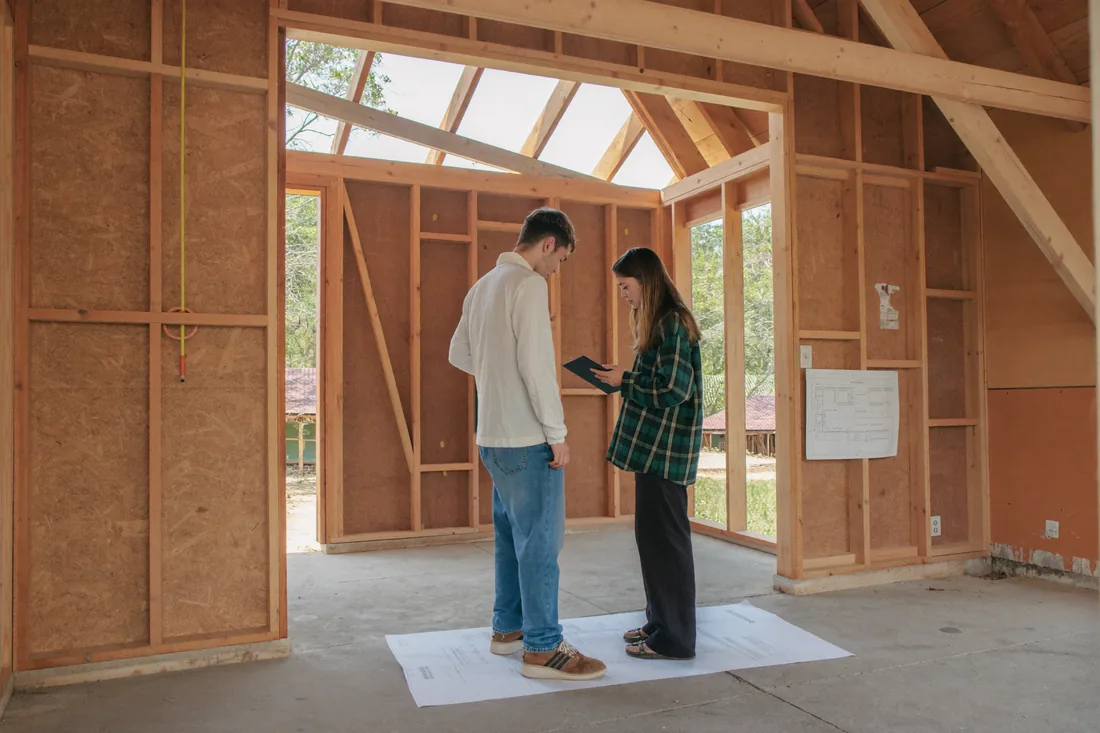
Stage 2: Frame (about 15 to 20%)
Wall frames go up, roof trusses are craned in and the roof covering is installed. The house looks like a house for the first time. A frame inspection should confirm correct timber sizes, bracing, and that window and door openings match the plans.
Stage 3: Lock-up / enclosed (about 20%)
External cladding, windows, external doors and the garage door go in. The home is now weathertight and can be locked, so the builder can work inside without weather delays. A lock-up inspection checks that openings are correctly flashed and there's no water ingress.
Stage 4: Fixing / fit-off (about 20%)
Internal walls are plastered, skirting and architraves installed, kitchen and bathroom cabinetry fitted, tiling completed, and electrical and plumbing rough-in finalised. The fit-off inspection is the most detail-heavy: focus on alignment, square cuts, consistent paint finish, and that every fitting matches the contract spec.
Stage 5: Completion / handover (remaining balance)
Final painting, flooring, tapware, light fittings, appliances and external works are finished. By the end of Stage 5 the home is ready for handover. The final inspection should produce a detailed defect ("snag") list the builder must rectify before you accept the keys and make the final payment.
At each stage, book an independent inspection through NestPath. Don't rely on the builder's internal QA or the lender's valuation inspection. An independent inspection costs $400 to $800 a stage and has saved buyers six-figure rectification bills. Our building and pest inspection guide covers what each stage inspection should look at.
Construction loans: how they work
A construction loan funds a build in stages rather than one upfront payment. For first home buyers, it's almost certainly the loan type you'll need: standard home loans don't handle progressive drawdowns, and lenders won't release funds for a home that doesn't exist yet.
Instead of settling the full loan on day one, the lender releases funds to the builder in five instalments, one at the end of each build stage, and you only pay interest on what's been drawn so far. With the slab poured and 10 per cent drawn on a $500,000 loan, you're paying interest on $50,000, not $500,000. By completion the full balance is drawn and the loan converts to a standard principal-and-interest home loan. That keeps holding costs low: if your build takes 10 months and the loan averages 40 per cent drawn, you pay well under half the interest of an equivalent fully drawn loan.
A few things to know:
- Rates are usually 0.10 to 0.50 per cent higher than the same lender's standard variable rate, reflecting the risk while the asset is still being built. Most construction loans are interest-only during the build and revert to P&I on completion.
- Deposit and LVR: most lenders want a 20 per cent deposit on total contract value (land + build). With the 5% Deposit Scheme, eligible first home buyers can build with just 5 per cent down and no LMI. In WA, Keystart allows a 2 per cent deposit with no LMI for eligible borrowers.
- Inspection fees: the lender charges a valuation fee of $150 to $400 at each drawdown ($750 to $2,000 across the five stages). Some absorb it into the establishment fee. Ask upfront.
- Documents you'll need: a signed fixed-price building contract, the land contract or title, council-approved plans and permit, the builder's licence and insurance, the home warranty certificate, and soil and engineering reports.
Construction loans are a specialist product, and slow drawdown processing can stall your builder, which delays your move-in and costs you rent. Match with a NestPath construction-loan specialist to find a lender with fast turnaround, and check what you can borrow first on the borrowing power calculator. For the full mechanics, our construction loans guide goes deeper.
Building contracts: what to check before you sign
The building contract is the single most important document in your build. It sets the price, the timeline, the quality standard and your rights if things go wrong. Before you sign, have your conveyancer review every page. A contract review costs $400 to $800 and has saved buyers from contracts that would have cost them far more.
Fixed-price vs cost-plus
A fixed-price contract sets a total price upfront; cost overruns are the builder's problem, not yours. A cost-plus contract bills you the builder's actual costs plus a margin, so the final price is unknown until the job is done. For first home buyers, always choose fixed-price. Cost-plus suits sophisticated buyers on complex custom builds where the scope is genuinely uncertain.
Key clauses to check
- Build timeline: start date, completion date, and what happens if the builder runs late. Look for a liquidated damages clause covering delays beyond a buffer period.
- Variation process: how changes are quoted, agreed and paid. Every variation must be documented in writing before work proceeds.
- Defect liability period: most Australian contracts run a 3-month initial defect period and a 6-year structural warranty; confirm your specific terms.
- Progress payment schedule: the percentage payable at each stage. Standard HIA and MBA contracts follow the five-stage breakdown above.
- Provisional sums and PC items: how site-cost allowances and product allowances are set, and what happens if the real figures come in higher.
- Dispute resolution: how disputes are handled and which tribunal has jurisdiction.
- Termination rights: when either party can walk, and the cost consequences.
Have your conveyancer review the building contract before you sign. That's separate from the land conveyancing, so budget for both. Most states also give you a short statutory cooling-off period on building contracts (usually 5 to 7 business days), but don't rely on it. Get the review done before you sign, not after.
Owner builder vs licensed builder
An owner builder manages the construction of their own home directly, engaging trades themselves instead of using a licensed builder to run the whole project. It's legal in every state with the right permit, but rarely the right call for a first home buyer.
The appeal is real: owner building can save 10 to 20 per cent by cutting the builder's margin, and you control trade selection, scheduling and materials. But the trade-offs are steep: a 15 to 25 hour-a-week commitment across a nine-month build, and you carry all the project-management risk for late trades, defective work and cost overruns. Many lenders won't finance an owner-builder project or will cap the LVR at 60 to 70 per cent. Home warranty insurance is often unavailable, which creates resale problems: if you sell within six years you usually must disclose owner-builder status and may need to obtain warranty insurance retrospectively (our home warranty insurance guide has the state-by-state rules). You'll also need an owner-builder permit, which means a white card and sometimes a one-day course.
Our recommendation for first home buyers: use a licensed builder. The theoretical savings rarely survive contact with reality. A missed inspection, a defective trade or a finance shortfall on your first home can cost more than the margin you saved. For your first build, a fixed-price contract with a licensed, HIA- or MBA-accredited, fully insured builder on your state's licensing register is the sensible choice.
New build checklist: before, during and after
A stage-by-stage checklist to keep your build on track from finance pre-approval to handover.
Before you sign
- Finance pre-approval from a lender that handles construction loans
- Builder research: licence check, reviews, display-home visits, referee checks from recent clients
- Contract review by your conveyancer
- Council approval / building permit in hand (or a confirmed timeline)
- Home warranty insurance certificate sighted and verified
- Site-cost allowance and soil-test arrangement clear in the contract
- All exclusions priced and budgeted separately (driveways, fencing, landscaping, window coverings)
During the build
- Independent inspections at Stages 1 (slab), 3 (lock-up), 4 (fit-off) and 5 (pre-handover)
- All variations documented and signed in writing before work proceeds
- Weekly site photos, useful for insurance claims and any builder dispute
- Monthly check-in call with the site supervisor
- Timeline monitored against the contracted completion date
- Every piece of correspondence kept: email, SMS, contract addenda
Handover and after
- Independent pre-handover inspection with a written defect list, the most important inspection of the whole build
- Defect rectification complete before you accept keys and make the final payment
- All certificates received: occupancy, compliance (electrical, plumbing, gas), termite treatment, home warranty insurance, energy rating
- Electricity, gas, internet and water connected. Most can be done 3 to 5 days before handover, and choosing an electricity plan means you are not left on a default standing offer
- Your move planned around the completion date, with a two-week buffer for handover delays
- Home insurance active from completion: the builder's works insurance stops at handover, so your cover must start the same day
- The defect liability clock started: usually three months to report initial defects, then a six-year structural warranty
For the full picture of settlement and handover paperwork, see our property settlement guide.
Frequently asked questions
How long does it take to build a house in Australia?
A standard single-storey project home from a volume builder takes 6 to 9 months from slab pour to handover, while double-storey or custom builds run 9 to 14 months. The national average across all houses is around 11.5 months (ABS, 2025), and once you add 3 to 6 months of pre-construction approvals, the realistic timeline from contract signing to move-in is 15 to 18 months. Plan your rental with a two-month buffer beyond the contracted date. Late handovers are common.
Is it cheaper to build or buy in 2026?
It depends on location and inclusions. In Perth, Adelaide and most regional areas, building new is often cheaper than buying a comparable established home once you factor in the First Home Owner Grant and stamp duty savings. In Sydney, building is typically more expensive per square metre than an outer-suburban established home. Always price both paths in your target area, and remember a new build comes with six years of structural warranty that an established home doesn't.
Can you build a house for $300,000 in Australia in 2026?
Realistically, $300,000 only covers a small home of around 150 to 170m² from a volume builder in the cheapest markets (Adelaide, Hobart and regional areas), and that's the build contract excluding land. Once you add site costs, council charges and the other soft costs, $300,000 rarely covers a full first-home build. Treat it as a starting contract figure, not your all-in budget.
Is $400,000 enough to build a house in Australia?
$400,000 is around the national average for a 200 to 230m² build, but that's the construction cost excluding land and soft costs. Budget another 20 to 25 per cent on top for site costs, council charges, connections and landscaping, so $400,000 is a realistic build contract but not the all-in figure. Add land and soft costs to know your true number.
What is the most expensive part of building a house?
In the construction contract itself, the frame and roof and the fit-out (kitchen and bathrooms) are the biggest line items. But for first-home-buyer budgets, the costliest surprise is usually site costs and soft costs, not the headline contract. They're the part the builder's quote leaves out, and they typically add 20 to 25 per cent on top.
What's the difference between a provisional sum and a prime cost (PC) item?
A prime cost item is an allowance for a product you'll choose later, such as taps, an oven or floor tiles. A provisional sum is an allowance for work of unknown scope, such as excavation or site costs. Both are estimates that can blow out, so pin down exact brands, specs and a realistic site-cost figure in the contract before you sign. Otherwise you cover the difference at the end.
What deposit do I need for a construction loan?
Most lenders require a 20 per cent deposit on the total contract value (land plus build). With the 5% Deposit Scheme, eligible first home buyers can build with just a 5 per cent deposit and no Lenders Mortgage Insurance, one of the strongest reasons to build as your first home. In WA, Keystart allows eligible buyers to build with a 2 per cent deposit. Check the state grants breakdown for what stacks with a 5 per cent construction loan in your state.
What is a progress payment in building?
A progress payment is a staged payment your construction lender makes to your builder when each build stage is finished: base/slab (about 10 to 15%), frame (about 15 to 20%), lock-up (about 20%), fixing (about 20%) and completion (remaining balance). You don't pay the builder directly; your lender does, after an independent valuer confirms the stage is complete. You're only charged interest on funds drawn so far, which keeps holding costs low during the build.
Do I need a building inspection during construction?
Yes. Book an independent inspection at each of the four critical stages: slab, lock-up, fit-off and pre-handover. The lender's valuation inspection confirms a stage is complete for drawdown purposes, not that the work is defect-free. An independent inspector works for you, produces a written report, and flags issues that must be fixed before the next stage. Inspections cost $400 to $800 each and are one of the highest-ROI expenses in a build.
Can first home buyers get grants for new builds?
Yes, and new-build grants are far more generous than established-home grants in most states. Queensland's First Home Owner Grant is $30,000 on eligible new-build contracts (the drop to $15,000 flagged for 1 July 2026 was not implemented), the NT offers up to $50,000 through HomeGrown Territory, SA offers $15,000 with no price cap, and WA and NSW offer $10,000. In most states stamp duty is payable only on the land, not the build. See the state-by-state grants breakdown for exact 2026 amounts.
How much does it cost to build a 4-bedroom house in Australia?
A typical 4-bedroom home of around 230m² costs about $443,000 to build excluding land, based on the national average for a single-storey home in 2026. A smaller 3-bedroom build (around 150m²) starts nearer $285,000 at volume-builder rates, while a premium or double-storey 4-bedroom build can run past $680,000. Add land and 20 to 25 per cent in soft costs to reach your all-in figure.
Ready to start? Run your numbers on the NestPath borrowing power calculator, check your state grants, then match with a construction-loan specialist broker who can model your exact scenario. If you're leaning towards a packaged build in a growth corridor, our house and land packages guide is the next thing worth reading.


