
Last updated 4 July 2026 · Reading time: 14 minutes
Building your first home instead of buying an established one unlocks more government money than any other way into the market in 2026. Most first home buyers don't find that out until after they've already signed for an existing place. This guide walks through how construction loans actually work in Australia, what deposit you really need, and the part bank websites won't write for you: the full grant stack you can claim on a new build.
The Quick Version, Construction Loans for First Home Buyers in 90 Seconds
If you only read one section, read this one. Here's the whole thing, with the numbers that matter up front:
- Money comes in stages, not all at once. A construction loan is a home loan that releases funds across five build stages, and you only pay interest on what's been drawn down so far, not the full approved amount.
- Five stages, five progress payments. Slab → Frame → Lockup → Fit-out → Completion. Each one is inspected and signed off before the next payment is released.
- 5% to 20% deposit. With the First Home Guarantee you can build with as little as a 5% deposit and pay no Lenders Mortgage Insurance.
- Roughly 0.10 to 0.50% higher rate during the build, then it drops back to a normal rate at completion when the loan switches to principal-and-interest.
- The grant stack is up to $50,000 in cash alone. First Home Owner Grant (from $10,000 up to $50,000 in the Northern Territory), the First Home Guarantee, state stamp-duty exemptions, and the new Help to Buy shared-equity scheme can all apply to a new build, and they stack in ways they simply don't for established homes.
- Most lenders won't touch owner-builders. If you're not using a registered builder on a fixed-price contract, your options shrink fast.
If you're weighing build versus buy as a first home buyer, the grants alone can be worth tens of thousands more on a new build than on an established one. Work out what you can afford to build, then get matched with a construction-loan specialist broker who knows which lender-and-grant combination works in your state.
This guide is general information only, not financial advice. Eligibility for grants and loan products depends on your circumstances and the state you're buying in. Figures here were checked against state revenue offices and federal sources in June 2026; always confirm current details before you commit.
How Does a Construction Loan Work in Australia?
A construction loan is genuinely different from the home loan most Australians know.
When you buy an existing home, your lender hands the seller's solicitor one lump sum on settlement day. The full balance starts charging interest from day one.
When you build, the lender won't do that. Funding a build up front is riskier: the home doesn't exist yet, the builder might not finish, the job can run over budget, and the finished property might not value up.
So the lender splits the loan into five progress payments and releases each one only after that stage has been independently inspected and signed off. Here's the bit that trips people up: it only charges interest on the cumulative balance you've drawn down so far, not the full approved amount.
Most first home buyers don't grasp that until they're holding their first invoice. Say you've got a $500,000 construction loan and only $50,000 has been drawn for the slab. You're paying interest on $50,000, not $500,000. By month six you might be on $250,000. Only when the home is finished and the last payment is released are you paying interest on the full balance.
That drip-feed is the whole point of a construction loan. It keeps building affordable for ordinary buyers, because your holding costs ramp up gradually instead of slamming you with a full mortgage from day one, while you're probably still paying rent on your current place.
During the build your repayments are interest-only. At completion the loan converts to a standard principal-and-interest home loan over 25 or 30 years, and you pay it down like any other homeowner. That's the whole shape of it. Everything else is detail: deposits, rates, grants, stages, paperwork.
Construction Loan vs Home Loan
The two products share a name and not much else. A standard home loan funds a house that already exists. A construction loan funds the building of one that doesn't yet. Every mechanical difference flows from that one fact.
| Feature | Standard home loan | Construction loan |
|---|---|---|
| How funds are released | Single lump sum at settlement | Five progress payments, one per build stage |
| Interest charged on | Full loan balance from day one | Cumulative drawn balance only |
| Repayments during the loan | Principal and interest from day one | Interest-only during build, P&I after completion |
| Interest rate | Lender's standard variable rate | Roughly 0.10 to 0.50% premium during build, reverts at completion |
| Inspections | One valuation at application | One valuation per stage drawdown |
| Paperwork | Income, debts, deposit, contract of sale | All of that plus fixed-price contract, plans, builder details, payment schedule |
| Timeline | 30 to 90 days to settle | 9 to 24 months from first drawdown |
| Owner-builder eligible? | N/A | Most lenders refuse; specialist lenders only |
The practical takeaway: a construction loan asks more of you up front and during the build, but charges you less interest along the way. By the time the home is finished and the loan converts, you're holding a normal home loan with the same lender and roughly the same balance you'd have had buying established, just with a brand-new home, a builder's warranty, and a stack of grants you wouldn't have qualified for buying old.
Construction Loans for First Home Buyers, The Grant Stack
This is the section bank websites won't write, because it isn't their job. For first home buyers building new, the federal and state grants stack on top of each other in a way they never do for established purchases. Get this right and it's the difference between needing a six-figure deposit and getting into a new home for the price of the 5% alone.
Here's the full stack, and how to think about each piece.

Federal: The 5% Deposit Scheme (formerly the First Home Guarantee), No LMI
The Australian Government 5% Deposit Scheme (formerly the First Home Guarantee) lets eligible first home buyers buy or build with as little as a 5% deposit, with the federal government guaranteeing the rest so you avoid Lenders Mortgage Insurance.
On a construction loan, that means:
- You can build with around $32,500 down on a $650,000 project instead of $130,000.
- You save the LMI premium, often $20,000 to $30,000 on a 95% loan.
- The loan still runs as a normal construction loan with staged progress payments.
The big change: from 1 October 2025, the previous cap of 35,000 places a year was removed, places are now unlimited, and the old income caps ($125,000 single, $200,000 couple) were scrapped entirely. Eligibility now needs Australian citizenship or permanent residency, first-home-buyer status, owner-occupier intent, at least a 5% deposit, and a property within the location price cap. As of 1 October 2025 those caps are $1.5M in Sydney, $1.0M in Brisbane and Canberra, $950K in Melbourne, $900K in Adelaide, $850K in Perth, $700K in Hobart and $600K in Darwin. The home must be your principal residence within 12 months of settlement. Check your eligibility in two minutes.
Federal: Help to Buy, Shared Equity for New Homes
Help to Buy is a separate federal scheme where the government takes an equity share in your home in exchange for chipping in toward the purchase price. It launched on 5 December 2025, and the government contributes up to 40% of the price on a new home, or up to 30% on an existing one. You can get in with a deposit as small as 2%.
The headline rules: income caps of $103,000 for singles and $165,000 for couples and single parents, a minimum 2% deposit, and 10,000 places a year (40,000 over four years). Location-based property price caps apply.
You can use Help to Buy on a new build, but it doesn't stack with the First Home Guarantee on the same property, so you pick one. Help to Buy suits you better if your deposit is tiny and you want to keep your loan much smaller; the Guarantee suits you better if you have 5% and want to own 100% of the home from day one. A broker can model both against your numbers.
State: First Home Owner Grant (FHOG)
The First Home Owner Grant is the original new-build grant, introduced in 2000. In most states it only applies to brand-new homes, which is exactly why first home buyers who build catch it and those who buy established miss out. Amounts and caps vary a lot by state, and a couple of these have hard deadlines coming.
| State / Territory | New-build FHOG | Property value cap |
|---|---|---|
| NT | $50,000 (HomeGrown Territory Grant, contracts to 30 Sep 2027) | No cap |
| QLD | $30,000 (continued beyond 30 Jun 2026 in the 2026-27 Budget) | Under $750K |
| TAS | $20,000 (from 1 Jul 2026, to 30 Jun 2027) | No cap |
| SA | $15,000 | No cap |
| NSW | $10,000 | $600K (built) / $750K (house & land contract) |
| VIC | $10,000 | $750K |
| WA | $10,000 | $750K (Perth metro) |
| ACT | No cash grant (replaced by stamp-duty concession) | N/A |
Two state grants worth knowing: QLD kept its $30,000 First Home Owner Grant beyond 30 June 2026 in the 2026-27 Budget (new homes under $750,000), and Tasmania's grant is now $20,000 for eligible transactions from 1 July 2026 to 30 June 2027 (down from the $30,000 that ended 30 June 2026). If you're building in either state, those five-figure grants are a big reason to factor the timing into your build plan. The NT's $50,000 HomeGrown Territory Grant is the biggest cash grant in the country and has no price cap, running for contracts signed to 30 September 2027. See your state's exact grants and concessions, or go straight to your state's page, for example /grants/qld or /grants/nt.
State: Stamp Duty Exemptions for New Builds
This is often the biggest single dollar amount in the whole stack. Stamp duty on a $650,000 home would normally run $25,000 to $30,000, and most states waive or heavily reduce it for first home buyers, especially on new construction.
- QLD: Full first-home transfer-duty concession on new homes and vacant land, with no price cap, for contracts from 1 May 2025.
- SA: Full stamp-duty relief on a new home or vacant land for first home buyers, no price cap, from 6 June 2024.
- NSW: Full exemption for first home buyers up to $800K, with concessional rates to $1M; for vacant land, full exemption to $350K and concessional to $450K.
- VIC: Full exemption up to $600K, sliding scale to $750K.
- WA: From 7 May 2026, no duty up to $600K and a concessional rate up to $800K statewide (the old metro and regional split is gone). A further threshold rise has been flagged but isn't yet law, don't bank on numbers above these until it passes.
- TAS: The 100% first-home stamp-duty exemption on established homes up to $750K ended on 30 June 2026 (it applied to settlements from 18 February 2024 to 30 June 2026). Confirm the current first-home duty concessions with the State Revenue Office before you sign, as Tasmania's rules have been changing.
Run your own state and price through the stamp-duty calculator to see what you'd actually pay or save.
State-Specific Schemes (Worth Checking)
- WA Keystart: A government-backed lender that lets eligible first home buyers build with as little as a 2% deposit. Works for new construction. Income and price caps apply. See the Keystart guide.
- VIC HomeBuyer Fund: A state-run shared-equity scheme similar to Help to Buy; the government takes up to a 25% equity share.
- NSW Shared Equity Home Buyer Helper: Up to a 40% equity share for eligible single parents, key workers, and singles aged 50+.
How the Stack Adds Up
Take an eligible first home buyer building a $650,000 home in Queensland in 2026:
- FHOG (new build, under $750,000): $30,000 cash.
- Stamp-duty exemption: the full duty waived. Since 1 May 2025 there's no price cap on the QLD first-home new-home concession, so the entire transfer duty that would otherwise apply is saved, on a project at this level that's well into five figures.
- First Home Guarantee (5% deposit, no LMI): roughly $20,000 to $30,000 in LMI avoided.
Add it up and the benefit comfortably clears $60,000 between cash in hand and costs avoided. That's the difference between this buyer needing around $130,000 to buy an established $650K home and around $30,000 to build the same value as new. The grants simply don't stack like this for established purchases.
A construction-loan specialist broker will know exactly which grants you qualify for in your state and how to structure the loan to claim them, including the timing rules that catch people out. Get matched with one, free.
The Five Build Stages and Progress Payment Schedule
Your construction loan is built around the same five physical stages every Australian build moves through. Each stage triggers a progress payment, and your lender releases money only after an independent valuer confirms the work is done. Typical schedules look like this. Your exact percentages depend on your builder's contract, but most land within these ranges.
1. Base / Slab, typically 10 to 15% of the build cost. Site prep, excavation, plumbing rough-in, footings poured, slab cured. This is the first physical sign your home is real. The slab inspection by the council and your lender's valuer triggers the first drawdown. Defects here (slab cracks, level issues, plumbing routing errors) are cheap to fix now and very expensive later, so book an independent inspection before you sign the stage off.
2. Frame, typically 15 to 20% of the build cost. Wall framing, roof trusses, internal frames up. The home now has a recognisable shape. Frame inspections check the structure against the engineering plans. Once approved, the second progress payment releases.
3. Lockup, typically 20 to 25% of the build cost. Roof on, external walls up, windows and external doors fitted. The home is now weathertight and secure. Lockup is the biggest single drawdown on most builds, because the bulk of the structural and weatherproofing work is done. From here, internal trades work in a sealed, dry shell.
4. Fixing / Fit-out, typically 20 to 25% of the build cost. Internal walls plastered, kitchen and bathrooms fitted, doors hung, electrical and plumbing finished, painting done. The interior becomes functional. This is where missed variations bite, if you wanted a different tap or an extra downlight, missing it now costs you.
5. Completion, typically 5 to 15% of the build cost. Final fit-out, landscaping per the contract, council compliance certificates, final clean. The builder hands over the keys, your lender releases the final payment, and the loan converts to a standard principal-and-interest home loan. Book your independent practical-completion inspection before you sign off, anything you find now is the builder's problem; anything you find afterwards is yours, under warranty.
Across all five stages, expect 9 to 18 months from first drawdown to handover for most builds. Volume builders running standard designs are at the faster end; custom and double-storey homes run longer. Your lender will give you a construction window, usually 24 months, and going beyond it means an extension and a fresh credit assessment.
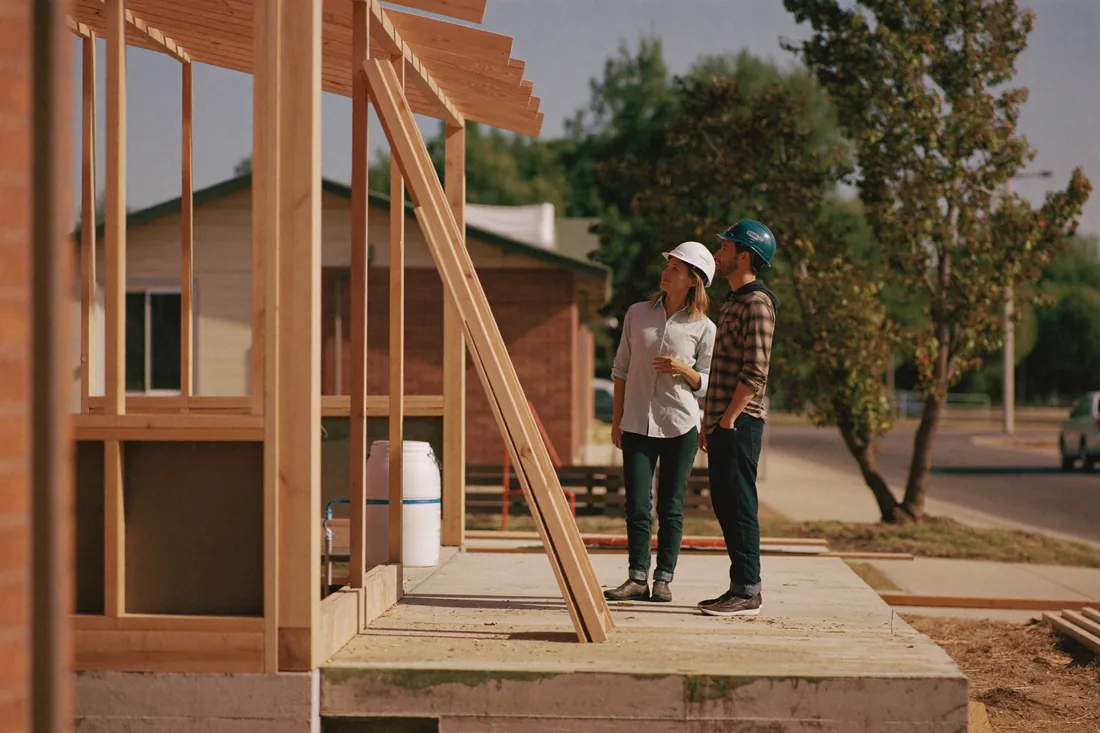
Land and construction loans, how the split works
There are two common shapes here, and it's worth knowing which one you're in before you talk to a lender.
A house-and-land package from a single builder is the simplest: the land and the build are wrapped together, the land settles first, then the staged construction runs on the same facility.
A land and construction loan is what you get when the land is bought separately, often from a different vendor, sometimes months before you've chosen a builder. Here the loan is usually structured as two parts: a land loan that settles and starts charging interest when you buy the block, and a construction loan that kicks in once you've signed a building contract and the work begins. Because the block is a separate purchase with its own contract, have a conveyancer review the land contract before you sign it. The mechanics of the build stages are identical; the difference is the timing gap between buying the land and starting the build, during which you're paying interest on the land with nothing being built yet.
For first home buyers the land-and-construction split matters for one reason: your grant and First Home Guarantee eligibility can hinge on the land and build being treated as a single transaction. Sign them too far apart, or in the wrong order, and you can fall outside the window. Tell your broker upfront which path you're on so the contracts are structured to keep your grants intact.
Construction Loan Deposit Requirements
Construction loan deposits are calculated on the total project value (land + build), not just the construction part. The minimum varies sharply depending on whether you're using a registered builder on a fixed-price contract, building a custom design, or going owner-builder.
| Build type | Minimum deposit | Typical deposit | First Home Guarantee eligible? |
|---|---|---|---|
| House & land package (registered builder, fixed price) | 5% (with the Guarantee) or 10% (without) | 10 to 20% | Yes |
| Custom build on land you already own | 10% (with the Guarantee) or 15 to 20% | 15 to 25% | Yes, if structured as combined land + build at signing |
| Knock-down rebuild | 10 to 15% | 15 to 25% | Sometimes, depends on lender |
| Owner-builder | 20 to 30% | 25 to 35% | Generally no |
| Major renovation | 10 to 20% | 15 to 25% | Generally no (the Guarantee is for new homes) |
For first home buyers, the cleanest path is a fixed-price house-and-land package combined with the First Home Guarantee. That gets you to a 5% deposit with no LMI on a brand-new home, plus the new-build grant stack. Custom builds work too, as long as your broker structures the land and build to settle together. Sign them sequentially and the Guarantee window can close.
What counts toward your deposit: genuine savings (held for three months or more), equity in land you already own outright, gifted funds from family (non-refundable), and First Home Super Saver Scheme withdrawals. What doesn't count: the value of the First Home Owner Grant (it's paid at completion, not before), tax refunds, or money borrowed from elsewhere.
Budget another 3 to 5% on top of your deposit for legal fees, lender fees, stage inspections, and a contingency for variations. Running too tight to the deposit minimum is the most common reason builds stall, give yourself a buffer. Track your deposit progress, and if you're sitting above 80% borrowing, see what LMI would cost you so you can weigh it against the Guarantee.
Construction Loan Interest Rates in 2026
Construction loan rates in 2026 sit a little above equivalent standard home loan rates, typically 0.10 to 0.50% over the same lender's owner-occupier variable rate during the build, reverting to the standard rate at completion. With the RBA cash rate at 4.35% in June 2026, owner-occupier variable rates for first home buyers broadly run in the high-5% to low-6% range, so a construction premium puts you a touch above that during the build.
The premium exists because the lender is carrying more risk. The home doesn't exist yet, the builder might not finish, costs might overrun, and the property might not value up. The progress-payment structure also costs more to run, every drawdown triggers a valuation and a release approval. That admin overhead is baked into the rate.
During the build your repayments are interest-only on the cumulative drawn balance, which keeps your holding cost low while you're still paying rent. Once the home is finished and the final payment releases, the loan automatically converts to your lender's standard principal-and-interest variable rate, and the construction premium drops away.
What actually drives the rate you're offered:
- Your loan-to-value ratio (LVR). Below 80% gets the best pricing. Above 80%, expect a small loading plus either LMI or a guarantee scheme.
- Whether the loan is variable or has a fixed option. Most lenders only offer variable during the build; some let you fix at completion.
- Owner-occupier vs investment. First home buyers building their own home get the cheapest pricing. Investment construction loans run higher.
- Whether you're using the First Home Guarantee. Lenders on the Guarantee panel quote standard owner-occupier rates with the build premium added. The LMI is replaced by the federal guarantee, not by a higher rate.
Advertised rates change too often to publish a useful table here, and a number that's right today is wrong next month. The rate you'll actually be offered depends on your situation, your deposit, and how hungry each lender is for construction lending right now. A construction-loan specialist broker will pull live quotes from several lenders and compare them on the same scenario, the only reliable way to know what you'll really pay. Match with a broker for free.
Worked Example: $650K First Home Build in Western Sydney
The mechanics are easier to follow with real numbers. Here's a realistic scenario for a NSW first home buyer building a four-bedroom home on a house-and-land package in Western Sydney in 2026. The rates and figures below are illustrative, to show how the structure works rather than to quote a price.
The numbers:
| Item | Amount |
|---|---|
| Land purchase | $280,000 |
| Fixed-price building contract (4-bed, 200m², standard inclusions) | $370,000 |
| Total project cost | $650,000 |
| Deposit saved (genuine savings) | $32,500 (5%) |
| First Home Guarantee | Eligible, 5% deposit, no LMI |
| Loan required | $617,500 |
Government money stacked on this build:
| Grant / concession | NSW value (illustrative) |
|---|---|
| First Home Owner Grant (new home, house & land ≤$750K) | $10,000 |
| Stamp duty on the $280K land, fully exempt under the First Home Buyer Assistance Scheme (vacant land ≤$350K) | about $8,000 saved |
| First Home Guarantee, no LMI on a 5% deposit | about $22,000 saved |
| Total free / saved | about $40,000 |
A quick note on the stamp duty, because this is where a lot of online examples get it wrong. As a first home buyer on a house-and-land package, you pay duty on the land, not on the finished home. The $280,000 block here sits under the NSW vacant-land full-exemption threshold of $350,000, so the duty that would otherwise apply to the land, roughly $8,000, is waived in full. It's a real saving, but it's the land duty, not duty on the whole $650K, which is a much smaller number than some calculators imply.
So this buyer's real out-of-pocket cost to get into a $650K new home is the $32,500 deposit plus a few thousand in legal and inspection costs, instead of the roughly $130,000 they'd need to bring to an established home of similar value.
What they pay during the build: the build runs about 9 to 12 months, at a construction rate sitting a fraction above the equivalent owner-occupier rate.
| Stage | Approx. % of loan | Cumulative drawn | Monthly interest (approx.) |
|---|---|---|---|
| Land settlement (month 0) | 45% | $278,000 | about $1,450 |
| Slab (month 2) | +10% | $340,000 | about $1,780 |
| Frame (month 4) | +20% | $464,000 | about $2,430 |
| Lockup (month 7) | +20% | $588,000 | about $3,080 |
| Fit-out (month 9) | +5% | $617,500 (full draw) | about $3,230 (final interest-only month) |
| Completion (month 11) | Final | $617,500 (P&I) | about $3,850 P&I/mo |
Over the roughly 10-month build, total interest is in the low-$20,000s, meaningfully less than if the full $617,500 had been drawn from day one, which would have cost several thousand more across the same period. That gap is the whole reason the staged structure exists.
At completion the loan converts to principal-and-interest at the standard owner-occupier rate, and repayments settle into a fixed monthly figure for the next 25 to 30 years. Estimate your post-completion repayments at a few different rate scenarios so you know what to budget for once the build wraps. And before you commit to any of it, run your own borrowing power to see what you could realistically afford to build.
Construction Loan Calculator, Working Out Your Numbers
There's no single "construction loan calculator" that spits out one perfect answer, because a build has moving parts a standard mortgage doesn't: staged drawdowns, interest-only holding costs, and a deposit measured against the whole project. The honest way to estimate it is to run two free tools side by side:
- Borrowing power calculator: start here. It tells you the total project value (land + build) you can realistically support, which is the number lenders assess a construction loan against.
- Mortgage repayment calculator: use this for what life looks like after completion, when the loan converts to principal-and-interest. That's the repayment you'll live with for decades, so it's the one to stress-test against a higher rate.
For the build period itself, your interest is only ever charged on what's been drawn, so your holding cost climbs stage by stage rather than landing all at once. The worked example above shows roughly how that ramps. A broker will turn these estimates into exact figures against live lender pricing.
Best Construction Loans Australia 2026, What Actually Matters
The honest answer to "which is the best construction loan" is "it depends on your state, your deposit, and your builder", but the questions you should ask every lender are the same. Headline rates change weekly and don't tell you the full story. The operational quality of a construction loan is where builds get delayed or run smoothly, and that never shows up in a comparison-site rate table.
Here are the features that actually move the needle, in rough order of impact:
| Feature | What to ask | Why it matters |
|---|---|---|
| Drawdown turnaround | "How fast does your team release funds after I lodge a progress claim?" | Three business days versus ten is the difference between your builder staying on schedule and your build stalling. Slow drawdowns are the single biggest cause of build delays. |
| Valuation method | "Do you value on land + contract cost, or on completed market value?" | Land + contract is more conservative; completed market value is more generous. It determines your LVR and whether you need LMI. |
| Progress payment fees | "What's the fee per drawdown, and is it absorbed in the establishment fee?" | $50 to $150 per claim across five stages is $250 to $750. Some lenders bundle it, some itemise it. Check before you sign. |
| Interest-only handling | "Are repayments interest-only during the build, and does it auto-convert at completion?" | Auto-conversion saves you a refinance application. Manual conversion lets some buyers shop the rate at completion, both are valid; know which you're getting. |
| Variation flexibility | "How do you handle mid-build variations and cost overruns?" | Some lenders demand a fresh credit assessment for any variation over $5K. Others accept variations up to a percentage of contract value. |
| Grant compatibility | "Do you participate in the First Home Guarantee, and will you handle the FHOG application for me?" | Not every lender on the Guarantee panel offers construction loans. Confirm before pre-approval. |
| Term and conversion | "What term does the loan default to at completion, and can I refinance penalty-free after 12 months?" | A 30-year term with no exit fee gives you the most flexibility to refinance for a better rate once the build premium drops off. |
What matters less than buyers think:
- The headline interest rate. A lender 0.10% cheaper but five days slower on drawdowns will cost you more in build delays than the rate ever saves.
- Brand familiarity. Some of the better construction lenders are credit unions or non-bank specialists, not the big four. Your broker knows them.
- Online application speed. Construction loans are paperwork-heavy regardless. A slick online form that lodges incomplete documents just delays you later.
The cleanest way to compare is to ask a construction-loan specialist broker to quote you the same scenario across several lenders. They'll surface the operational differences a rate table can't show. Match with one, free.
Construction Loans for Owner Builders, Why Most Lenders Won't Lend
Owner-builders are people who decide to manage their own build rather than use a licensed builder on a fixed-price contract. Most Australian lenders flatly refuse to lend to them, and the few that do want bigger deposits, charge higher rates, and demand more paperwork.
Why lenders are so wary:
- No fixed-price contract means cost overruns can blow out the loan.
- No registered builder means no builder's warranty insurance behind the work.
- No professional project management means a higher chance of stalled or substandard builds.
- Owner-builders carry full personal liability for defects, injuries, and compliance failures.
What you'll typically face going owner-builder:
- A minimum 20 to 30% deposit, with no First Home Guarantee access in most cases.
- Interest rates 0.50 to 1.50% above standard construction loan rates.
- Required builder's-risk insurance, owner-builder warranty (in some states), and detailed cost schedules.
- A very short list of lenders, usually credit unions and a handful of specialists.
- A strict drawdown structure, with funds released against actual receipts and inspections rather than neat stages.
The bottom line for first home buyers: if your deposit is small and you're relying on the First Home Guarantee, owner-builder is almost never the right path. The lender pool is too narrow and the deposit requirement too high.
If you're set on project-managing the build yourself, talk to a broker who specialises in non-bank construction lending before you sign anything. The decision is recoverable: you can switch to a registered builder mid-process. But the grants are not. Match with a construction-savvy broker.
How to Apply for a Construction Loan, Step by Step
Construction loan applications follow the same shape whichever lender you use. The order matters, getting it right protects your deposit, your grants, and your timeline. Getting it wrong can cost tens of thousands and months of delay.
Step 1: Get pre-approved. Before you sign anything else, before you commit to a builder, put a deposit on land, or pick a plan, get a construction-loan pre-approval that confirms your borrowing capacity for the total project value (land + build). Signing a contract first is the most common way first home buyers lose their deposit. Pre-approvals last around 90 days and can be extended.
Step 2: Sign a fixed-price building contract. Get your builder to issue a fixed-price contract that itemises inclusions, exclusions, and the progress payment schedule. Insist on fixed-price, cost-plus and labour-only contracts disqualify you from most construction loans. Ask explicitly what's excluded: landscaping, fencing, driveways, blinds, flooring upgrades, and utility connections almost always are.
Step 3: Get council approval and finalise plans. Development approval and a construction certificate, or your state's equivalent, need to be in hand before the formal application. The lender needs council-stamped plans to value the build. Some lenders accept a "subject to DA" condition; most don't.
Step 4: Lodge the formal application. Your broker submits everything: income and employment, debts and expenses, your deposit source, the fixed-price contract, council-approved plans, the builder's licence and insurance, and the progress payment schedule. The lender runs a full valuation. Approval usually takes two to four weeks.
Step 5: Settle the land. On a house-and-land package, the land settles first. The lender funds the land purchase and you start paying interest on that component from settlement day. The build hasn't started, but the meter is already running on the drawn portion.
Step 6: Construction begins; payments release at each stage. Your builder starts work. At the end of each stage you sign a claim, an independent valuer confirms the work, and your lender releases the payment directly to the builder. You never handle the money. Your interest cost steps up as the balance grows.
Step 7: Practical completion and conversion. Once the final payment releases, the construction loan automatically converts to a standard principal-and-interest home loan over 25 or 30 years. This is also the point to line up your building, contents and home insurance before you move in, and to get an independent practical-completion inspection sorted. A qualified building inspector is the person to catch defects while they're still the builder's problem. Then set a reminder: six months in, check your rate against the market, because most first home buyers leave money on the table by not refinancing once the build premium drops off. Not sure where you are in all this? The buying journey map lays out every step from "what can I afford" to keys in hand.
9 Construction Loan Mistakes First Home Buyers Make
These are the traps that come up again and again with first-time builders. None of them are obvious until you've hit one.
1. Chasing the lowest sticker rate without checking valuation rules. Lenders value on land + construction cost, not market value. A lender with a slightly higher rate but a more generous valuation method can save you tens of thousands in LMI compared with the cheap-rate one.
2. Forgetting about construction exclusions. Fixed-price contracts almost always exclude landscaping, fencing, driveways, blinds, flooring upgrades, and utility connections. Budget another $30,000 to $60,000 on top of the contract.
3. Not getting pre-approval before signing the building contract. If finance falls through after you sign, you can lose your deposit and be sued for the contract price. Pre-approval first, contract second. Always.
4. Underestimating the build timeline. Builders quote 9 to 12 months. Many builds run well beyond that once trade and material delays are factored in, so build extra rent into your monthly budget and don't assume the optimistic end of the quote.
5. Picking a non-fixed-price contract. Cost-plus and labour-only contracts shift the overrun risk onto you and rule you out of most construction loans. Insist on fixed-price.
6. Ignoring the variation process. Every change, a different tap, an extra power point, an upgraded benchtop, needs a written variation, lender approval, and sometimes a fresh valuation. Lock your inclusions down before the slab is poured.
7. Not budgeting for stage-payment fees. Most lenders charge $50 to $150 per progress claim. Across five-plus payments that's another $300 to $750 most people forget.
8. Getting the grant and stamp-duty timing wrong. Some grants are paid at first drawdown, others only at completion, and some require you to move in within 12 months. Miss a timing rule and you can lose the whole grant. Your broker should be coaching you on this, if they're not, find a better one.
9. Treating the construction loan as the finished product. At completion it converts to a standard home loan but stays with the same lender. Plenty of first home buyers forget to refinance once the build is done, missing 12 to 18 months of switching discounts. Set a calendar reminder for six months post-completion to compare your rate.
Frequently Asked Questions
How does a construction loan work in Australia?
A construction loan releases money in stages as your home is built, rather than as one lump sum. There are five progress payments, slab, frame, lockup, fit-out and completion, and each is released only after that stage is independently inspected and signed off. Crucially, you only pay interest on the cumulative balance drawn down so far, not the full approved amount. During the build your repayments are interest-only; at completion the loan converts to a standard principal-and-interest home loan.
How much deposit do you need for a construction loan in Australia?
Most lenders want a minimum 5% deposit if you qualify for the First Home Guarantee, or 10 to 20% otherwise. Owner-builders typically need 20 to 30%. Your deposit is calculated on the total project value, land plus construction cost, not just the building component. Budget another 3 to 5% on top for legal fees, lender fees and a contingency.
What's the difference between a construction loan and a regular home loan?
A regular home loan releases the full amount on settlement day for an existing property and charges interest on the whole balance from day one. A construction loan releases funds in five progress payments, one per build stage, and only charges interest on the cumulative drawn balance. You make interest-only repayments during the build, and at completion the loan converts to a standard principal-and-interest home loan.
What's the difference between a land and construction loan and a regular construction loan?
A regular construction loan, usually on a house-and-land package, wraps the land and build into one facility where the land settles first and the staged construction follows. A land and construction loan is used when the land is bought separately, often from a different vendor or earlier in time, and is typically structured as two parts: a land loan that starts charging interest when you buy the block, and a construction loan that begins once you sign a building contract. The build mechanics are identical; the difference is the gap in between, during which you pay interest on the land with nothing yet being built.
How long does a construction loan last?
The construction phase usually runs 9 to 18 months, and most lenders give you a 24-month construction window from first drawdown. After completion the loan converts to a standard home loan over 25 or 30 years.
Can I use the First Home Owner Grant with a construction loan?
Yes. The First Home Owner Grant is designed for new builds, in most states it doesn't apply to existing homes, so a construction loan is the natural pairing. The amount varies by state: $10,000 in NSW, VIC and WA; $15,000 in SA; $30,000 in QLD (continued beyond 30 June 2026) and $20,000 in TAS (from 1 July 2026); and $50,000 in the NT for contracts to 30 September 2027. Property value caps apply in most states.
Can owner-builders get construction loans?
Most major lenders refuse to lend to owner-builders. A small number of credit unions and non-bank lenders will, but they usually require a 20 to 30% deposit and charge 0.50 to 1.50% higher rates. Owner-builders generally can't access the First Home Guarantee. If you're a first home buyer with a small deposit, owner-builder is almost never the right path.
Are construction loan interest rates higher than home loan rates?
Yes, typically 0.10 to 0.50% higher than the equivalent standard variable rate during the build, reflecting the extra risk and admin overhead. At completion the loan converts to the lender's standard variable rate and the premium drops away.
Do I pay stamp duty twice on a construction loan?
No. You pay stamp duty once, on the land, at land settlement. The construction component isn't separately stamped. Most states offer full or partial stamp-duty exemptions for first home buyers on new builds, and a few, including QLD and SA, have removed the price cap entirely.
What happens if my build goes over budget?
If costs exceed your loan, you'll need to either fund the overrun from savings, apply to increase the loan (with a fresh valuation and credit assessment), or stop work. This is exactly why a fixed-price contract and a 10 to 20% contingency buffer are so important.
How does a construction loan differ for a house-and-land package versus a custom build?
For a standard house-and-land package with one builder, a single loan covers both the land settlement and the staged construction. For a custom build where you've bought the land separately, the structure is similar but often involves a land + construction split with two facilities. Tell your broker upfront which path you're on, because it affects how your grants and First Home Guarantee eligibility are protected.
Get Matched with a Construction-Loan Specialist Broker
Construction loans are a niche product. Most general home-loan brokers don't structure them often enough to know which lenders are best for your specific state, deposit and grant eligibility.
NestPath connects first home buyers building new homes with brokers who specialise in construction lending, and who'll help you stack the First Home Guarantee, First Home Owner Grant, state stamp-duty exemptions, and Help to Buy where you're eligible.
It's free. We're paid a referral fee by the broker only if you settle a loan, so the service costs you nothing. Match with a broker now. Or, if you're earlier in the process, run the borrowing power calculator to see what you can afford to build.
This article is general information only and doesn't consider your personal circumstances. Grant amounts, eligibility and tax treatments change frequently. Verify current details with your state's revenue office and an independent professional before making decisions. NestPath is not a lender, not a financial adviser, and not a tax adviser.


