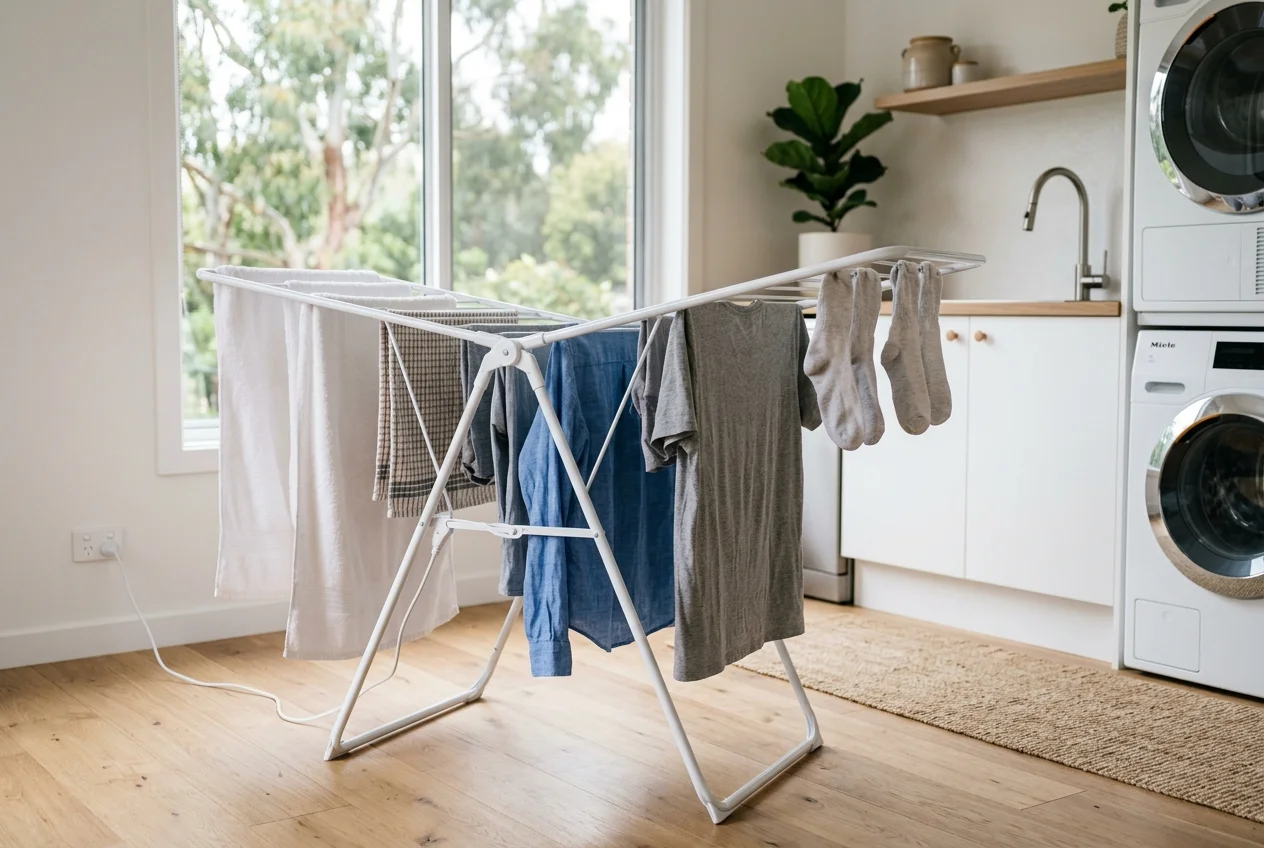
The bullets describe a folding rack that dries clothes, towels and shoes together in a small space, with 20 heated rods and 4 shoe bars. The product information table gives 61D x 66W x 101H centimetres and a weight capacity of 15 kilograms maximum, and the description says it folds down slim for easy storage.
The description gives a power rating of AC 220 to 240V, 50Hz, 230W, a surface temperature of 45 to 55°C reached in 5 to 10 minutes, and a 1.7 m power cord that it calls SAA approved. The listing does not say what plug type the cord has, so we do not call it an Australian plug, and we found no RCM mark mentioned in the listing. Check the rating plate on the unit.
The listing says it typically dries clothes within 3 to 5 hours, depending on fabric and conditions. That is the seller's claim, not our test, and drying indoors still puts moisture into the room.
The bullets also list overheat protection, a water resistant design against spills and flame retardant PP material; those are the listing's words, and we have not tested them. The byline reads Visit the Maxkon Store while the seller shown is AUSWAY. Do not cover the airer unless its listing says a cover is designed for it, and keep water off the plug and controls.
How we checked these two listings
We read each listing on Amazon AU: the title, the bullet points, the product information table and the description with its specification list. Our two sources are the Amazon AU listings and the makers' own wording on them. Specs come from the maker's bullet points and the product information on each listing. We have not tested either product, and the general drying and safety advice on this page is not a finding about either listing.
| Listing | Type | Power shown | Size or capacity shown | Plug and voltage words |
|---|
| Electric Heating Clothes Drying Rack, Aluminium Alloy Foldable | Heated airer | 230W (bullets and description) | 20 heated rods, 4 shoe bars, 15 kg weight limit | AC 220 to 240V, 50Hz; power cord called SAA approved; plug type not stated |
| KEJU BEAR Portable Clothes Dryer 600W | Portable dryer | 600W (title) | Capacity 10 kg (table); folded 22D x 22W x 14H centimetres | Title says AU PLUG; no voltage line |
Last checked: 23 October 2026.
KEJU BEAR Portable Clothes Dryer 600W: a portable dryer, not a heated airer
This is a portable dryer, a different type from a heated airer: a small compact foldable electric dryer with a storage bag, rather than a rack with heated rods. Its listing shows 5.0 from 9 ratings on Amazon AU, sold by KEJU BEAR and shipped by Amazon, so the count is thin. We have not tested it.
The title says 600W and AU PLUG, which are the seller's words, and the product table gives no voltage. The bullets say it can dry up to 10 clothes at once in as fast as 30 minutes and has a built in timer of 1H, 2H and 4H, while the table gives a capacity of 10 kg, so the two figures use different units. The folded size is 22D x 22W x 14H centimetres and the table gives an item weight of 1.6 kilograms.
The 5.0 rating rests on only 9 ratings, against 71 for the AUSWAY airer, and it is a different type, so we do not rank the two against each other. The brand shown is Dysokan while the seller is KEJU BEAR. A 30 minute claim for a small portable dryer is not comparable with the airer's 3 to 5 hours.
Before you buy: four checks
Both cards are Amazon AU listings from third party sellers, so these four checks apply to each. We found no RCM mark mentioned in either listing and we did not ask either seller for compliance details. Apply these checks yourself:
- The RCM mark. Look for the Regulatory Compliance Mark on the unit or its rating plate. Neither the AUSWAY listing nor the KEJU BEAR listing mentions an RCM mark, so ask the seller about it before you buy and read the plate when the unit arrives.
- An Australian plug and rating. The plug should be the Australian type. The KEJU BEAR title says AU PLUG, while the AUSWAY description gives a 1.7 m SAA approved cord and does not state a plug type. Check that the voltage rating on the plate covers Australian supply. Both cards are from third party sellers, so ask the seller if anything on the plate is unclear. That is a general check, not a finding about either listing.
- The wattage. The rating plate gives the rated power, which you need to estimate the running cost. Wattage alone does not tell you how fast a model dries.
- The seller. The airer is sold by AUSWAY and the portable dryer by KEJU BEAR, shipped by Amazon. If a unit arrives without an RCM mark or a rating plate you can read, ask the seller who supplies it in Australia and keep the packaging until you are happy with it.
What a Heated Clothes Airer Is and How It Works
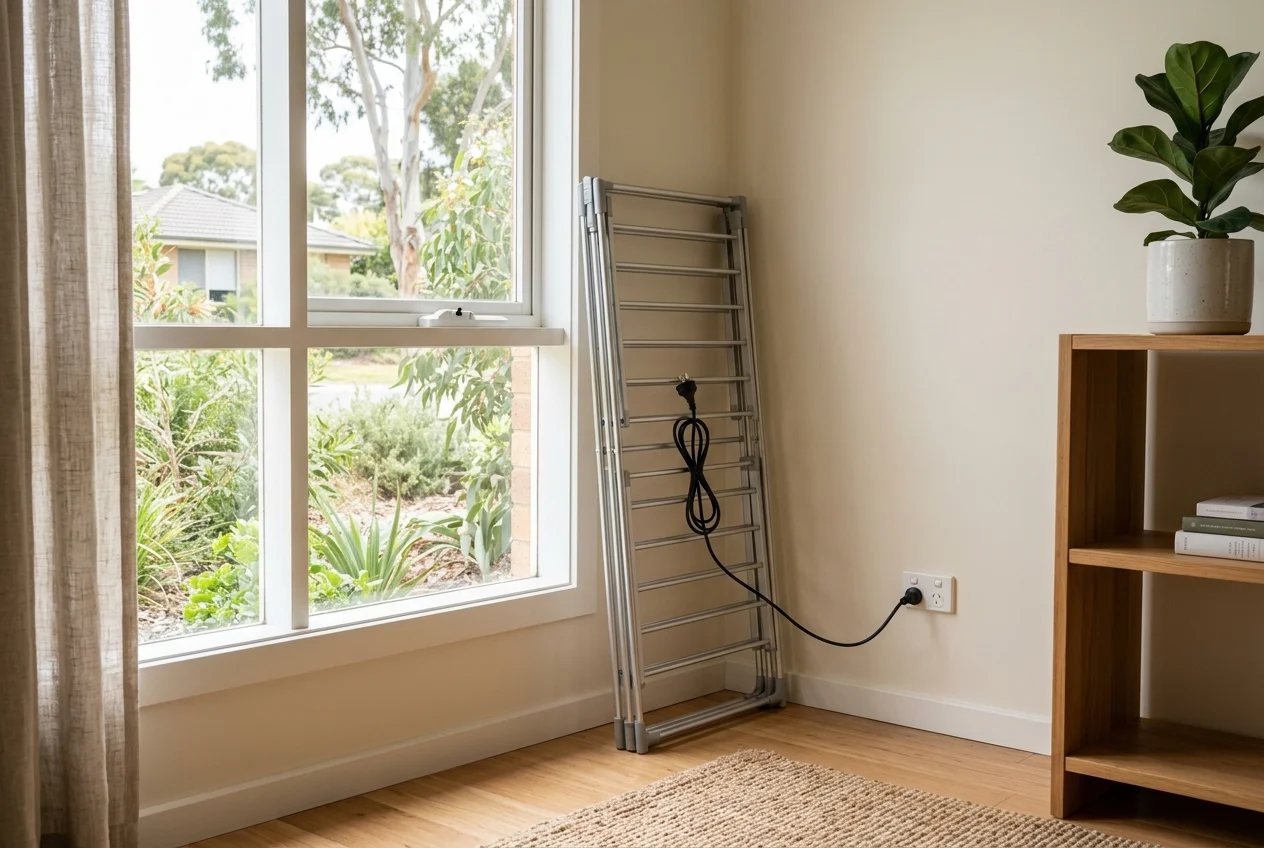
A heated clothes airer, also sold as a heated drying rack, heated clothes rack or heated clothes horse, is a clothes airer with heating elements built into the rods or rails. When you switch it on, the rails warm up, and the warmth helps the moisture evaporate from the washing hanging across them.
On a model with heated rails, the moisture that evaporates from the washing goes into the room. How long a load takes depends on the model, the load and the room, so check what the maker states for your model.
Do not cover an airer unless its listing says a cover is designed for it.
How Much Does a Heated Airer Cost to Run?
Running cost comes from three numbers: the power in kilowatts, the hours you run it, and your tariff per kilowatt hour. Multiply them together to estimate a load. For the AUSWAY listing's 230W, 4 hours is 0.92 kilowatt hours. Rated power assumes full draw throughout, so treat the result as an estimate.
Compare the cost of a whole load rather than a single hour. The KEJU BEAR portable dryer is titled 600W, so 4 hours is 2.4 kilowatt hours, and its listing gives timer settings of 1H, 2H and 4H.
Heated Airer, Portable Dryer or Tumble Dryer
It helps to see the three indoor drying options side by side, because each suits a different household.
A tumble dryer dries the whole load inside the machine. Machine types differ in what they cost to buy and to run, and a vented machine needs somewhere to send its hot air, so compare the rated power and the estimated cost of a whole load rather than assuming. The AUSWAY heated airer states 230W and the KEJU BEAR portable dryer is titled 600W, which gives you a reference point for that comparison.
Whether a heated airer is cheaper than a tumble dryer depends on the rated power of each and how long each runs, so estimate the cost of a whole load for each at your own tariff. A heat pump dryer is another machine type, and it also dries the load inside the machine. A heated airer leaves the washing to dry in the room, so the moisture from the washing goes into the room. Compare the purchase price, the space you have, and the estimated cost of a load at your tariff. The machines are covered in our guide to heat pump, condenser and vented dryers compared in our dryer guide.
A portable clothes dryer is a different type again. The KEJU BEAR listing above is titled a Portable Clothes Dryer and described as a small compact foldable electric drying machine with a storage bag, not a rack. Because airer, rack and dryer sit close together in listing titles, read the title to see which type you are buying.
A heated clothes airer sits between a dryer and a plain rack. Like a rack, it leaves the washing to dry in the room, so the moisture goes into the room air. Like a dryer, it uses electricity, so check the rated power and estimate the cost of a load. If storage is tight, check whether the model folds flat. The same check applies to compact ironing boards for small spaces, which suit the same tight laundries.
An unheated airer, a plain clothes horse, uses no electricity. It adds nothing to your power use, though the washing still dries in the room and puts moisture into the air, so ventilate as you would with a heated airer.
Check the Model's Dimensions and Hanging Space
Check the actual model: its unfolded dimensions against your space, the number and length of its heated rails against your usual load, and how it folds for storage.
The AUSWAY product information table gives 61D x 66W x 101H centimetres and a weight capacity of 15 kilograms maximum, and its description says it folds down slim for easy storage. The KEJU BEAR portable dryer folds to 22D x 22W x 14H centimetres, per its product table. Measure your hanging space against these figures.
Capacity and Wattage: Matching the Airer to Your Load
The right size comes down to how much washing you dry at once. If an airer is too small for your load, you end up drying in shifts while the rest waits damp in the basket, so check the hanging space before you buy.
On wattage, remember the running cost maths from earlier: at the same tariff, a higher rated wattage means a higher estimated cost per hour. Do not judge drying speed on wattage alone; check what the maker states for the model.
For a sense of scale, the AUSWAY listing states 230W with 20 heated rods, 4 shoe bars and a 15 kg weight limit, while the KEJU BEAR title states 600W for a portable dryer whose table gives a capacity of 10 kg. They are different types, so compare the cost of a whole load rather than the wattage.
Drying Time and Realistic Expectations
Drying time depends on the model, the load, the fabric and the room, so be wary of any single number.
The AUSWAY listing says it typically dries clothes within 3 to 5 hours, depending on fabric and conditions. That is the listing's claim, not our test. The KEJU BEAR listing says its portable dryer can dry up to 10 clothes at once in as fast as 30 minutes, which is a different type of machine. If a maker states a drying time, check what load and conditions it was measured under.
The practical tip is to start early in the day, so the drying happens while you are doing other things, and follow your model's instructions for use, including anything they say about leaving it running unattended.
The Condensation and Mould Caveat
This part matters. Drying washing indoors puts moisture into the air, whether the airer is heated or not. Drying clothes indoors can increase humidity, and that can add to condensation and mould problems.
Mould needs moisture to grow, so if moisture builds up indoors, mould can appear on surfaces such as walls, ceilings and window frames.
Turn on an exhaust fan while you dry clothes, and open windows when the weather permits to improve cross ventilation. A dehumidifier can also help dry clothes more quickly and reduce the amount of damp air in the house, though it uses electricity too, so you can choose to run one only when you cannot dry outside or keep windows open. If your home already has a mould problem, look at other moisture sources too, such as water leaks.
Safety
Follow the manufacturer's instructions for use and maintenance, and check any appliance before you plug it in, because water in the appliance, frayed leads or damaged plugs could cause a fire or electric shock. For a heated airer, that means following your model's instructions for use, including anything they say about leaving it running unattended and on which covers and accessories are approved, and keeping water from dripping onto the heating elements, controls or plug.
If the supply cord or plug is damaged, stop using the airer and have it repaired or replaced. The AUSWAY bullets list a Safety System with overheat protection, a water resistant design against spills and flame retardant PP material. Those are the listing's words and we have not tested them, so they do not replace checking the cord and plug yourself.
Heated airer or dehumidifier: which should you actually buy?
They do different jobs. A heated airer warms the washing, and the moisture that comes out of it goes into the room. A dehumidifier removes moisture from the room air, and it can help dry clothes more quickly and reduce the amount of damp air in the house.
A heated airer on its own does not remove moisture from the room, so if your home already has condensation or mould problems, look at ventilation, a dehumidifier and other moisture sources, such as water leaks. Both appliances use electricity, so check the rated power of each.
Buying a heated airer in Australia
Both cards link to Amazon AU listings from third party sellers: AUSWAY for the heated airer, and KEJU BEAR for the portable dryer, shipped by Amazon. Run the four checks above before you buy either. An unheated clothes airer uses no electricity and is a simpler starting point if you are not sure heated drying suits your home.
Frequently Asked Questions
How effective is a heated airer?
A heated airer warms the washing so the moisture evaporates, but that moisture still goes into the room. The AUSWAY listing says it typically dries clothes within 3 to 5 hours, depending on fabric and conditions. That is the listing's claim, not our test, so treat it as a guide and check your fabric and room.
Do heated airers really work?
They are designed to: heating elements in the rods warm the washing so moisture evaporates from it. They do not remove that moisture from the room, so ventilation still matters. The AUSWAY listing gives a surface temperature of 45 to 55°C and 20 heated rods, and we have not tested it, so read those as the listing's figures.
What is the best heated airer in Australia?
We put the Electric Heating Clothes Drying Rack, Aluminium Alloy Foldable first, as the only heated airer on this page. Its listing shows 4.1 from 71 ratings on Amazon AU, with 20 heated rods, 4 shoe bars and a 230W rating. We have not tested it, and the listing does not state its plug type.
What's the best clothes airer?
For a heated airer, we put the Electric Heating Clothes Drying Rack, Aluminium Alloy Foldable first, at 4.1 from 71 ratings on Amazon AU, because it is the only heated airer on this page. If you do not need heat, an unheated clothes airer uses no electricity and is a simpler starting point.
Do heated airers use a lot of electricity?
It depends on the rated power and the hours. The AUSWAY listing gives 230W, so 4 hours is 0.92 kilowatt hours, which you multiply by your tariff. The KEJU BEAR portable dryer is titled 600W, so 4 hours is 2.4 kilowatt hours. Both are estimates that assume full power throughout.
Which type of dryer is most energy efficient?
It depends on the machine type and the hours it runs, so compare rated power and the cost of a whole load at your tariff. A plain rack uses no electricity. The AUSWAY heated airer states 230W and the KEJU BEAR portable dryer is titled 600W, but they are different types, so compare the cost of a load.
Are clothes drying racks worth it?
A plain rack uses no electricity, so it is the simplest option if you have the room and the time to let washing dry. A heated rack adds heat and uses power for the hours you run it, so weigh that extra use against the drying you need, and ventilate the room because the moisture still goes into it.
How to dry bedding on a heated airer?
The AUSWAY listing says it holds up to 15 kg and names clothes, towels, baby items, swimwear and delicates. It does not mention bedding. Check the weight limit and your model's instructions before loading sheets, and do not cover the airer unless its listing says a cover is designed for it.