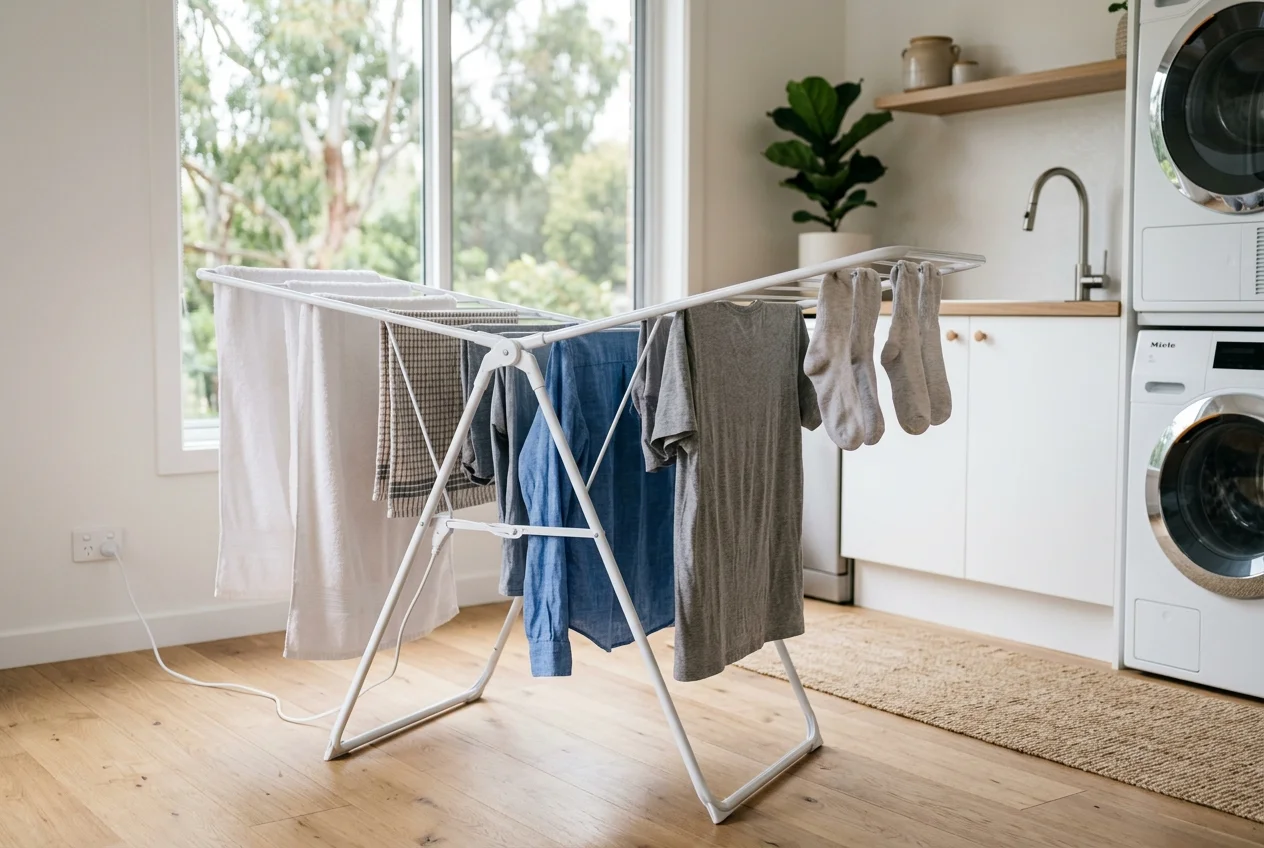
If you dry washing indoors through an Australian winter, a heated clothes airer is one option to consider. This guide focuses on heated airers with heated rails: a clothes airer with heating elements built into the rails. Some models heat with a fan instead, so check how the one you are looking at works. You hang your washing on it as you would on a normal airer, switch it on, and the warm rails help the moisture in the washing evaporate.
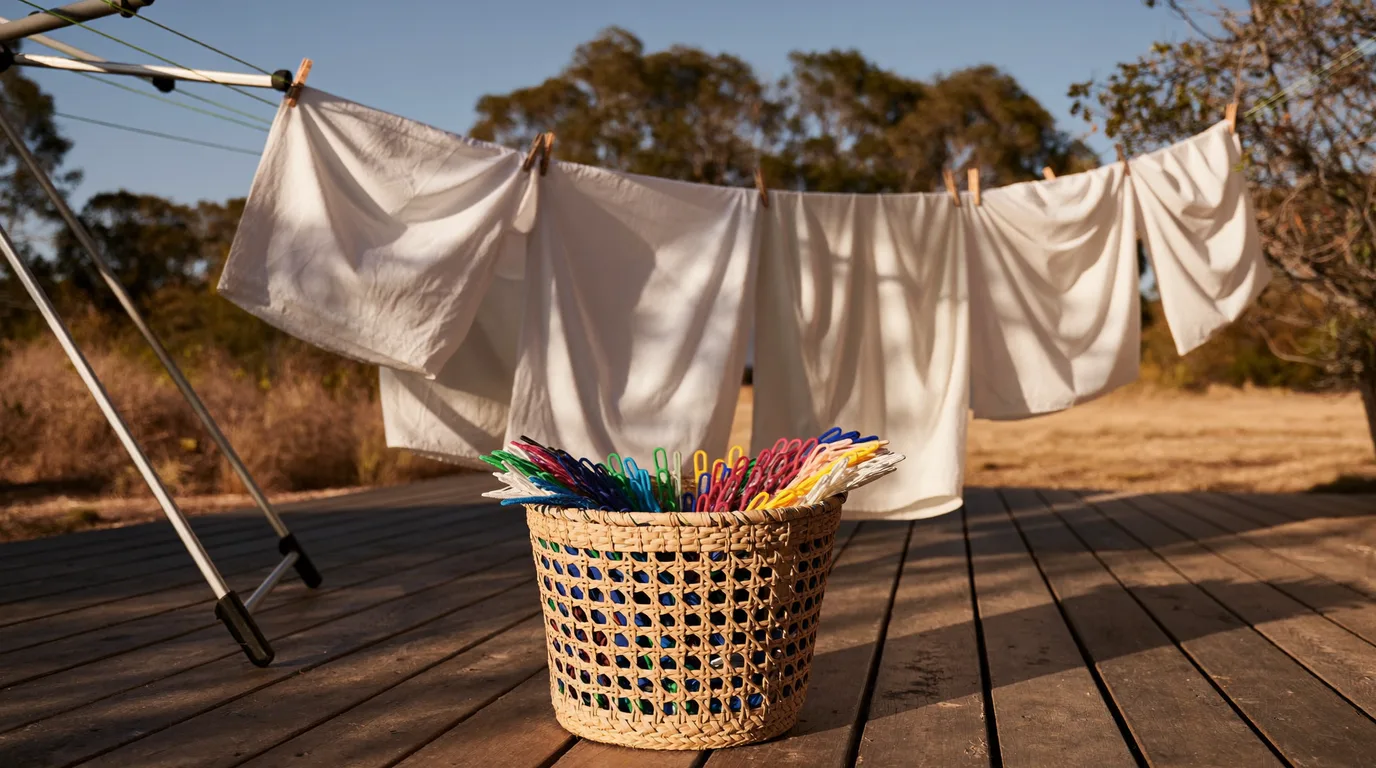
Government energy guidance is a useful starting point. On energy use, the government's Energy Rating site says drying clothes outside is the best option, and that a drying rack in a warm, ventilated spot inside your home is better than using a clothes dryer. That advice is about plain racks. A heated airer adds heat, so it uses electricity, and its running cost depends on its power draw and how long you run it. This guide covers how they work, how to estimate running costs, how they compare with a dryer, and the electrical safety checks to make before you buy one.
Before you buy: four checks
We are rebuilding this guide. We have removed our heated airer picks. One listing turned out to be a cover for an airer rather than an airer, and the other two were sold by UK based sellers, with no Australian plug or RCM mark we could confirm and no entry we could find on the register kept under Australia's Electrical Equipment Safety System (EESS). We will add picks back once we can confirm each exact model. Until then, these are the checks we will apply, and you can apply them yourself:
- The RCM mark. Look for the Regulatory Compliance Mark on the unit or its rating plate. The EESS says suppliers of in scope electrical equipment must make sure it is marked with the RCM before sale, and that the mark represents compliance with the EESS and the ACMA labelling requirements.
- An Australian plug and rating. The plug should be the Australian type, and Energy Safe Victoria says plugs must have insulated pins. Check that the voltage rating on the plate covers Australian supply. Queensland's Electrical Safety Office warns that electrical appliances bought online from overseas sellers might not comply with Australian safety standards or come with information on how to use them safely.
- The wattage. The rating plate gives the rated power, which you need to estimate the running cost. Wattage alone does not tell you how fast a model dries.
- The EESS register. The EESS national database has a free public search of equipment and supplier registrations. Registration is mandatory for Level 2 and Level 3 equipment and voluntary for Level 1 equipment, so a missing entry is not proof that a product is unsafe, but it is a good reason to ask the seller who the registered Responsible Supplier in Australia or New Zealand is before you buy.
What a Heated Clothes Airer Is and How It Works
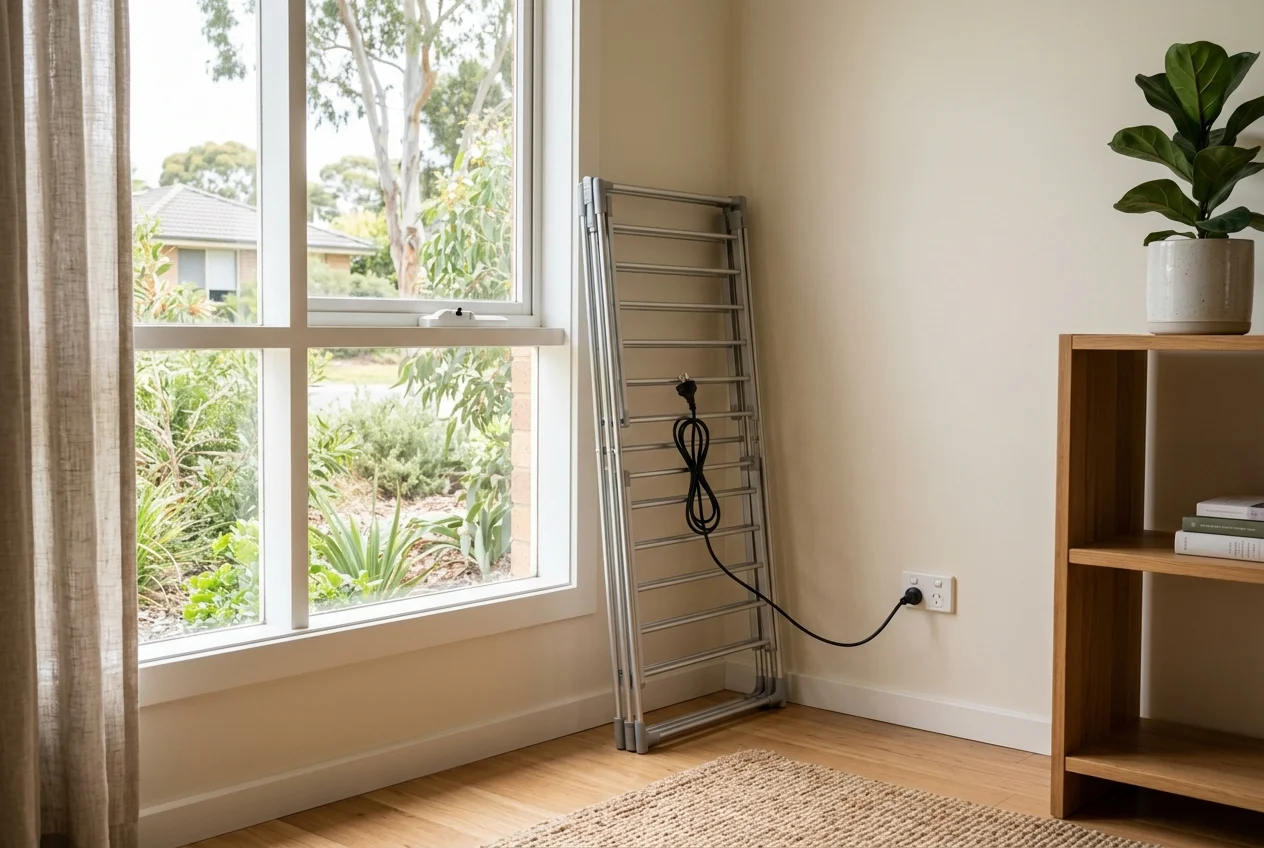
A heated airer with heated rails is a drying rack with heating elements running through the bars or rails. When you switch it on, the rails warm up, and the warmth helps the moisture evaporate from the washing hanging across them.
On a model with heated rails, the moisture that evaporates from the washing goes into the room. How long a load takes depends on the model, the load and the room, so check what the maker states for your model.
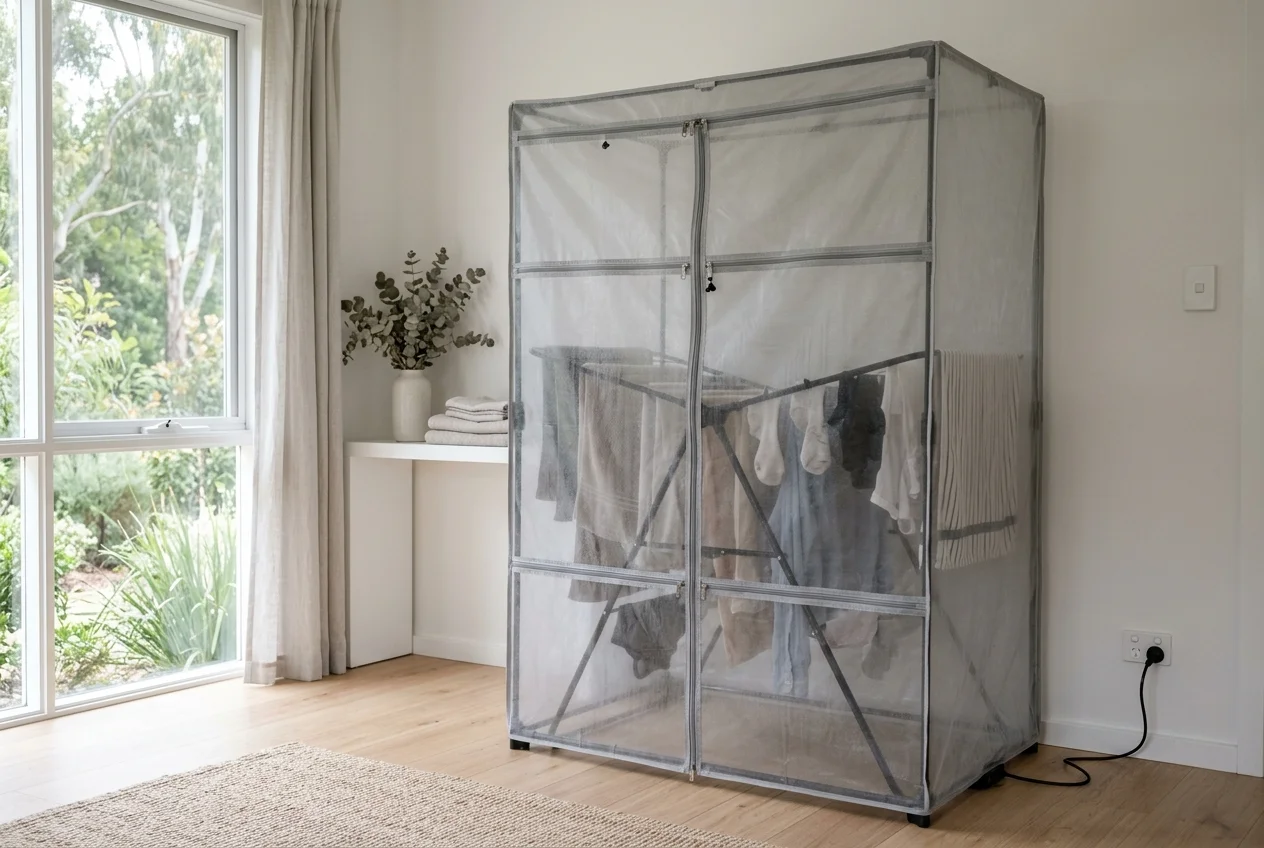
Check whether the maker supplies or permits a zip up cover or tent for your model, and only use one if the instructions allow it.
How Much Does a Heated Airer Cost to Run?
Estimated running cost comes from three numbers: the power in kilowatts, the hours you run it, and your tariff per kilowatt hour. Multiply them together to estimate the cost of a load. Using the rated wattage on the plate assumes the airer draws that power the whole time it runs, so treat the result as an estimate, and compare the cost of a whole load rather than a single hour.
Heated Airer vs Tumble Dryer vs Unheated Airer
It helps to see the three indoor drying options side by side, because each suits a different household.
A tumble dryer dries the whole load inside the machine. The government's Energy Rating site describes vented dryers as the simplest and cheapest type to buy but expensive to run, and notes that they pump hot, humid air into the room, so they need venting to the outdoors. The Australian Government's YourHome guide says heat pump dryers are much more energy efficient than conventional models.
A heated clothes airer sits between a dryer and a plain rack. Like a rack, it leaves the washing to dry in the room, so the moisture goes into the room air. Like a dryer, it uses electricity, so check the rated power and estimate the cost of a load. If storage is tight, check whether the model folds flat.
An unheated airer, a plain clothes horse, uses no electricity. On energy use, the Energy Rating site ranks drying outside first, and a rack in a warm, ventilated spot inside ahead of a clothes dryer.
Check the Model's Dimensions and Hanging Space
Check the actual model: its unfolded dimensions against your space, the number and length of its heated rails against your usual load, and how it folds for storage.
Check whether the maker supplies or permits a zip up cover for your model, and only use one if the instructions allow it.
Capacity and Wattage: Matching the Airer to Your Load
The right size comes down to how much washing you dry at once. If an airer is too small for your load, you end up drying in shifts while the rest waits damp in the basket, so check the hanging space before you buy.
On wattage, remember the running cost maths from earlier: at the same tariff, a higher rated wattage means a higher estimated cost per hour. Do not judge drying speed on wattage alone; check what the maker states for the model.
Drying Time and Realistic Expectations
Drying time depends on the model, the load, the fabric and the room, so be wary of any single number.
We are not publishing drying times until we can source them for specific models. If a maker states a drying time for its model, check what load and conditions it was measured under.
The practical tip is to start early in the day, so the drying happens while you are doing other things, and follow your model's instructions for use, including anything they say about leaving it running unattended.
The Winter Condensation and Mould Caveat
This part matters. Drying washing indoors puts moisture into the air, whether the airer is heated or not. The Australian Government's YourHome guide says drying clothes indoors can increase humidity and add to condensation and mould problems.
NSW Health notes that mould needs moisture to grow, and that if moisture builds up, mould growth will often occur on indoor surfaces.
NSW Health advises turning on exhaust fans when doing laundry and drying clothes, and opening windows when the weather permits to improve cross ventilation. The YourHome guide adds that a dehumidifier can help dry clothes more quickly and reduce the amount of damp air in the house, though it uses electricity too, so you can choose to run one only when you cannot dry outside or keep windows open. If your home already has a mould problem, the NSW Health factsheet also covers other moisture sources, such as water leaks.
Safety
Queensland's Electrical Safety Office says to follow the manufacturer's instructions for use, maintenance and service, and to check appliances before you plug them in and use them, because water in the appliance, frayed leads or damaged plugs could cause a fire or electric shock. For a heated airer, that means following your model's instructions for use, including anything they say about leaving it running unattended and on which covers and accessories are approved, and keeping water from dripping onto the heating elements, controls or plug.
The Electrical Safety Office also says that if the supply cord or plug is damaged, you should stop using it and throw it away or get it repaired.
Heated airer or dehumidifier: which should you actually buy?
They do different jobs. A heated airer with heated rails warms the washing on them, and the moisture that comes out of the washing goes into the room. A dehumidifier removes moisture from the room air, and the YourHome guide says it can help dry clothes more quickly and reduce the amount of damp air in the house. A heated airer on its own does not remove moisture from the room, so if your home already has condensation or mould problems, look at ventilation, a dehumidifier and the other moisture sources NSW Health lists, such as water leaks. Both appliances use electricity, so check the rated power of each.
Where to buy a heated airer in Australia
We are not recommending specific sellers while we rebuild this guide. Wherever you buy, run the four checks above, and keep in mind the Electrical Safety Office warning about overseas online sellers. An unheated clothes airer uses no electricity and is a simpler starting point if you are not sure heated drying suits your home.
Frequently Asked Questions
How much does a heated clothes airer cost to run?
Estimate it from the rated power on the plate, the hours you run it and your tariff: multiply the power in kilowatts by the hours and by your rate per kilowatt hour. Using the rated power assumes the airer draws it the whole time, so treat the result as an estimate. At the same tariff, a higher rated wattage means a higher estimated cost per hour, so compare the cost of a whole load, not a single hour.
Do heated airers actually dry clothes?
They are designed to. On a model with heated rails, the rails warm the washing so the moisture evaporates into the room. How long a load takes depends on the model, the load and the room. We are not publishing drying times until we can source them for specific models, and if a maker states a drying time, check what load and conditions it was measured under.
Are heated airers cheaper than a tumble dryer?
It depends on the rated power of each and how long each runs, so estimate the cost of a whole load for each at your own tariff. For context, the Energy Rating site describes vented dryers as expensive to run, and the YourHome guide says heat pump dryers are much more energy efficient than conventional models.
How long does a heated clothes airer take to dry clothes?
It depends on the model, the load, the fabric and the room, so be wary of any single number. We are not publishing drying times until we can source them for specific models. If a maker states a drying time, check what load and conditions it was measured under. Follow your model's instructions for use, including anything they say about leaving it running unattended.
Do heated airers cause condensation or mould?
Drying clothes indoors can increase humidity and add to condensation and mould problems, according to the Australian Government's YourHome guide, and NSW Health notes that mould needs moisture to grow. NSW Health advises turning on exhaust fans when drying clothes and opening windows when the weather permits, and YourHome says a dehumidifier can help dry clothes more quickly and reduce the amount of damp air in the house.
Do you need a cover for a heated airer?
Follow your model's instructions on whether a cover is supplied, required or permitted, and only use one if the instructions allow it.
Are heated clothes airers safe to leave on?
Follow your model's instructions for use, including anything they say about leaving it running unattended. Before you buy, check for the RCM mark and an Australian plug. Queensland's Electrical Safety Office says to follow the manufacturer's instructions for use, maintenance and service, to check appliances before you plug them in and use them, and to stop using an appliance whose supply cord or plug is damaged. Keep water from dripping onto the heating elements, controls or plug.
How do I check a heated clothes airer is safe to use in Australia?
Check for the RCM mark on the unit or its rating plate, and check that it has an Australian plug and a voltage rating that covers Australian supply. Energy Safe Victoria says plugs must have insulated pins. Then look it up on the free public search of the EESS national database. Registration is mandatory for Level 2 and Level 3 equipment and voluntary for Level 1 equipment, so a missing entry is a reason to ask the seller, not proof that a product is unsafe. If you cannot find the product on the register, ask the seller who its registered Responsible Supplier in Australia or New Zealand is. Queensland's Electrical Safety Office warns that electrical appliances bought online from overseas sellers might not comply with Australian safety standards.
Should I buy a dehumidifier or a heated airer?
They do different jobs. A dehumidifier removes moisture from the room air, and the YourHome guide says it can help dry clothes more quickly and reduce the amount of damp air in the house. A heated airer warms the washing but does not remove moisture from the room. If your home already has condensation or mould problems, look at ventilation and the other moisture sources NSW Health lists, such as water leaks, as well as a dehumidifier.
Where can you buy a heated clothes airer in Australia?
We are not recommending specific sellers while we rebuild this guide. Wherever you buy, check for the RCM mark and an Australian plug, and keep in mind that Queensland's Electrical Safety Office warns that appliances bought online from overseas sellers might not comply with Australian safety standards.
Should I buy a heat pump dryer or a heated airer?
They do different jobs. A heat pump dryer dries the load inside the machine, and the Energy Rating site says it either captures the condensed water in a removable container or drains it away if the dryer is plumbed in. The YourHome guide says heat pump dryers are much more energy efficient than conventional models, and the Energy Rating site says they are more expensive to buy. A heated airer leaves the washing to dry in the room, so the moisture from the washing goes into the room. Compare the purchase price, the space you have, and the estimated cost of a load at your tariff.