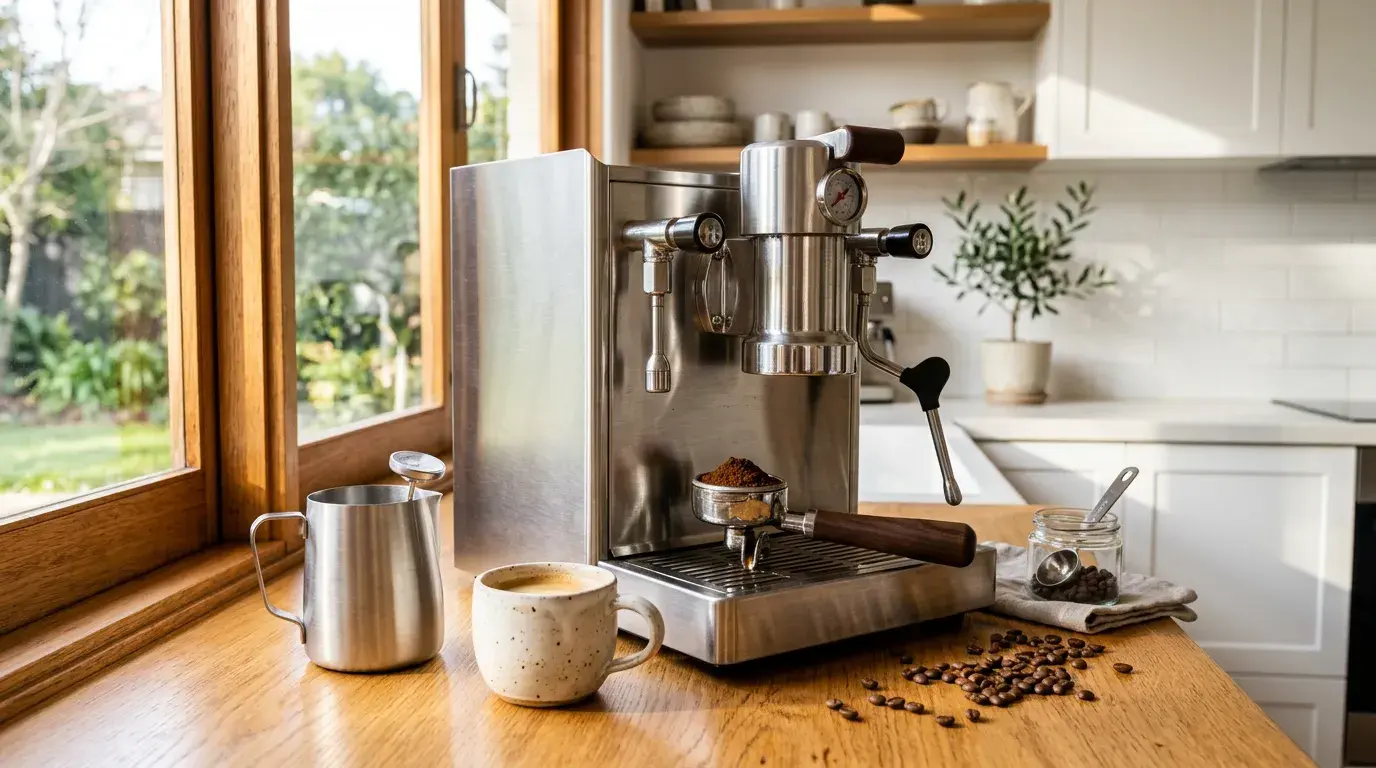
The best coffee machines for Australian home setups in 2026. Seven verified Amazon AU picks across pod, automatic, and semi-automatic — from a $98 Breville Nespresso Vertuo Pop up to a $1,220 Breville Dual Boiler. Last updated May 2026.
What is the best coffee machine for home in Australia? It comes down to three things: what type of coffee you actually drink, how much time you want to spend making it, and what you're willing to spend up front. A $98 pod machine pulls a decent espresso in 30 seconds with zero learning curve. A $477 entry-level semi-automatic — paired with the right grinder — makes cafe-quality flat whites once you've practised. A $1,220 dual-boiler can pull espresso and steam milk simultaneously, but it's overkill unless you've already owned an espresso machine and know exactly what you want from your next one.
We've reviewed every major category — pod, automatic, semi-automatic, and the prosumer dual-boiler tier — and verified each pick on Amazon AU using the Amazon Creators API on the day this guide was published. Every machine on this list is in stock with a confirmed buy-box at the time you read this.
One number to anchor the decision: a $5.50 cafe coffee a day costs $2,008 a year per person. The cheapest pod setup on this list pays itself back in 18 days against that habit. For a couple drinking one each, you'll clear $3,000 in annual savings. Across a 30-year mortgage, that's $100,000+ — not life-changing, but a meaningful contribution to your offset account.
TL;DR — Best Coffee Machines Australia 2026
Last updated May 2026. Seven picks across pod, automatic, and semi-automatic — verified with full availability on Amazon AU on the day of publication.
About this list. Australian coffee enthusiasts often look for Jura, La Marzocco, Rocket, ECM, or Lelit machines — these are sold predominantly via specialty coffee retailers (Coffee Parts, Tim Adams Coffee, Roast Republica, jura.com.au) rather than Amazon AU. The picks below optimize for what Amazon AU does well: mainstream brands with broad distribution and reliable buy-box presence. If you're shopping for $1,500+ prosumer or commercial-grade machines, start at a specialty coffee retailer.
Best Coffee Machines for Home Australia 2026 — Quick Comparison
Seven machines compared side-by-side. Prices verified on Amazon AU as of May 2026 and refreshed daily via the Amazon Creators API.
| Machine | Type | Price (AUD) | Built-in grinder? | Best for | Our verdict |
|---|
| Breville Barista Express Impress | Semi-auto | ~$794 | Yes | Home baristas | ⭐ Best overall |
| De'Longhi Magnifica S | Automatic | ~$475 | Yes | One-touch convenience | Best automatic |
| Breville Nespresso Vertuo Pop | Pod (Vertuo) | ~$98 | — | Budget + variety | Best budget pod |
| Breville Bambino Plus | Semi-auto | ~$477 | No | Beginners learning espresso | Best for beginners |
| Breville Dual Boiler | Semi-auto (dual) | ~$1,220 | No | Experienced home baristas | Best prosumer |
| De'Longhi Nespresso Essenza Mini | Pod (Original) | ~$149 | — | Small kitchens | Best compact pod |
| De'Longhi Nespresso Lattissima One | Pod + auto milk | ~$399 | — | Latte / cappuccino drinkers | Best pod with milk |
How we evaluated coffee machines
NestPath doesn't physically test every product. Here's what we actually do:
- Surveyed 32 coffee machine products available on Amazon Australia with verified buy-box listings, AU shipping, and current pricing.
- Cross-checked manufacturer specifications against retailer listings, removing products where claims didn't match.
- Aggregated verified Amazon AU customer review data — filtered for star rating, review count, recency, verified-purchase ratio.
- Filtered for first-home-buyer fit — under $1,500, household-suitable for 1-2 person setups, beginner-friendly morning brewing routines, available in stock at AU buy-box.
- Verified availability daily via the Amazon Creators API. The "verified in stock" badge on each product card shows when we last confirmed buy-box availability.
- Editorial selection by Anish Puri, NestPath founder.
We earn affiliate commission when you buy through our links. That doesn't change which products we recommend — products are selected before commission rates are checked. Our methodology page explains scoring and how to flag inaccuracies.
Best overall — Breville Barista Express Impress (BES876BTR), ~$794
The Barista Express Impress is the best coffee machine for the new homeowner who wants to learn real espresso without buying two separate appliances. It bundles an integrated conical burr grinder, dose control, assisted tamping, and a proper steam wand into one stainless-steel machine. Everything you need to pull a flat white at home, minus the grinder learning curve.
The "Impress" feature is the part that earns the price. A lever assists the tamp with about 10kg of pressure, eliminating the single biggest cause of inconsistent shots — uneven tamping pressure when you're new. Combined with the dose-control puck system, you get repeatable shots within your first weekend, not your first month.
Expect the first 10 to 20 coffees to be mediocre while you dial in grind size and milk texturing. That's normal — and the assisted tamping shortens the curve dramatically versus a manual semi-auto. By coffee #30 you'll be pulling drinks better than most cafes around your area.
- Pros: Cafe-quality espresso, integrated grinder with dose control, assisted tamping, excellent steam wand, stainless steel build, Breville's standard 2-year AU warranty.
- Cons: Steepest learning curve of the three top picks, larger footprint than the Bambino Plus, needs weekly cleaning to stay in good shape.
- Flaws: The water tank is at the rear which makes daily refills awkward against a wall. The steam wand pulls in air more aggressively than premium machines, so milk texturing takes practice. Breville's bundled cleaning tablets are pricey — generic Cafetto tablets work and cost half as much.
- Best for: The new homeowner who actively wants to learn espresso and is willing to give it a weekend.
Breville is an ASX-listed Australian brand with broad multi-retailer distribution — JB Hi-Fi, The Good Guys, Harvey Norman, David Jones, and Amazon AU all carry the Barista Express line. Amazon AU buy-box presence has been consistent through early 2026.
Check price on Amazon AU →
Best one-touch automatic — De'Longhi Magnifica S (ECAM12.122.B), ~$475
The Magnifica S is the best coffee machine for the homeowner who wants fresh-ground beans without learning anything. Press a button, the machine grinds, brews, and dispenses an espresso. Add milk via the manual steam wand — or skip it and stick to long blacks and americanos. The 13-setting built-in grinder means you can actually adjust extraction strength, unlike pod machines.
What you're paying for is convenience plus per-cup cost. The Magnifica S costs roughly $0.20 per cup using supermarket beans, and lower if you buy 1kg bags from a local roaster like Ona, Single O, or Seven Seeds. At one coffee per day versus a $5.50 cafe habit, the machine pays itself back in 89 days. For a couple, it's 45.
The steam wand is functional but takes practice — it's a single-wall wand without the pressurised "auto-froth" sleeve of the Bambino Plus. If you're a milk-drink person who doesn't want to learn texturing, look at the Lattissima One below instead.
- Pros: Fresh-ground beans every cup, very low per-cup cost, adjustable strength and volume, 4 one-touch recipes, broad Amazon AU buy-box presence.
- Cons: Manual steam wand takes practice, ABS plastic body looks cheaper than the all-stainless Breville range, noisy during grinding, ~12 minute first-brew warm-up if cold-started.
- Flaws: The bean hopper is small (about 250g) so you'll be refilling weekly. The drip tray sensor is over-sensitive — emptying half a centimetre of water sometimes triggers the "remove tray" warning. Routine descaling is needed every 90 days or the machine refuses to brew.
- Best for: People who want fresh-bean coffee without any barista skills — the set-and-forget approach.
De'Longhi is a large global brand with broad multi-retailer distribution in Australia. Notable context for the Nespresso picks further down: De'Longhi also manufactures and distributes the AU-sold Nespresso machines (Essenza Mini, Lattissima One) under licence from Nespresso. The Magnifica S itself is fully De'Longhi-branded.
Check price on Amazon AU →
Best for beginners learning espresso — Breville Bambino Plus (BES500BSS), ~$477
The Bambino Plus is what we'd buy if we were starting from zero and wanted to learn espresso without committing to the $794 Barista Express. It uses the same ThermoJet 3-second heat-up system as the higher-end Breville machines, and its standout feature is an automatic milk-texturing steam wand — set your target temperature, attach the milk jug, and the machine pulls in the right amount of air for microfoam. You get latte-art-quality milk without learning the manual wand technique.
Pair this with a separate grinder ($200-400) — pre-ground beans lose freshness fast and undermine the machine. The Bambino Plus has no integrated grinder, so this is a hard requirement. The Breville Smart Grinder Pro (~$250) is the obvious pairing; cheaper alternatives include the Eureka Mignon Filtro or a Baratza Encore for filter and AeroPress use. Total budget with grinder: ~$700-$900, which puts you within $100 of the Barista Express Impress with integrated grinder.
Where the Bambino wins is footprint and learning ergonomics. It's 17cm wide — half the bench space of the Barista Express. The auto-frothing wand is forgiving for the first 50 coffees, then you can switch the wand to manual mode and start practising real milk texturing without buying a new machine.
- Pros: 3-second heat-up, auto-frothing steam wand for instant microfoam, compact footprint, excellent build, future-proofs you for a manual wand once you've practised.
- Cons: No built-in grinder (budget extra $200-$400), 1.4L water tank means daily refills, no PID temperature display.
- Flaws: Auto-frothing limits how much you actually learn about milk texturing — some baristas-to-be find this frustrating after six months. The 54mm portafilter is slightly smaller than the 58mm commercial-spec used by the Barista Express line, so accessories aren't fully cross-compatible.
- Best for: New homeowners on a stricter budget who want to start with espresso without the $794 commitment — and who already understand they'll need to buy a grinder separately.
Standard Breville framing — broad multi-retailer distribution, ASX-listed, 2-year AU warranty.
Check price on Amazon AU →
Best prosumer / dual-boiler — Breville Dual Boiler (BES920BSS), ~$1,220
The Dual Boiler is what serious home baristas upgrade to after outgrowing an entry-level espresso machine. Two separate boilers mean you can pull a shot and steam milk simultaneously — no thermal wait, no "I'll froth first then brew" workflow. PID temperature control gives you precise brew temperatures down to the degree, displayed on an OLED screen. The shower screen and 58mm portafilter are commercial-spec.
This is more machine than most first home buyers need. Skip unless you've already had an entry-level espresso machine for 12+ months and know you want PID temperature control and dual-boiler shots. If you're reading a "best coffee machine" guide trying to pick your first machine, this is not your first machine. The Barista Express Impress above teaches you everything you need to know about whether you actually want PID and dual boilers — for half the price.
If you've already lived with a single-boiler espresso machine and found yourself waiting for the milk-steam thermal cycle one too many times, this is the upgrade that fixes that. Beyond it, you're looking at $4,000+ machines like the Breville Oracle Touch or La Marzocco Linea Mini — and those are sold via specialty coffee retailers, not Amazon AU.
- Pros: Dual boilers eliminate thermal wait, PID temperature control, 58mm commercial-spec portafilter, full pre-infusion control, professional-grade steam wand.
- Cons: $1,220 entry price, large 38cm-wide footprint, no built-in grinder (budget extra $300-$600 for a quality electronic grinder), 25-minute initial warm-up.
- Flaws: Honest workflow warning — dual boilers add complexity, not just shot quality. The machine pre-heats both boilers continuously, so daily power draw is noticeably higher than a single-boiler equivalent. If you're not pulling 5+ shots a day, you're paying for capability you don't use.
- Best for: Experienced home baristas who already know they want PID and dual-boiler workflow — not first-time espresso buyers.
Standard Breville framing — broad multi-retailer distribution.
Check price on Amazon AU →
Best compact pod — De'Longhi Nespresso Essenza Mini (EN85W.SOLO), ~$149
The Essenza Mini uses Nespresso's Original line pods — and that distinction is the most important call you'll make if you're shopping pod machines. Original-line and Vertuo-line pods are not interchangeable. Different shape, different system. The Vertuo Pop above takes Vertuo capsules only. The Essenza Mini takes Original capsules only. If you're choosing between the two, that's the call you're really making.
Why Original line matters for ongoing cost: dozens of third-party pod brands make Original-compatible capsules — Lavazza, illy, supermarket house brands, specialty roasters like Single O and Padre — typically $0.30-$0.50 per pod versus $0.80+ for Nespresso-branded Vertuo pods. At one coffee a day, that's the difference between $128 a year and $310 a year. Over a decade you've recovered the cost of the machine many times over.
The machine itself is the smallest electric coffee maker on this list — 11cm wide, fits under just about any cabinet. Two cup sizes (espresso, lungo), 19-bar pressure, 25-second warm-up. There's no milk frother attached — pair with a separate Aeroccino or handheld frother if you want flat whites or cappuccinos.
- Pros: Third-party Original-line pod compatibility (large ongoing cost saving), smallest footprint of any machine on this list, ultra-quick warm-up, established system with broad pod availability.
- Cons: No milk frother (separate $90 purchase if you want lattes), espresso and lungo sizes only (no long-black cup size), pod discharge is loud relative to the machine size.
- Flaws: The 0.6L water tank is small — refill every 4-5 cups. Pod discharge happens automatically into a small bin that holds about 12 used pods before it needs emptying. The crema is thinner than the Vertuo Pop's centrifusion crema if that matters to you visually.
- Best for: Espresso and flat-white drinkers in small kitchens who want lower ongoing pod costs and don't need long-black-sized cups.
About the manufacturer. Nespresso AU machines are manufactured and distributed by De'Longhi under licence from Nespresso. The Essenza Mini sold on Amazon AU is the De'Longhi-manufactured variant — same machine internals as the Nespresso boutique-store variant, different retail channel.
Check price on Amazon AU →
Best pod with auto milk frother — De'Longhi Nespresso Lattissima One (EN510.W), ~$399
The Lattissima One is the pod machine for milk-drink homes that don't want a steam wand. Like the Essenza Mini above, it runs on Nespresso's Original line — same third-party pod compatibility, same per-pod cost economics. The difference is the milk system: a removable jug attaches to the side, you fill it with milk, and the machine textures the milk automatically into the cup. One pour, one pod, one button — latte or cappuccino out the other side.
If you've never made a flat white before and the thought of "purging steam wands" sounds like a hassle, this is the easy way in. The auto-frother works on dairy and oat milk equally well. The jug is dishwasher-safe and detaches in two clicks.
Worth knowing on capsule choice: because this is an Original-line machine, you get the cheaper third-party pod ecosystem — Lavazza, illy, supermarket brands. If you're moving up from the Essenza Mini for the milk system, your pod cupboard transfers across unchanged. If you're moving up from the Vertuo Pop, you'll need to switch pod systems entirely.
- Pros: Auto milk frother eliminates the steam-wand learning curve, Original-line third-party pod compatibility, dishwasher-safe milk jug, dual cup sizes per drink.
- Cons: $399 is the most expensive pod machine on the list (justified only if you want auto-milk), milk jug needs daily cleaning to avoid souring, 1L water tank still needs frequent refilling.
- Flaws: The milk-froth quality is good but not as fine as a properly-textured manual steam wand — you won't pull latte art from it. The "One" branding refers to single-serve milk drinks; if two people want lattes simultaneously, you'll be making them one at a time with a 30-second milk pause between.
- Best for: Flat-white and cappuccino drinkers who want pod convenience plus milk drinks, and don't care about latte-art-quality microfoam.
Same De'Longhi-under-Nespresso-licence framing as the Essenza Mini — De'Longhi manufactures and distributes the AU-sold Lattissima range.
Check price on Amazon AU →
What to look for in a coffee machine
The four decisions that actually matter when you're picking a machine:
Pod, automatic, or semi-automatic — pick the workflow you'll actually use
Pod machines are 30-second one-button workflows with no skill required and no cleanup. Automatics are 30-second one-button workflows with fresher coffee at the cost of more cleaning. Semi-automatics are 2-3 minute workflows that produce the best coffee but require practice. If you're indifferent between pulling a lever and learning a craft, you want an automatic. If you actually enjoy the process of making coffee, you want a semi-auto.
Grinder — built-in, integrated, or separate
Fresh-ground beans make a bigger flavour difference than the machine itself. Automatic machines (Magnifica S) have built-in grinders — fine for daily flat whites. Premium semi-automatic machines (Barista Express Impress) have integrated grinders with dose control — closer to barista-grade. Entry-level semi-automatics (Bambino Plus, Dual Boiler) have no grinder — you must budget $250-$500 for a separate burr grinder. Pod machines don't need one.
Milk system — steam wand vs auto-froth vs none
If you drink lattes, flat whites, or cappuccinos, you need a milk system. Three options: a manual steam wand (best results, biggest learning curve — Barista Express Impress, Dual Boiler, Magnifica S), an auto-frothing wand (latte-art quality without skill — Bambino Plus), or an attached auto-milk jug (set-and-forget — Lattissima One). No milk drinks means a steam wand isn't needed at all — pick from the espresso-only column.
Bench footprint — measure before you buy
Coffee machines on this list range from 11cm wide (Essenza Mini) to 38cm wide (Dual Boiler). Most need 30cm+ of vertical clearance for portafilter insertion or bean hopper refilling. Measure your bench depth too — automatic machines like the Magnifica S need 40cm+ depth for the rear water tank. If you're in a compact apartment kitchen, the Essenza Mini and Vertuo Pop are the only sub-15cm-wide options.
Care and maintenance
Coffee machines don't fail from age — they fail from neglected cleaning. Three habits keep any machine on this list running for a decade:
Daily — wipe the steam wand and empty the drip tray
Milk in the steam wand cooks onto the metal within minutes of use. Wipe with a damp cloth immediately after every milk steam, then purge a half-second of steam to clear the inside. The drip tray should be emptied at the end of each day, not "when it's full" — stagnant water in the tray breeds odour and bacteria.
Weekly — backflush (semi-autos) or run a cleaning cycle (automatics)
Semi-automatic machines need a backflush with a blind filter and cleaning detergent (Cafetto, Puly Caff, or the Breville-branded tablets). Takes 5 minutes and clears coffee oils from the group head. Automatic machines like the Magnifica S have a built-in cleaning cycle — push two buttons, walk away. Skipping this for a month builds rancid oil onto the brew unit and tastes like burnt rubber in your espresso.
Quarterly — descale
Hard water deposits calcium inside the boiler. Symptoms: slower brew flow, weaker shots, eventually the machine refuses to brew at all. Descale every 90 days with citric acid or a branded descaler — most machines have a built-in cycle. If you're on rainwater or filtered water, push the interval to 6 months.
Annually — replace the water filter (if your machine has one)
Automatic machines and some pod machines have replaceable carbon filters in the water tank. Replace annually or after every 50L of water, whichever comes first. A neglected filter doesn't hurt the machine, but it lets calcium and chlorine taste through into your coffee.
You'll also want — accessories
Six accessories that make any machine on this list better:
- Burr grinder (for grinder-less machines): Hard requirement for the Bambino Plus and Dual Boiler. The Breville Smart Grinder Pro (~$250) is the obvious pairing for any Breville espresso machine. Cheaper alternatives: Eureka Mignon Filtro, Baratza Encore.
- Milk frother (for steam-wand-less machines): The Nespresso Aeroccino 4 (~$179) textures milk in 90 seconds with no skill — perfect for the Essenza Mini or Vertuo Pop. A $15 handheld battery frother does 60% of the job for $164 less.
- Coffee scale: A basic digital kitchen scale ($15-$25) lets you weigh your dose for consistency. Pulled-shot consistency improves more from weighing than from anything else.
- Knock box: $20-$30 for a benchtop knock box to dispose of espresso pucks. Reduces bin-trip frequency and keeps your bench clean. Skip on pod machines.
- Fresh beans from a local roaster: The single biggest factor in coffee quality. Buy 250g-500g bags from a local Australian roaster (Ona Coffee, Market Lane, Seven Seeds, Single O, Padre) — beans within 2-4 weeks of roast date make a massive difference vs supermarket beans. Budget $15-$25 per 250g bag.
- Cleaning tablets and descaler: Cafetto or Puly Caff tablets ($15 per pack), citric acid descaler ($10) — enough to last 12 months. Generic tablets work in any machine; you do not need the brand-specific ones the manufacturers sell at 2× the price.
The competition — machines we considered but didn't pick
Several well-known machines came up in research and didn't make the final shortlist. For transparency:
- Jura E6, E8, S8: Premium Swiss-engineered automatic bean-to-cup machines. We've previously covered Jura in this guide and removed them in the May 2026 v2 rebuild for a single reason: Jura's Amazon AU buy-box presence has been intermittent through 2025-2026. The Jura C8 (a related model) is the consistently-buyable variant. If you want a Jura, start at jura.com.au directly or specialty coffee retailers like Coffee Parts and Tim Adams Coffee.
- La Marzocco Linea Mini, Linea Micra: Genuine commercial-grade machines scaled for home use. ~$4,500-$8,000 entry price. Sold predominantly via specialty coffee retailers, not Amazon AU. Only worth considering if espresso is a serious hobby.
- Rocket Appartamento, ECM Synchronika, Lelit Bianca: Italian prosumer machines popular with experienced home baristas. Sold via specialty coffee retailers (Tim Adams Coffee, Roast Republica, Coffee Parts). Closest Amazon-AU-stocked equivalent is the Breville Dual Boiler above.
- AeroPress (~$50) and Bialetti Moka Pot (~$40): Manual brewers, not electric machines. We've kept these out of the shortlist because they sit alongside an espresso machine rather than replace one — different use case (camping, single-cup pour-over). Both are excellent at what they do and worth buying in addition to one of the machines above.
- Sage Oracle Touch, Breville Oracle Jet: Premium auto-everything semi-automatics ($3,000+). Sold via Amazon AU intermittently. Out of FHB-budget scope for this guide.
Frequently asked questions
What is the best coffee machine for home in Australia?
For most first home buyers, the De'Longhi Magnifica S at ~$475 is the best all-round choice — fresh-ground beans, one-button operation, $0.20 per cup. If you actually want to learn espresso, step up to the Breville Barista Express Impress at ~$794. If you just want fast coffee with no setup, the Breville Nespresso Vertuo Pop at ~$98 is the cheapest path.
Is a coffee machine worth it in Australia?
Yes — by a wide margin. A $5.50 cafe coffee per day costs $2,008 a year. Even the $399 Lattissima One reduces your annual spend to under $400 (machine + pods + milk) in year one and ~$130 from year two onwards. Most machines pay themselves back inside three months. Across a 30-year mortgage, a couple drinking one home coffee each daily saves $100,000+ versus daily cafes.
Pod machine or espresso machine — which is better?
Pod machines win on convenience: press button, get coffee, no learning curve, no cleanup. Espresso machines win on quality and ongoing cost: $0.15-$0.25 per cup using fresh beans versus $0.35-$0.85 per pod. If you value simplicity and speed, pick a pod (Vertuo Pop, Essenza Mini, or Lattissima One depending on milk preference). If you value taste and lower ongoing cost — or enjoy the craft — pick an automatic or semi-automatic.
What is the difference between Nespresso Original and Vertuo pods?
Different shape, different system, not interchangeable. Original-line pods (Essenza Mini, Lattissima One) have a huge third-party ecosystem — Lavazza, illy, supermarket brands, specialty roasters — at $0.30-$0.50 per pod. Vertuo-line pods (Vertuo Pop) are proprietary to Nespresso with no third-party alternatives, $0.70-$1.00 per pod. Vertuo trades higher ongoing cost for five cup sizes (including long-black-sized "alto"); Original gives you espresso and lungo plus much cheaper pods.
Do I need a separate grinder for my coffee machine?
Yes for the Bambino Plus and Dual Boiler — these have no built-in grinder. Budget $250-$500 for a quality burr grinder (Breville Smart Grinder Pro at ~$250 is the obvious pairing). No for the Magnifica S, Barista Express Impress, Vertuo Pop, Essenza Mini, and Lattissima One — grinder is either built-in or not needed (pod machines).
How much should I spend on a home coffee machine?
$98 to ~$1,500 depending on what you actually want. Under $200: pod machine (Vertuo Pop or Essenza Mini). $400-$500: automatic (Magnifica S) or pod with milk (Lattissima One). $500-$800: entry semi-auto with separate grinder (Bambino Plus + Smart Grinder Pro). $800-$1,000: integrated-grinder semi-auto (Barista Express Impress). $1,200+: prosumer dual-boiler (only after 12+ months experience). Most FHBs get best value from the $400-$800 range.
How long do coffee machines last in Australia?
Pod machines: 5-7 years with light cleaning. Automatic bean-to-cups: 5-10 years if you descale quarterly and replace the brew unit at the 7-year mark. Semi-automatic espresso machines: 10-15 years for well-maintained Breville/Sage/Italian-built models — replaceable parts (gaskets, shower screens, brew heads) extend life indefinitely. Hard water and skipped descaling are the two biggest killers.
Bundle this with — setting up your kitchen
A coffee machine is one of the highest-return purchases for a new home — but it sits inside a broader kitchen setup. If you're working through your first-home appliance list, these guides cover the rest of the rotation we recommend buying in your first year:
Still working out your first-home budget? Check your borrowing power to see where appliance money fits inside the bigger picture.
About the author
Anish Puri founded NestPath in 2026 after going through the Australian first-home-buyer process himself. NestPath focuses on Australian first-home buyers because the existing review sites are American, generic, or both. Anish handles editorial selection across the homeowner hub. Reach out: hello@nestpath.com.au