This guide describes three microwaves listed for Australian kitchens on 30 September 2026. Two are flatbeds with inverter power, while one combines microwave cooking with convection and air fry functions. Capacity is only a starting point: a plate, baking dish or rectangular container still needs to clear the cavity walls and door. The appliance also needs to fit the bench with the ventilation clearance in its installation instructions.
The comparison uses maker Australian pages and live Amazon AU listings checked on 30 September 2026. Listed watts refer to microwave cooking output where a figure is available, which is different from the electrical input used to estimate running cost. Customer star ratings are a snapshot of the checked listings, not a test of heating, durability or safety. Compare the exact model identifier when reading an offer, because a similar name or finish can lead to a different listing.
Best microwaves in Australia 2026: quick comparison
Amazon AU lists two 27L Panasonic flatbed inverters and a combi microwave with convection and air fry functions at the 30 September 2026 check. The table compares their capacities, outputs, cavity formats and price bands.
| Model | Capacity | Microwave output | Format | Band |
|---|---|---|---|---|
| Panasonic NN-SF564WQPQ | 27L | 1000W | Flatbed inverter | Under $350 |
| Panasonic NN-SF57QSQPQ | 27L | 1000W | Flatbed inverter | Under $400 |
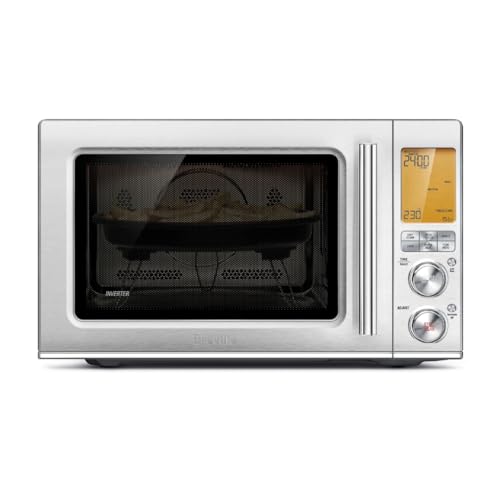
| Breville BMO870BSS | 32L | 1100W (Breville stated) | Microwave, air fryer and convection oven | Under $650 |
Prices checked 1 October 2026; bands reflect that check.
Output sources: the 1000W on both Panasonic rows comes from each model's Amazon AU listing, and Panasonic Australia's store page also states it for the NN-SF57QSQPQ. The 1100W on the Breville row is the microwave power on Breville Australia's specification page.
Estimated running cost is the input kilowatts multiplied by hours used multiplied by your tariff per kilowatt hour, taken from your own bill. Actual cost depends on the appliance input rating, time used and household tariff. The output watts in the table are not the input watts for that calculation.
How we picked
The three cards are the Panasonic NN-SF564WQPQ and NN-SF57QSQPQ 27L flatbed inverters and the Breville BMO870BSS the Combi Wave 3 in 1. For each one we read its Amazon AU listing and its maker page: Panasonic Australia's product and store pages for the two Panasonic models, and Breville Australia's page for the BMO870. Capacities come from those maker pages, at 27 litres for both Panasonic models and 32 litres for the Breville.
Listings and maker pages were checked 2 October 2026. Ratings quoted in this guide come from our 30 September 2026 check and the price bands from our 1 October 2026 check. This guide has no single top pick right now, so each card is listed by its format rather than ranked.
One figure worth knowing before you choose: the South Australian Government's guide to saving energy in the kitchen says microwaves use about 75% less energy than ovens and cooktops, because they cook quickly. That is a guide for the appliance type, not a measurement of any model on this page.
Solo vs Convection vs Grill Microwave
A solo microwave uses microwave energy for reheating, defrosting and basic cooking. The two flatbeds in this guide fit that description. They differ in finish and listing feedback, but their listed functions do not include a convection oven or air fry mode. A solo unit leaves oven cooking to another appliance. That distinction matters more than a small difference in listed litres when the daily job is warming food.
A grill microwave adds a heating element that can brown a surface. There is no dedicated grill model among the three cards here, so this guide does not compare grill results. Product names alone may not tell you which cooking modes are present: check the exact model's function list if browning is a requirement. An oven dish that fits into the cavity must also leave the clearance specified in the product instructions.
A convection microwave circulates heated air as well as providing microwave cooking. The combi model here lists convection and air fry modes. It suits kitchens where those extra functions would be used and where bench space is available for the appliance. An air fry label describes a cooking mode, not an outcome: cooking time and texture depend on the recipe, load and oven design. The air fryer guide covers separate appliances for that task.
Separate appliances can be used at the same time, and a fault in one does not remove every cooking function. A combi combines several jobs in one cavity but handles only one cooking load at a time. The dimensions and ventilation instructions remain relevant whichever format is used. On a crowded bench, even a multifunction appliance may need a different position from a compact solo microwave.
What an inverter microwave actually does
An inverter microwave controls its power differently from a conventional one. Think of a dimmer switch: the aim is to deliver lower microwave power more continuously, while a conventional design commonly cycles full power on and off to produce a lower average setting. That explains the control method; it is not evidence that a listed inverter unit will heat every meal evenly. Food shape, portion size, starting temperature and stirring also matter.
All three cards carry inverter descriptions: both Panasonic flatbeds are listed as inverter models, and Breville names its Power Smoothing inverter technology on the Combi Wave. If a particular cooking mode matters, compare the exact model's maker description and operating instructions. The wattage on a microwave listing describes cooking output, while the rating plate input is the figure to use for an electricity estimate.
Lower power settings can be useful for gradual warming and defrosting, but the safest setting and duration depend on the food. Follow the product instructions and the food's handling directions. Rotate, stir or allow standing time where the cooking directions call for it. A flatbed removes the glass turntable from the cavity; it does not remove the need to check the food after heating.
Flatbed vs Turntable
A turntable model rotates food on a glass plate. Rotation changes the food's position during cooking, but a large rectangular dish can catch on the wall and stop turning. The plate and its support ring are additional parts to lift out when cleaning. A compact turntable solo microwave can still cover straightforward reheating when its cavity dimensions match the dishes used at home.
A flatbed has no glass turntable. A mechanism beneath the floor distributes microwave energy while the cavity floor stays clear for dishes. The absence of a rotating plate can make a rectangular container easier to position, and there is no plate or ring to wash. Flatbed does not guarantee that every container with a small enough volume will fit. Compare the cavity width, depth and height with the dish, including handles and lid.
Both solo microwaves on this page are listed as flatbeds. The combi uses a turntable rather than a flat floor: the Breville lists a glass turntable, so its usable floor is set by the plate. The difference between the two 27L Panasonic units comes down to finish and listing feedback, and litres alone do not reveal the shape of a cavity.
What Size Microwave Do You Need? 20L, 25L, 27L and 32L compared
Capacity is the volume of the cavity, not a measurement of the widest plate it accepts. As a broad guide, a compact 17 to 20L unit is the smallest class, a 23 to 27L unit takes larger plates and many oven dishes, and a 28 to 32L unit has room for larger casserole dishes. These are size descriptions, not guarantees for a particular plate or model.
| Capacity | Fits a dinner plate | Typical bench depth note |
|---|---|---|
| 20L | The tightest class for a dinner plate; check the internal width against your plate. | Compact size category, but check external depth and ventilation clearance. |
| 25L | More cavity room than the compact class; still check the plate against the internal dimensions. | Check external depth and required clearance before placing it on a bench. |
| 27L | A good size guide groups this with larger plates and many oven dishes; verify fit. | Both Panasonic flatbeds are 27L; their bench depth still needs checking. |
| 32L | The largest class here; verify plate fit against the listed internal dimensions. | The combi is 32L; allow for the external depth and ventilation clearance. |
For an individual plate, measure its diameter in centimetres, including any raised rim or handles, then compare it with the maker's usable internal width and depth. A model's outside width, height and depth answer a different question: whether it physically fits the available bench position. Leave the ventilation space required by its instructions.
The combi carries the largest stated capacity here at 32L. Large capacity can bring a larger exterior, so measure the appliance space as carefully as the dishes. Nearby appliances matter too: the toaster guide covers another common use of bench space.
Best microwave brands in Australia
The brand names here describe the models on this page, not a ranking of reliability. Panasonic accounts for both flatbeds, while Breville accounts for the combi. Sharp, LG, Samsung and Kmart are included for context but have no card on this page. A store listing, owner score and model specification answer different questions, so read them separately.
| Brand | Sold as | Inverter models on this page | Flatbed models on this page |
|---|---|---|---|
| Panasonic | Amazon AU listings in this guide | NN-SF564WQPQ; NN-SF57QSQPQ | NN-SF564WQPQ; NN-SF57QSQPQ |
| Sharp | No card in this guide | none on this page | none on this page |
| Breville | Amazon AU listing in this guide | Combi Wave 3 in 1 (Power Smoothing) | none (glass turntable) |
| LG | No card in this guide | none on this page | none on this page |
| Samsung | No card in this guide | none on this page | none on this page |
| Kmart (Anko) | Kmart stores and kmart.com.au; no card in this guide | none on this page | none on this page |
At the 30 September 2026 listing check, the Panasonic NN-SF57QSQPQ showed 4.7 stars from 43 ratings at our 30 September 2026 check and the NN-SF564WQPQ showed 4.6 from 66. The Breville BMO870BSS showed 4.8 from 16. These counts are too different to treat the highest number as a brand reliability measure. They are owner feedback attached to product listings, subject to changing as more ratings arrive.
Best Budget Microwaves Under $200
Entry level microwaves in this band are typically compact solo units, commonly with a turntable. A solo microwave covers basic reheating and defrosting without adding a convection oven or air fry mode. A turntable adds a glass plate and support ring to clean, and the dish must be able to rotate without striking the cavity wall. In a small kitchen, that practical fit can matter more than the litre number on the box.
There is no product card in this price band on this page. The descriptions here establish what the format does, not the current availability or quality of a particular unit. Check the exact listing for internal dimensions, external dimensions, output power, settings and any clearance instructions. If a plate has a wide rim or a dish has projecting handles, measure those as part of its footprint. The turntable's usable diameter can be more limiting than the nominal cavity volume.
For a household that mostly reheats a single plate, a compact solo format can provide the relevant functions. For cooking in an oven or air fryer as well, those tasks require separate appliances or a combi with the corresponding listed modes. The descriptions in the following section show which of the current cards have those different functions.
Panasonic's NN-ST25JW 20L solo now sits in Panasonic Australia's product archives, and no compact solo currently holds a card on this page, so the budget band carries no card. If you only reheat and defrost, a 20L solo from a major brand at retail still covers the job with fewer modes; check the seller, the stated capacity and the electrical safety registration for the exact model before buying.
Best Mid-Range Microwaves
The two flatbeds in this guide sit in the stated under $350 and under $400 bands at the listing check. Each has an inverter description and a flat floor without a turntable. They share a stated 27L capacity and 1000W output but have different finishes and listing rating counts. Those figures describe specifications, not measured cooking speed or heating uniformity.
Panasonic NN-SF564WQPQ 27L 1000W Flatbed Inverter, White
The white Panasonic has a 27L flatbed cavity and a listed 1000W inverter microwave output. There is no turntable to lift out when wiping its floor. Its checked listing showed 4.6 stars from 66 ratings at our 30 September 2026 check. The size category suggests room for larger plates than a compact unit, but fit still depends on the cavity's usable dimensions and the shape of the dish.