Rice is the quiet backbone of weeknight cooking in Australia, the side that turns a $10 curry, stir-fry or grilled fish into a full meal for the whole family. Yet most of us still cook it in a saucepan, hovering over the stove, draining starchy water and occasionally scorching the bottom. A rice cooker removes all of that: you rinse, measure, press one button, and walk away. It is one of the cheapest set-and-forget upgrades you can make to a new kitchen, and it pairs naturally with a slow cooker for the protein side of the same dinner. If the stir-fry rather than the curry is your weeknight default, a bench-top electric wok cooks that half without a gas burner at all.
But "rice cooker" covers three quite different machines at three very different prices: a $49 one-touch cooker, a $139 digital model and a $249 Japanese workhorse are not doing the same thing. The best rice cooker in Australia for most kitchens is the Panasonic 8-Cup Digital (SR-DA152WST) at about $139, with the Russell Hobbs Turbo at about $49 the big-capacity budget buy and the made in Japan Tiger JNP-1800 at about $249 the one to keep for a decade. And the number to know before you buy any of them: a rice cooker cup is 180ml, not the 250ml metric cup in your drawer, so a 10-cup cooker holds 1.8 litres of raw rice and makes about 20 cups cooked. This guide explains the three types, matches each to a budget and household, and clears up the single most common mistake people make: the rice-cooker "cup". Every pick below has been checked for genuine Australian availability, with an Australian plug and local warranty where it matters.
The Three Rice Cookers Compared
Capacity below is in rice cooker cups of 180ml, which is how every maker rates a cooker, not in the 250ml metric cup.
| Model | Type | Capacity | Key features | Price | Rating |
|---|
| Russell Hobbs Turbo Rice Cooker (RHRC20BLK) | One-touch conventional | 10 rice cups raw, about 20 cooked | Turbo element, steamer basket, dishwasher safe pot | About $49 | 4.3 |
| Panasonic 8-Cup Digital Rice Cooker (SR-DA152WST) | Digital micom | 8 rice cups raw, about 16 cooked | 4 auto menus, 24 hour delay timer, AU plug and warranty | About $139 | 4.4 |
| Tiger JNP-1800 10-Cup Japanese Rice Cooker | Conventional, made in Japan | 10 rice cups raw, 1.8 litres | Removable non-stick pot, automatic keep-warm, AU 240V | About $249 | 4.6 |
The Three Types of Rice Cooker: Matched to Your Budget
Before you compare brands, decide which type you actually need. Spending more does not always get you better rice; it gets you more control, more menus and (at the very top) a genuinely different heating method. Here is how the three tiers break down.
1. One-touch / conventional (the cheapest)
The original design, and still the best value. A single heating plate under the pot boils the water; a thermostat senses when the water has all been absorbed (which can only happen once the rice is cooked) and flips the cooker to keep-warm. That's it: one switch, one job. These are reliable, dead-simple, and you can buy a big-capacity model cheaply. The trade-offs: there is no fine control over the cook, no menus for different grains, and with some rice types or a very full pot they can occasionally boil over or cook a touch unevenly. For everyday white rice and a big family, none of that matters much. This is the tier our Russell Hobbs pick sits in.
2. Digital or micom: "microcomputer" and "fuzzy logic" (the mid-range)
Step up and a small microcomputer takes over. Instead of just on/off, a micom cooker adjusts time and temperature through the cook and offers menus tuned for different jobs (white rice, brown rice, quick cook, congee or porridge), plus the two features most households quickly come to rely on: a delay timer (load it the night before, wake up to cooked rice) and a long keep-warm. "Fuzzy logic" is the marketing term for the more advanced micom programming that makes small adjustments based on conditions rather than following a fixed timing. This tier is the value sweet spot for most Australian homes, and it's where our Panasonic pick sits: a digital, auto-menu microcomputer cooker.
3. Induction heating (IH) and pressure-IH (the premium tier, about $300 and up)
At the top, induction-heating cookers ditch the single hot plate and instead use an electromagnetic field to heat the entire metal pot at once. Because the whole bowl becomes the heating element, the cook is more even and the temperature control is far more precise, which shows up as better texture, especially for brown rice, multigrain and large batches. Pressure-IH adds pressure on top for an even softer, glossier result. It is genuinely better rice, but it is also expensive and overkill for casual cooking. Brands like Panasonic, Tiger and Cuckoo make IH and pressure-IH models from around $300 and up. Panasonic's entry induction model, for example, sits near $300. Our heritage Tiger pick sits just below this tier: a premium conventional cooker rather than an IH one (more on that honesty point below).
Best Budget Rice Cooker: Big Capacity, One Touch
If you want the most rice for the least money and have no interest in menus, a one-touch conventional cooker is all you need. The cooking method is identical to the expensive models for plain white rice. You're simply giving up programmability.
Russell Hobbs Turbo Rice Cooker (RHRC20BLK) at about $49
The standout here is capacity for the price. The Russell Hobbs Turbo cooks up to 10 cups of uncooked rice, which is roughly 20 cups once cooked, enough for a large family, a share house, or batch-cooking for the week. The "Turbo" element runs hotter to cook noticeably faster (Russell Hobbs quotes around 30% quicker than a standard cooker), and it's genuinely one-touch: press down, and it switches to keep-warm on its own when the rice is done. In the box you get a steamer basket that sits above the rice, so you can steam vegetables or dumplings while the rice cooks underneath, plus a rice spoon and a measuring cup. The non-stick pot is dishwasher-safe, and the matte black finish is plainer and more modern than most budget cookers.
- Pros: Big 10-cup uncooked capacity for under $50, faster "Turbo" cook, genuine one-touch with auto keep-warm, steamer basket included, dishwasher-safe non-stick pot
- Cons: No delay timer and no grain menus (it's a conventional one-touch cooker), no digital display, a very full pot can occasionally need a stir for perfectly even results
- Best for: Big families, share houses and anyone who just wants reliable rice plus a steamer tray, without paying for menus
Check price on Amazon AU →
The Rice-Cup Gotcha: Why Your Measuring Cup Is Wrong
This trips up almost everyone the first time. A rice-cooker "cup" is not a metric or US measuring cup. The plastic cup that comes in the box holds about 180 ml, while a standard metric cup is 250 ml. So when a cooker is described as "10-cup", it means 10 of those 180 ml rice cups of uncooked rice, not 10 metric cups. If there is no proper metric set in the drawer to check against, our measuring cups guide covers the sets we rate.
Two practical rules follow from this:
- Always measure with the cup that came in the box, and fill water to the matching numbered line inside the pot. If you use a kitchen measuring cup instead, your water ratio will be off and the rice will come out too wet or too dry. Lost the cup? Measure 180 ml.
- Read capacity as uncooked rice, and remember it roughly doubles. Cooked rice is about twice the volume of raw rice, so a "10-cup" cooker makes roughly 20 cups cooked, and a "3-cup" mini makes around 6 cups cooked. This is why people accidentally undersize a cooker: a "5-cup" model sounds tiny but feeds a family.
| Cooker rating | Raw rice it holds | Cooked rice it makes | Feeds |
|---|
| 3 rice cups | About 540ml raw | About 6 metric cups cooked | 2 to 3 people |
| 5 rice cups | About 900ml raw | About 10 metric cups cooked | 3 to 4 people |
| 8 rice cups | About 1.44 litres raw | About 16 metric cups cooked | 4 to 6 people |
| 10 rice cups | About 1.8 litres raw | About 20 metric cups cooked | A big family or batch cooking |
The way around the cup problem entirely is to weigh it. One rice cooker cup of raw rice is about 150 grams, so if you have a kitchen scale you can ignore the plastic cup and never get the ratio wrong again.
One more habit worth forming: rinse your rice in a separate bowl, not in the cooker's non-stick pot. Swirling rice against the coating with your hand is a slow way to wear it out. Rinse until the water runs mostly clear (this removes surface starch and stops the rice clumping), then tip the drained rice into the pot.
Best Rice Cooker for Most People: Digital, Trusted Brand
For the majority of Australian households, the digital/micom tier is the right place to spend. You get menus for the grains you actually cook, a delay timer that changes how you use the machine, and a long, reliable keep-warm, from a brand with local warranty support.
Panasonic 8-Cup Digital Rice Cooker (SR-DA152WST) at about $139
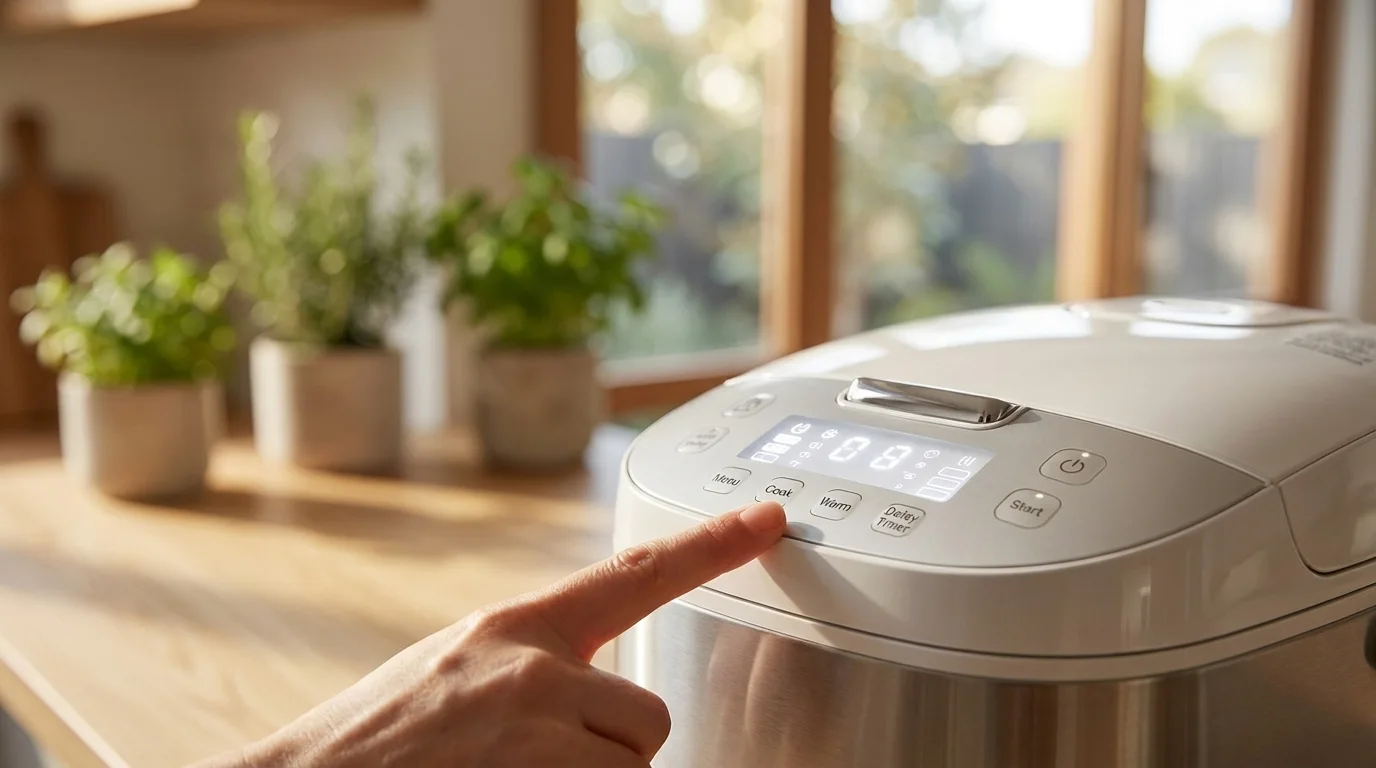
Panasonic is the mainstream rice-cooker name most Australians already trust, and the SR-DA152 is the digital model that earns it. It's an 8-cup cooker with an LED display and touch control, and it covers the four jobs most homes need with dedicated auto menus: White Rice, Quick Cook/Steam, Congee/Soup, and Brown Rice. The microcomputer adjusts the cook for you rather than relying on a single on/off thermostat, and a 24-hour delay timer lets you load it before bed and wake up to fresh rice, or set it in the morning to be ready at dinner. Keep-warm runs up to 24 hours, the inner pot is non-stick, and it ships with a measuring cup, scoop and steaming basket. Two details matter for Australian buyers specifically: it comes with an Australian plug and an Australian manufacturer's warranty, which the grey-import bargains often don't.
To be precise about the technology: this is a digital, auto-menu microcomputer cooker. We're describing it that way deliberately. Its listing doesn't specifically use the "fuzzy logic" label, so we won't claim that exact term for this model, even though micom and fuzzy logic belong to the same broad category of microcomputer-controlled cooking.
- Pros: Trusted mainstream brand, digital touch control with four auto menus (including brown rice and congee), 24-hour delay timer, keep-warm up to 24 hours, Australian plug and local warranty, steam basket included
- Cons: Pricier than a one-touch cooker, 8-cup capacity is slightly smaller than the big budget models, it's conventional micom rather than induction-heating (IH)
- Best for: Most households: anyone who wants menus, a delay timer and a trusted brand with local warranty, without stepping up to premium IH pricing
Check price on Amazon AU →
The Features That Actually Matter (in Australia)
Past the type and the cup confusion, these are the specs worth weighing before you buy, and the ones not to overpay for.
- Capacity for your household: read it as uncooked cups and remember it doubles cooked. As a rough guide: 3 cups suits singles and couples; 5 to 8 cups suits most families; 10 cups suits big families, share houses or batch cooking. A part-full pot still cooks well, so it's better to size up than down.
- Keep-warm (and how long is realistic): almost every cooker keeps rice warm, but rice slowly dries out and can yellow if held for many hours. Keeping it warm for an hour or two is perfect; overnight is pushing it on any cooker. A longer rated keep-warm (the Panasonic's 24 hours) gives you more buffer, but plan to eat within a few hours for the best texture.
- Delay timer: the feature people underrate until they have it. Load rice and water before bed, set the finish time, and wake to cooked rice, or set it in the morning to greet you at dinner. Only the digital tier offers this.
- Non-stick inner pot (and protecting the coating): use the plastic or wooden paddle that comes with the cooker, never metal spoons; don't scrub with steel wool; and rinse rice in a separate bowl, not the pot. Treated well, a non-stick pot lasts years.
- Steaming tray: a basket that sits above the rice lets you steam vegetables, fish or dumplings while the rice cooks. Both our Russell Hobbs and Panasonic picks include one.
- Grain menus: if you cook brown rice, multigrain or congee, dedicated menus genuinely help: brown rice in particular needs more water and longer cooking than white, and a one-touch cooker can't adjust for that.
- Australian plug and local warranty: some cheap online imports ship with non-AU plugs or no local warranty support. It's worth checking. Our picks are Australian-spec, and the Panasonic and Tiger both carry Australian warranty backing.
- Easy-clean lid: a removable or wipeable inner lid stops starchy steam residue building up. A small thing, but you'll notice it weekly.
Best Premium Rice Cooker: Made-in-Japan Heritage
The premium pick here isn't about gadgetry. It's about build quality and longevity from a brand serious rice eaters revere. It also gives us the chance to be honest about where the genuine "best texture" upgrade actually lives.
Tiger JNP-1800 10-Cup Japanese Rice Cooker at about $249
Tiger is one of the great Japanese rice-cooker names, and the JNP series is its long-running, made-in-Japan conventional cooker. This is the 10-cup (1.8L) model, supplied as an Australian 240V version, with a removable non-stick inner pot, automatic keep-warm and simple indicator lights. There's no touch screen and no menu list, and that's the point. The JNP is bought for what it is: a durable, beautifully made cooker that produces consistently good white rice and holds it warm reliably for years. For a lot of households who eat rice daily, that dependability is worth more than menus they'd never use.
One critical honesty point. The Tiger JNP is a conventional electric-heating cooker: a single heating plate under the pot, like the Russell Hobbs but with far better materials and build. It is not an induction-heating (IH) or pressure model, and we won't imply otherwise. If your goal is the very best rice texture, IH is the real upgrade, and it costs more: Panasonic, Tiger and Cuckoo all make IH and pressure-IH cookers from roughly $300 upward (Panasonic's entry induction model sits around $300). So think of the JNP as the heritage-build, conventional premium pick, not as a cut-price route to induction performance. If menus and IH texture matter more to you than made-in-Japan durability, your money is better spent stepping up to an IH model than across to this one.
- Pros: Genuinely made in Japan, durable heritage build, 10-cup (1.8L) capacity, Australian 240V model, removable non-stick pot, rock-solid automatic keep-warm
- Cons: Conventional heating, not induction (IH); no delay timer or grain menus; basic indicator-light interface; premium price for a conventional cooker
- Best for: Daily rice eaters who value made-in-Japan durability and reliability over menus, and who don't need IH-level texture
Check price on Amazon AU →
Rice Cooker Brands in Australia, and What Each Is Good At
Six names cover almost every rice cooker sold here, and they do not all compete for the same buyer.
- Panasonic is the mainstream Australian default, strongest in the digital micom tier around $139, with an Australian plug and a local warranty, and an entry induction model from about $300.
- Tiger and Zojirushi are the Japanese specialists. Tiger makes the made in Japan JNP conventional cookers from about $249 and induction models above that; Zojirushi sits in the same bracket and is the name serious rice eaters raise first.
- Cuckoo is the Korean brand, sold through its own Australian arm as well as retailers, and it is where the pressure induction cookers cluster.
- Russell Hobbs and Kambrook own the one-touch budget end, roughly $49 to $79, where capacity per dollar is the whole argument.
- Breville sits in the middle with multifunction cookers that also steam and slow cook, which overlaps with a pressure cooker and a slow cooker more than with a plain rice cooker.
The honest summary: brand matters far less than tier. A $139 Panasonic micom and a $139 Breville micom cook near-identical rice, while a $49 one-touch and a $300 induction cooker genuinely do not.
Which Rice Cooker Should You Actually Buy?
Strip away the jargon and it comes down to how much control you want and how much rice you cook:
- Buy the one-touch Russell Hobbs (about $49) if you want maximum capacity for minimum money, cook mostly plain white rice, and don't care about timers or menus. The included steamer tray is a genuine bonus for veg and dumplings.
- Buy the digital Panasonic (about $139) if you want the best all-rounder for a typical home: menus for brown rice and congee, a delay timer so rice is ready when you are, long keep-warm, and a trusted brand with an Australian plug and local warranty. This is the right pick for most readers.
- Buy the Tiger JNP (about $249) if you eat rice daily and prize made-in-Japan durability and a dependable keep-warm over digital menus, and you're comfortable that it's a conventional, not induction, cooker.
- Step up to an IH model (about $300+) if texture is your priority, especially for brown or multigrain rice. That's the genuine performance upgrade, and it's a real step up in price.
A rice cooker also quietly earns its bench space beyond rice: it steams vegetables and fish, makes porridge and congee, and some models slow-cook too. For the rest of your benchtop line-up, our kitchen essentials checklist covers what to buy first, and a good inverter microwave handles the gentle reheating of leftover rice without drying it out.
Frequently Asked Questions
Which type of rice cooker should I buy: one-touch, digital or induction?
It depends on how much control you want. A one-touch conventional cooker (like the Russell Hobbs Turbo, about $49) is the cheapest and simplest: press one button for reliable white rice, with big capacities available cheaply. A digital/micom cooker (like the Panasonic SR-DA152, about $139) adds menus for white, brown, quick and congee, plus a delay timer and long keep-warm, and is the best choice for most households. Induction-heating (IH) cookers (about $300+) heat the whole pot electromagnetically for the most even cook and best texture. It's genuinely better, especially for brown and multigrain rice, but overkill for casual cooking.
Why is my rice always too wet or too dry?
The usual culprit is the measuring cup. A rice-cooker "cup" is about 180 ml (smaller than a metric 250 ml cup), so always measure with the plastic cup that comes in the box and fill the water to the matching numbered line inside the pot. If you use a regular kitchen cup, the rice-to-water ratio is wrong and the result comes out too wet or too dry. Rinsing the rice until the water runs mostly clear before cooking also helps the texture and stops it clumping.
What's the difference between a micom (fuzzy logic) and an induction rice cooker?
A micom (microcomputer) cooker, sometimes marketed as "fuzzy logic", uses a single heating plate but adds a chip that adjusts time and temperature through the cook and offers menus for different grains. It's the value sweet spot for most homes. An induction-heating (IH) cooker heats the entire metal pot electromagnetically rather than from one plate underneath, giving more even, precise cooking and better texture, especially for brown and multigrain rice. IH costs more (generally from around $300), and pressure-IH models go higher again for an even softer result.
Can a rice cooker cook brown rice properly?
Yes, but a dedicated brown-rice menu helps a lot. Brown rice keeps its bran layer, so it needs more water and a longer cook than white rice. A digital cooker with a Brown Rice setting (like the Panasonic SR-DA152) adjusts the timing and temperature automatically, which a basic one-touch cooker can't do. On a one-touch model you'll get a better result by adding a little extra water and letting it rest on keep-warm afterwards. For the best brown-rice texture overall, induction-heating cookers are a clear step up.
How long can you safely keep rice warm in a rice cooker?
Most cookers keep rice warm for several hours, and models like the Panasonic SR-DA152 are rated for up to 24 hours, but for the best texture, eat within a few hours. Held longer, rice slowly dries out at the edges and can start to yellow, and the longer it sits the less appealing it gets. If you need rice much later, it's better to use the delay timer so it finishes cooking close to mealtime, rather than cooking early and holding it on keep-warm all day.
What capacity rice cooker do I need for my household?
Read capacity as uncooked cups, and remember cooked rice is roughly double the volume. As a rough guide: a 3-cup cooker suits singles and couples; a 5 to 8 cup model (like the 8-cup Panasonic) suits most families; and a 10-cup cooker (like the Russell Hobbs Turbo or Tiger JNP) suits big families, share houses or batch cooking. A part-full pot still cooks rice well, so when you're between sizes it's safer to go up than down.
Are cheap imported rice cookers a problem in Australia?
They can be. Some very cheap online imports ship with a non-Australian plug or without local manufacturer's warranty support, which leaves you stuck if something fails. It's worth confirming the cooker is an Australian-spec model with a local plug and warranty. Our Panasonic and Tiger picks both carry Australian warranty backing, and the Tiger is supplied as an Australian 240V model. Paying a little more for a properly supported, AU-spec unit is usually worth it on an appliance you'll use several times a week.
Can you cook more than rice in a rice cooker?
Yes, a rice cooker is more versatile than its name suggests. With the steaming basket that comes with models like the Russell Hobbs Turbo and the Panasonic SR-DA152, you can steam vegetables, fish or dumplings above the rice while it cooks. Digital cookers with congee or soup menus handle porridge and congee, and some models can slow-cook too. It won't replace a dedicated slow cooker for long braises, but for everyday steaming and one-pot rice meals it earns its bench space several times a week.
Which rice is best in a rice cooker?
Any of them, as long as you match the water. Long grain white rice such as jasmine or basmati is what the numbered lines in the pot are calibrated for and needs no thought. Short grain and sushi rice want a rinse until the water runs clear and slightly less water. Brown rice needs more water and about twice the time, which is why a menu button for it matters, and the Panasonic has one. Wild and multigrain blends are where an induction cooker earns its price.
Is a rice cooker better than boiling rice on the stove?
For consistency, yes, and that is the whole point. A saucepan needs you to judge the water, the heat and the timing every single time; a rice cooker senses when the water has gone and switches itself to keep-warm, which can only happen once the rice is cooked. It also frees a burner and cannot boil over onto the cooktop. A good cook with a heavy lidded pot will match it on the first batch. Nobody matches it on the hundredth.
Can you reheat rice in a rice cooker?
You can, and the trick is steam rather than heat. Break up the cold rice in the pot, sprinkle over a tablespoon or two of water per cup, close the lid and run the keep-warm setting for 10 to 15 minutes. Do not use the cook cycle, which will dry the bottom layer out. The food safety rule matters more than the method: cool leftover rice quickly, refrigerate it within an hour, keep it no longer than a day and reheat it once only.
How do you clean a rice cooker?
Unplug it and let it cool, lift out the inner pot and wash it by hand with a soft sponge, even on the models that say dishwasher safe, because dishwasher detergent is what wears a non-stick coating out. Wash the lid, the steam vent and the inner lid plate separately, since that is where the starchy residue collects and where a smell starts. Wipe the heating plate with a dry cloth and never put the base in water. Rinse the rice in a separate bowl rather than in the pot and the coating will last years longer.