Oral-B and Philips Sonicare build their electric toothbrushes around two different brushing actions. Oral-B's round heads oscillate and rotate, and on its PRO models also pulsate; Sonicare heads use sonic vibration, which Philips lists at up to 62,000 brush movements per minute on several current models. This guide ranks neither brand; both are compared on what their makers state.
Below you will find how the two actions differ, what each brand's Australian range offers, what two research reviews found, how brush heads fit, and the practical questions for a new bathroom. For two specific brushes compared side by side, see our electric toothbrush guide.
The Short Answer
Choose the brand whose features you will actually use. Both makers sell brushes with pressure feedback, two minute timers and several modes, and both sell higher models that connect to an app: Oral-B lists Bluetooth on its iO, Genius and Smart ranges, and Philips lists the Sonicare app on the DiamondClean 9000 and Prestige 9900.
The research does not settle it for you either. A 2014 Cochrane review found that powered toothbrushes reduce plaque and gingivitis more than manual brushing, and said the clinical importance of that finding remains unclear. A 2023 review comparing the two actions found a small but significant difference in favour of oscillating rotating brushes, which it called potentially clinically relevant; PubMed lists a Procter & Gamble grant for that review. Both are summarised, with their limits, in the research section below.
The bigger day to day differences are the brush head you will be buying for years, how each brush tells you to move on or ease off, and which models include an app. Those are covered section by section, so you can match a brand to the way you brush.
How They Differ: The Mechanical Action
The two brands use different motions, and that shapes the head design and the way each maker tells you to brush.
Oral-B: oscillating and rotating
Oral-B's FAQ describes its PRO series as using "3D technology" that oscillates, rotates and pulsates, and its Vitality series as using "2D technology" that oscillates and rotates. The head is small and round; Oral-B says its round head "hugs each tooth" on the Pro Expert. The iO range changes the drive: Oral-B describes it as combining its round brush head with micropulsating bristles.
Oral-B's brushing instructions follow from the round head. Its FAQ tells you to guide the head slowly from tooth to tooth, holding it in place for a few seconds against each tooth, and not to press hard or scrub, because the brush provides the brushing action.
Sonicare: sonic vibration
Philips lists its brushes by movement speed: "31000 brush strokes per minute" on the 3100 series, and up to 62,000 brush movements per minute on the ProtectiveClean 4300 and 5100 and the DiamondClean 9000. Philips calls its standard Sonicare head a click-on head.
The DiamondClean 9000 manual describes a different technique from Oral-B's. You place the bristles at a slight angle of 45 degrees to the gumline, keep the centre of the brush in contact with the teeth and use a small back and forth motion so the bristles reach between the teeth. The manual says it is not recommended to scrub as you would with a manual toothbrush.
Why the difference matters
For most buyers the motion matters less as a cleaning claim than as a habit. With Oral-B you pause on each tooth; with Sonicare you hold the angle and let the head sweep. If you already know you press too hard, both brands answer that with pressure feedback, described in the range sections below. If you want the research view of the two actions, the 2023 review in the research section is the direct comparison.
The Oral-B Range in Australia
Oral-B's FAQ groups its rechargeable brushes into series: iO, Genius, Smart, PRO and Vitality. It says the iO, Genius and Smart series come with Bluetooth and work with the Oral-B app. Here is what Oral-B Australia lists for the models we checked on 2 October 2026.
Vitality: the entry series
The Vitality Pro has three modes: daily clean, sensitive and sensitive plus. Oral-B Australia says it has a 2 minute handle timer that pulses every 30 seconds to remind you to brush all four quadrants. Its FAQ says Vitality brushes have no charging light, and that the battery in Oral-B electric toothbrushes cannot be replaced.
PRO: the Pro Expert
Oral-B Australia's range and sitemap, checked on 2 October 2026, carry no Pro 3 product page; its FAQ still mentions Pro 3 charging, which does not show current Australian availability. The PRO model it lists is the Pro Expert. It has three modes (daily clean, sensitive and whiten), the same 2 minute timer with 30 second pulses, and a vibrating gum pressure sensor that stops the pulsations when you brush too hard. Oral-B says its round head cleans back molars for a deeper clean than a regular manual toothbrush.
iO: the magnetic range
Oral-B Australia lists three modes (Daily Clean, Whitening, Sensitive) and a Smart Pressure Sensor on the iO Series 3. The iO Series 5 has five modes: Daily Clean, Intense, Sensitive, Super Sensitive and Whitening. The iO Series 6 swaps Super Sensitive for Gum Care and adds an interactive display and position detection. On the iO Series 5 and 6, Oral-B describes a smart gum pressure sensor that signals when you are brushing too hard, too soft or just right.
Charging differs by series: Oral-B Australia says Series 7 onwards uses a magnetic fast charging station that recharges in 3 hours, while Series 6 or below is best charged overnight. On its iO pages, Oral-B Australia also offers up to 3 years of warranty if you register the brush.
Oral-B brush heads
Oral-B says its standard replacement heads fit all of its electric toothbrush handles except iO, which takes iO heads. The standard range includes CrossAction, Sensitive Clean, FlossAction, 3D White, Precision Clean, Ortho for braces, Interspace, TriZone and Dual Clean. Oral-B recommends changing the head every 3 months, after you have been ill or when the bristles become worn, and several heads have indicator bristles that change colour when a change is due.
The Philips Sonicare Range in Australia
Philips Australia's current Sonicare range runs from single mode brushes to app connected models. This table lists one model from each series we checked on 2 October 2026, as Philips describes them.
| Series (model) | Modes and intensities | Pressure feedback | Timer | Operating time (Philips) | App |
|---|
| 3100 series (HX3671/33) | 1 mode: Clean | Pressure sensor; vibrates the handle | QuadPacer and SmarTimer | 14 days | Not listed |
| ProtectiveClean 4300 (HX6800/06) | 1 mode; Low and High intensities | Pressure sensor; vibrates the handle | QuadPacer and SmarTimer | Up to 2 weeks | Not listed |
| ProtectiveClean 5100 (HX6859/35) | 3 modes: Clean, White, Gum Care | Pressure sensor | QuadPacer and SmarTimer | Up to 2 weeks | Not listed |
| DiamondClean 9000 (HX9912/63) | 4 modes, 3 intensities | Vibration and pulsing sound | BrushPacer and SmartTimer | 14 days | Sonicare app |
| Prestige 9900 (HX9992/22) | 5 modes, 3 intensities | Ring lights up purple; vibration and pulsing sound | BrushPacer and SmartTimer | 14 days | Sonicare app |
Philips footnotes the 3100 series operating time as based on two periods of two minute brushing per day on the standard mode.
Entry and mid models
The 3100 series has one Clean mode, a pressure sensor that alerts you when brushing too hard by vibrating the handle, and a BrushSync replacement reminder. The ProtectiveClean 4300 adds Low and High intensities, and the ProtectiveClean 5100 has three modes: Clean, White for surface stains and Gum Care, which Philips says gently massages gums. Philips does not list an app for these three models.
DiamondClean 9000 and Prestige 9900
The DiamondClean 9000 has four modes (Clean, Deep Clean+, Gum Health and White+) and three intensities, including a Low setting Philips describes as for sensitive teeth and gums. It connects to the Sonicare app over Bluetooth. The Prestige 9900 has five modes, adding Sensitive, and uses SenseIQ, which Philips says automatically adjusts brushing based on pressure and motion, with real time coaching on pressure, motion and coverage in the app.
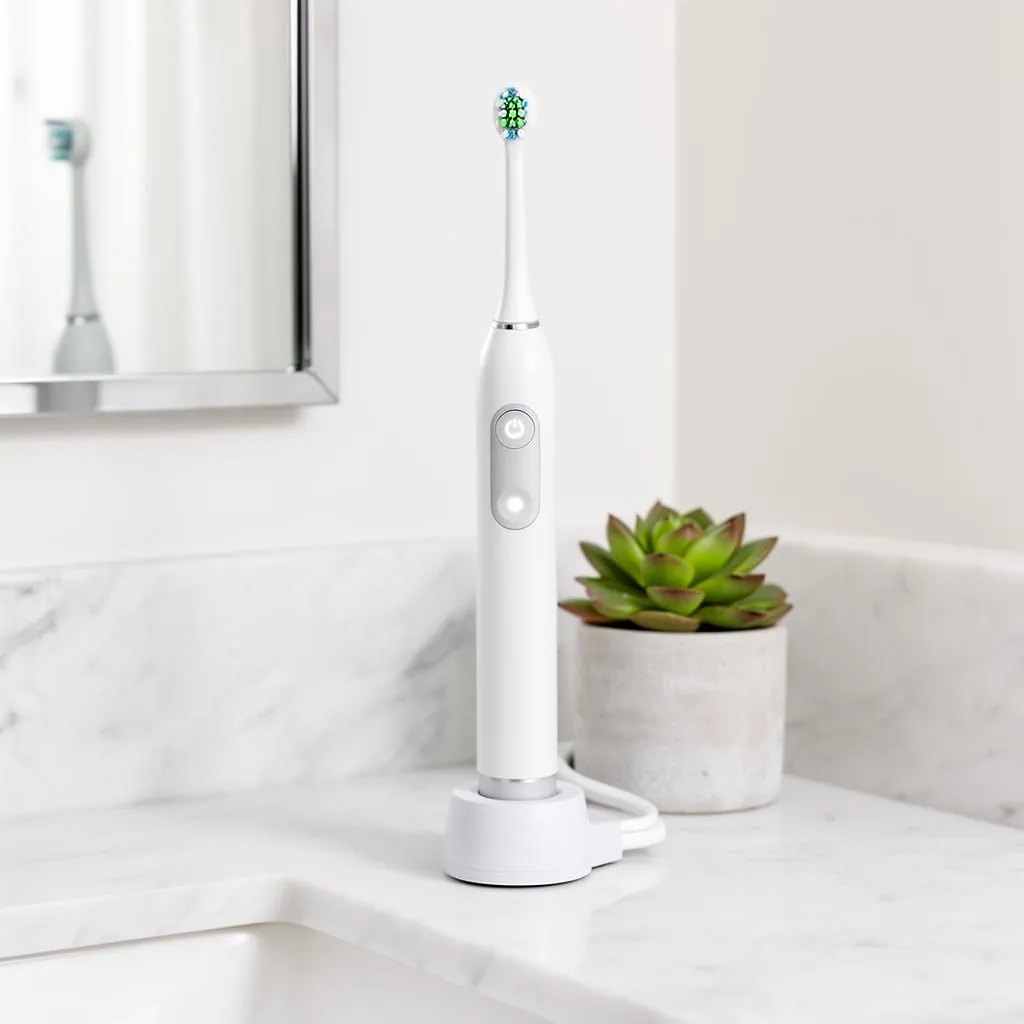
The card below is the DiamondClean 9000 in navy, model HX9911/96, as sold on Amazon Australia. It charges on its charging base and stand, which Philips Australia lists for this model; the exact charger model is not identified on the listing.
Sonicare brush heads
Philips says its click-on brush head is the standard head and fits most Sonicare rechargeable toothbrushes. Older Essence models take a larger screw-on head, and Philips One heads fit only the Philips One. Smart heads, marked with a smart icon near the base of the head, tell the handle which head is fitted, and the handle then selects the mode and intensity. Philips Australia says dental professionals recommend changing your brush head every 3 months.
Clinical Evidence: What the Research Shows
Two reviews are worth knowing about. Neither one ranks a specific model, and both come with limits that matter as much as their headline figures.
Powered versus manual: the 2014 Cochrane review
The Cochrane review by Yaacob and colleagues (2014) included 56 trials, with 51 trials involving 4,624 participants providing data for its analysis. It rated the evidence "moderate quality" that powered toothbrushes reduced plaque more than manual brushing, corresponding to an 11% reduction in the short term (one to three months) and 21% in the long term (more than three months), and reduced gingivitis by 6% and 11% respectively. Rotation oscillation brushes had the most trials, 27, and showed a statistically significant reduction in plaque and gingivitis at both time points.
The same review flagged high levels of variation between trials, rated five trials at low risk of bias, five at high risk and 46 at unclear risk, and concluded that the clinical importance of these findings remains unclear. Its PubMed record notes that some authors had worked on trials sponsored by Braun AG through university grants.
Oscillating rotating versus sonic: the 2023 review
A systematic review by van der Sluijs and colleagues in the International Journal of Dental Hygiene (2023) compared oscillating rotating brushes with high frequency sonic brushes in healthy people. Searching up to April 2021, it included 32 publications with 38 comparisons and found a significant difference in favour of the oscillating rotating brush in 54% of the comparisons. It found no difference in safety, and 78% of participants preferred the oscillating rotating brush.
Its authors concluded that the difference is small but significant and potentially clinically relevant. PubMed lists a Procter & Gamble grant for the review, and Procter & Gamble owns Oral-B; the authors declared no conflicts of interest, 45% of the publications they included reported conflicts of interest, and 22 of the 32 reported a source of funding.
What the Australian Dental Association says
The Australian Dental Association says scientific studies show benefits of electric toothbrushes compared with manual toothbrushes, and that they can remove bacteria and decrease gum inflammation more than manual toothbrushes in the short and long term. It adds that how well any toothbrush cleans your teeth depends on how well you use it.
The First-Home-Buyer Decision
A new bathroom makes the brand choice a long term one, because each brand's heads fit only its own handles. Before you buy, think about who will use the brush, where it will charge and which feature you are paying for.
Heads for the household
Both makers give a three month replacement interval, so a two person household is buying heads for two people several times a year. Oral-B's standard heads cover every Oral-B handle except iO; Sonicare's click-on heads cover most Sonicare rechargeables. If two people share a vanity, choosing handles from the same head family means one type of head to stock: Oral-B iO heads and standard Oral-B heads do not swap, and Sonicare click-on heads do not fit Essence or Philips One handles.
Charging space
Each of these brushes recharges on its own charger, so plan a spot near a power point at the vanity. Oral-B says iO Series 7 onwards recharges in 3 hours on its magnetic station, and Series 6 or below is best charged overnight. Philips lists 14 days or up to 2 weeks of operating time across the Sonicare models above.
Match the feature to the habit
If you press too hard, look for the pressure feedback both brands list. If you lose track of time, both brands list a two minute timer with prompts to move on. If you want coaching, the app connected models are Oral-B's iO, Genius and Smart ranges and Sonicare's DiamondClean 9000 and Prestige 9900. If you are unsure, the Australian Dental Association's routine, brushing 2 times every day for 2 minutes with soft bristles and fluoride toothpaste, is the part that matters most.
Frequently Asked Questions
Which toothbrush is better, Sonicare or Oral-B?
Neither brand is better for every mouth, so this guide does not rank them. The research that compares the two brushing actions directly, a 2023 systematic review, found a small but significant difference in favour of oscillating rotating brushes and called it potentially clinically relevant; PubMed lists a Procter & Gamble grant for that review, and Procter & Gamble owns Oral-B. Choose on the features you will use every day: pressure feedback, timers, modes and whether you want an app.
Do dentists recommend Sonicare or Oral-B?
The Australian Dental Association's consumer guidance we checked does not recommend either brand. It says your dentist may recommend an electric toothbrush if you have trouble holding and controlling a manual toothbrush, have braces or have gum disease. Ask your dentist which features suit your mouth, and take the model name to the appointment.
Is the Oral-B IO worth the upgrade over the Pro 3?
It depends on which extra features you would use. Oral-B Australia describes the iO range as pairing its round brush head with micropulsating bristles, and lists a smart gum pressure sensor that signals brushing too hard, too soft or just right, with five modes on the iO Series 5 and 6. We found no Pro 3 product page in Oral-B Australia's range on 2 October 2026; its PRO model there, the Pro Expert, has three modes, a 2 minute timer that pulses every 30 seconds and a gum pressure sensor that stops the pulsations when you press too hard.
Can I use Oral-B brush heads on a Sonicare handle (or vice versa)?
Neither maker lists the other brand's handles as compatible, so plan to buy heads from the brand you choose. Oral-B says its standard heads fit all of its electric toothbrush handles except iO, which takes iO heads. Philips says its click-on head fits most Sonicare rechargeable toothbrushes, while older Essence models take a larger screw-on head and Philips One heads fit only Philips One handles.
Is Oral-B or Philips Sonicare better for sensitive gums?
Both brands make settings for sensitive gums, so look at the modes and the pressure feedback rather than the brand. Oral-B's iO Series 5 lists Sensitive and Super Sensitive modes, and Philips lists a Low intensity setting for sensitive teeth and gums on the DiamondClean 9000 and a Sensitive mode on the Prestige 9900. The Philips manual says to stop using the brush and consult your dentist or doctor if excessive bleeding occurs after use, if bleeding continues after 1 week of use, or if you experience discomfort or pain.
Is there a toothbrush better than Sonicare?
No single brush is better for everyone. The 2023 review that compared oscillating rotating brushes such as Oral-B's with high frequency sonic brushes such as Sonicare found a small difference in plaque and gum bleeding scores in favour of the oscillating rotating group, and 78% of participants preferred that brush. The authors called the difference potentially clinically relevant, and the review lists Procter & Gamble funding, so read it alongside the brand you are comparing.
What is the #1 dentist recommended toothbrush?
The ADA guidance we checked does not name a number-one toothbrush. The Australian Dental Association recommends brushing 2 times every day, for 2 minutes each time, with a manual or electric toothbrush, soft bristles and fluoride toothpaste, and it does not rank brands. Treat any number one claim as marketing unless it names a checkable programme.
Do Oral-B brush heads fit every Oral-B handle?
Most do, with one exception. Oral-B Australia says its standard replacement heads fit all of its electric toothbrush handles except Oral-B iO, which uses its own iO heads. Check the head pack for the handle range before you buy.
How often should I replace an Oral-B or Sonicare brush head?
Every three months is the interval both makers give. Oral-B's Australian FAQ recommends changing the head every 3 months, after you have been ill or when the bristles become worn, and Philips Australia says dental professionals recommend changing your brush head every 3 months. Several Oral-B heads have indicator bristles that fade to show when a change is due.
Setting up your bathroom?
An electric toothbrush is one piece of a working bathroom. Our electric toothbrush guide compares two specific brushes sold on Amazon Australia. For the rest of the vanity, see our bathroom scales guide and hair dryer guide, and if you are early in the move, our new home checklist covers the room by room essentials.
How we checked
Sources checked 2 October 2026: Oral-B Australia's product pages for the iO Series 3, 5 and 6, Pro Expert and Vitality Pro, and its FAQ; Philips Australia's pages for the Sonicare 3100, ProtectiveClean 4300 and 5100, DiamondClean 9000 and Prestige 9900, its brush head FAQ and the DiamondClean 9000 manual; the Amazon Australia listing for the DiamondClean 9000 HX9911/96, ASIN B0FCSWF4KV; the Cochrane review (2014) and the van der Sluijs review (2023) via PubMed; the Australian Dental Association consumer site; and Australia's EESS public register.
We searched Australia's EESS public register on 2 October 2026 and could not confirm a current charger registration for the Oral-B or Philips brushes we looked at, so this guide ranks neither brand.
We removed the Oral-B PRO 3 3500 card, ASIN B0B4WQXL21, because its Amazon Australia listing named Amazon UK as shipper and seller and carried Amazon's notice that international products may have different plugs needing an adapter. The other Pro 3 listings we found on Amazon Australia state a UK plug in their titles, so the card has no replacement.