In Australian home ownership, the BBQ sits alongside the Hills Hoist and the screen door as a near-universal fixture. It's where Sunday lunches happen, where housewarmings get hosted, where you'll burn your first batch of sausages and eventually master a proper brisket. Buying the right one matters more than most first home buyers realise — and buying the wrong one is the kind of $1,500 mistake that haunts a backyard for a decade.
The market has shifted significantly for 2026. Weber is no longer unchallenged at the top of the premium tier, Beefeater has closed much of the quality gap, Ziegler & Brown has redefined what $800 to $1,400 looks like in a built-to-last 4-burner, and Everdure's design-led electric range has finally made balcony BBQs a genuine option rather than a compromise. At the budget end, the line between "disposable after two summers" and "will still work in 2032" now sits at roughly $400 — below that, expect rust, burner failure, and regret.
We've compared every major BBQ sold in Australia for 2026 — gas, charcoal, electric, portable, 4-burner — and matched them to the realistic laundry list of first home buyer scenarios. Apartment balcony with body corp rules? Courtyard townhouse? Full suburban backyard with space to entertain? There's a specific pick for each. Here's what to buy, what to avoid, and how to work out which category actually suits your home.

Best BBQs Australia 2026 — Quick Comparison
If you've only got two minutes to shop, these are the eight BBQs we'd actually recommend for an Australian first home buyer in 2026, spread across types and budgets.
| Pick | Model | Type | Burners | Best for | Price (AUD) |
|---|---|---|---|---|---|
| Best overall | Weber Spirit II E-320 | Gas (LPG) | 3 | Most backyards, 4-6 people | $1,199 |
| Best premium | Weber Genesis II E-435 | Gas (LPG) | 4 + side | Serious entertainers | $2,499 |
| Best value 4-burner | Ziegler & Brown Turbo Elite 4-burner | Gas (LPG) | 4 | Family of 4-6, tight budget | $1,099 |
| Best 4-burner under $700 | Beefeater Discovery 1100E 4-burner | Gas (LPG) | 4 | Entry-level entertainers | $699 |
| Best charcoal | Weber Original Kettle 57 cm | Charcoal | — | Flavour purists, weekend cooks | $399 |
| Best portable | Weber Baby Q1200 | Gas (LPG) | 1 | Apartments, camping, small patios | $429 |
| Best electric/balcony | Everdure Force 2-burner electric | Electric | 2 | Apartment balconies with body corp gas rules | $699 |
| Cheapest worth buying | Gasmate Voyager Portable | Gas (LPG) | 2 | Camping, beach days, starter BBQ | $299 |
All prices are average April 2026 street prices across Barbeques Galore, BBQs Galore, The Good Guys, Bunnings, and Appliances Online. Expect end-of-financial-year and Black Friday sales to drop specific models 10 to 25%. Every pick above is in current production with confirmed stock across at least three major retailers.
If you want a one-liner: most Australian first home buyers with a backyard should buy the Weber Spirit II E-320 at $1,199 and stop worrying. If budget is tighter, the Ziegler & Brown Turbo Elite 4-burner at $1,099 is the smart alternative. For apartments and balconies, skip gas entirely — the Everdure Force electric is the only BBQ most apartment body corporates will actually allow you to use.
Best Gas BBQ Australia 2026
Gas BBQs dominate the Australian market for good reason: they're fast, controllable, and they don't require the two hours of charcoal wrangling that separates a Sunday lunch from a Sunday afternoon project. They run on standard 9 kg LPG cylinders from any servo or Bunnings swap station, light at the push of a button, and hit cooking temperature in 10 to 15 minutes.
Search demand on "best gas bbq australia" sits at 320/mo (seasonal trough), peaking at ~390/mo in spring. Within the gas category, the market splits into three clear price bands — $500 to $900 entry, $1,000 to $1,600 mid (where most Webers sit), and $1,800+ premium.
Our top gas picks
Weber Spirit II E-320 (3 burners, ~$1,199) — Our overall pick for Australian first home buyers. Three stainless-steel burners, porcelain-enamel cast iron grates, GS4 ignition system that rarely fails, and the best grill-to-lid fit on the market (which translates to even heat distribution and less gas waste). The built-in iGrill bluetooth probe slot is a nice touch if you ever graduate to slow-cooked brisket. Backed by Weber's 10-year warranty on burners, cookbox, and grates. If you can only look at one BBQ, make it this one.
Weber Genesis II E-435 (4 burners + side burner, ~$2,499) — The serious entertainer's Weber. Four main burners plus a side burner, sear zone for high-heat finishing, huge grilling area (roughly 23% bigger than the Spirit), and Weber's premium Crafted cart system for storage and hanging accessories. At $2,499 it's no impulse buy, but you're paying for a BBQ that will outlast most roofs.
Beefeater Signature 3000E 4-burner (~$1,499) — Australian-designed, solidly built, and competitive with Weber in build quality at a meaningfully lower price. Quartz-start ignition, solid stainless burners, and the brand's excellent local service network. A strong Weber alternative if you prefer to buy Australian-owned.
Ziegler & Brown Turbo Elite 4-burner (~$1,099) — The Australian-designed challenger that's been steadily eating Weber's lunch in the mid-range. Four high-efficiency turbo burners, cast-iron grilling plates, rotisserie-ready, and impressively good flame stability in wind (a genuine issue on coastal properties). Their 5-year warranty has been well-honoured in our experience.
Best Charcoal BBQ Australia
Charcoal BBQs are having a quiet revival in Australia — searches for "best charcoal bbq australia" sit at 260/mo despite the category being dominated by gas. The appeal is flavour: charcoal produces that deep, smoky char that gas simply can't replicate, and the low-and-slow capability opens up brisket, ribs, pork shoulder, and whole-bird cooking that a gas BBQ struggles with.
The trade-off is time and mess. Charcoal takes 30 to 45 minutes to reach cooking temperature, produces ash that needs cleaning, and requires actual attention during the cook. For weekend food enthusiasts and anyone drawn to proper smoking, it's worth it. For weeknight dinner, it's the wrong choice.
Our top charcoal picks
Weber Original Kettle Premium 57 cm (~$399) — The classic black kettle you've seen in a thousand Australian backyards. 57 cm cooking diameter is right for 4 to 6 people. One-touch cleaning system collects ash in a removable tray, the lid hinges rather than lifting off (so you always have somewhere to put it), and hinged grates make adding charcoal mid-cook genuinely easy. Built-in lid thermometer. Backed by Weber's limited lifetime warranty. This is the $400 buy-once-cry-once benchmark.
Weber Smokey Joe Premium (~$179) — The compact sibling of the Original Kettle, a 37 cm diameter kettle perfect for apartments with balcony permission, camping, or anyone who wants charcoal flavour without a garden. Our travel BBQ of choice.
Kamado Joe Classic III (~$3,299) — Premium ceramic kamado for serious enthusiasts. Holds low temperatures (95°C) for 18+ hour brisket cooks, hits pizza-oven temperatures (300°C+) for searing, and the ceramic walls deliver extraordinary heat retention. Not a first-home purchase — buy a $400 Weber kettle first and upgrade to this in year three if you actually enjoy charcoal cooking.
Beefeater Bugg (~$999) — An Australian-designed kettle alternative with cast aluminium construction and surprisingly good temperature control. Easier to use than a traditional kettle for newcomers, and the lid thermometer is more accurate than Weber's. A solid mid-range charcoal pick.
Best Portable BBQ Australia
Portable BBQs solve three distinct problems: apartment balcony restrictions, camping/road trips, and small courtyards where a full-size unit simply won't fit. Demand has softened 48% YoY as the post-pandemic camping surge normalises, but 170/mo is still meaningful volume — and portables are often the right answer even for buyers who think they want a full-size BBQ.
Our top portable picks
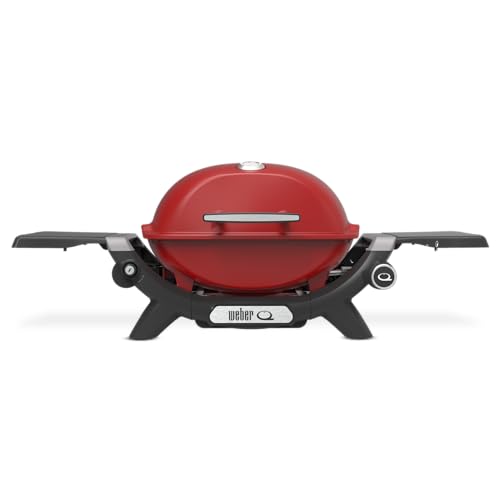
Weber Baby Q1200 (~$429) — Weber's iconic small-but-serious portable. One burner, 43 cm × 32 cm cooking surface (feeds 4 comfortably), built-in thermometer, cast iron grates. Piezo ignition, runs off 1 kg screw-on gas cartridges for true portability or hooks to a standard 9 kg LPG cylinder for backyard duty. The only portable we'd use as a primary BBQ in a small home.
Weber Baby Q2200 (~$549) — Same platform as the Q1200 but with a larger 54 cm × 39 cm cooking area, a dual-function thermometer, and slightly more robust build. The right call if you're buying for regular use rather than occasional camping.
Gasmate Voyager Portable (~$299) — The budget portable pick. Two burners, folding legs, runs on 1 kg disposable cartridges (campers) or a standard 9 kg cylinder (backyard). Build quality is basic, but at under $300 it's the cheapest BBQ we'd actually recommend over a Kmart-tier unit. Ideal first BBQ for a balcony-friendly apartment with a sympathetic body corporate.
Coleman RoadTrip 285 (~$499) — Three burners, collapsible trolley-style stand, perfect for caravan parks and beach setups. Slightly larger cooking surface than the Weber Q2200 and genuinely portable with wheels. The enthusiast camper's pick.
Best 4-Burner BBQ Australia 2026
4-burner BBQs are the fastest-growing subsegment of the market — "best 4 burner bbq australia" is up 57% year-on-year. They're the sweet spot for families of four or more and for anyone who regularly hosts: four burners means four independent temperature zones, enough cooking area for a full spread (steaks on one side, vegetables on the other, buns on warming), and a rotisserie shaft on most models for whole-bird or pork-shoulder cooking.
Our top 4-burner picks
Ziegler & Brown Turbo Elite 4-burner (~$1,099) — Best-value 4-burner on the Australian market. High-efficiency turbo burners, cast-iron grilling plates, rotisserie-ready, excellent wind resistance. 5-year warranty. Australian-designed. This is the first 4-burner we'd look at for most first home buyers ready to entertain.
Beefeater Discovery 1100E 4-burner (~$699) — Best 4-burner under $700. Quartz-start ignition, vitreous enamel roasting hood, porcelain-coated cast iron grills, enamel side trays. Not quite the build quality of the Z&B or Weber, but at $699 it's genuinely good value. Ideal for a first BBQ you'll upgrade in 5-7 years.
Weber Spirit II E-420 (~$1,499) — Weber's 4-burner in the Spirit II range. Same build standards as the E-320 but scaled up for bigger cooks. Still stops short of the Genesis II's premium features, but at $300 less than the Genesis, it's the right pick for buyers who want a Weber 4-burner without the full premium spend.
BeefEater Signature 3000E 4-burner (~$1,499) — Australian-owned, premium fit-and-finish, full stainless steel construction, and a genuinely competitive alternative to the Weber Spirit II E-420 if you prefer Australian brands. The enamel hood looks high-end at the price.
Best BBQ for Apartments & Balconies
Apartment BBQ shopping is different. In most Australian apartment buildings, the body corporate or strata rules will ban LPG gas BBQs on balconies outright — either because of fire risk, because of the 4 kg LPG cylinder limit, or because of general by-laws against combustible appliances on common-property-adjacent spaces. Charcoal is almost always banned for the same reasons plus smoke complaints. That leaves electric.
The good news: electric BBQ technology has improved dramatically since 2020. The bad news: the best electric BBQs still don't match a premium gas unit for sear or smoke. They're the right tool for the apartment job, not the best tool for every job.
Should you buy a gas or electric BBQ for an apartment balcony?
Electric, almost always. Most Australian strata schemes written after 2005 specifically prohibit LPG gas BBQs on balconies — NSW Fair Trading's model by-laws, VIC consumer affairs model rules, and QLD's community-titles standard schedule all allow owners corporations to ban gas barbecues, and most do. Before you buy any gas BBQ intending to use it on a balcony, read your by-laws. If they're silent, check meeting minutes. If the minutes are silent, email the strata manager in writing and get a written OK. Without that written approval, your $1,199 Weber Spirit is an expensive shed ornament.
Electric BBQs sidestep the issue entirely — they're standard domestic appliances, draw less power than a kettle, and the body corporate has no legal basis to ban them. Modern electric units hit 260 to 290°C (hot enough to genuinely sear), produce no combustion fumes, and light with the flip of a switch. You won't get charcoal smokiness, but you will get apartment-friendly BBQ cooking that won't get you a strata breach notice.
Our top apartment/balcony picks
Everdure Force 2-burner Electric (~$699) — The best-designed electric BBQ in Australia. Hits 290°C, two independent heat zones, cast-iron grilling surface, and a sub-60cm footprint that fits a standard apartment balcony. Runs off a standard 10-amp power point — no electrician required. The Heston Blumenthal design collaboration shows in the fit-and-finish; it's a BBQ you're happy to have visible.
Weber Q2400 Electric (~$579) — The electric sibling of the Weber Baby Q. Same iconic shape, same build quality, 2200-watt heating element that hits 230°C. Slightly cooler than the Everdure but the cast-iron grates hold heat impressively. Weber's 10-year warranty applies. Our budget-conscious pick for apartments.
George Foreman Indoor/Outdoor Electric (~$199) — The cheap-and-cheerful option for renters or very tight budgets. Small cooking surface, modest heat, but functionally a BBQ that you can use on any balcony in Australia. If you're only cooking for one or two, it's enough.
Small portable gas alternative — if your by-laws specifically permit LPG in a limited size (rare, but it happens), the Weber Baby Q1200 at $429 is the smallest footprint LPG BBQ worth owning. Always have it approved in writing first.
Best BBQ Brands Australia 2026
Brand matters more in BBQs than in most appliances, because the premium brands hold value, keep spare parts available for 10+ years, and have local service networks that actually take warranty calls. Here's the honest brand read for 2026. Search demand on "best bbq brands australia" is up 21% year-on-year — this is a growing query.
Weber — The benchmark. American design, largely manufactured in the US with some Asian-sourced components, imported and distributed by Weber-Stephen Products Australia with a full local warranty and service network. Weber's Spirit II and Genesis II ranges are the most-copied BBQs on the market — every other mid-range brand is measured against them. 10-year warranty on burners, cookbox, and grates. Best for: buyers who want the safe, boring, excellent choice and don't want to think about it again for a decade.
Beefeater — Australian-owned since 1986, designed and engineered locally, with manufacturing split between Australia and Asia depending on the model line. The Signature range competes directly with Weber at a lower price point, and the Discovery range owns the $500 to $900 entry segment. Best for: buyers who want to support Australian-owned and don't want to pay the Weber premium for similar build quality.
Ziegler & Brown — Australian-designed (founded in Adelaide), with a strong focus on wind-performance and efficiency — two things that actually matter in Australian coastal and exposed-suburb backyards. Their Turbo Elite range has become the value 4-burner benchmark. Smaller dealer network than Weber or Beefeater, but the warranty has been well-honoured. Best for: buyers who cook in windy conditions or want maximum value-per-dollar at the $800 to $1,400 price point.
Everdure — Design-led Australian brand co-founded by chef Heston Blumenthal. Their electric and fast-ignition charcoal ranges are the most attractive BBQs sold in Australia at any price — genuinely furniture-worthy design. Small product range and a premium price position. Best for: apartment and design-conscious buyers who care how a BBQ looks on their balcony.
Masport — New Zealand brand with a long Australian presence. Masport sits in the $600 to $1,400 gas-BBQ segment with solid build quality and a reputation for reliability. Less feature-rich than equivalent Webers but often $200 to $400 cheaper. Best for: buyers who want a no-nonsense, well-built BBQ without brand-premium pricing.
Napoleon — Canadian premium brand with growing Australian distribution. Their Prestige and LEX ranges compete with Weber's Genesis at slightly lower prices, with genuinely innovative features (infrared sear zones, LED lighting). Best for: buyers who want premium specs and don't mind a less-established local service network.
Gasmate — Budget brand owned by BarBQ Warehouse. Good value at the $200 to $600 entry tier for portables and small 2-burners. Build quality reflects the price — expect 3 to 5 years of service life rather than 10+. Best for: first BBQs, camping, and budget-constrained buyers.

Gas vs Charcoal vs Electric — Which BBQ Type?
The type decision is more important than the brand decision. A $400 Weber Original Kettle charcoal will make better food than a $1,500 gas BBQ in the wrong hands — and vice versa. Here's the honest head-to-head.
| Factor | Gas | Charcoal | Electric |
|---|---|---|---|
| Upfront cost (mid-range) | $700–$1,500 | $250–$500 | $500–$800 |
| Time to cooking temp | 10–15 min | 30–45 min | 5–10 min |
| Temperature control | Excellent | Moderate | Excellent |
| Sear quality | Good | Excellent | Fair |
| Smoke/char flavour | Minimal | Excellent | None |
| Low-and-slow cooking | Possible with effort | Natural fit | Difficult |
| Cleanup complexity | Easy | Moderate (ash) | Easy |
| Apartment-balcony suitable | Usually no (body corp) | Usually no (fire) | Yes (almost always) |
| Weather dependence | Low | High (wind, rain) | Low |
| Typical lifespan | 10–15 yrs (premium) | 10–20 yrs | 5–10 yrs |
The decision rule: if you have a backyard and cook 2+ times a week, buy gas. If you have a backyard and cook for flavour over convenience, buy charcoal (or buy both — it's allowed). If you have an apartment balcony, buy electric. If you're in a townhouse or small courtyard with body corp rules, check the rules first, then default to electric.
How to Choose a BBQ for Your New Home
A BBQ is one of the bigger "outdoor" purchases of the first year of home ownership, and it interacts with your space, your strata rules, your gas-bottle-swap logistics, and the furniture around it. Here's the decision framework we'd work through before buying.
1. Check your strata/body corp rules first. If you're in an apartment, townhouse, or any strata-titled property, read your by-laws before shopping. Most apartments prohibit gas and charcoal on balconies entirely. Many townhouse schemes have clauses about smoke affecting adjoining properties. This single step can save you $1,500 of wasted spend.
2. Measure your space. A Weber Spirit II E-320 is roughly 1.3 m wide, 1.65 m deep with lid open, and needs 60 cm of clearance on all sides for ventilation and access. A 4-burner is another 20-30 cm wider. A portable like the Weber Baby Q fits in a 50 cm × 50 cm footprint. Measure the spot before the shop, not after.
3. Count the household. 1-2 people: 2-burner gas or a Weber Baby Q. 3-4 people: 3-burner gas (Spirit II E-320 territory). 5+ people or regular entertaining: 4-burner gas or charcoal kettle. Upsize only if you actually host — an underused 4-burner wastes space and money.
4. Plan the gas logistics. Standard LPG BBQs run on 9 kg gas bottles swapped at Bunnings (~$30 per swap) or servos (~$35). One bottle runs a 3-burner for roughly 20-25 hours of cooking — about 2-3 months of regular use. Factor in the swap convenience when buying: is there a Bunnings near you? Keep a spare bottle if you entertain.
5. Factor in the rest of the outdoor setup. A BBQ alone doesn't make a usable outdoor space. You'll want outdoor seating, task lighting, and weather-proof storage. If the full outdoor fit-out is still coming together, our best outdoor furniture Australia guide pairs naturally with this one, and the new home essentials checklist covers the practical order of outdoor spend over the first year.
6. Budget it properly. A realistic first-home BBQ budget sits at $700 to $1,500 for a mid-range gas unit that will last 10-15 years, plus $100 to $200 for accessories (grill brush, thermometer, cover, tool set) and $50 to $60 for the first gas bottle. If $900 all-in is out of range, a $299 Gasmate Voyager portable or a $399 Weber Original Kettle charcoal both do the job at roughly a third of the spend. If you're still working out what your first home can realistically afford across all the outdoor and indoor setup, our borrowing power calculator shows the total-budget picture before you shop.
Once the BBQ is home, assembled, and seasoned, the rest of the outdoor space should come together quickly. One good BBQ, decent seating, a decent outdoor light, and you've got the single best entertainment setup an Australian backyard can offer.
Frequently Asked Questions
What is the best BBQ in Australia?
The Weber Spirit II E-320 at around $1,199 is our overall pick for most Australian first home buyers — three stainless-steel burners, excellent build quality, 10-year warranty, and genuine Weber build standards at a price meaningfully below the Genesis II. If budget is tighter, the Ziegler & Brown Turbo Elite 4-burner at $1,099 is the best-value mid-range alternative. For serious entertainers, the Weber Genesis II E-435 at $2,499 is the premium pick, and for apartments and balconies the Everdure Force 2-burner electric at $699 is the right choice.
Should I buy a gas or electric BBQ for an apartment balcony?
Almost always electric. Most Australian apartment body corporates and strata schemes prohibit LPG gas BBQs on balconies outright because of fire-risk by-laws, and many also ban charcoal for smoke-nuisance reasons. Before you buy any gas BBQ intending to use it on a balcony, read your by-laws and, if unclear, get written approval from your strata manager. Electric BBQs are treated as standard domestic appliances, cannot typically be banned, and modern units (Everdure Force, Weber Q2400 Electric) hit genuine searing temperatures of 260 to 290°C. You sacrifice some smoke flavour but gain compliance and simplicity.
What is the best BBQ brand in Australia?
Weber is the benchmark brand for most Australian buyers — extensive service network, 10-year warranty, strong resale, and the widest range across price points. For Australian-owned alternatives at similar quality, Beefeater (owned locally since 1986) and Ziegler & Brown (Australian-designed) are the two strongest competitors. Everdure leads on apartment electric BBQs and design. Masport offers solid reliability in the mid-range. Napoleon is the premium challenger brand. Gasmate is the budget choice. Brand choice matters less than type (gas vs charcoal vs electric) and size (2 vs 3 vs 4 burner) — nail those two first, then pick a brand.
Is Weber worth the money?
Yes, for most buyers. Weber's Spirit II and Genesis II ranges command a 20 to 40% premium over comparable 4-burner BBQs from cheaper brands, but you get measurably better burner longevity, a 10-year warranty that's actually honoured, near-universal spare part availability (a decade out you can still buy replacement grates and burners), and a local service network. The Weber premium disappears over a 15-year ownership period — by year 7 a cheaper BBQ has often been replaced once, netting a higher total cost. If you'll only keep the BBQ 3 to 4 years, a $700 Beefeater Discovery or Gasmate is better value. If you expect to keep it for a decade, Weber is the lowest total cost.
What size BBQ do I need?
Match the burners to your typical cook size. One to two people: a 2-burner gas or portable Weber Baby Q is enough. Three to four people: a 3-burner gas (Weber Spirit II E-320 territory) gives you two hot zones and a warming area. Five-plus people or regular entertaining: a 4-burner gas (Ziegler & Brown Turbo Elite, Beefeater Discovery 1100E, or Weber Spirit II E-420) is the sweet spot — four independent zones, a rotisserie shaft on most models, and enough capacity for steaks, sausages, vegetables, and buns all at once. Upsize only if you genuinely host — a 6-burner wastes gas and kitchen real estate if you're cooking for two.
Gas or charcoal — which is better?
For convenience and weeknight cooking, gas wins by a wide margin — 10-minute heat-up, precise temperature control, easy cleanup, and no ash management. For flavour and weekend-project cooking, charcoal wins — deeper sear, genuine smoke, and natural fit for low-and-slow cooking (brisket, ribs, pork shoulder) that gas handles awkwardly. Most first home buyers are better served by gas as their primary BBQ; serious food enthusiasts add a $400 Weber kettle as a second BBQ in year two or three. Electric is a distant third unless apartment rules force it.
How much should I spend on a BBQ?
Three honest price bands for 2026. Budget $200 to $500 gets you a portable Weber Baby Q, a Gasmate Voyager portable, or a Weber Original Kettle charcoal — all genuinely decent BBQs. Mid-range $500 to $1,200 is the sweet spot for most first home buyers — a Beefeater Discovery 4-burner, Ziegler & Brown Turbo Elite, or a Weber Spirit II E-320. Premium $1,200+ gets you a Weber Genesis II, Napoleon Prestige, or high-end Beefeater Signature. Above $2,500 you're paying for size and brand positioning rather than meaningful cooking performance. Spending less than $200 usually means buying a BBQ you'll throw away in two summers.
Ready to finish the outdoor setup? Pair your new BBQ with outdoor furniture in our best outdoor furniture Australia 2026 guide, and cover the full first-year outdoor and indoor fit-out in our new home essentials checklist. If you're still sorting out what your first home budget can realistically cover across appliances, furniture, and outdoor setup, our borrowing power calculator gives you a realistic total-cost view.