You can buy a beard trimmer for $20 at Kmart or $549 at Shaver Shop: same fan-and-blade concept, 27× the price. The best beard trimmer in Australia for most men is the Philips Norelco Multigroom 5000 (MG5910/49) at about $114, which runs up to 2.8 hours on a charge and ships with 18 pieces, with the Philips OneBlade 360 at about $65 the value pick because it trims and shaves with one blade, and the Philips Beard Trimmer 3000 Series BT3619/15 at about $60 the budget buy. The cheap one isn't dangerous; it's just enough worse in three specific ways that you end up using it less, then giving up and growing a long-form beard you didn't plan because the cleanup feels worse than the regrowth. The three failure modes a $20 trimmer reliably produces: skipping (the blade bogs in a thick patch and stops cutting until you yank it free), tugging (dull blades catch hairs and pull instead of slicing), and the length cascade (you trim at 6 mm, find a patch, drop to 5 mm, find another, drop to 4 mm, and keep falling until your "beard trim" is a panicked stubble buzz).
TL;DR: what we'd buy in 2026
- Best overall: Philips Norelco Multigroom 5000 ($114) - the best-rated pick here at 4.6 stars, an 18-piece head-to-toe kit and the longest runtime in this guide.
- Best value: Philips OneBlade 360 ($65) - trims to a set length and shaves to skin with one blade, and the most-reviewed pick here.
- Best budget: Philips BT3619/15 (about $60).
- Best premium all-in-one: Braun AIO7560 Series 7 (about $266) - a 13-in-1 kit, but only one Amazon AU rating so far.
- Best for long beards over 10 mm: Panasonic ER-GB86-K541 - 58 length settings from 0.5 to 30 mm, but currently unavailable on Amazon AU.
- Mid-range alternative: Philips BT5775/15 (about $95) - a hair-collector vacuum, but a 3.6-star average from 20 ratings.
Last updated September 2026. Prices verified live via the Amazon Creators API.
The beard trimmers at a glance
| Pick | Best for | Key spec | Price band | Rating |
|---|
| Philips Norelco Multigroom 5000 (MG5910/49) | Best overall, grooms more than a beard | Adjustable 3mm to 7mm guard plus 12 combs, 18 pieces | from $114 | 4.6 (6,714 ratings) |
| Philips OneBlade 360 (QP2734/30) | Best value, trims and shaves | 0.5mm to 5mm with the guide comb | from $65 | 4.3 (12,671 ratings) |
| Philips Beard Trimmer 3000 Series (BT3619/15) | Best budget, pure beard trimmer | 0.5mm to 10mm, 20 step dial, 100% waterproof | from $60 | 4.3 (566 ratings) |
| Philips Beard Trimmer 5000 Series (BT5775/15) | Mid-range with a hair collector | 40 lock-in settings in 0.2mm steps | from $95 | 3.6 (20 ratings) |
| Braun AIO7560 All-in-One Series 7 | Best premium all-in-one, 13-in-1 kit | 14 fixed lengths from 3mm to 21mm | from $266 | 1 Amazon AU rating so far |
| Panasonic ER-GB86-K541 | Beards over 10mm | 58 lengths from 0.5mm to 30mm, wet and dry | Unavailable on Amazon AU | Not rated here |
How we evaluated beard trimmers
NestPath doesn't physically test every product. Here's what we actually do:
- Surveyed 30+ beard trimmer products available on Amazon Australia with verified buy-box listings, AU shipping, and current pricing.
- Cross-checked manufacturer specifications against retailer listings, removing products where claims didn't match (length range, battery runtime, waterproof rating).
- Aggregated verified Amazon AU customer review data, filtered for star rating, review count, recency, and verified-purchase ratio. Discarded review patterns that suggested incentivised reviews.
- Filtered for first-home-buyer fit: four of the six picks land under $120, with one premium all-in-one above that and one listing currently unavailable, suitable for a daily grooming routine in a shared bathroom, beginner-friendly settings and cleanup, available in stock at AU buy-box.
- Verified availability daily via the Amazon Creators API. The "verified in stock" badge on each product card shows when we last confirmed buy-box availability.
- Editorial selection by Anish Puri, NestPath founder.
We earn affiliate commission when you buy through our links. That doesn't change which products we recommend. Products are selected before commission rates are checked. Our methodology page explains scoring and how to flag inaccuracies.
Best overall: Philips Norelco Multigroom 5000 MG5910/49
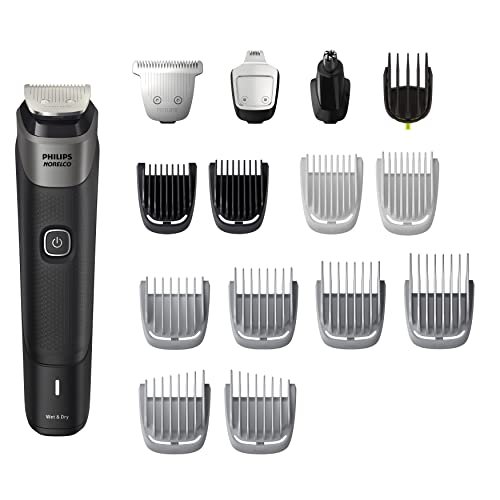
The Philips NEW Norelco Multigroom Series 5000 MG5910/49 (about $114) is our pick, and the numbers are the reason: at 4.6 stars from more than 6,700 ratings it is both the best-rated and the most broadly proven trimmer in this guide. It is sold under the Philips Norelco label, which is Philips' US sub-brand grooming line imported to Amazon AU, so it is the same parent-company quality as the Philips BT5000/3000 below with a different badge. The value calculation isn't only about beard cutting; it's about replacing a beard trimmer, a body groomer and a nose and ear trimmer for less money than buying them separately.
The kit includes 18 pieces: a steel beard trimmer, a steel precision trimmer for cheek lines and edging, a nose-and-ear head, an extra-wide hair trimmer for body work, an adjustable 3 to 7 mm guard, four wide hair guards, two wide fading guards, two body guards and two stubble guards, plus a soft pouch and cleaning brush. The stainless steel blades are self-sharpening and need no blade oil, the head is fully washable, and the lithium-ion battery runs up to 2.8 hours per charge, the longest runtime of any pick in this guide.
Buy this if you're setting up a fresh bathroom from scratch and don't already own a body groomer or nose trimmer: one $114 kit instead of three single-purpose devices. Skip it if you already own a working body groomer and only want a beard trimmer, in which case the BT5775 at about $95 is the better keep. One packing note: the charging cable is USB-A and the wall adapter is not in the box, so plan to use a plug you already own.
Flaws but not dealbreakers
Real tradeoffs: dial resolution on the beard head is coarser than the BT5775, which is versatility bought at the cost of precision; the body-shaver attachment is fine but a dedicated body groomer is meaningfully better at body shaving; the 18 pieces eat a full vanity drawer even in the supplied pouch; and it is badged Norelco rather than Philips, which is worth knowing before you compare model numbers against the trimmers below.
Best premium all-in-one: Braun AIO7560 All-in-One Series 7
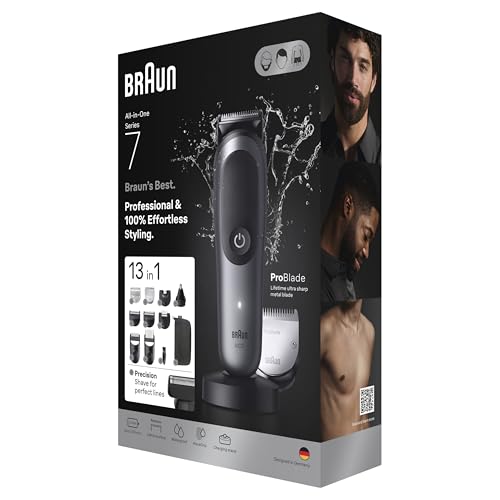
The Braun AIO7560 All-in-One Series 7 (about $266) is the best in-stock premium Braun, and it does far more than a dedicated trimmer: it's a 13-in-1 head-to-toe grooming kit that handles your beard, ear & nose hair, hair clipping and body grooming in one tool. The headline feature is the Ultra Sharp ProBlade paired with AutoSense technology: the blade stays sharp while AutoSense reads your beard density and adapts power on the fly so it doesn't bog down in thick patches. In practice that means a single purchase of about $266 that replaces a beard trimmer, a body groomer and a nose-and-ear trimmer.
The 14 trim lengths span 3 to 21 mm (enough resolution for stubble through to a mid-length beard), and the PrecisionShave head cuts clean cheek and neck lines. The kit's attachments cover beard combs, an ear-and-nose trimmer, a body-groomer head and a hair-clipping comb, so one device replaces three. The trimmer is 100% waterproof with AquaGrip; rinse the head under the tap when you're done.
That said, it is not our pick, and the reason is evidence rather than engineering: this listing has drawn a single Amazon AU rating so far, which is nowhere near the track record we ask of a top pick. The Norelco Multigroom 5000 above covers much the same head-to-toe ground for well under half the price, with more than 6,700 ratings behind it. Buy the Braun if you want the best hardware here and a thin review history does not bother you; buy the Norelco if you want the safe recommendation.
Flaws but not dealbreakers
Real tradeoffs: there's no hair-collector vacuum (cleanup means rinsing the head and wiping the basin; the Philips BT5775 below has one), the supplied storage pouch is soft fabric not a hard travel case, and the all-in-one attachment set takes a full vanity drawer to organise. AutoSense and the Ultra Sharp ProBlade are excellent, but it's an all-in-one rather than a dedicated beard tool, so the dial isn't as fine-grained as a pure trimmer. Battery life of up to 120 minutes is generous, though it is not the longest here: the Norelco is rated to 2.8 hours.
Mid-range alternative: Philips Beard Trimmer 5000 Series BT5775/15
The Philips Beard Trimmer 5000 Series BT5775/15 (about $95) is the mid-range Philips, and on paper it is the model where every feature that genuinely matters is present and you stop paying for things you won't use. On the evidence it has not earned a place at the top of this guide: its Amazon AU listing sits at 3.6 stars from 20 ratings, the lowest average of any pick here, so we have kept it as an alternative rather than a recommendation. If the hair-collector vacuum is what you are here for, it is the only pick that has one.
The 40 lock-in length settings step in 0.2 mm increments, finer than the Braun's 14 fixed lengths across 3 to 21 mm, though the difference is academic for most beards. The metal blades are self-sharpening and Philips states they need no blade oil. The "BeardSense Technology" the box brags about is a density sensor that scans the beard 125 times a second and bumps power when the blade hits a thick patch; it works well enough that you stop noticing patches mid-trim. The headline feature is the built-in hair collector: a small motor pulls cuttings into a chamber inside the trimmer body, and Philips claims it catches up to 80% of them rather than the basin or your shirt. For anyone with a partner who has firm opinions about beard hairs in the basin, this single feature earns the upgrade from the budget 3000 Series.
The trimmer is 100% waterproof, and a click-on detail trimmer with a narrow head is in the box for definition work. Philips does not publish a runtime figure for this model, so we are not quoting one.
Flaws but not dealbreakers
Real tradeoffs: the hair-collector vacuum adds bulk that makes the trimmer slightly nose-heavy compared to the bare-handle 3000, the soft pouch in the box is barely a travel case (budget $20 to $30 for a hard case if it goes anywhere), and the 40-step dial is a numbered ring rather than a digital readout, which is squinty through a half-fogged bathroom mirror. Philips publishes no runtime figure for it either, which is not the transparency you want at this price.
Best budget: Philips Beard Trimmer 3000 Series BT3619/15
The Philips Beard Trimmer 3000 Series BT3619/15 (about $60) is the right starting point for someone making the supermarket-clipper-to-real-trimmer switch, or for anyone who only trims monthly and doesn't need the mid-range upgrade. Sub-$50 supermarket clippers from Conair, Remington and the Amazon house-brands all share the same three failure modes, skip, tug, length-cascade, to varying degrees. The Philips 3000 sits just above that floor at about $60. If the job is a full head cut rather than a beard line, that is a different tool again, and our hair clippers guide covers the ones sold here.
The 0.5 mm dial resolution is what matters most at this price: it's the difference between knowing what length you want and being able to land on it, instead of guessing between two clip-on combs that are 3 mm apart and finishing the trim hoping you got it right. The Lift & Trim comb pre-lifts hairs into the blade so you don't get the "stuck on a patch" pause. The whole trimmer is rated 100% waterproof, so cleanup is a rinse under the tap rather than four minutes with the little brush. It charges from the supplied USB-A cable, and like the OneBlade and the Norelco it ships without a wall adapter, so use a USB plug you already own.
For a first-home-buyer trimming 1 to 4 times a month, this is genuinely all you need. The mid-range BT5775 is the smart-buy if your trim cadence is weekly or more; the BT3619 is the right call if it's slower than that.
Flaws but not dealbreakers
Real tradeoffs at about $60: there is no hair collector, so cleanup means rinsing the head and wiping the basin; the build is plastic-light, which is fine at home and fragile in a travel bag without a hard case; and there are no body, nose or ear attachments at all. The 20-step dial is coarser than the BT5775's 40-step dial, half-millimetre steps against 0.2 mm ones, which most people will never notice. Philips does not publish a runtime figure for this model.
Best for stubble + clean shave: Philips OneBlade 360 QP2734/30
The Philips OneBlade 360 + Extra Blade QP2734/30 (about $65) is a different product class than the dedicated trimmers above, and we're flagging that explicitly because the OneBlade gets bought by people who think they're buying a beard trimmer and then wonder why it doesn't work like one. The OneBlade trims AND shaves: with the 5-in-1 adjustable comb on it trims short stubble, and with the comb off it shaves close-but-not-flush against the skin. The 360 blade flexes in every direction to follow face contours, which is what makes it good at jawline and neckline edging.
This is the right tool for someone running short stubble (under 5 mm) plus a daily clean neck and cheek line: the OneBlade does both jobs in one device, which is genuinely convenient for that specific routine. It's the wrong tool for someone who wants a 5 to 15 mm beard trimmed weekly: the 5-in-1 comb tops out well short of a mid-length beard and there is no continuous-dial length adjustment, so settling on a 7 mm beard length isn't possible. For that routine, the BT5775 at about $95 is the better keep.
The listing rates the OneBlade waterproof, so it rinses clean under the tap. The blade is a consumable rather than a self-sharpening head, so it is a running cost the other Philips trimmers here do not have. This bundle ships with a spare, so the first replacement is already paid for.
Flaws but not dealbreakers
Real tradeoffs: it is not a true beard trimmer, because a 5-in-1 comb is not a continuous dial; the blade is a consumable, so there is an ongoing cost the self-sharpening Philips heads avoid; and the shave is close-but-not-flush rather than truly clean, so a foil shaver still shaves closer. It is a hybrid, and anyone who wants both jobs done properly is better served by a dedicated trimmer plus a separate shaver. If that separate shaver is for a scalp rather than a face, the rotary and flexing-head units in our head shaver guide are the ones built for it.
Best for long / thick beards (over 10 mm): Panasonic ER-GB86-K541
The Panasonic Wet & Dry Cordless Rechargeable Beard Trimmer/Grooming Kit ER-GB86-K541 is the only trimmer in this guide that genuinely handles beards over 10 mm. Most consumer trimmers cap at 20 mm and stutter on dense longer growth, because the dial settings get ignored as the comb fills with hair faster than the blade can clear it. Panasonic's ER-GB86 has 58 cutting lengths from 0.5 mm to 30 mm in 0.5 mm increments, and its stainless-steel blades use a wider pitch that catches more hair per stroke on thick coarse growth.
This is the trimmer for someone running an 18 to 25 mm beard who needs to evenly trim it down to 15 mm without dropping into stubble territory. The 30 mm max length covers anyone outside actual yard-beard territory; below 30 mm the dial increments are 0.5 mm so you can hit (and re-hit) any length precisely. The trimmer is wet and dry rated, takes about an hour for a full charge, and ships with three attachments covering 1 to 10 mm, 11 to 20 mm and 21 to 30 mm.
The Panasonic has been the long-beard specialist here, and the use case is genuinely different: the Braun is the head-to-toe all-in-one for short-to-mid beards (3 to 21 mm), the Panasonic is built for long beards (5 to 30 mm). Its Amazon AU listing is unavailable at the time of writing, so treat it as one to watch rather than one to buy today. For shorter beards or all-round grooming the Braun is the better keep in any case.
Flaws but not dealbreakers
Real tradeoffs: the dial is small and harder to read than the Braun's or Philips' numbered rings which is functional but less obvious to set, and the trimmer is heavier than the Philips and Braun equivalents, which helps stability on a thick beard and is less pleasant for short-stubble work. Below 5 mm the Philips BT5775 is the more comfortable tool.
What to look for in a beard trimmer
Beard-trimmer marketing leans on two-thirds invented technology terms: "BeardSense Technology", "DualCut Precision", "Lock-In Settings", "PowerBoost". Here's what actually changes how the trimmer cuts.
Length range and step size: the cascade-failure spec
The single most important spec (and the one most reviews skip past) is dial step size. A 6-position guide-comb trimmer (1, 3, 6, 9, 12, 18 mm) gives you six possible lengths total. A 20-step dial (0.5 to 10 mm in 0.5 mm increments) gives you 20. A 40-step dial gives 40. The cascade-failure mode happens when you overshoot a length, can't get back to where you were, and have to keep dropping until something looks even. The narrower your step size, the easier it is to hit the same length next week and fix a patchy spot without dropping the whole beard a millimetre. For most beards 20 steps in 0.5 mm increments is sufficient. For stubble work under 5 mm where every half-millimetre changes how the beard reads, the 40-step dial is genuinely better.
Maximum length: the long-beard ceiling
Most consumer trimmers cap at 20 mm. That covers anyone running stubble through to a "stage 3" beard. If you're maintaining anything over 20 mm (full beards, the Garibaldi, anything yardstick-adjacent), you need a trimmer with a 25 to 30 mm ceiling, which narrows the field to the Panasonic ER-GB86 in this guide and a small handful of barbershop-tier trimmers from Wahl and BaBylissPRO that aren't really aimed at home users.
Wet/dry capability and cleanup
"100% waterproof" is the spec to verify on the listing, not the box. A waterproof trimmer can be rinsed under the tap to clear cuttings, the difference between 30 seconds of cleanup and four minutes of poking the included tiny brush between blade teeth. Every Philips beard trimmer above the absolute entry tier is washable; most cheap supermarket trimmers aren't. The hair-collector vacuum on the BT5775 is the next-level cleanup feature, worth the upgrade for households where bathroom cleanliness is a shared concern.
Blade type and the "self-sharpening" claim
Two blade flavours: chromium-coated steel (entry tier, needs occasional oiling, dulls in 12 to 18 months of weekly use) and self-sharpening stainless or titanium (mid-range and up, the blade pair grinds against itself on every cycle to maintain edge geometry). The "self-sharpening blades, no blade oil required" claim is stated on the listings for the Philips BT3619, the Philips BT5775 and the Norelco Multigroom 5000, which covers every Philips pick in this guide including the cheapest. Braun makes a different claim for the AIO7560: an Ultra Sharp ProBlade, with no self-sharpening or oil-free wording. Verify the claim on anything cheaper than these.
Battery, charging and the cable in the box
Battery specs have mostly converged: every modern beard trimmer above $50 runs on Li-ion and gets 50 to 100 minutes per charge, plenty for any home use. Two things to check: what the charging cable actually is, because the Philips 3000, the OneBlade and the Norelco all ship a USB-A cable with no wall adapter in the box, while older trimmers still use a proprietary barrel jack that lives in a drawer somewhere; and quick-charge support, if you are the sort to remember at the last minute. Cordless rechargeable is universal; mains-corded trimmers are obsolete outside barbershop tools.
Care and maintenance
Trimming to a line is far easier when you can see the line, so a lit shaving mirror earns its place next to the trimmer. A combo kit is also a compromise: if you cut your own head hair as well, a dedicated hair clipper does that job better than any beard trimmer attachment.
A good trimmer used badly lasts 18 months; the same trimmer used well lasts 5 years. The maintenance habits matter more than the hardware tier for total cost of ownership.
How to use the trimmer (without producing the length-cascade)
First pass with the grain (downward) at the longest dial setting that's longer than your target. This bulk-cuts to roughly the right length without overshooting any patch. Second pass against the grain (upward) at the same dial setting. This evens out the micro-patchiness from variable hair growth direction. Third pass at one step shorter only if needed; resist dropping more than one step in a single trim. Cheek lines and the neckline are detail work. Use the trimmer's edging blade or detail head, not the comb attachment, and follow your existing line rather than re-defining it every trim.
Cleaning after each trim
Rinse the head under the tap (works on every trimmer in this guide, all 100% waterproof). Tap excess water out, leave to air-dry head-down on a microfibre towel. The included tiny cleaning brush is for stubborn cuttings that don't rinse out. Use it on a dry head before rinsing, not after. Don't put a wet trimmer back on a charging dock; the contacts corrode. The Philips BT5775's hair-collector chamber empties through a clip-off door; rinse the chamber under the tap weekly.
Blade oil: when, why, and the self-sharpening exception
For chromium-coated steel blades on supermarket-tier trimmers: one drop of clipper oil between the moving and fixed blade plates every 6 months of weekly use, then run the trimmer for 30 seconds to distribute it. Every Philips pick in this guide, the BT3619 included, states self-sharpening blades that need no oil, so this is a step you can skip. Some owners still put a tiny drop on annually; harmless if you do it, fine if you don't.
When to replace blades vs the whole trimmer
The signal that blades are dying isn't visual: it's the tug. When the trimmer starts catching hairs and pulling instead of slicing cleanly, the cutting edge has rounded off. For Philips replaceable heads (3000, 5000, Norelco), buy a $25 to $40 replacement head and snap it on; whole-trimmer replacement isn't needed. For the Braun AIO7560, Braun's claim is an Ultra Sharp ProBlade rather than a replaceable head, so if it starts tugging, rinse-after-trim discipline is the first thing to fix. Battery degradation is the other replacement signal, when runtime drops below 30 minutes per charge after 4 to 5 years, the Li-ion has aged out and a new trimmer is the right call.
You'll also want
The trimmer is one piece of a beard-and-grooming setup; here's the rest of what most readers buy alongside.
- Self-cut barber cape with elastic neckline: search Amazon AU. $15 to 25 polyester cape that catches cuttings before they hit your shirt and the bathroom floor. Pairs perfectly with a non-vacuum trimmer (Braun AIO7560, Philips BT3619).
- Beard oil (Bossman or Mountaineer): search Amazon AU. $20 to 30. Apply post-trim to soften the new edges and reduce the "freshly cut" itch. Argan-and-jojoba blends are the standard.
- Beard comb (boar bristle or wide-tooth wood): search Amazon AU. $10 to 20. Pre-trim use to align hairs in the natural growth direction so the trimmer cuts evenly across the beard.
- Replacement Philips Series 5000 trimmer head: search Amazon AU. $25 to 40. Buy at year three of weekly use if the BT5775 starts tugging. Snap-on swap, no tools.
- Hard travel case for cordless trimmer: search Amazon AU. $20 to 30. Compatible with most Philips and Braun bodies. Worth it if the trimmer leaves the bathroom. The bundled soft pouches don't protect against drops.
- Bathroom mirror with built-in light: search Amazon AU. $40 to 80. Diffused front lighting eliminates the shadow-on-cheek that makes patch detection nearly impossible under a single overhead bathroom light.
The competition: products we considered but didn't pick
Six products that came close but didn't make the lineup, with the one-line reason each.
- Braun Series 9 BT9520 (about $229), a dedicated premium beard trimmer (52 length settings, 180-min battery), but it does only the beard, so for the small price gap against the roughly $266 Braun AIO7560 all-in-one we'd take the kit that also grooms body, ear and nose.
- MANSCAPED Beard Hedger (about $160), solid trimmer with strong AU SERP visibility, but the buy-box pricing has been volatile and the $159 list is closer to flagship Braun pricing without flagship build quality.
- Wahl Stainless Steel Lithium Ion+ (about $120), barbershop-tier hardware, but the dial setup and replacement-head ecosystem are aimed at professional barbers more than home users; there are friendlier options at this price.
- Philips OneBlade Pro 360 QP6552/15 (about $169), the premium OneBlade with 20 length settings via a precision comb. We picked the QP2734/30 instead because at about $65 it's the more honest price point for the OneBlade product class, and the precision comb on the Pro doesn't change the close-but-not-flush shave limitation.
- Philips Beard Trimmer 7000 Waterproof (about $130), sits between the BT5775 and the BT9000 Prestige and doesn't add anything the BT5775 doesn't have for $30 more. The BT5775 wins on price-per-feature.
- Remington The Works MB905AU (about $49), sub-$50 Remington kit that's a step up from the unbranded supermarket tier but still misses the 0.5 mm dial resolution that defines the Philips 3000. Good for someone who only trims monthly; we'd prefer the BT3619 even at the price gap.
What about the Braun BT7540, Wahl and Remington?
Those are the models the Australian shopping results are built around, and none of them is one of our picks. The Braun Series 7 BT7540 sells for about $149 at Shaver Shop, the Series 5 BT5560 for about $104 and the BT5440 for about $119 at Chemist Warehouse. Philips All-in-One models sit at about $69 and $129 through JB Hi-Fi and The Good Guys, the Wahl Beard and Stubble is about $41, the VS Sassoon Xpert about $75 and the Remington Barber's Best about $49. We hold no affiliate link for those, so they are context rather than picks.
Frequently Asked Questions
Should you trim your beard up or down?
Down for the first pass, with the grain, in the direction the hair grows, longest dial setting first. This bulk-cuts the beard to roughly the right length with the least risk of overshooting a patch. Once the bulk is off, do a second pass against the grain (upward) at the same dial setting for the cleaner finish. Short beards in particular look more even after an against-the-grain pass because hair growth direction varies across the face. Cheek lines and the neckline are detail work. Use the trimmer's edging blade or detail head, not the comb attachment.
How often should you replace beard trimmer blades?
For self-sharpening blades on the Philips 5000 Series and above, every 3 to 5 years of weekly use, well beyond the warranty period. For chromium-coated steel blades on entry-tier trimmers, every 18 to 24 months. The signal that blades are dying isn't visual (the blades still look sharp). It's the tug. When the trimmer starts catching hairs and pulling instead of slicing cleanly, the cutting edge has rounded off. Replacement heads run $25 to $40 for the Philips standard line; replacement is a 10-second snap-on job, no tools.
What's the difference between a beard trimmer and an electric shaver?
A beard trimmer cuts hair to a set length (down to about 0.4 mm minimum on most models) and leaves stubble; an electric shaver cuts hair flush to the skin and leaves a clean-shaven finish. The two aren't interchangeable. A trimmer can't shave you smooth, and a foil or rotary shaver can't hold a 5 mm stubble. If you want a clean shave rather than a trim, that is a different machine, and our electric shaver guide covers it. The Philips OneBlade range is the one product that bridges both jobs (it trims at 0.5 to 5 mm with a guide comb and shaves close-but-not-flush without one), which is why it shows up in nearly every "best beard trimmer Australia" list as a hybrid pick.
Are Philips beard trimmers better than Braun?
Different strengths. Philips dominates the under-$100 segment in Australia: the 3000 and 5000 series are the entry and mid-range standards, the Amazon AU buy-box is stable, and replacement heads are everywhere. Braun's All-in-One Series 7 (about $266) and Series 9 (about $229) are arguably the best premium grooming hardware on the market, with SkinGuard, AutoSense and the Ultra Sharp ProBlade. Battery life is not the Braun advantage it is often sold as: the AIO7560 is rated to 120 minutes and the Philips Norelco Multigroom 5000 to 2.8 hours. Under $120, Philips wins on price, availability and ecosystem. At $200+, Braun wins on hardware. Both brands are excellent; there's no losing buy above the supermarket tier.
Is a multigroom kit better than a dedicated beard trimmer?
It depends on what you're grooming. If it's only a beard, a dedicated trimmer (Philips BT5775) wins on dial resolution and ergonomics. Single-purpose tools always cut better than an all-in-one with multiple attachments like the Braun AIO7560. If you're grooming beard PLUS body PLUS nose/ear, a multigroom kit (Philips Norelco Multigroom 5000) replaces three single-purpose devices for less than buying them separately. The cost-benefit threshold is whether you'd otherwise own a body groomer and a nose trimmer.
Which beard trimmer brand is best in Australia?
Philips has the widest range and the deepest Amazon AU review base, which is why four of the six picks here are Philips, and the OneBlade alone carries 12,671 ratings. Braun builds the best premium all-in-one kits and sells hardest through Shaver Shop and Chemist Warehouse. Panasonic owns the long beard end with 58 settings up to 30mm. Wahl and Remington are the budget shelf at JB Hi-Fi, and VS Sassoon is the supermarket tier.
Is Wahl or Philips better?
For a home beard, Philips. Wahl hardware is barbershop grade and the Stainless Steel Lithium Ion+ at about $120 cuts beautifully, but the dial and replacement head system is aimed at barbers, and the cheap Wahl Beard and Stubble at about $41 has none of that. Philips gives you finer dial resolution at every price, from a 20 step 0.5mm dial on the $60 BT3619 to 40 lock-in settings in 0.2mm steps on the BT5775.
What is the 3 day beard rule?
It is the shorthand for keeping designer stubble at roughly 3 days of growth, which lands around 3mm to 5mm on most men. The rule is that you trim back to the same dial setting every 2 to 3 days rather than letting it grow and then cutting it hard, because an even 3mm reads as deliberate and an uneven 6mm reads as neglected. A trimmer with 0.5mm steps makes it repeatable.
Can a beard trimmer cut hair?
It can tidy a neckline, but it is the wrong tool for a full head. Beard trimmer blades are narrow, usually 30mm to 40mm wide, so a head cut takes a long time and the passes show. Multigroom kits like the MG5910/49 include wider hair guards and an extra-wide hair trimmer head, which makes them workable for a simple buzz. For a proper head cut, use a hair clipper with a wider blade and taller guards.
How do you trim a beard with a trimmer?
Start dry and brushed, with the dial one or two settings longer than the length you actually want, because you can always take more off. Make the first pass down with the grain to bulk cut, then a second pass up against the grain at the same setting to even it. Set the cheek line and neckline last, using the trimmer without a comb, and put the neckline about two fingers above the Adams apple.
How do you trim sideburns with a beard trimmer?
Take the comb off and use the bare blade upside down, drawing it downward across the bottom edge of each sideburn so the blade cuts a straight line. Check both sides in the mirror at eye level rather than looking down, because a sideburn that looks level from above rarely is. For most faces the base of the sideburn sits level with the middle of the ear opening, and matching the two sides matters more than the exact height.
Setting up your bathroom?
A beard trimmer is one piece of a working bathroom, not the whole of it. For oral care (the bathroom appliance with the fastest payback period), our best electric toothbrush guide covers Oral-B vs Sonicare and the brush-head economics that dominate 5-year cost. Comparing brand approaches in detail, our Sonicare vs Oral-B comparison covers oscillating-rotating versus sonic and which suits which gum profile. For drying and styling, our best hair dryer guide covers the small-appliance category where the budget-vs-premium gap has narrowed dramatically since 2023. Our best bathroom scales guide covers the small-appliance category with the widest accuracy spread between budget and premium models. For storage planning around a vanity that holds all of the above, see bathroom storage ideas. And if you're at the start of the new-home setup process, our new home checklist covers the room-by-room essentials so you can prioritise.
About the author
Anish Puri founded NestPath in 2026 after going through the Australian first-home-buyer process himself. NestPath focuses on Australian first-home buyers because the existing review sites are American, generic, or both. Anish handles editorial selection across the homeowner hub. Reach out: hello@nestpath.com.au