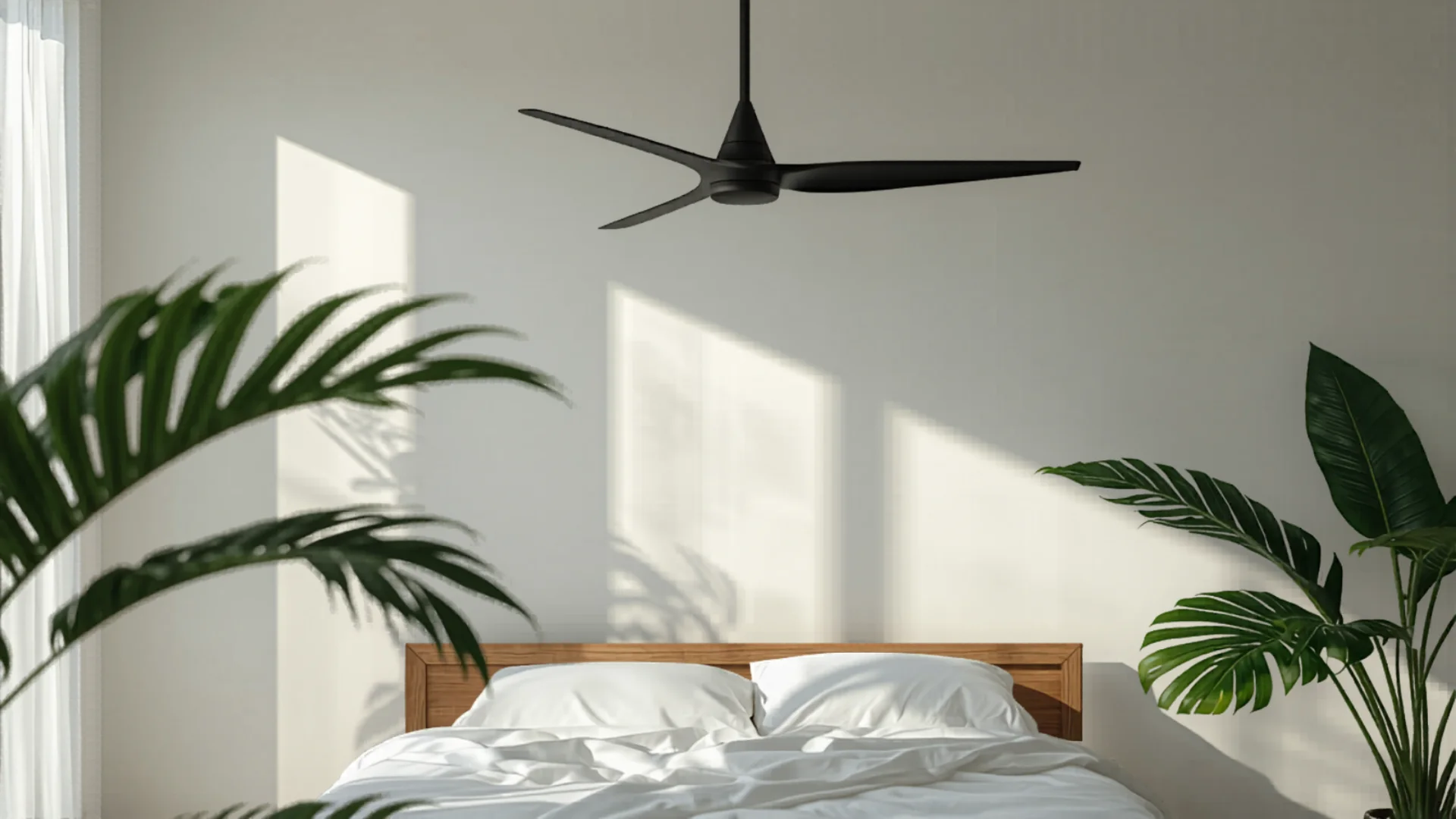
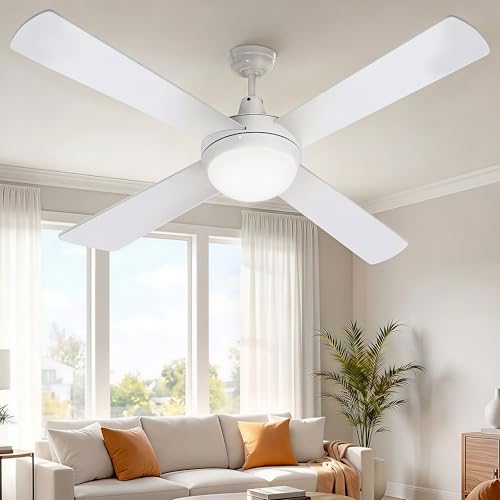
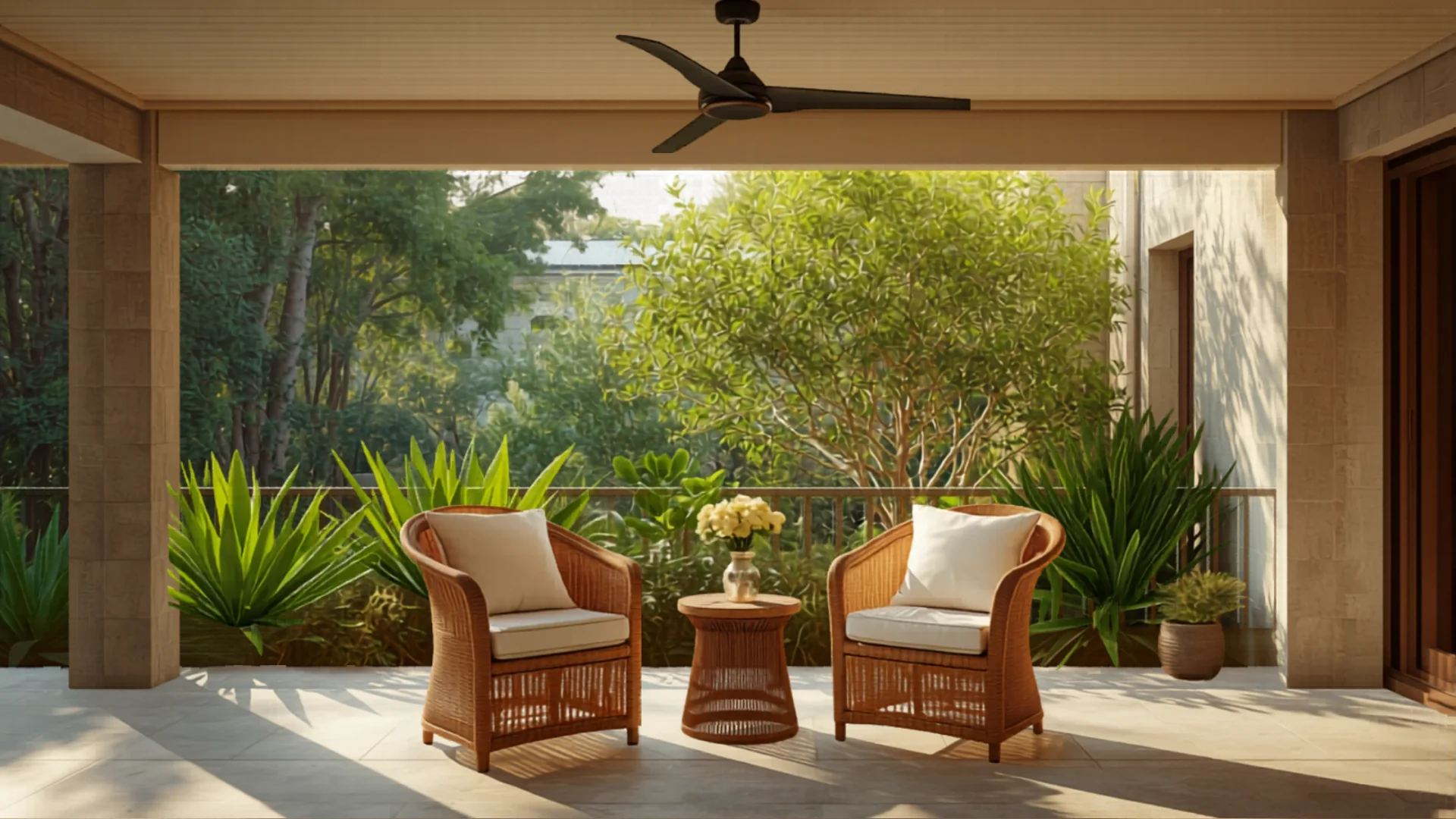
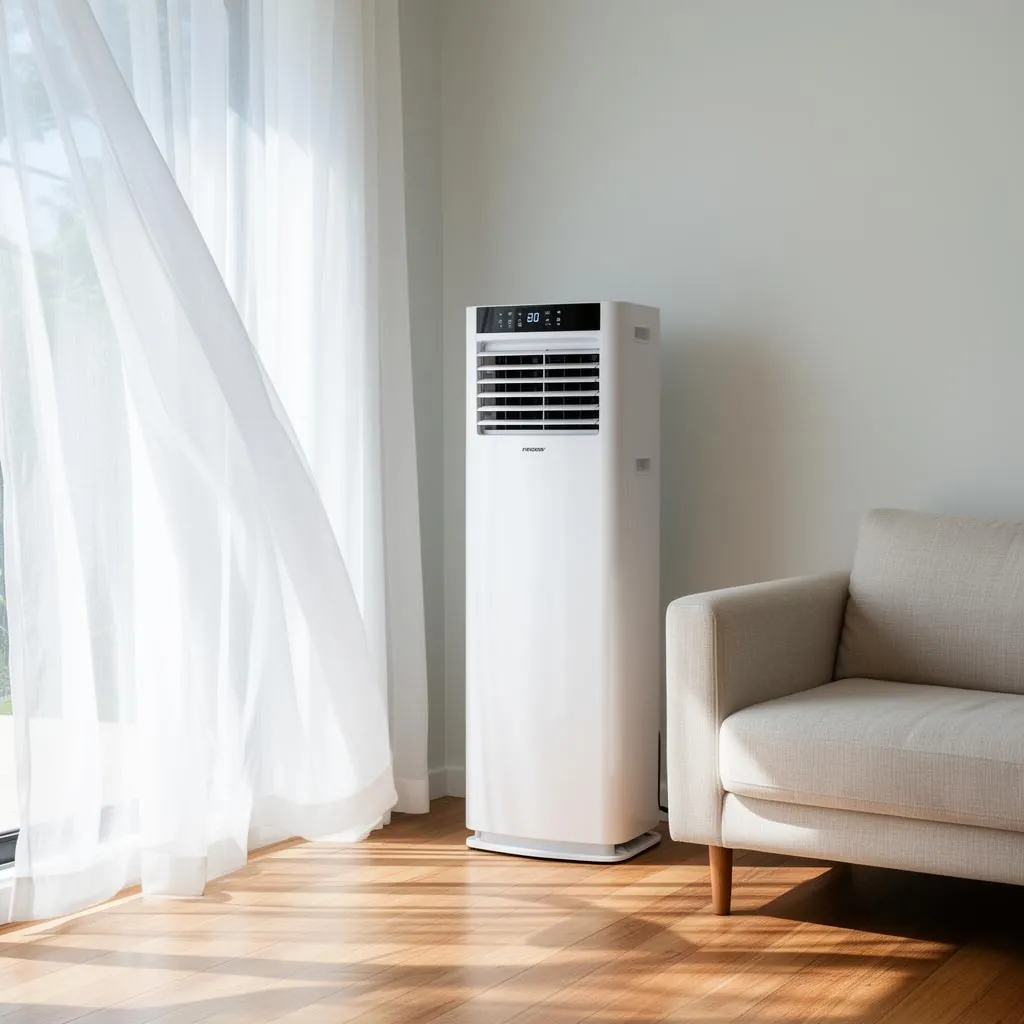
For an Australian home, choose a DC motor ceiling fan with quiet low speeds, winter reverse and a blade span matched to the room, about 1,200mm for a 10 to 15 square metre bedroom. It must be installed by a licensed electrician, and energy.gov.au puts ceiling fan running costs at around 2 cents per hour.
Here is the maths that turns most Australians into ceiling fan converts: a standard air conditioner running on a warm afternoon costs around $1.00 to $1.50 per hour. energy.gov.au puts ceiling fan running costs at around 2 cents per hour and says fans make you feel about 3°C cooler when they blow on you. In dry inland heat an evaporative cooler is the next step up and still runs for a fraction of refrigerated cooling. For the days when a fan alone is not enough, our split system air conditioner guide covers the proper reverse-cycle upgrade, but a ceiling fan handles the 200+ mild days a year that do not justify firing up the AC. Over a full Australian summer, even a mild one, the difference in your electricity bill runs into hundreds of dollars. That's before you factor in the wear and tear on the air conditioning compressor, or the fact that a ceiling fan keeps running on days when the AC would be overkill. Another fan installed by a licensed electrician in a new home is the bathroom exhaust fan, and the two jobs are often quoted together.
But ceiling fans do more than just cool your home cheaply. In winter, most modern fans have a reverse function that pushes warm air (which naturally rises to the ceiling) back down into the living space. Warm air that was sitting uselessly at ceiling height gets circulated into the room, reducing how hard your heater has to work. Running a ceiling fan in reverse during winter costs a few cents a day and can meaningfully reduce heating costs in rooms with high ceilings, useful alongside a reverse-cycle heater or split system in larger living areas.
If you've just bought a home in Australia (whether it's a Queensland Queenslander with 3.5m ceilings, a Melbourne terrace, or a new Perth build), having a licensed electrician install a ceiling fan in every bedroom and main living area is one of the best value-for-money upgrades you can make. This guide covers motor types, room sizing, quiet ceiling fans and why a ceiling fan must be installed by a licensed electrician.
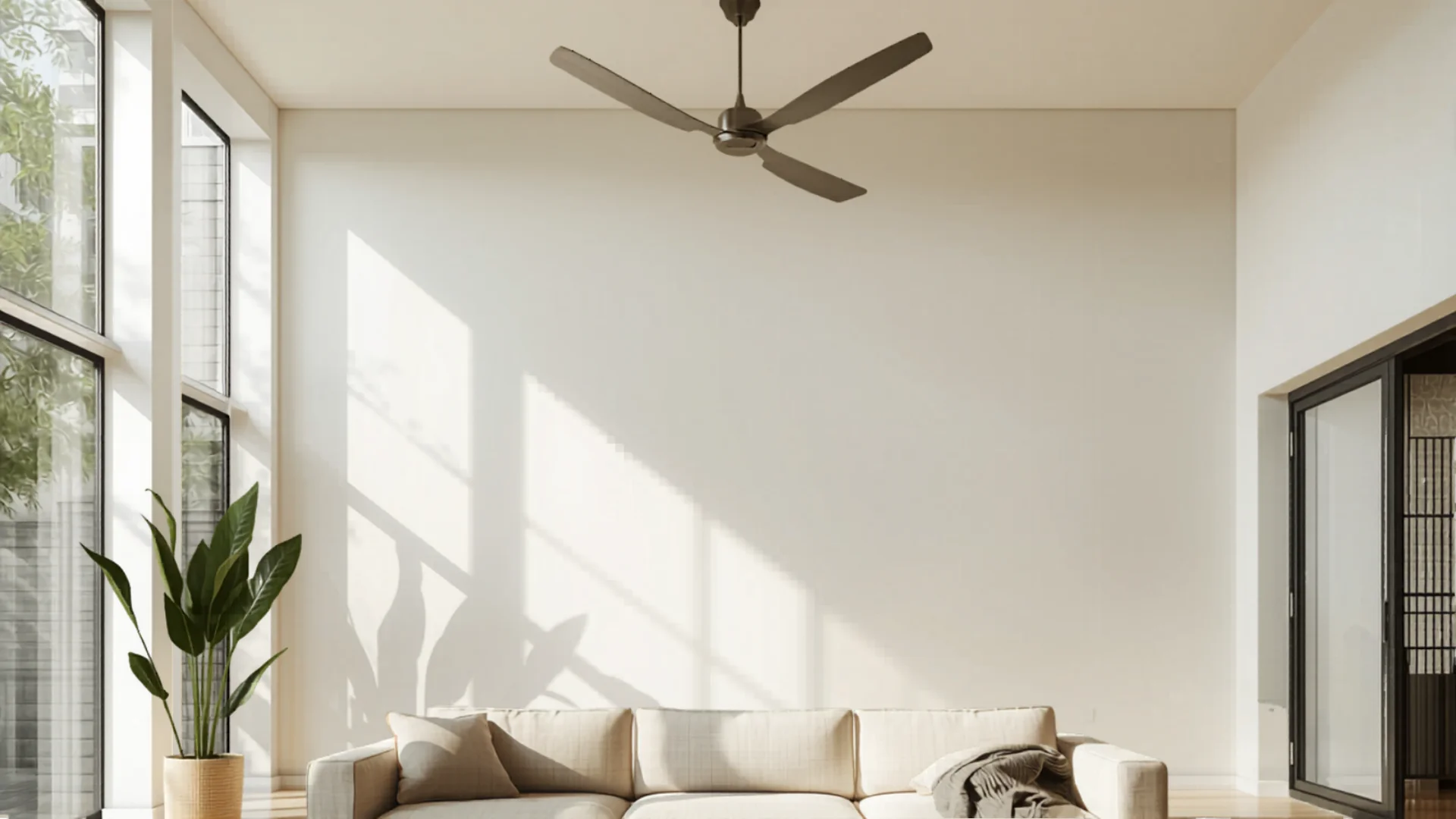
AC Motor vs DC Motor Ceiling Fans
The most important specification when choosing a ceiling fan is the motor type. It determines noise level, speed options, energy consumption, and ultimately how much you'll enjoy having the fan in your home. There are two types available in Australia:
AC Motor Ceiling Fans
AC (alternating current) motors are the traditional standard for ceiling fans. They're cheaper to manufacture, which means lower retail prices, typically $100 to $300 for a quality model. AC motor fans are reliable and have been used successfully for decades. Their limitations are a smaller number of speed settings (usually three), a slightly higher energy consumption than DC equivalents, and more noise at higher speeds due to the way AC motors operate.
For a garage, outdoor undercover area, or a room where the fan runs occasionally rather than continuously, AC motor fans are perfectly adequate and represent excellent value. If your priority is minimising upfront cost and you're not sensitive to fan noise, AC is a sensible choice.
DC Motor Ceiling Fans
DC (direct current) motors represent the premium tier of ceiling fans. They use 70% less energy than comparable AC motor fans, offer six or more speed settings rather than three, operate almost silently (a genuine whisper at low speeds), and often include more sophisticated remote controls with timer functions and reverse capability. The retail price reflects this: quality DC fans range from $250 to $700 and above.
For a bedroom, where the fan runs on low speed through the night for eight or more hours, a DC fan makes a real difference. Pair it with a tower or pedestal fan for the dressing-table side of the bed if the ceiling fan's airflow is not reaching far enough on Australia's hottest nights. The silence is noticeable compared to an AC motor at low speed, and the fine-grained speed control lets you find the exact airflow that's comfortable without turning the fan off. The energy savings over a decade of use also reduce the effective price premium considerably.
Our recommendation: DC motor for bedrooms and main living areas where the fan runs frequently. AC motor for garages, outdoor areas, and secondary rooms where usage is occasional.
Energy efficient ceiling fans: what a DC motor actually saves
Put the two figures from the top of this page together and the saving is easy to check. A DC motor draws about 70 percent less power than an AC motor of the same blade span, and a ceiling fan of any kind costs 1 to 2 cents an hour to run. Leave a DC fan on for 8 hours a night across a 90 night summer and you spend roughly $7 to $14. The same 8 hours a night on a split system at $1.00 to $1.50 an hour is $720 to $1,080. That gap, not the motor type on its own, is the reason a fan in every bedroom is the cheapest cooling upgrade in an Australian home. The DC motor then pays for itself a second time because it runs cooler, which is the single biggest factor in how long a fan lasts.
What Size Ceiling Fan for Your Room?
Getting the right blade span is critical. An undersized fan won't move enough air to make a difference; an oversized fan in a small room can feel overwhelming and create too much air movement. The standard Australian sizing guide is based on floor area, and in a humid coastal summer air movement does more of the work than temperature, which is also why a dehumidifier and a fan together beat either on its own:
- Under 10 square metres (small bedrooms, studies): 900mm to 1,050mm blade span. Compact fans that move air efficiently without dominating a small room.
- 10 to 15 square metres (standard bedrooms, smaller living areas): 1,200mm blade span. The most common size in Australian homes and the sweet spot for most bedroom applications.
- 15 to 25 square metres (main bedroom, large living areas): 1,320mm blade span. Sufficient to circulate air effectively in a proper-sized living room or master bedroom.
- 25 square metres and above (open plan living, large rooms): 1,500mm or larger, or consider installing multiple fans. Very large rooms often benefit more from two well-placed 1,200mm fans than a single large fan.
Ceiling height also matters. The absolute minimum ceiling height for a flush-mount fan is 2.4 metres. Any lower and you risk a head strike or the fan simply not circulating air properly. Ideally, the fan blades should hang no lower than 2.1 metres above the floor. For higher ceilings (2.7m+), use a downrod to bring the fan to the optimal height for airflow. A fan sitting flat against a 3m ceiling is much less effective than one hanging 60cm lower.
How we picked and checked these fans
We compare motor type, blade span, speeds, light and remote controls, and winter reverse using the Amazon Australia listings. Our sources are those listings, the EESS public register, energy.gov.au and the Queensland Electrical Safety Office. We checked the sources on 3 October 2026.
The EESS in-scope equipment list v4.3 classifies fans as Level 3 equipment. Ceiling fans sold here must have a current registration on the Australian EESS electrical equipment register.
We could not find a current Australian electrical registration for any of the three Devanti models listed here at our 3 October 2026 check: for the 64 inch CF-B-64-334-SI we found no record, the 48 inch listing gave no model code and the related family records we found had expired, and the 52 inch ESC-301YY appeared only on a record that expired on 29 July 2023. Ask your licensed electrician to confirm a fan's registration before it is installed.
Our Picks: The Best Ceiling Fans on Amazon AU
We restricted this list to fans sold on Amazon AU. The three Devanti DC fans below, each with an integrated light, a remote, reverse mode for winter and a 3-colour LED kit, cover the size range that matters for most homes: a 64" for large living and open-plan areas, a 48" for standard bedrooms, and a 52" as the best-value DC fan for a standard room. They share the same feature set; the choice between them is mostly about blade span and price. We also list the registered Kogan 132cm DC fan, the Chriari 52 inch DC fan and a Devanti 52 inch AC fan with light.
If you are wondering why the well-known Australian fan brands are not on this list, skip to the premium buy-direct brands section below. The short version is that Mercator, Fanco, Hunter Pacific and Big Ass Fans simply are not sold on Amazon AU.
| Pick | Best for | Key spec | Price |
|---|---|---|---|
| Devanti 64" DC Ceiling Fan with Light & Remote | Large living and open plan | 162cm span, DC motor, indoor or covered outdoor | From $185 |
| Devanti 48" DC Ceiling Fan with Light & Remote | Standard bedrooms | 122cm span, DC motor, 5 speeds | From $150 |
| Devanti 52" DC Ceiling Fan with Light & Remote | Best value | 130cm span, DC motor, 6 speeds | From $130 |
| Kogan 132cm DC Motor Ceiling Fan (KA52DCMCFFW) | Registered alternative, standard rooms | 132cm span, DC motor, 5 speeds | See listing |
| Chriari 52 inch DC Ceiling Fan | Classic wood look, standard rooms | 52 inch span, DC motor, reversible | See listing |
| Devanti 52 inch AC Ceiling Fan with Light | AC motor option | 52 inch span, AC motor, 3 speeds, LED light | See listing |
Prices are the Amazon AU figures at the time of writing and the picks are re-checked against Amazon AU stock regularly, so check the live listing before you buy.
Best overall: Devanti 64" DC Ceiling Fan with Light and Remote
This is the standout because a genuine big-span DC fan on Amazon AU is rare. The 162cm (64") blade span moves a large volume of air, which is exactly what an open-plan living area or a large lounge with high ceilings needs. A small fan in a big room just stirs the air near the ceiling and never reaches you. The reverse holds too: for one person at one workstation a desk fan aimed at a single chair puts moving air where you actually sit, for a fraction of the price and no wiring. The DC motor draws roughly 70% less power than an equivalent AC fan and runs near-silent, so you can leave it on all afternoon for cents. It comes with a light + remote, an 8-hour timer, reverse mode to push warm air down in winter, a 3-colour LED kit (warm/cool/neutral), and three ABS blades, and it is rated for indoor or covered-outdoor installation. It showed 4.9 stars from 23 ratings on Amazon Australia at 3 October 2026. We could not find a current Australian electrical registration for this model at the 3 October 2026 check.
- Pros: Large 162cm (64") span for big rooms, efficient near-silent DC motor, light + remote + 8H timer + reverse + 3-colour LED included, indoor/outdoor rated
- Cons: Too large for a small bedroom, so size down to the 48" or 52", single brand/finish range
- Best for: Large living rooms, open-plan areas and high-ceiling lounges that need real air movement