The two benchtop dishwashers in this guide that are sold on Amazon AU. The full-size models are compared from maker specifications in the table below.
The Bosch Series 6 SMS6HCI02A combines 15 place settings, 44 dB(A), 4.0/5.5 energy/water stars, Wi-Fi Home Connect and heat-exchanger drying. LG XD3A15MB is quieter at 41 dB(A). Hisense HSAA16FS holds more at 16 place settings and rates higher at 4.5/6.0 stars; premium alternative Miele G 5210 SC CLST also rates 4.5/6.0. Solt GGSDW6013W is the cheapest model with a checked price band, and Hisense HSCE14FS is another budget option. These comparisons use desk research on published specifications.
Best dishwashers in Australia 2026: quick comparison
| Model | Type | Place settings | Noise | Energy stars | Water stars | Width | Best for |
|---|
| Bosch Series 6 SMS6HCI02A | Freestanding | 15 | 44 dB(A) | 4.0 | 5.5 | 600 mm | Balanced specifications, premium |
| Bosch Series 6 SMU6HCS01A | Built-under | 15 | 44 dB(A) | 4.0 | 5.5 | 598 mm | Best built-under, premium |
| Bosch Series 6 SMV6HCX03A | Fully integrated | 15 | 44 dB(A) | 4.0 | 5.5 | 598 mm | Best fully integrated, premium |
| Bosch Series 6 SPS6IKI01A | Slimline freestanding | 10 | 48 dB(A) | 3.0 | 3.5 | 450 mm | Best 45 cm slimline, premium |
| LG XD3A15MB | Freestanding | 15 | 41 dB(A) | 4.0 | 5.5 | 600 mm | Quietest here, premium |
| Miele G 5210 SC CLST | Freestanding | 14 | 45 dB(A) | 4.5 | 6.0 | 598 mm | Premium alternative |
| Hisense HSAA16FS | Freestanding | 16 | 44 dB(A) | 4.5 | 6.0 | 599 mm | Biggest capacity here, under $900 |
| Hisense HSCE14FS | Freestanding | 14 | 49 dB(A) | 3.5 | 4.5 | 598 mm | Budget full-size, under $700 |
| Haier 300 Series HDW13F0W1 | Freestanding | 13 | 51 dB(A) | 3.0 | 4.5 | 597 mm | Budget option by specification |
| Solt GGSDW6013W | Freestanding | 13 | 52 dB(A) | 3.0 | 4.5 | 598 mm | Cheapest worth buying, under $500 |
Scope: nine 60 cm models and one 45 cm slimline. The price bands reflect the supplied checks of 30 September 2026.
How we picked
We compared the supplied Australian product-page specifications from Bosch AU, LG AU, Miele AU and Hisense AU, alongside The Good Guys specification tables. Running-cost inputs come from energyrating.gov.au, the Bosch SMS6HCI02A specification sheet and the Australian Energy Regulator's default market offer. Details in the separate benchtop section come from the two Amazon AU listings linked there.
Last checked: 30 September 2026. This is desk research on published specifications, and the recommendations are specification-based judgements. Prices move, so model price bands are limited to the supplied verification for that date.
Affiliate disclosure: NestPath earns through Amazon AU affiliate cards.
Best full-size freestanding dishwashers
Bosch Series 6 SMS6HCI02A: 15 place settings at 44 dB(A)
The Bosch balances 15 place settings, 44 dB(A), 4.0 energy stars, 5.5 water stars, Wi-Fi Home Connect and heat-exchanger drying. Its page also lists Rackmatic height-adjustable basket, EcoSilence Drive, Extra Dry, Dosage Assist, Aqua Sensor and AquaStop. The trade-offs are clear: LG XD3A15MB is quieter at 41 dB(A), Hisense HSAA16FS holds 16 place settings and rates 4.5/6.0 energy/water stars, and Miele G 5210 SC CLST also rates 4.5/6.0.
Quietest: LG XD3A15MB
LG XD3A15MB is the quietest of these ten at 41 dB(A), with 15 place settings, 4.0 energy stars and 5.5 water stars. It pairs QuadWash, Auto Open Dry for steam release and EasyRack Plus with ThinQ Wi-Fi, a soil sensor, a water softener and an AquaStop valve; its Inverter Direct Drive motor carries a 10-year parts warranty. It is a premium model with one fewer place setting than Hisense HSAA16FS and lower energy and water star ratings, 4.0/5.5 against 4.5/6.0.
Biggest capacity: Hisense HSAA16FS, under $900
Hisense HSAA16FS has the largest listed capacity here at 16 place settings, alongside 44 dB(A), 4.5 energy stars, 6.0 water stars. It uses 10.6 L on the eco cycle. Its noise figure is higher than LG XD3A15MB's 41 dB(A), although its capacity and star ratings are higher.
Premium alternative: Miele G 5210 SC CLST
Miele G 5210 SC CLST offers 14 place settings, 45 dB(A), 4.5 energy stars, 6.0 water stars and 9.2 L eco-cycle water use, with QuickPowerWash for a full load in under an hour, AutoOpen drying and a 3D MultiFlex tray. Miele states that this model is "tested for the equivalent of 20 years' service life" during development, defined as 5,600 wash cycles, about 280 a year, from testing during the development of the G 5000 and G 7000 series; its warranty is two years and extendable. That is a development-testing claim, not a guaranteed lifespan, and its specification trade-offs against Bosch Series 6 SMS6HCI02A are one fewer place setting and 45 dB(A) rather than 44 dB(A), with higher energy and water star ratings.
Best under $700: Hisense HSCE14FS
Hisense HSCE14FS is a budget full-size pick with 14 place settings, eight programs and touch control. Its published figures are 49 dB(A), 3.5 energy stars, 4.5 water stars and 12.7 L on the eco cycle. Against Hisense HSAA16FS, it has two fewer place settings, a higher noise figure and lower energy and water star ratings.
Cheapest worth buying: Solt GGSDW6013W, under $500
Solt GGSDW6013W has 13 place settings, Extra Dry, half load and delay start. It is listed at 52 dB(A), 3.0 energy stars, 4.5 water stars and 11 L on the eco cycle. Compared with Hisense HSCE14FS, it has one fewer place setting, a higher noise figure and a lower energy star rating, while both have 4.5 water stars.
Best built-under and integrated dishwashers
Best built-under: Bosch Series 6 SMU6HCS01A
Bosch Series 6 SMU6HCS01A is our premium built-under pick, with 15 place settings, 44 dB(A), 4.0 energy stars, 5.5 water stars, 598 mm width and 11 L eco-cycle water use. Its listed features are Rackmatic, EcoSilence Drive, Extra Dry, Extra Clean Zone, Dosage Assist, AquaStop, Wi-Fi Home Connect and high loading flexibility. Match its built-under installation type to your kitchen; the Bosch Series 6 SMV6HCX03A below is the fully integrated option.
Best fully integrated: Bosch Series 6 SMV6HCX03A
Bosch Series 6 SMV6HCX03A is our premium fully integrated pick, with 15 place settings, 44 dB(A), 4.0 energy stars, 5.5 water stars, 598 mm width and 11 L eco-cycle water use. Its page lists Info Light, Extra Clean Zone, Extra Dry, Rackmatic, EcoSilence Drive, AquaStop and Wi-Fi Home Connect. Its capacity, noise and star ratings match the Bosch Series 6 SMU6HCS01A, but the installation type differs.
Best 45cm slimline dishwasher
Best 45cm slimline: Bosch Series 6 SPS6IKI01A
Bosch Series 6 SPS6IKI01A is a premium slimline freestanding model for a narrower kitchen space, with 450 mm width, 10 place settings, 48 dB(A), 3.0 energy stars and 3.5 water stars. Its page lists Dosage Assist, EcoSilence Drive, Extra Dry, Aqua Sensor, AquaStop and Wi-Fi. Compared with the 600 mm-wide Bosch Series 6 SMS6HCI02A, it has five fewer place settings, a higher noise figure and lower energy and water star ratings.
Best dishwasher under $1000 in Australia
Hisense HSAA16FS: 16 place settings, under $900
Of the models with checked price bands, Hisense HSAA16FS offers 16 place settings, 44 dB(A), 4.5 energy stars and 6.0 water stars. Hisense HSCE14FS has 14 place settings, 49 dB(A) and 3.5/4.5 energy/water stars. Solt GGSDW6013W has 13 place settings, 52 dB(A) and 3.0/4.5 energy/water stars.
Budget option by specification: Haier 300 Series HDW13F0W1
Haier 300 Series HDW13F0W1 has 13 place settings, 51 dB(A), 3.0 energy stars and 4.5 water stars, with a 60-minute cycle, adjustable upper rack and keylock. It has one fewer place setting and a higher noise figure than Hisense HSCE14FS. Its inclusion here is a specification comparison; no price band is assigned.
Benchtop dishwashers on Amazon Australia
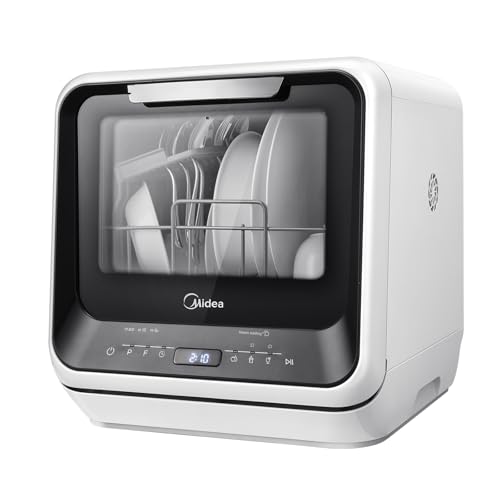
For a kitchen without plumbing, the no-plumbing claim in the supplied Amazon AU evidence applies to the Midea Mini Plus 7+3 Programs MDWMINIPLUS. The two listings below have 3 place settings each.
Midea Mini Plus 7+3 Programs MDWMINIPLUS
The Amazon AU listing for ASIN B0CKHV6RBM states "No Plumbing Required" and lists a 6 L built-in water tank you fill manually, or an optional tap connection using the included hose. The Midea Mini Plus 7+3 Programs MDWMINIPLUS has 3 place settings and about 58 dB(A).
Benchtop vs full-size: which is right for you?
Decide first on installation, then on capacity. A full-size or slimline dishwasher is plumbed in, and the models here are 450 to 600 mm wide. Check the exact model's installation instructions for the cavity, clearances and connections it needs. The full-size and slimline models in this guide hold 10 to 16 place settings, and they range from 41 to 52 dB(A) on their published noise figures.
A benchtop unit sits on the counter and holds 3 place settings, so it suits a smaller number of dishes at a time and a kitchen where a built-in is not an option, such as a rental. Of the two Amazon AU listings in the benchtop section above, the Midea Mini Plus MDWMINIPLUS listing states that no plumbing is required, filling from a 6 L tank or an optional tap connection with the included hose.
If you can plumb in a built-in, choose from the full-size or slimline models above on capacity, noise and the energy and water labels. If you cannot, use the benchtop section. Either way, compare the model's listed width with your available width, then check height, depth, door clearance and water and waste connections before you buy.
What Size Dishwasher Do You Need?
Dishwasher capacity is measured in place settings, a rough guide to how many people's dishes a full load holds. If you are also buying mugs, plan for them in that count. Use capacity as a starting point for the dishes, glasses and cooking items you normally load. The full-size and slimline models here span 10 to 16 place settings; choose around your loads rather than a fixed household-size threshold.
- 10 place settings: Bosch Series 6 SPS6IKI01A offers this capacity in a 450 mm-wide slimline model. Consider it when width is restricted and that capacity fits your normal loads.
- 13 place settings: Haier 300 Series HDW13F0W1 and Solt GGSDW6013W sit at this capacity. Compare it with the amount you usually load.
- 14 place settings: Hisense HSCE14FS and Miele G 5210 SC CLST offer one more place setting than the listed 13-place models.
- 15 place settings: Bosch Series 6 SMS6HCI02A, SMU6HCS01A and SMV6HCX03A, plus LG XD3A15MB, offer this capacity. Compare these when you want more capacity than the listed 13- and 14-place models.
- 16 place settings: Hisense HSAA16FS has the largest capacity in the ten-model comparison. Check it against your larger regular loads.
Check height, depth, door clearance and water and waste connections as well as width before choosing an installation type.
Dishwasher Features That Actually Matter
Worth prioritising: drying, noise and loading
Check the drying features on the exact model. Bosch Series 6 SMS6HCI02A combines heat-exchanger drying with Extra Dry; SMU6HCS01A, SMV6HCX03A and SPS6IKI01A also list Extra Dry. LG XD3A15MB lists Auto Open Dry for steam release, while Miele G 5210 SC CLST lists AutoOpen drying.
If your priority is a published noise figure below 44 dB(A), LG XD3A15MB is the qualifying model in this ten-model comparison at 41 dB(A). Bosch Series 6 SMS6HCI02A, SMU6HCS01A and SMV6HCX03A are each listed at 44 dB(A).
For loading features, Bosch Series 6 SMS6HCI02A lists a Rackmatic height-adjustable basket, and SMU6HCS01A and SMV6HCX03A also list Rackmatic. LG XD3A15MB has EasyRack Plus, Miele G 5210 SC CLST has a 3D MultiFlex tray, and Haier 300 Series HDW13F0W1 has an adjustable upper rack.
Nice to have: connectivity and scheduling
Treat connectivity as a preference when choosing between these models. Bosch Series 6 SMS6HCI02A, SMU6HCS01A and SMV6HCX03A list Wi-Fi Home Connect; SPS6IKI01A lists Wi-Fi, and LG XD3A15MB lists ThinQ Wi-Fi. Solt GGSDW6013W lists half load and delay start.
Dishwasher Running Costs Australia 2026
The Bosch Series 6 SMS6HCI02A example below works out at roughly 22 cents of electricity a wash. To calculate electricity cost, divide the model's yearly energy figure by the number of cycles behind that figure, then multiply by your electricity rate.
The Good Guys specification table for the Bosch SMS6HCI02A lists 245 kWh a year, and energyrating.gov.au explains that the Australian energy label assumes about seven uses a week. Using seven washes a week as 7 x 52 = 364 washes for this illustration, the calculation is 245 kWh / 364 washes x 33 cents per kWh = roughly 22 cents of electricity per wash. The tariff input is about 33 cents per kWh including GST from the Australian Energy Regulator's 2026-27 default market offer cap for Ausgrid.
At one wash a day, roughly 22 cents x 365 washes comes to about 80 dollars a year for electricity. Water and detergent are extra, and our best dishwashing tablets guide compares detergent options. Rates and cycle bases vary, so use your own rate from your bill and the cycle basis printed on your model's label; LG XD3A15MB, for example, states its figure per 365 uses.
A dishwasher is one of the appliances to plan alongside a washing machine when you set up a new home. The listed labelled-programme water use figures span 9.2 to 12.7 L across these ten models (the LG XD3A15MB figure is for its Eco plus Energy Saver programme):
| Model | Eco-cycle water use |
|---|
| Bosch Series 6 SMS6HCI02A | 11 L |
| Bosch Series 6 SMU6HCS01A | 11 L |
| Bosch Series 6 SMV6HCX03A | 11 L |
| Bosch Series 6 SPS6IKI01A | 11.2 L |
| LG XD3A15MB | 11.1 L |
| Miele G 5210 SC CLST | 9.2 L |
| Hisense HSAA16FS | 10.6 L |
| Hisense HSCE14FS | 12.7 L |
| Haier 300 Series HDW13F0W1 | 11.8 L |
| Solt GGSDW6013W | 11 L |
Frequently Asked Questions
What's the best dishwasher in Australia in 2026?
This guide does not name one best dishwasher; it compares ten full-size models on published specifications. The Bosch Series 6 SMS6HCI02A combines 15 place settings, 44 dB(A), 4.0 energy stars, 5.5 water stars, Wi-Fi Home Connect and heat-exchanger drying. LG XD3A15MB is quieter at 41 dB(A), Hisense HSAA16FS holds more at 16 place settings and rates higher at 4.5/6.0 energy/water stars, and Miele G 5210 SC CLST also rates 4.5/6.0. This comparison comes from desk research.
Which dishwasher brand is most reliable in Australia?
This guide compares published specifications, not reliability surveys, and has no Australian failure-rate data to rank brands. Bosch lists AquaStop for the Series 6 SMS6HCI02A, SMU6HCS01A and SMV6HCX03A; LG lists a 10-year parts warranty for the XD3A15MB's Inverter Direct Drive motor. Miele states that the G 5210 SC CLST is "tested for the equivalent of 20 years' service life" during development, defined as 5,600 wash cycles, about 280 a year, from testing during the development of the G 5000 and G 7000 series. Miele's warranty for that model is two years and extendable.
What's the quietest dishwasher in Australia?
LG XD3A15MB is the quietest of the ten full-size and slimline models in this guide, with a published noise figure of 41 dB(A). Bosch Series 6 SMS6HCI02A, SMU6HCS01A and SMV6HCX03A are each listed at 44 dB(A). The 45 cm Bosch Series 6 SPS6IKI01A is listed at 48 dB(A).
How many place settings do I need?
Choose capacity around your normal loads, without a fixed household-to-place-setting rule. The full-size and slimline models in this guide span 10 to 16 place settings. Compare those capacities with the dishes, glasses and cooking items you usually load, and check the rack layout for the exact model.
Is a dishwasher cheaper than hand washing?
It depends on your own rates, so compare rather than assume. To estimate a dishwasher's electricity per wash, take its yearly energy figure from energyrating.gov.au, divide by the number of cycles behind it (the energy label assumes about seven washes a week, or 364 a year) and multiply by your electricity rate; on the running-costs example the Bosch Series 6 SMS6HCI02A works out at roughly 22 cents of electricity a wash. Add water from the model's WELS water use per wash and your water rate. Hand washing uses however much hot water you run, so the comparison depends on your habits and your own rates, not a single published figure.
What's the cheapest dishwasher worth buying in Australia?
Solt GGSDW6013W is the cheapest of the models with checked price bands, with 13 place settings and a published noise figure of 52 dB(A). Hisense HSCE14FS is another budget option, with 14 place settings and 49 dB(A). The comparison table shows their price bands, checked on 30 September 2026.
Freestanding vs integrated dishwasher: which is better?
Neither is better; they are different installation types. A freestanding dishwasher has finished sides and a finished top, so it can stand alone or slide under a benchtop; a built-under model has a finished front but no top so it fits under a continuous benchtop; a fully integrated model sits behind a cabinet door with its controls on the top edge. Among the models in this guide, the Bosch Series 6 SMU6HCS01A is the built-under option and the Bosch Series 6 SMV6HCX03A is the fully integrated option, the Bosch Series 6 SPS6IKI01A is a 450 mm slimline, and the rest are freestanding. Match the installation type to your kitchen, then compare capacity, noise and the energy and water labels.
Is Miele better than Bosch?
Choose between these models according to the specifications that matter to you. Bosch Series 6 SMS6HCI02A has 15 place settings, 44 dB(A), 4.0/5.5 energy/water stars, Wi-Fi Home Connect and heat-exchanger drying. Miele G 5210 SC CLST has 14 place settings, 45 dB(A), 4.5/6.0 energy/water stars and QuickPowerWash for a full load in under an hour. Miele's statement that this model is "tested for the equivalent of 20 years' service life" refers to testing during the development of the G 5000 and G 7000 series, 5,600 wash cycles or about 280 a year; it is not a guaranteed lifespan.
Which dishwasher brands should you stay away from?
We do not single out brands to stay away from. Avoid a model if you cannot confirm Australian parts and service, if its capacity is too small for your household, or if its installation type does not fit your kitchen. Confirm support and installation requirements before buying, and read reviews for the exact model code.
What are the top 5 rated dishwashers in Australia?
We do not rank dishwashers by star ratings. Judged on the published specifications in the comparison table, which are energy and water stars, noise and capacity, five strong full-size options are the Bosch Series 6 SMS6HCI02A, the fully integrated Bosch Series 6 SMV6HCX03A, the quiet LG XD3A15MB at 41 dB(A), the premium Miele G 5210 SC CLST at 4.5 energy and 6.0 water stars, and the high-capacity Hisense HSAA16FS at 16 place settings and 4.5/6.0 stars. That is a specification comparison, not a ranking by customer ratings.
How long does a dishwasher last?
Miele states that the G 5210 SC CLST is "tested for the equivalent of 20 years' service life", which it defines as 5,600 wash cycles, about 280 a year, from testing during the development of the G 5000 and G 7000 series; that is a development test, not a guarantee. LG lists a 10-year parts warranty for the XD3A15MB's Inverter Direct Drive motor, and Miele's warranty for the G 5210 SC CLST is two years and extendable. Check the current warranty terms for the exact model before buying.
How do you clean a dishwasher?
Bosch's manual for the Series 6 SMS6HCI02A says to check the filters for residue after each wash, turn the coarse filter anticlockwise, lift out the filter system and rinse the parts under running water; if dishes are not coming out clean, clean the spray-arm nozzles under running water. Run Machine Care when prompted; if the appliance lacks a reminder function, Bosch recommends every two months. The manual says to use only cleaners made for dishwashers, never chlorine-based or abrasive cleaners, and wipe the door seals with a damp cloth. Follow the manual for your own model.
What is the best dishwasher under $1,000 in Australia?
Among the models here with prices verified under $1,000 at Australian retailers, the Hisense HSAA16FS (under $900) offers the most capacity at 16 place settings with 4.5 energy stars and 6.0 water stars; the Hisense HSCE14FS (under $700) has 14 place settings and 49 dB(A); and the Solt GGSDW6013W (under $500) is the cheapest at 13 place settings and 52 dB(A). Pick on capacity and noise within your budget. The comparison table shows the price bands, verified on 30 September 2026.