Best Knife Sharpeners in Australia 2026: Electric, Pull-Through & Guided Compared
By Anish Puri·2 June 2026·Last updated 6 September 2026·9 min read
A dull knife is the dangerous one. Here's how to keep your kitchen knives genuinely sharp, and which sharpener type is right for your knives and your skill level.
Prices checked 17 October 2026 on Amazon AU and subject to change.
A sharp knife is one of those things you only appreciate once you have one, and only realise you have been missing once you sharpen a knife that has been quietly going dull for two years. The kitchen knife you bought when you moved in, or the one that came in your block knife set, was sharp from the factory, and it has been losing that edge a fraction at a time with every cut since. Most Australian households never sharpen their knives at all, then blame the knife when slicing a tomato turns into sawing it.
The good news is that keeping a knife sharp is cheap, quick, and genuinely easy, provided you pick the right tool for your knives and your skill level. You can spend $22 or $140, and both are sensible buys for different people. The question is not which sharpener is best in the abstract; it is which one matches the knives you own and how much you care about them.
Here is what the different types of sharpener actually do, the difference between honing and sharpening that almost everyone gets wrong, what angle you should be sharpening at, and the three sharpeners worth buying in Australia in 2026.
Why a Sharp Knife Matters (and Why a Dull One Is Dangerous)
The most common misconception in the kitchen is that a sharp knife is the dangerous one. The opposite is true. A sharp knife bites into food cleanly with light pressure and goes where you point it. A dull knife slides off the skin of a tomato or an onion, needs far more force to cut, and when it finally slips (because you were leaning on it hard), it carries all that force into your fingers. Most serious kitchen cuts happen with blunt knives, not sharp ones.
Beyond safety, a sharp knife is simply more pleasant to use. Prep that felt like a chore (dicing onions, slicing a roast, halving a crusty loaf) becomes quick and clean. Food looks better because the cuts are clean rather than crushed, and herbs and tomatoes do not bruise. If cooking at home has started to feel like hard work, a dull knife is often quietly part of the reason, and it is the single cheapest thing in the kitchen to fix.
Budget pick
SHARPAL
SHARPAL 191H Pocket Kitchen Chef Knife & Scissors Sharpener
4.5(49,420)
$26.99
Amazon.com.au price as of 05:01 am AEDT, subject to change
As an Amazon Associate, NestPath earns from qualifying purchases.
Honing vs Sharpening: the Difference Everyone Confuses
This is the single most important thing to understand, because almost everyone gets it wrong, and getting it wrong is why so many home knives are dull despite their owner "sharpening" them regularly. Honing and sharpening are two different jobs.
Honing is what you do with the long steel rod that comes in nearly every knife block. A honing steel does not sharpen. It removes almost no metal. As you use a knife, the very fine edge rolls over microscopically to one side and stops cutting cleanly. The steel simply pushes that rolled edge back into alignment, straightening it so the existing sharpness works again. You hone often (every few uses, or even before each cooking session), and it takes a few seconds.
Sharpening is a fundamentally different process: it actually grinds away a small amount of metal to form a brand-new edge. Over time, honing can only straighten an edge so many times before the edge itself wears down and there is nothing left to realign. At that point the steel does nothing and you need a real sharpener (a pull-through, an electric, a whetstone, or a guided system) to cut a fresh edge into the blade. You sharpen occasionally, every few months for a typical home cook.
So the rule is simple: hone often, sharpen occasionally. If you have been faithfully running your knife along the steel from the block and wondering why it is still dull, this is why: you have been honing a knife that needed sharpening. The rod keeps a sharp knife sharp; it cannot rescue a dull one.
The Types of Knife Sharpener: Which Is Right for You
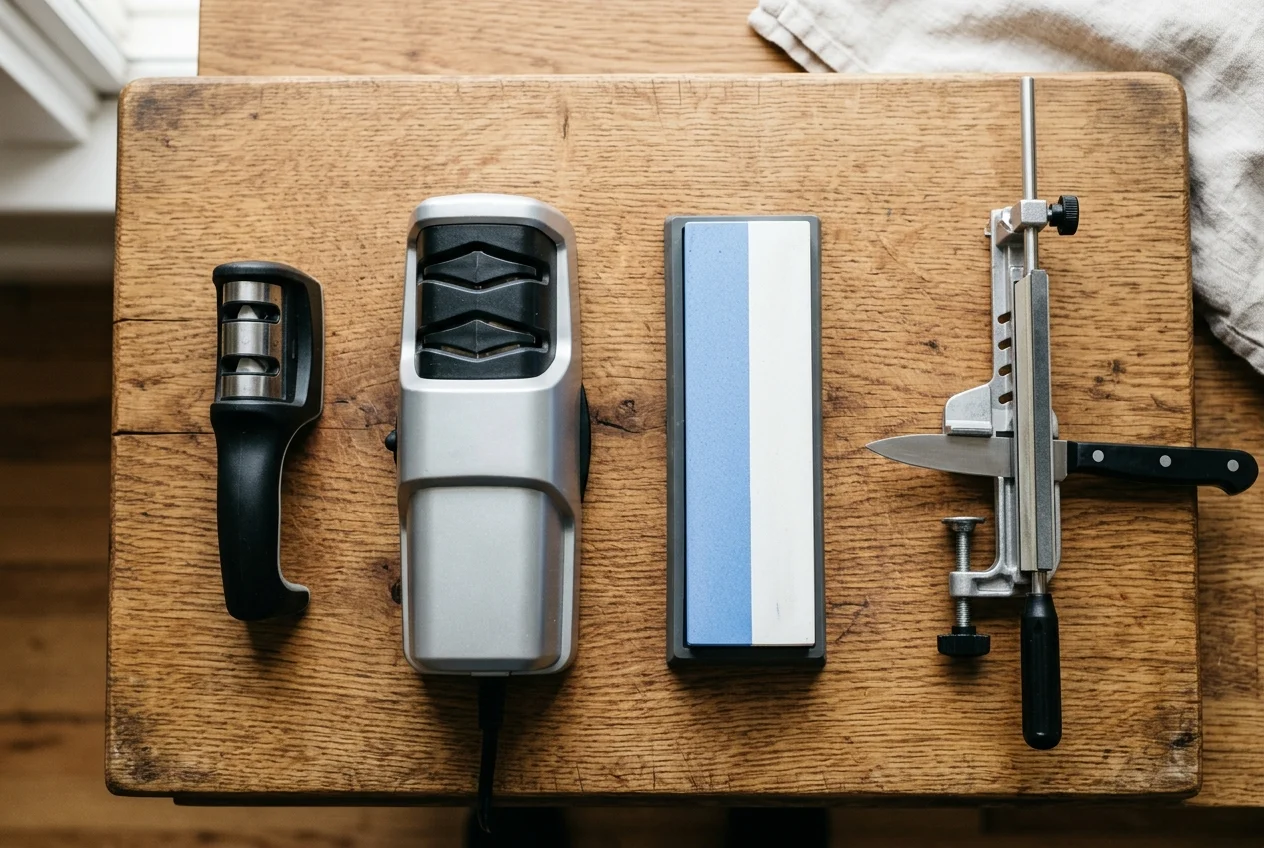
There are four broad families of sharpener, and the right one depends entirely on what knives you own and how much control you want. Here is the honest version of each.
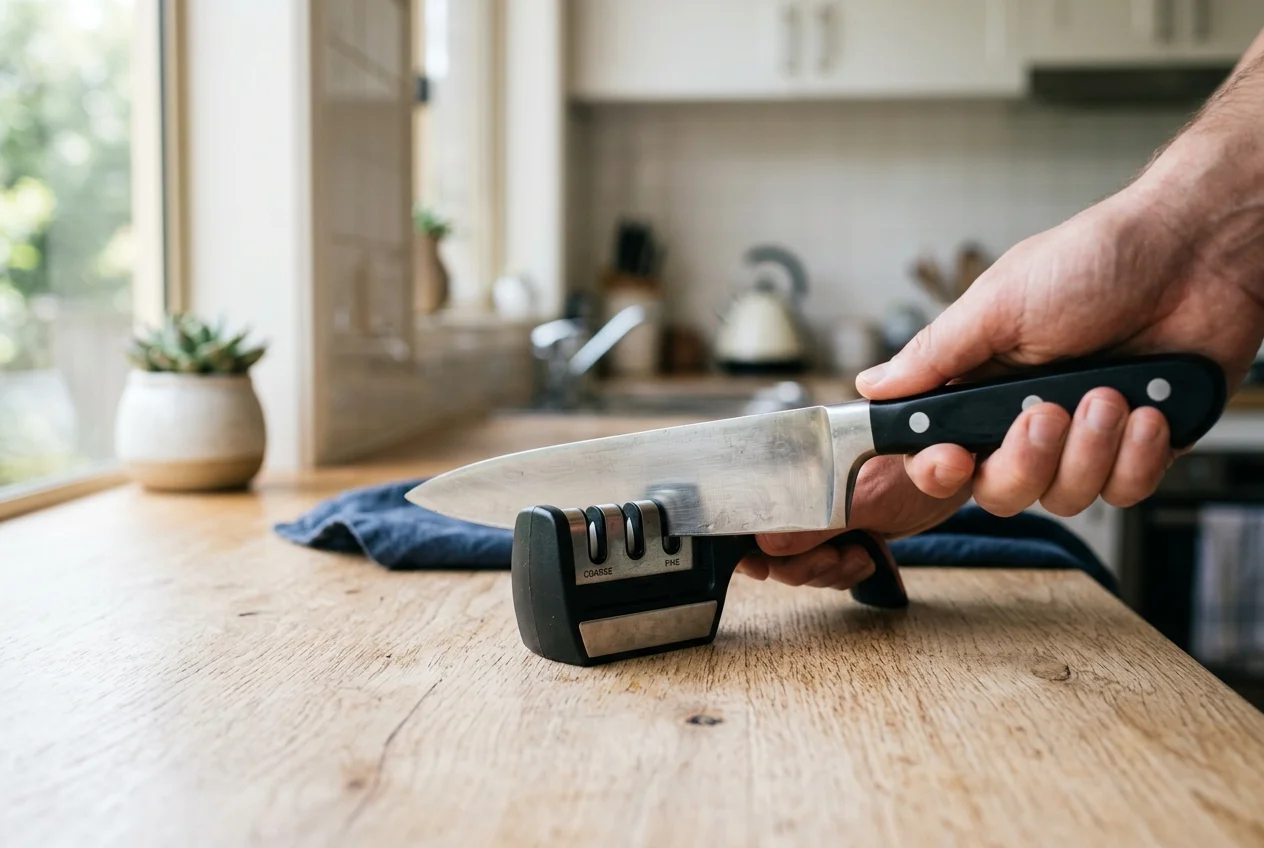
Pull-through / manual sharpeners are the cheapest and simplest: a handheld body with one or more slots you draw the blade through. The slots hold abrasives (often a carbide slot for coarse work and a ceramic slot for finishing) set at a fixed angle, so there is nothing to learn: you pull the knife through a few times and it is sharper. The trade-off is that the angle is fixed and the carbide stage is aggressive. It removes a noticeable amount of metal each time. That is completely fine for everyday and inexpensive knives, but it is too crude for premium blades. For a casual cook with a drawer of ordinary kitchen knives, a pull-through is genuinely all you need.
Electric sharpeners use motorised abrasive wheels and usually run two or three stages: a coarse grinding stage, a finer honing stage, and sometimes a ceramic polishing stage. They are fast, consistent and require no skill: the motor does the work and the slots hold the angle for you. The multi-stage design means they can both rebuild a tired edge and finish it cleanly. The catch is that they still sharpen at a fixed-ish angle and, like a pull-through, remove metal faster than a stone. For most home cooks who want a proper sharpener without a learning curve, this is the convenient all-rounder.
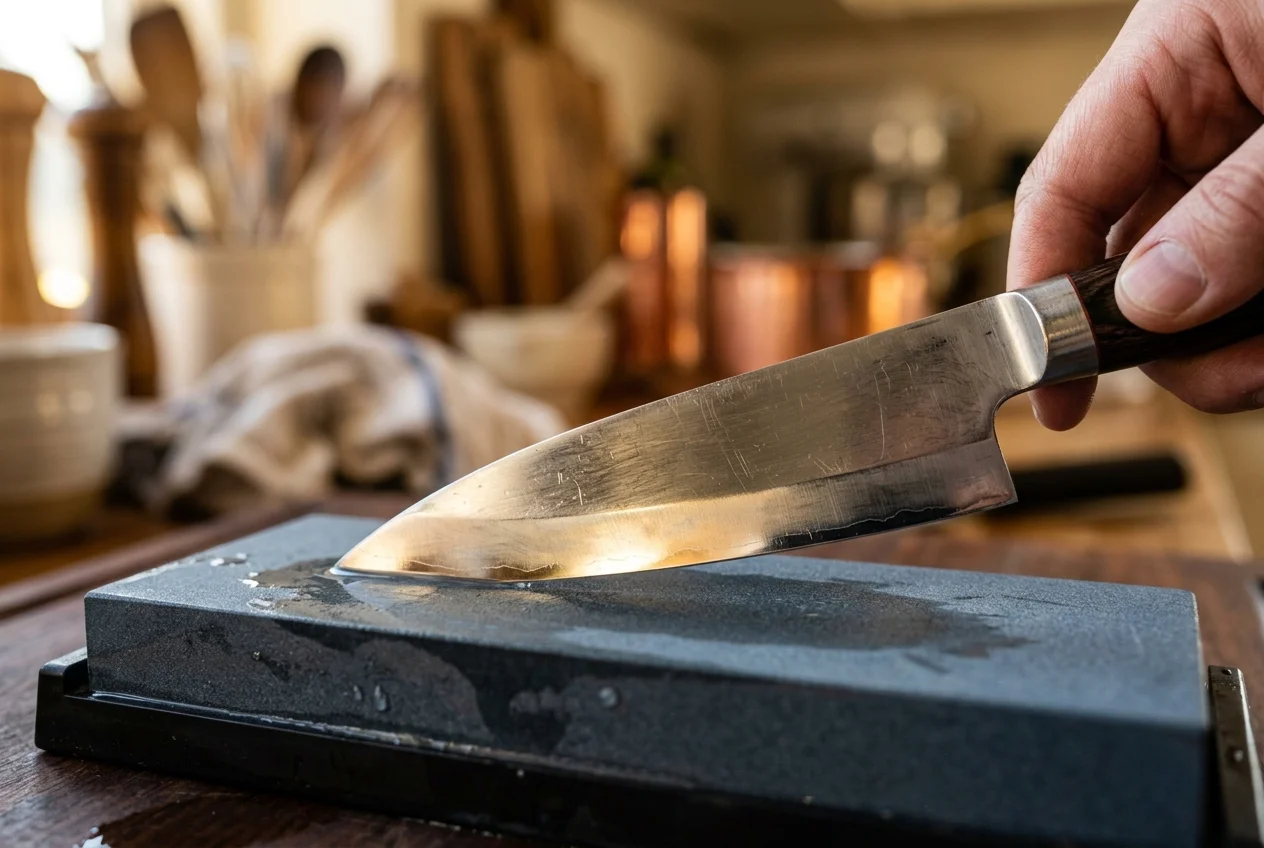
Whetstones (sharpening stones) give the best, most controlled edge of any method and remove the least metal, which is exactly why they are the choice for good knives and for Japanese knives in particular. You control the angle entirely by hand, so a skilled user can match any blade precisely and take off only what is needed. The honest downside is the learning curve: holding a consistent angle freehand takes genuine practice, and your first few attempts will probably make a knife duller before they make it sharper. Worth learning if you care about your knives; not the place to start if you just want a sharp bread knife tonight.
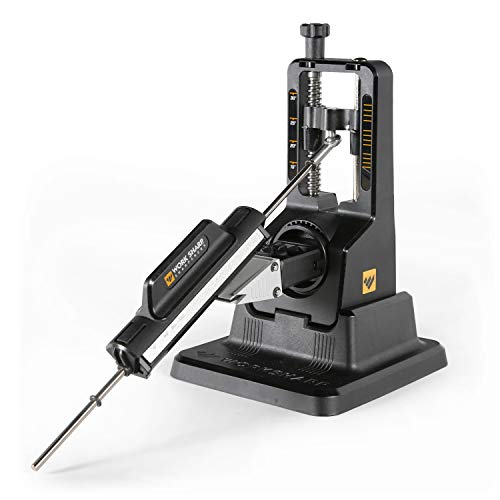
Guided-angle and rolling systems are the bridge between electric convenience and whetstone control. A guided system clamps the knife and lets you set a precise, repeatable angle. You draw the abrasive across the edge and every stroke meets the blade identically, so you get whetstone-style control without the years of freehand practice. Magnetic rolling sharpeners work on a similar principle, holding the abrasive at a fixed angle as it rolls. These give you a cleaner, more controlled edge than an electric while being far more forgiving than a bare stone. This is the keen cook's sweet spot.
Top pick
SHARPAL
SHARPAL 198H Electric Knife Sharpener (3-Stage)
4.6(2,184)
$99.99
Amazon.com.au price as of 11:01 am AEDT, subject to change
As an Amazon Associate, NestPath earns from qualifying purchases.
What Angle Should You Sharpen At?
The angle you sharpen at (measured from the flat of the blade to the abrasive, per side) is what determines how sharp and how durable the edge is. A finer (smaller) angle is sharper but more delicate; a wider angle is more robust but less keen. The mistake to avoid is sharpening a knife at the wrong angle for its design.
Western and European knives (your typical German-style chef's knife, the kind most Australian households own) are usually ground at around 20 degrees per side. They are built to be a bit tougher and more forgiving, which suits everyday kitchen use.
Japanese knives are ground much finer, often around 15 degrees per side, which is what gives them that famously keen, precise edge. The catch is that the fine edge is also more delicate. If you run a Japanese knife through a pull-through or electric sharpener set to a Western 20-degree angle, you grind away that fine geometry and effectively turn an expensive Japanese knife into a blunter Western one. You cannot undo it without re-profiling the whole edge on a stone. This is the single biggest reason premium Japanese knives should go on a whetstone or a guided system you can set to the correct angle, never through a fixed-angle pull-through.
The practical takeaway: match the tool to the knife. Fixed-angle pull-throughs and most electrics are built around the Western 20-degree standard, which is perfect for ordinary kitchen knives. If you own finer Japanese blades, you want a method where you control the angle, which is exactly what the guided system below is for.
How Often Should You Sharpen?
For a typical home cook, the rhythm is: hone every few uses, and sharpen every few months. If you cook daily or do a lot of prep, sharpen more often, perhaps monthly. If your knives mostly sit in the block and come out at the weekend, a couple of times a year is plenty. The knife tells you when it is time, and there are two quick tests.
The paper test: hold a sheet of paper up by one edge and try to slice down through it with the knife. A sharp knife glides through and cuts a clean line; a dull one catches, folds, or tears the paper rather than slicing it. It is the fastest way to check an edge in a couple of seconds.
The tomato test: rest the blade on the skin of a ripe tomato and draw it back gently without pressing down. A sharp knife bites in and starts slicing under its own weight; a dull one skids across the skin and needs you to push. A tomato is unforgiving because the smooth skin sits over soft flesh, which is exactly why it is the classic real-world sharpness check.
Can You Sharpen Serrated Knives and Scissors?
Serrated knives (bread knives, most steak knives) need a different approach, and this trips a lot of people up. The teeth of a serrated blade each have their own little bevel, so you cannot run them through a standard pull-through or electric sharpener; doing so just grinds down the points of the serrations and ruins them. Serrated edges are sharpened with a specific tapered rod (a ceramic or diamond rod that fits into each gullet), or sent to a professional sharpening service. The upside is that serrated knives hold their usable bite far longer than a straight edge, so they need attention only rarely.
Scissors are a different question again. Some sharpeners (including the budget pick below) include a dedicated scissors slot that sharpens each blade of the scissors as you draw it through. It is a handy bonus for kitchen shears and household scissors, though it will not rescue badly damaged or very high-end scissors. If a sharpener does not have a scissors slot, do not try to force scissors through the knife slots. The geometry is wrong and you will make them worse.
Also great
Work Sharp
Work Sharp® Precision Adjust Professional
4.4(1,036)
$139.95
Amazon.com.au price as of 11:01 pm AEDT, subject to change
As an Amazon Associate, NestPath earns from qualifying purchases.
Safety and Technique Basics
Sharpening is low-risk if you follow a few basics, and genuinely hazardous if you do not. You are, after all, deliberately making a blade as sharp as possible. A handful of habits cover almost everything.
Always work away from your body. Whatever the method, the cutting edge should be travelling away from your hands and torso, never towards them. With a pull-through or electric, keep your free hand clear of the slot. With a stone or guided system, set up so a slip sends the blade away from you.
Secure the sharpener or stone. A sharpener that slides around mid-stroke is how accidents happen. Most pull-throughs and electrics have a non-slip base or a handle to brace. Use a stable benchtop, not a wobbly chopping board. Whetstones should sit on a damp cloth or a dedicated holder so they cannot skate.
Use light, consistent pressure and let the tool do the work. The instinct is to bear down hard, but pressure does not make a sharpener work faster. It just removes metal unevenly and wears the abrasive. Light, even strokes at a consistent angle give a better edge than heavy ones, on every type of sharpener. Take your time, keep the pressure steady, and let the abrasive do what it is designed to do.
Frequently Asked Questions
What is the difference between honing and sharpening?
Honing realigns an existing edge; sharpening creates a new one. A honing steel (the rod that comes with most knife blocks) removes almost no metal and simply straightens the fine edge that rolls over with use, which is why you do it often, even before each cooking session. Sharpening actually grinds away a small amount of metal to form a fresh edge, using a pull-through, electric, whetstone, or guided system, and you only need to do it every few months. The common mistake is honing a knife that has gone genuinely dull. Once the edge has worn down, the steel can no longer realign it and only a real sharpener will bring it back.
Are pull-through knife sharpeners bad for your knives?
Pull-through sharpeners are not bad for everyday knives, but they are aggressive. They sharpen at a fixed angle and the coarse carbide stage removes a noticeable amount of metal each time, which is completely fine for ordinary, inexpensive kitchen knives and is the whole reason they are so quick and easy. The problem is using one on knives you care about long-term (premium or Japanese blades), where the metal removal and fixed angle steadily wear down the blade and ruin a fine edge. For a drawer of everyday knives, a pull-through is a sensible, cheap choice; for good knives, use a whetstone or a guided system instead.
Electric vs whetstone knife sharpener: which is better?
Neither is universally better. They suit different people. An electric sharpener is fast, consistent and needs no skill: the motorised stages do the work and hold the angle for you, which makes it the convenient choice for most home cooks who just want sharp everyday knives. A whetstone gives the best, most controlled edge and removes the least metal, which is why it is the choice for good and Japanese knives, but it has a genuine learning curve and takes practice to hold a steady angle by hand. If you want quick results with no technique to learn, choose electric; if you care deeply about your knives and are willing to practise, choose a stone. A guided system sits between the two, giving stone-like control without the freehand skill.
What angle should you sharpen a kitchen knife at?
It depends on the knife. Western and European knives (the typical chef's knife most Australian households own) are usually sharpened at around 20 degrees per side, which gives a tough, everyday edge. Japanese knives are ground much finer, often around 15 degrees per side, for a keener but more delicate edge. The key rule is not to sharpen a Japanese knife at a Western angle: running a fine Japanese blade through a fixed 20-degree pull-through grinds away its geometry and turns it into a blunter Western-style edge. Most pull-throughs and electrics are built around the 20-degree standard, so for finer knives use a whetstone or a guided system you can set to the correct angle.
How often should you sharpen your knives?
For most home cooks, hone every few uses and sharpen every few months. If you cook daily or do heavy prep, sharpening monthly keeps the edge keen; if your knives mostly stay in the block, a couple of times a year is plenty. The knife will tell you when it is due: use the paper test (a sharp knife slices cleanly through a held sheet rather than tearing it) or the tomato test (a sharp knife bites into the skin of a ripe tomato under its own weight rather than skidding across it). Honing in between keeps a sharp knife sharp for far longer, so the more diligently you hone, the less often you need to sharpen.
Can you sharpen serrated knives?
Yes, but not with a standard sharpener. Serrated knives (bread knives and most steak knives) have individual teeth, each with its own bevel, so running them through a pull-through or electric sharpener just grinds down the points and ruins them. Instead, serrated edges are sharpened one gullet at a time with a tapered ceramic or diamond rod, or sent to a professional sharpening service. The upside is that serrated knives hold their usable bite far longer than a straight edge, so they need attention only rarely. Many home cooks go years without sharpening a bread knife.
What is the best knife sharpener for beginners?
For a complete beginner who just wants sharp everyday knives with zero technique, a 3-stage electric sharpener is the easiest path: you feed the blade through and the motorised stages handle the grinding, honing and polishing at a consistent angle. A pocket pull-through is the cheapest beginner option and works the same way for a few seconds of effort, though it is more aggressive on the blade. If you want to learn to do the job properly without the steep freehand learning curve of a whetstone, a guided-angle system is the beginner-friendly route to a precise, repeatable edge: you set the angle on a dial rather than holding it by hand. Avoid starting on a bare whetstone unless you are happy to practise.
DETAILED REVIEWS
Budget pick
SHARPAL
SHARPAL 191H Pocket Kitchen Chef Knife & Scissors Sharpener
4.5(49,420)
$26.99
Amazon.com.au price as of 05:01 am AEDT, subject to change
Affiliate Disclosure: As an Amazon Associate, NestPath earns from qualifying purchases. This means if you click a product link and buy something, we may receive a small commission at no extra cost to you. We only recommend products we genuinely believe will help new homeowners. This does not influence our recommendations.
CERTAIN CONTENT THAT APPEARS ON THIS SITE COMES FROM AMAZON. THIS CONTENT IS PROVIDED ‘AS IS’ AND IS SUBJECT TO CHANGE OR REMOVAL AT ANY TIME.