How heavy will you lift? That is the real question
Before you compare a single spec, answer this: are you mostly doing dumbbell and bodyweight work, or do you plan to load a barbell? It is the question that splits this whole category in two. A light foldable bench like the FitGoods or Gymenist packs into a closet, needs little or no assembly and handles incline, decline and flat dumbbell work for under 120 dollars. A heavy-duty bench like the JOROTO or the commercial REP AB-3000 weighs more, stays put and holds a steady angle under a fully loaded barbell. Get that one decision right and the rest is easy.
The six picks below run from the FitGoods up to the REP, and they map onto that split: the first two are foldable benches for the simplest, most space saving setup, the middle three are heavier benches for people who lift more seriously, and the REP is a true commercial bench. The other things worth weighing as you read are FID adjustability - whether a bench flips from flat to incline to decline - along with weight capacity, build certification and footprint, so match the bench to how you will actually train and you will not overspend.
FitGoods Adjustable Weight Bench
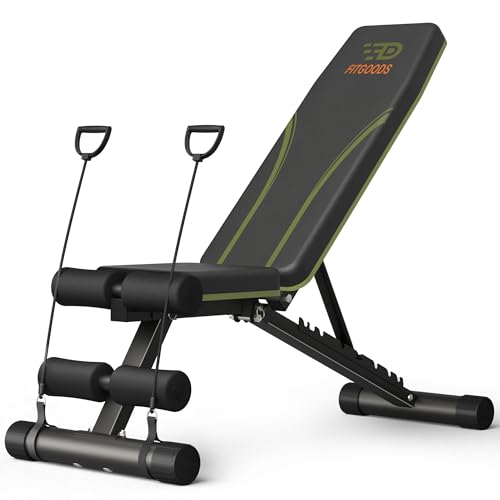
If you just want a proper adjustable bench without spending much, the FitGoods is the entry point. It is the cheapest pick here, and it does the FID job well: 9 backrest positions let you run incline, decline, flat and sit up movements off one frame, and the high strength steel is rated to a 700 lb total capacity, which is comfortably enough for dumbbell work and lighter barbell sessions.
It arrives 95 percent pre-assembled and folds down to a compact 31.5 by 11.1 by 7.5 inches, so it tucks into a closet between workouts, and non-slip stripes on the cushion stop you sliding on steeper angles. Two resistance bands are thrown in as well, and our resistance band sets for a home gym guide shows what a full band kit adds. The trade-offs at this price are honest ones: the review base is smaller at around 90 ratings, so there is less long-term feedback than the bigger sellers carry, and a 700 lb frame is built for moderate loads rather than maximal barbell pressing.
Gymenist Folding Exercise Bench
The Gymenist is the pick if you want an adjustable bench that needs no setup at all and disappears when you are done. It arrives ready to use with no assembly required, the backrest moves through incline, flat and decline, and the seat itself adjusts to three positions so you stay locked in place rather than sliding down on a steep incline.
It folds flat for carrying and storage, which makes it a genuinely good travel and small-space option, and with more than 1,300 ratings it has a far broader track record than the budget pick. The honest caveat is that this is a lighter, compact bench built for dumbbell and bodyweight work rather than heavy loaded barbell pressing, so if your plan is to build up to a serious barbell program you will eventually outgrow it.
JOROTO MD80 Adjustable Weight Bench
The JOROTO MD80 is the bench to buy when you actually want to load a barbell, because it is built like commercial gym kit rather than a folding home unit. The frame uses thick commercial steel with dual back-support tubes and a 1,000 lb rated capacity, so it stays planted under heavy presses, and the 6 backrest and 2 seat positions cover upright, incline, decline and flat.
The padding is a generous 2.4 inches thick under sweat-proof leather, the backrest runs 34 inches so taller lifters get head and neck support, and built-in wheels and handles make a heavy bench easy to reposition. The honest trade-off is that it weighs about 24 kg and does not fold, so it is a stay-put bench you find a permanent spot for rather than something you tuck away after each session.
YOLEO Adjustable Weight Bench
The YOLEO is the standout for value, and the one bench here with both formal certification and an enormous happy review base. The steel is ASTM-certified and rated to 827 lb, the double-triangle frame with double supports keeps it stable under tough sessions, and 6 back, 4 seat and 3 leg adjustments give you 84 position combinations so you can fine-tune almost any angle.
It arrives 98 percent pre-assembled, folds down for storage and uses a fast ladder-style adjustment that locks in seconds, and with well over 4,700 ratings it has by far the largest track record in this guide. The honest caveat is that at this price you are close to the heavy-duty JOROTO, which carries a higher 1,000 lb rating, so the choice comes down to certification and foldable storage versus outright load rating.
FLYBIRD Flat Weight Bench
The FLYBIRD is the pick if you have decided you want a dedicated flat bench rather than an adjustable one, because a fixed flat platform is inherently more stable than any folding hinge. It is rated to a 1,000 lb capacity with excellent welding and no wobble, arrives with no assembly and still folds for storage under a bed, and the 45.3 inch extended cushion gives you room to lie back fully on thick PU leather padding.
A pin and spring lock plus non-slip foot caps add a second layer of stability for heavy work. The important honest caveat is that this one is flat only - it does not incline or decline - so if you want angled pressing or sit-ups, one of the FID benches above is the better buy despite this flat bench costing more than several of them.
REP Fitness AB-3000 FID Bench
The REP AB-3000 is the genuine commercial-grade bench in this guide, and it is built to a standard the others simply do not reach. The frame is heavy 11-gauge steel with a 1,000 lb capacity, the back pad offers eight common-degree angles from -12 to 85 with laser-cut numbering so you can repeat a setting exactly, and a five-position seat plus a built-in six-position leg roller lock you in for incline and decline work.
The dense CleanGrip pads, wider rear base and rubber-covered feet make it feel like gym equipment rather than home kit, and it protects your flooring while it grips. The honest trade off is the price: it is a serious commercial bench and frankly overkill for most home lifters, who will be very well served by the JOROTO or YOLEO at a fraction of the cost. This one is for the dedicated lifter building a long-term garage gym, not the casual buyer.
How to match the bench to how you will train
The single biggest mistake is buying for the training you imagine rather than the training you will actually do. If the honest answer is dumbbell work, bodyweight movements and the occasional light barbell session, a foldable FID bench is the smart buy, and it packs away when you are done. If you are committing to a loaded barbell program, a heavy-duty bench with a 1,000 lb rating like the JOROTO earns its keep by staying rock-solid under the bar.
Footprint is the other deciding factor. A foldable bench like the FitGoods, Gymenist or YOLEO collapses into a closet or under a bed, which matters enormously in an apartment or shared space. A non-folding heavy bench like the JOROTO or the REP needs a permanent home, but rewards you with stability you cannot get from a hinge. Be realistic about your space and your real lifting plans, because the best bench is the one that is stable enough for your loads and still fits your room.
What the key specs actually mean
A few details do most of the work when you compare these benches. FID stands for flat, incline and decline, and a true FID bench flips between all three so you can press at different angles off one frame - the FitGoods, Gymenist, JOROTO, YOLEO and REP all do this, while the FLYBIRD is flat only. Backrest positions tell you how finely you can dial the angle: more positions, like the YOLEO with its 84 combinations or the REP with eight numbered angles, mean you can fine-tune and repeat a setting exactly.
Weight capacity is the headline safety number, but read it as the total of your bodyweight plus the load - a 1,000 lb rating like the JOROTO or REP leaves huge headroom for barbell work, while a 700 lb rating suits dumbbells and lighter lifting. Certification, such as the YOLEO ASTM rating or the REP 11-gauge steel, is your evidence the capacity is real rather than a marketing figure. Read FID adjustability, backrest positions, weight capacity and certification together and any product page starts to make sense.
Frequently Asked Questions
What does FID mean on a weight bench?
FID stands for flat, incline and decline - the three positions a fully adjustable bench can flip between. A true FID bench lets you press flat, angle the backrest up for incline work that targets the upper chest and shoulders, and tilt it down for decline movements, all off a single frame. Most benches in this guide are FID benches, including the FitGoods, Gymenist, JOROTO, YOLEO and REP. The FLYBIRD is the exception - it is a flat-only bench, which trades adjustability for the extra stability of a fixed platform.
What weight capacity do I need in a home bench?
Read the capacity as your bodyweight plus the load you will lift, then leave a margin. For dumbbell and bodyweight training a 700 lb rated bench like the FitGoods is plenty, because you rarely get close to that total. Once you are pressing a loaded barbell, step up to a 1,000 lb rated bench like the JOROTO, FLYBIRD or REP, or the ASTM-certified 827 lb YOLEO, so the frame stays rock-solid well below its limit. As a rule, more capacity means thicker steel and a more stable bench, so it is worth a little headroom even if you never approach the number.
Is a foldable bench stable enough for heavy lifting?
It depends on the bench and the load. A light foldable bench like the FitGoods or Gymenist is stable and safe for dumbbell, bodyweight and lighter barbell work, which is exactly what most home users do. For heavy loaded barbell pressing, a heavier non-folding bench like the JOROTO, or a fixed flat bench like the FLYBIRD, gives you more planted stability because there are fewer hinges and a heavier frame. The honest answer is that foldable benches are a brilliant space-saving choice up to moderate loads, and dedicated lifters chasing big numbers are better served by a heavy stay-put bench.
Do these benches come with weights or a barbell rack?
No - every bench in this guide is sold as the bench alone, without weights, dumbbells or a barbell rack. They are designed to pair with equipment you already own or buy separately, whether that is a set of adjustable dumbbells or a separate squat and bench rack. The FitGoods is the one exception that adds a small extra, throwing in two resistance bands as accessories. If you are building a home gym from scratch, budget for the weights and any rack on top of the bench price.
How much assembly do these benches need?
It varies, and it is worth checking before you buy if you dislike flat-pack. The Gymenist and FLYBIRD arrive ready to use with no assembly needed at all. The FitGoods and YOLEO are 95 to 98 percent pre-assembled, so they take only a few minutes to finish. The heavier JOROTO and the commercial REP need more setup and include the tools for it, which is normal for benches built from thick commercial steel. As a general rule, the lighter foldable benches are the quickest to get going.
Can I do barbell bench press on an adjustable bench?
Yes, provided the bench has the capacity and stability for your loads, and you have a separate rack to hold the barbell. An adjustable FID bench like the JOROTO, with its 1,000 lb rating and heavy steel frame, is well suited to barbell pressing flat or on an incline. Lighter foldable benches handle a barbell at moderate weights but are happiest with dumbbells. The key safety point is that none of these benches include uprights to rack a barbell, so for barbell bench press you also need a squat or bench rack, or a spotter, to load and unload safely.
Is the premium REP bench worth it over the cheaper options?
For most home lifters, no - and we say that plainly. The REP AB-3000 is a genuinely excellent commercial grade bench with eight numbered back angles, 11 gauge steel and a 1,000 lb capacity, but it costs many times more than benches that will serve a typical home gym just as well day to day. The JOROTO offers the same 1,000 lb rating in a heavy duty home bench, and the ASTM certified YOLEO is excellent value too. The REP makes sense if you are a dedicated lifter building a permanent garage gym and want commercial-tier durability and repeatable angles, but it is overkill for casual training.