What to look for in a cat tree, and why stability matters
The best cat tree in Australia on this page is the Costway Solid Wood Cat Tree, rated 5.0 from 12 ratings on Amazon AU. Its listing describes pear wood trunks, jute scratching posts, four layers and a 15 kg weight capacity per layer. Twelve ratings is a thin base, so read the score as an early signal.
Three choices decide which cat tree suits you: how tall it is against how much floor it covers, what the scratching posts are wrapped in, and how much lounging space it offers, such as caves, hammocks and perches. Height and base belong together. A tall, narrow tree has less to stop it tipping than a shorter, broader one, which is why an anti tip kit in the listing matters more the taller you go.
The trees below split along that line. The Costway at 110 cm and the Feandrea 86 cm sit lower, the Hzuaneri at 203 cm and the PAWZ Road at 184 cm are tall climbers, and the FUKUMARU mounts on a wall and uses no floor at all. Match the tree to your cat's size, your floor space and your ceiling before you look at the extras.
Cat tree or cat tower?
A cat tree, also called a cat tower, is a structure with perches, scratching posts and sometimes caves for a cat to climb and rest on. The listings use both words for the same product: the Feandrea title says Cat Tree, 86 cm Modern Cat Tower, and the Costway title says Cat Tree, Modern Wooden Cat Tower.
| Cat tree | Height | Scratching | Base and anti tip | Weight figure in the listing | Amazon AU rating |
|---|
| Costway Solid Wood Cat Tree | 110 cm | Natural jute posts | Floor mount, anti tip kit not listed | 15 kg per layer | 5.0 from 12 ratings |
| FUKUMARU Wall Mounted Cat Activity Tree | 36.6 inch in the bullet points, 37 x 28 x 10 cm in the information table | Replaceable jute posts | Wall mount, fixed with the right screws | Not stated in the listing | 4.7 from 2,001 ratings |
| Feandrea 86 cm Cat Tower | 86 cm | 80 cm sisal post and a small mat | 66 x 40 cm base, anti tip device included | Not stated in the listing | 4.7 from 2,185 ratings |
| Hzuaneri 203 cm Cat Tree | 203 cm | 7 sisal trunks and a sisal rope | 60 x 50 cm bottom plate, anti tip kit included | 6 large cats, each up to 7 kg | 4.8 from 529 ratings |
| PAWZ Road 184 cm Cat Tree | 184 cm | 7 posts wrapped in natural sisal and a bottom pad | Large thick base, anti tip kit not listed | Condo for cats between 7 and 9 kg | 4.7 from 3,179 ratings |
Read height and base together. The Feandrea 86 cm lists a 66 x 40 cm base and the Hzuaneri lists a 60 x 50 cm bottom plate under a 203 cm tree, and the Hzuaneri listing says the tree is more stable with its included anti tip kit. The Costway and PAWZ Road listings do not mention an anti tip kit, so check the box on arrival and consider fixing a tall tree to a wall. Two further cards, the Feandrea 135 cm and the LEO and LEXI, could not be bought on 17 October 2026 and are covered in their own sections below.
Best overall: Costway Solid Wood Cat Tree
The Costway Solid Wood Cat Tree is the best overall cat tree on this page. It has the highest rating of the trees that could be bought, 5.0 from 12 ratings on Amazon AU, and the listing shows it as shipped by Amazon and sold by COSTWAY-AU. Twelve ratings is a thin base, so read the score as an early signal rather than a track record.
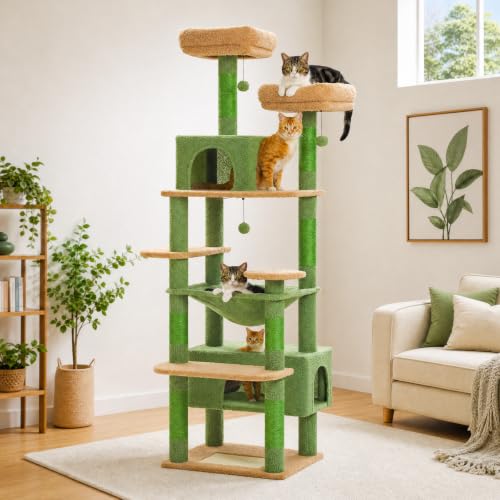
The listing describes real natural pear wood trunks, 4 layers with a cozy top perch and 2 jumping platforms, platforms covered in 800 G/M2 long plush, and natural jute on the scratching posts. It also lists a plush dangling ball with a bell, a 15 kg weight capacity for each layer, a size of 59 x 49 x 110 cm and hand wash only care. The title says it is for indoor use.
The listing does not mention an anti tip kit or a wall anchor, and the package holds the tree and a user manual. Check that it stands steady on arrival, and consider fixing it to a wall if your cat jumps hard.
Quick picks by cat and home
Pick by cat and home: the Costway Solid Wood Cat Tree, 5.0 from 12 ratings, for a wood look, the Hzuaneri for a tall climber, the PAWZ Road for large cats, the Feandrea 86 cm for a small room and the FUKUMARU to keep the floor clear. Listing figures follow.
- Large or several cats: the PAWZ Road listing says 4 to 5 big cats and names cats between 7 and 9 kg, and the Hzuaneri listing says 6 large cats, each up to 7 kg.
- Tall climber: the Hzuaneri is 203 cm with 7 layers.
- Small room: the Feandrea 86 cm has a 66 x 40 cm base.
- Floor space: the FUKUMARU is wall mounted.
- Wood look: the Costway has real natural pear wood trunks and measures 59 x 49 x 110 cm.
Highest rated cat tree: the ratings behind each card
The Costway Solid Wood Cat Tree has the highest rating here, 5.0 from 12 ratings on Amazon AU, but that is the smallest base. The Hzuaneri is next at 4.8 from 529 ratings, then the Feandrea 86 cm at 4.7 from 2,185, the FUKUMARU at 4.7 from 2,001 and the PAWZ Road at 4.7 from 3,179.
A rating shows what buyers gave a listing, not a test result, and a small count moves easily. The PAWZ Road has the most ratings of the five trees we could buy, at 3,179. Look at the count before the stars.
Best cat tree under $200
Four of the five cat trees we could buy showed a listing price under $200 on Amazon AU: the Costway, FUKUMARU, Feandrea 86 cm and Hzuaneri. The PAWZ Road listing showed no price, so we make no price claim for it. Prices change, so check the live listing.
For a tight budget, the checks that matter most are the weight figure and the base. Google's AI Overview for best budget cat tree lists Weight Limit first when it explains what to look for. The Hzuaneri listing says it can hold 6 large cats up to 7 kg each, and the Costway lists 15 kg per layer.
Cat tree buyer guide: weight limit and base stability
Check the weight figure and the base before the colour. Google's AI Overview for best budget cat tree puts Weight Limit and Base Stability first, and says many cheap 2 pole towers wobble or tip if jumped on by heavier or adult cats. That is Google's overview text, not a test of ours.
Listings state weight in different ways, and only some state it at all. The Costway lists 15 kg for each layer. The Hzuaneri says it can hold 6 large cats, each up to 7 kg, and includes an anti tip kit. The PAWZ Road names cats between 7 and 9 kg and says its 184 cm height suits 4 to 5 big cats. The Feandrea 86 cm and the FUKUMARU listings did not give us a weight limit in the bullets we saved, so we do not give one for them.
For the base, the overview says to look for a wide base or a model with a wall anchoring strap. The Hzuaneri at 203 cm is the tallest tree here, so its anti tip kit matters most. The Feandrea 86 cm has a 66 x 40 cm base. The FUKUMARU is wall mounted, so it needs no floor base at all.
Which cat tree suits which cat
A single small cat or a kitten does well on the Feandrea 86 cm, which is the lowest tree here. Two or more adult cats, or one large cat, need a stated weight figure, so look first at the Costway, Hzuaneri and PAWZ Road. A cat that likes height suits the Hzuaneri at 203 cm. If floor space is the problem, the FUKUMARU goes on the wall instead.
How we checked these cat trees
We read the Amazon AU listing for each cat tree: the title, the bullet points, the product information table and the description, and we took the star rating, rating count and seller shown on the listing. Specs come from the maker's bullet points and the product information on each listing. These are listing based picks, not hands on tests.
Last checked: 17 October 2026.
Which cat tree brands appear in Australian searches?
Our seven cards are Amazon Australia listings, which is where we can check a live rating and stock. The brands below appeared in Google Australia results for cat tree searches, and we have not checked their range or stock. The brand names in our card titles are Costway, Feandrea, FUKUMARU, Hzuaneri, PAWZ Road and LEO & LEXI.
- Cat Tree King. The first organic result for best cat tree australia in the Google Australia results we saved, and the AI Overview names its Tiger Dark Grey tree for large and multi cat households.
- Kazoo. Its Cat Trees and Towers collection is the fourth organic result in the same results.
- Catit Vesper. The AI Overview names it with the Petsbelle Solid Wood Cat Tree, as options that Pet Circle highlights.
- i.Pet. The AI Overview lists i.Pet via Kogan among the value and budget options.
We have not rated or checked the stock of these brands, because none of them is an Amazon AU listing we check. If you shop that tier, the questions do not change: height against base width, the surface on the posts, a weight rating that covers your cat, and whether an anti tip kit is included.
What is a floor to ceiling cat tree?
A floor to ceiling cat tree is a pole that braces between the floor and the ceiling instead of standing on a weighted base. None of the cards here is one. If floor space is your concern, the wall mounted FUKUMARU uses a wall instead of the floor, and the questions below give the short answer.
Outdoor cat trees and catios
None of the cards here is listed for outdoor use. The Costway title says for indoor use, and the product information for the Hzuaneri, PAWZ Road and FUKUMARU lists indoor as the recommended use. If you want vertical space outdoors, start with a cat enclosure and put the climbing structure inside it.
Wooden cat trees
The Costway Solid Wood Cat Tree is the wood tree on this page that could be bought. Its listing describes real natural pear wood trunks with distinctive grain patterns, and the product information lists the material as engineered board, jute, long plush fabric and wood. It measures 59 x 49 x 110 cm and has 4 layers, so it is a mid height tree rather than a tall climbing wall. Choose wood if the tree has to live somewhere visible, and a taller plush tree if climbing matters more.
Where do you buy a cat tree in Australia?
Our cards link to Amazon Australia, where we can check listings. Other places that appear in Google Australia results for this search include Bunnings for the PawPawUp Woven Rattan Multi-Level Cat Tree, Kogan and Dick Smith for an i.Pet tree, Pet Circle, Cat Tree King, The Cat Tree Co. and Kazoo. We have not checked their stock or range.
One buying note applies everywhere: check the listing for an anti tip kit, because a tall tower without one is easier to tip.
Is it cheaper to build a cat tree or buy one?
We did not cost a build, so we cannot say which is cheaper. Some bought trees list a weight limit and parts, such as the Costway 15 kg per layer figure or the anti tip kit on the Feandrea 86 cm and the Hzuaneri. A home build needs its own heavy, wide base to stay upright.
A built tree has no listing to check, so you set the base width, the platform spacing and the fixings yourself. A bought tree lets you compare the listed size, weight figure and anti tip parts before you order. Either way, pair the tree with the right cat toys, because a tree gives a cat height and something to claw but nothing to chase.
How to choose the right cat tree for your home
Start with your cat and your space, not the spec sheet. If you have a young, athletic cat and the room for it, a tall tree like the 203 cm Hzuaneri or the 184 cm PAWZ Road gives real climbing exercise and a high perch, but it needs more care to keep upright. Fit the Hzuaneri's anti tip kit, and for the PAWZ Road, which lists none, check it is steady and consider fixing it to a wall. If you live in an apartment or a tight room, the 86 cm Feandrea or the wall mounted FUKUMARU gives your cat scratching and lounging without taking over the floor.
Cat size and number matter just as much. For one cat, the Costway at 110 cm covers climbing, scratching and lounging in a mid height tree, and its listing gives a 15 kg limit per layer. For several cats, or large breeds around 7 to 9 kg, the PAWZ Road listing describes a tree for 4 to 5 big cats, and the Hzuaneri listing says 6 large cats, each up to 7 kg. If the tree has to live in a visible part of an open plan home, the wood look of the Costway is the one to start with. Be honest about how athletic your cat is: the right tree is the one your cat uses and that does not wobble, not the tallest one on the page.
A tree gives an indoor cat height and something to claw, but it does not give it a hunt. That is what a wand or a food puzzle is for, and our guide to the best cat toys in Australia covers the seven worth owning.
What the key specs mean
A few details do most of the work when you compare cat trees. Height tells you how much climbing a tree offers, but read it together with the base: a tall tower on a narrow base is easier to tip under a big cat, which is why an anti tip kit matters more the taller you go. The Hzuaneri at 203 cm and the PAWZ Road at 184 cm are the tall climbers, while the Feandrea 86 cm and the Costway at 110 cm sit lower.
The scratching surface is the next thing to check. The Costway and FUKUMARU use jute on their posts, and the Feandrea 86 cm, Hzuaneri and PAWZ Road list sisal. If climbing is not the point and your cat only needs somewhere to scratch, a standalone sisal scratching post does that job in a fraction of the floor space. After that it comes down to lounging features such as caves for hiding, hammocks and perches for sleeping and watching, and the build material, where the Costway lists real natural pear wood trunks. Read height, base size, scratching surface and materials together and any product page starts to make sense.
Frequently Asked Questions
What is the best cat tree in Australia?
The Costway Solid Wood Cat Tree is the best cat tree in Australia on this page. Its listing describes pear wood trunks, jute scratching posts, four layers, a 110 cm height and a 15 kg limit per layer. Its 5.0 rating comes from only 12 ratings, so treat it as an early signal.
What are people saying about the Costway cat tree?
The Costway Solid Wood Cat Tree shows a 5.0 rating from 12 ratings on Amazon AU, so there is little feedback to read yet. The listing describes 800 G/M2 long plush on the platforms and natural jute on the posts, and lists hand wash only care. It does not mention an anti tip kit.
Is it worth getting a cat tree?
A cat tree is worth buying if your cat needs somewhere to climb, scratch and perch. Each of the five cards we could buy describes those jobs, such as jute or sisal posts, a top perch or a hammock. It will not suit a cat that ignores furniture, and some trees need floor or wall space.
What is the best cat tree for large cats?
For large cats, check the weight figure in the listing before the looks. The PAWZ Road listing names chubby cats between 7 and 9 kg, the Hzuaneri listing says each of 6 large cats weighs up to 7 kg, and the Costway lists 15 kg per layer. Compare these figures with your own cat's weight.
What is the best cat tree for a small space?
For a small room, the Feandrea 86 cm has a 66 by 40 cm base, a cave, 3 perches and an 80 cm sisal post. The Costway measures 59 by 49 by 110 cm, and the FUKUMARU mounts on a wall and uses no floor at all. Check your space against these listed sizes before you order.
Should I buy a tall cat tree or a short one?
A taller tree such as the Hzuaneri at 203 cm or the PAWZ Road at 184 cm gives a cat more to climb, but it needs a bigger base and more care to keep upright. A shorter tree such as the Feandrea 86 cm or the Costway at 110 cm sits lower. Choose by your cat and your ceiling.
Will a cat tree tip over?
Any tall tree can tip if it is jumped on hard, so look for anti tip parts in the listing. The Feandrea 86 cm lists an anti tip device and the Hzuaneri an anti tip kit. The Costway and PAWZ Road listings do not mention one, so check the box and consider fixing the tree to a wall.
Should I get a freestanding or wall mounted cat tree?
A freestanding tree such as the Costway, Feandrea 86 cm, Hzuaneri or PAWZ Road stands on its own and needs no drilling. The FUKUMARU is wall mounted, so it saves floor space but needs the right screws and a suitable wall, as its listing says. If you rent or cannot drill, choose freestanding.
Where is the best place to buy a cat tree in Australia?
Our cards link to Amazon Australia, where we can check listings. Other places that appear in Google Australia results for this search include Bunnings for the PawPawUp woven rattan tree, Kogan and Dick Smith for an i.Pet tree, Pet Circle, Cat Tree King, The Cat Tree Co. and Kazoo. We have not checked their stock or range.
Is it cheaper to build a cat tree or buy one?
We did not cost a build, so we cannot say which is cheaper. Some bought trees list a weight limit and parts, such as the Costway 15 kg per layer figure or the anti tip kit on some models. A home build needs its own heavy, wide base to stay upright.
What cat tower should I get for a new kitten in Australia?
For a new kitten, pick a tree the kitten can climb safely. The Hzuaneri listing says both kittens and adult cats can climb it, the FUKUMARU listing says its hammock suits cats of all ages, and the Costway description says its jute posts let kittens release the scratching urge. Check the listed sizes suit a small cat.
Can you put a cat tree outside?
None of these trees is listed for outdoor use. The Costway title says for indoor use, and the Hzuaneri, PAWZ Road and FUKUMARU product information lists indoor as the recommended use. We found nothing on outdoor use in these listings, so for a catio see our cat enclosure guide.
What is a floor to ceiling cat tree?
A floor to ceiling cat tree is a pole that braces between the floor and the ceiling instead of standing on a weighted base. None of the cards here is one. If floor space is your concern, the wall mounted FUKUMARU uses a wall instead of the floor.
What are cat tree scratching posts made of?
The Costway and FUKUMARU use jute for their scratching posts, and the Feandrea 86 cm, Hzuaneri and PAWZ Road list sisal. The FUKUMARU says its jute posts are replaceable and available from the maker. Check which surface your cat already scratches before you choose.
Where can I find Australian made cat trees?
None of the Amazon listings we read states Australian made, so we cannot call any card local. Google lists this question for our search, and its results show Australian shops such as Cat Tree King, The Cat Tree Co., PawPawUp and Kazoo, but we did not check where they make their trees.