Start with size, then choose the crate type
Before you look at a single price, get the size right, because it is the one thing a crate has to nail. Your dog should be able to stand up without ducking, turn around in a full circle and lie down stretched out - no smaller, and not so cavernous that it stops feeling like a snug den. Measure your dog from nose to tail base and from the floor to the top of their head while standing, then add roughly 10 cm to each for comfort. If you have a puppy, this is where a divider earns its place: several wire crates here include one, so you can buy the adult size now and shrink the usable space while they grow, rather than buying twice.
With size settled, the next choice is the material. Wire crates are the home standard - durable, airy, foldable and easy to clean, and most come with a divider and a leak-proof tray. Soft fabric crates like the Feandrea are light and pack down for travel, but suit calm, crate-trained dogs rather than chewers or escape artists. Then there is single versus double door: a second door simply gives you more freedom in where the crate can sit in a real room. The six picks below run from the MidWest iCrate up to the New World, covering small puppies through to medium adult dogs.
MidWest iCrate 24 inch Single Door
If you want the simplest, most affordable way to start crate training a small dog, the MidWest iCrate is the standard pick. It is the cheapest crate here, and it is a proper folding wire crate that assembles in seconds without tools and measures 24 x 18 x 19 inches, sized so a small dog can stand, turn and lie down.
It arrives complete: a divider panel so a puppy space grows with them, a leak-proof plastic tray and rubber feet that protect your floor, all secured by a slide-bolt latch with a paw block, and a washable crate pad for a small dog is the one thing left to add. The honest trade-offs are that it is a single-door crate, so placement is a touch less flexible than a two-door model, it is built for small breeds rather than big dogs, and its stock can run low - so buy it when you see it available.
MidWest Life Stages 24 inch Double Door
The Life Stages is the iCrate with a second door, and that small change makes it noticeably easier to fit into a real room. A front and a side opening mean you can tuck it into a corner or beside furniture and still get your dog in and out without trouble, which is the most common frustration people have once a crate is set up.
It keeps the same trusted MidWest build: a divider panel for growing puppies, a leak-proof tray, floor-protecting feet and slide-bolt latches with a paw block on both doors. With more than 13,000 ratings it is one of the most proven crates in this guide. The honest notes are that it is sized for small breeds, so larger dogs need a bigger model, and like the single-door iCrate it can run low on stock, so grab it when it is there.
Feandrea 30 inch Soft Folding Dog Crate
The Feandrea is the travel pick and the one soft crate in this guide. Instead of heavy wire it uses an Oxford-fabric shell on a steel frame, so it is light to carry, folds down in seconds and slides into a car boot or a corner using its two built-in handles. At 30 x 21 x 21 inches it suits pets up to about 25 kg.
Four mesh doors give it plenty of airflow and easy access, self-locking zips stop a curious nose nudging it open, and the padded Sherpa cushion lifts out to wash. The honest trade-off is the one common to every soft crate: fabric will not contain a determined chewer or escape artist the way wire does, so this is best for settled, crate-trained dogs and short trips rather than unsupervised all-day use or anxious pups still learning to relax in a crate.
Amazon Basics 91cm Double Door Wire Crate
The Amazon Basics crate is the value workhorse and, with more than 28,600 ratings, by far the most-reviewed crate in this guide. At 91 x 58 x 63 cm it is meaningfully roomier than the small 24 inch crates, so it suits a medium dog or a large breed still growing, and the included divider lets you size that space down for a puppy in the meantime.
Two doors, front and side, make it easy to place in a real room, and it folds flat with a top handle and a removable tray for cleaning. The build is straightforward durable metal wire with reliable manual locks on both doors. The honest trade-off is that those latches are simple manual locks rather than the paw-block slide-bolts on the MidWest crates, so a very determined dog might need a clip on the door - but for the size and the price, the value is hard to beat.
Petmate Precision ProValu Double Door
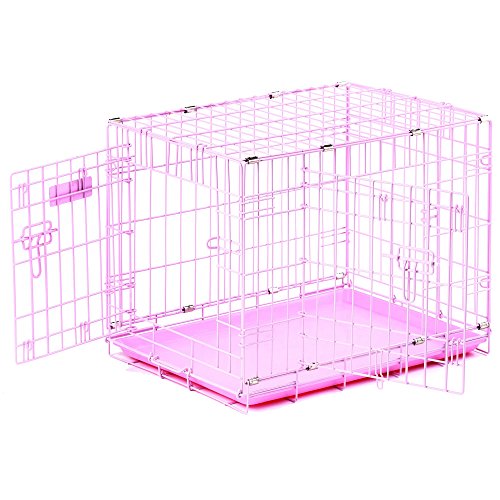
The Petmate ProValu is the pick if you want a small double-door wire crate with a finish built to last and a little more style than plain black. It is sized like the MidWest iCrate at 24 x 18 x 19 inches, but pairs two doors for flexible placement with a rust-resistant baby-pink electro-coat finish, added safety latches and rounded corners.
The included divider panel adjusts the space as a puppy grows, so you are not buying a second crate down the track, and the slide-out plastic pan makes cleaning quick. It folds for storage and has a carry handle. The honest trade-off is that it costs more than the very similar MidWest and Amazon Basics small crates without adding any capacity, so you are mainly paying for the coated finish and the styling rather than for extra room.
The New World is the premium, step-up pick for a medium dog rather than a small one. At 30 x 19 x 21 inches it is built for breeds in roughly the 26 to 40 pound range, and the emphasis is on a solid, secure build: a heavy-duty slide-bolt latch locks the door firmly, two doors make it easy to position, and a leak-proof plastic tray keeps cleaning simple.
With nearly 12,000 ratings it has a deep, reassuring track record at this larger size. The honest caveats are that it keeps things deliberately simple - there is no divider mentioned, so it is best bought to fit your dog now rather than to grow into - and being a larger, sturdier crate it costs more and takes up more floor space than the small folding models earlier in the guide.
How to choose the right crate for your dog
Work in this order and the decision gets simple. First, size: measure your dog and add about 10 cm so they can stand, turn and lie down, then pick the crate length that matches - the 24 inch models suit small dogs, while the 30 inch and 91cm crates suit medium breeds. If you have a puppy, prioritise a crate with a divider so you buy the adult size once and shrink it down for now. Second, material: choose wire for an everyday home crate that is durable, airy and easy to clean, or soft fabric only if your main need is lightweight travel for a calm, crate-trained dog.
Third, doors and details. A double door is worth the small premium for most people because it gives you real freedom in where the crate sits, while a single door is fine if it will live in an open spot. Look for a leak-proof tray for easy cleaning, which almost all of these have, and a secure latch - the MidWest and New World crates use paw-block or heavy-duty slide-bolts, while the Amazon Basics uses simpler manual locks. Match those three things to your dog and your room, and you will not overspend on size or features you do not need. A crate settles where your dog rests indoors; if the friction you actually want gone is the late-night trip to the back door, that is what a dog door fixes.
What the key specs mean
A handful of details do most of the work on a crate listing. The dimensions are the headline number - they tell you the breed size the crate is built for, so read them against your own dog rather than against the price. Wire versus soft fabric describes the whole character of the crate: wire is the durable, ventilated, chew-resistant home standard, while soft fabric trades that toughness for light weight and packability. A divider panel is the feature that future-proofs a puppy purchase, letting one crate serve from puppyhood to adulthood. A crate is for sleeping and travel, though, not for daytime containment: that is the job a dog playpen does, and the two are usually bought together for a puppy.
The rest are about living with it day to day. Single versus double door is purely about placement flexibility in your room, not about security. A leak-proof tray is the difference between a quick wipe-down and a mess on your floor, and the latch type - a paw-block slide-bolt, a heavy-duty bolt or a simple manual lock - tells you how escape-resistant the door is. Read dimensions, material, divider, doors, tray and latch together and any crate listing becomes easy to judge.
Frequently Asked Questions
What size dog crate should I buy?
Buy the size that lets your dog stand up without ducking, turn around fully and lie down stretched out - and no bigger. Measure your dog from the nose to the base of the tail and from the floor to the top of the head while standing, then add roughly 10 cm to each measurement for comfort. As a rough guide, the 24 inch crates here suit small breeds, while the 30 inch New World and the 91cm Amazon Basics suit medium dogs. When in doubt, size up slightly and use a divider to shrink the space rather than buying a crate that is too small.
Wire, soft fabric or plastic - which crate type is best?
It depends on how you will use it. Wire crates are the home standard: durable, well ventilated, foldable, easy to clean and usually supplied with a divider and a leak-proof tray, which makes them the default for everyday use and training. Soft fabric crates like the Feandrea are light and pack down for travel, but they suit calm, crate-trained dogs rather than chewers or escape artists. Plastic crates sit in between and are common for airline travel. For most homes a wire crate is the right first choice, with a soft crate as a travel addition.
Do I need a single or double door crate?
A double door is more convenient for most people, but a single door is perfectly fine. The only real difference is placement: a second door, usually on the side as well as the front, lets you tuck the crate into a corner or against furniture and still get your dog in and out easily. If the crate will live in an open spot where the front is always accessible, a single door like the MidWest iCrate saves you a little money. It does not affect how secure or comfortable the crate is - it is purely about where it can sit in your room.
Is it cruel to crate a dog?
No, when it is done properly - a crate is for safe rest and training, never for punishment. Dogs are den animals and many genuinely settle and relax in a snug, covered space of their own, which is why crate training is widely recommended for toilet training, calm time and safe travel. The key rules are that the crate must be big enough to stand, turn and lie down in, that it is introduced gently with treats and positive associations rather than forced, and that a dog is never shut in for excessively long stretches. Used that way it is a comfort, not a confinement.
What is the divider panel for?
The divider future-proofs a puppy purchase. It lets you buy the full adult-size crate now but block off part of the space, so the area stays cosy and den-like while your puppy is small - which also helps with toilet training, since dogs avoid soiling a space just big enough to sleep in. As your dog grows you move or remove the divider to open up the full crate, so a single purchase covers them from puppyhood to adulthood. Most of the wire crates here, including both MidWest models, the Amazon Basics and the Petmate, include one.
How do I keep my dog safe in a crate?
Get the size and the setup right, and keep the introduction positive. Make sure the crate is large enough to stand, turn and lie down in, and place it somewhere with good airflow and out of direct sun or draughts. It is sensible to remove your dog's collar or anything dangling before they go in, so nothing can snag on the wire. Build positive associations with treats, a comfortable mat and short sessions to start, never use the crate as punishment, and avoid leaving a dog shut in for excessively long periods, especially puppies who cannot hold on as long.
Can a soft fabric crate hold a strong or anxious dog?
Usually not reliably, which is the main limit of soft crates. Fabric and mesh, even on a sturdy steel frame like the Feandrea's, will not contain a determined chewer or a dog that panics and pushes hard at the seams the way a wire crate will. Soft crates are best for dogs that are already calm and crate-trained, and for travel or short, supervised stays. If your dog is anxious, strong or still learning to settle, a wire crate such as the MidWest or New World models is the safer choice, with a soft crate reserved for trips once they are reliably relaxed.