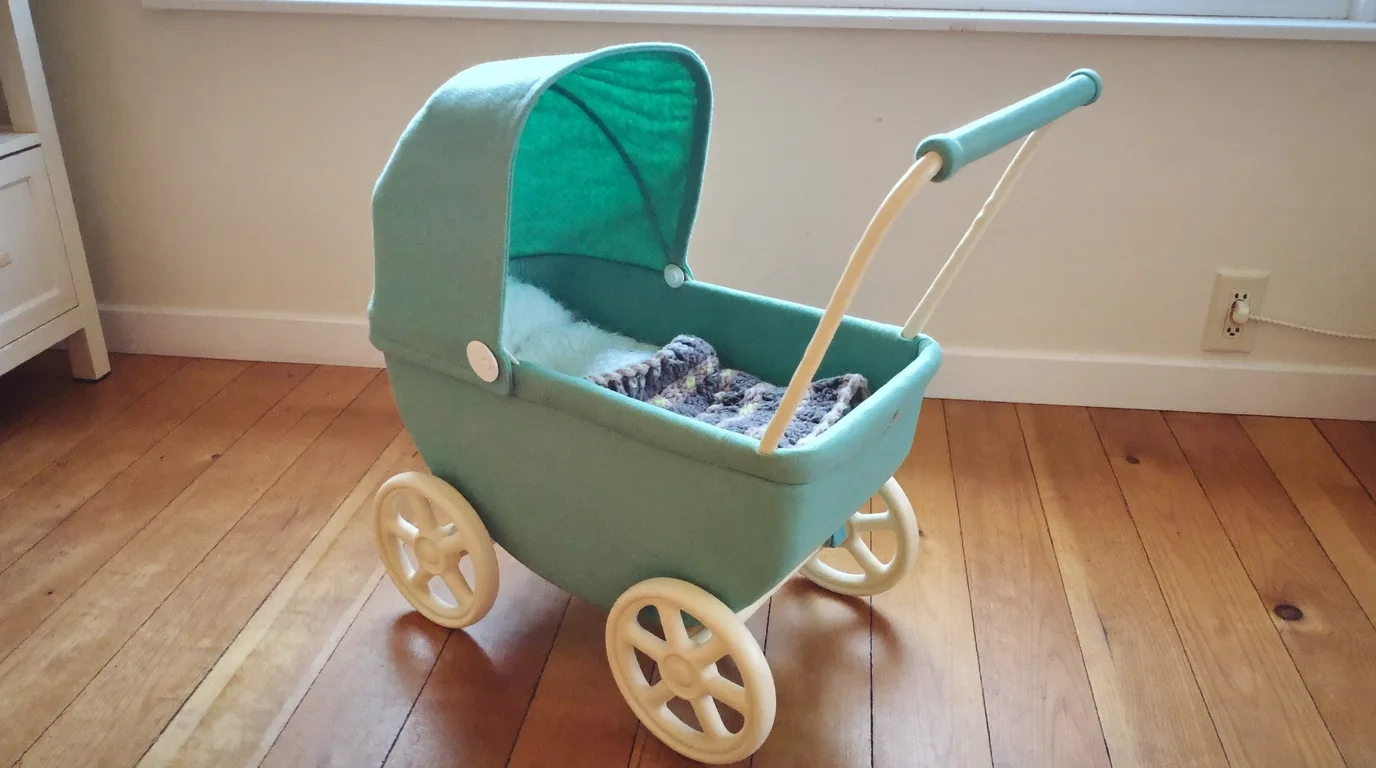
What is a bassinet?
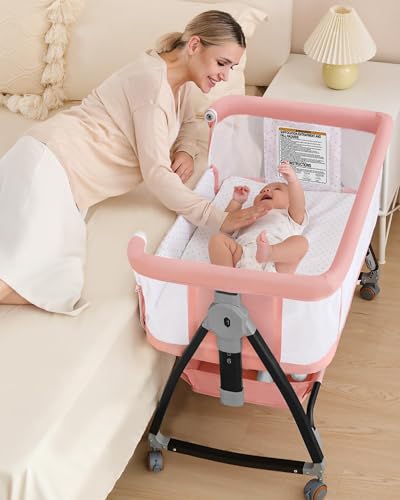
A bassinet is a small enclosed baby bed, usually with an insert about 80 to 90 cm long, that sits beside your bed from birth until your baby can roll over, push up on hands and knees or sit unassisted. Most Australian babies reach that point between four and six months. For most families the pick is the Darling Child 3-in-1 Bedside Co-Sleeper, with the BABY JOY 4-in-1 the best value and the ManKami 3-in-1 the budget option of our six picks.
Why is buying a bassinet in Australia harder than it should be?
Because what you are really buying is six months of sleep, and nothing on the listing tells you whether you will get it. A bassinet is the shortest-lived purchase in the nursery. Most babies outgrow one between four and six months, or earlier if they start rolling, so you are paying for a bed your child uses for about twenty weeks.
That short runway changes what matters. A bassinet needs to do three things: hold a firm flat surface, sit at the right height beside your bed, and let you reach the baby at 3am without standing up. The mosquito net and the music box are packaging.
The Amazon Australia aisle makes this worse. Almost every listing under $220 comes from a third-party seller you have never heard of, wrapped in the same stock photos and the same "3-in-1" bullets. Graco is the only name in the pool most Australian parents would recognise. That is not a reason to avoid the cheap ones. It is a reason to read the reviews, not the marketing.
What is the best bassinet in Australia right now?
For most families, the Darling Child 3-in-1 Bedside Co-Sleeper is the one worth choosing. It is a genuine bedside sleeper with adjustable height, a side wall that folds down so you can reach the baby while lying in bed, and a rocking cradle mode. It holds 4.5 stars from 53 Australian ratings, the deepest review base of any bedside sleeper here, and its spare parts and mattresses are stocked in Australia under the Star Kidz brand.
If the Darling Child does not suit your budget, the BABY JOY 4-in-1 does the same core job. Six height levels, an incline setting for reflux, a drop-down mesh side, lockable wheels and a carry bag, at 4.5 stars from 47 ratings. It ties with the Darling Child on rating.
If the budget is genuinely tight, the ManKami 3-in-1 is the budget option of our six picks, and light at 8 kg. It holds a perfect 5.0 star rating, but from only 8 Australian ratings, which is a thin base to lean on. Read its flaws section before you commit.
The six bassinets side by side on what their listings state. Ratings are Amazon Australia star ratings with their rating counts.
| Bassinet | Attaches to your bed | Height settings | Listed weight rating | Unit weight | Rating |
|---|
| Darling Child 3-in-1 Bedside Co-Sleeper | Yes, with securing straps | Adjustable; number of levels not stated | 22.68 kg maximum | 6.8 kg | 4.5 stars (53 ratings) |
| BABY JOY 4-in-1 | Yes | Six levels | 9 kg | 9.5 kg | 4.5 stars (47 ratings) |
| ManKami 3-in-1 | Yes | Six levels, 70.5 to 83 cm | 15 kg | 8 kg | 5.0 stars (8 ratings) |
| Graco SmartSense | No | Not stated | About 9 kg | Not stated | 4.0 stars (164 ratings) |
| Timkos 3-in-1 | Yes | Six levels | 10.5 kg baby weight | 10 kg | 4.4 stars (28 ratings) |
| PlayPals 3-in-1 | Yes | Six levels | 25 kg structural load (frame brace) | 16.6 kg | 4.2 stars (37 ratings) |
One thing to know before you spend anything: since 19 January 2026 bassinets have had to meet mandatory Australian safety and information standards for infant sleep products, so ask the supplier for evidence covering the exact model rather than trusting a listing that simply says it meets a standard. The checks below focus on what you can see instead: firmness, mesh coverage, gap-free bed attachment and stability.
How do the six bassinets compare at a glance?
All six are Amazon Australia listings, all six carry a real star rating from Australian shoppers, and five of the six attach to your bed. Check the current listing before you buy.
| Bassinet | Rating | Max baby weight | Bedside attach | Best for |
|---|
| Darling Child 3-in-1 | 4.5 (53) | 22.68 kg | Yes | Most families |
| BABY JOY 4-in-1 | 4.5 (47) | 9 kg | Yes | Best value |
| ManKami 3-in-1 | 5.0 (8) | 15 kg | Yes | Budget option |
| Graco SmartSense | 4.0 (164) | About 9 kg | No | Automated soothing |
| Timkos 3-in-1 | 4.4 (28) | 10.5 kg | Yes | Frame strength |
| PlayPals 3-in-1 | 4.2 (37) | 25 kg | Yes | No-assembly setup |
Two patterns fall straight out. The Graco has the deepest review base at 164 ratings, yet the lowest star rating of the six at 4.0. The ManKami has the highest rating at 5.0 but the thinnest evidence behind it at 8 ratings. The Darling Child and the BABY JOY are tied at 4.5 stars, and between them they are the sensible middle of this category.
How did NestPath choose these bassinets?
Last checked: 9 October 2026, covering stock, seller and ratings on every Amazon Australia card.
NestPath is an aggregator, not a laboratory. We do not put babies in bassinets and we do not pretend to. We read the data that already exists, at a depth most shoppers do not have time for, and say plainly what it shows. On safety we follow Red Nose guidance in plain language: a firm, flat, level sleep surface, baby on the back, no pillows, no soft bedding, no bumpers, no toys.
- We pulled every bassinet a shopper in Australia can actually buy, then verified each candidate against the live listing for availability, price in Australian dollars, star rating and rating count.
- We cut anything with no real rating. Several listings have zero Australian ratings. That is a bassinet nobody has slept a baby in yet.
- We cut price outliers. One well-known American bassinet was listed at more than double what the same product sells for locally, the signature of a grey-import reseller.
- We cut a listing showing 131 ratings because the reviews attached to it were plainly for a different product. Review counts only help if they belong to the item you are buying.
- We collapsed variant pairs so each model appears once, and we read the negative reviews first. Every pick carries a flaws section drawn from what Australians actually complained about.
We do not claim any of these products is certified to a standard, because the listing data does not let us verify it.
Best overall: Darling Child 3-in-1 Bedside Co-Sleeper
The Darling Child 3-in-1 Bedside Co-Sleeper is the bassinet we would put in most nurseries if the budget allows. It is a proper bedside sleeper, not a standalone cot with a flap, and the difference shows up at 3am.
The headline feature is the bedside co-sleeper design. It straps to the side of your adult bed with the included securing straps, and the side wall folds down so its mattress sits alongside yours with no step and no gap. The height is adjustable, which matters more than it sounds. Australian bed heights vary enormously once you add a topper or an ensemble base, and a fixed-height sleeper often will not line up. This one adjusts to land it.
The folding side wall is the other reason it earns its place. On a standalone bassinet, reaching a newborn means standing up and leaning over a fixed rail. Here the wall folds down so you can lift or settle the baby from where you are lying, then lift it back up between feeds. If you have had a caesarean, that one design decision is worth more than every music box in this category combined.
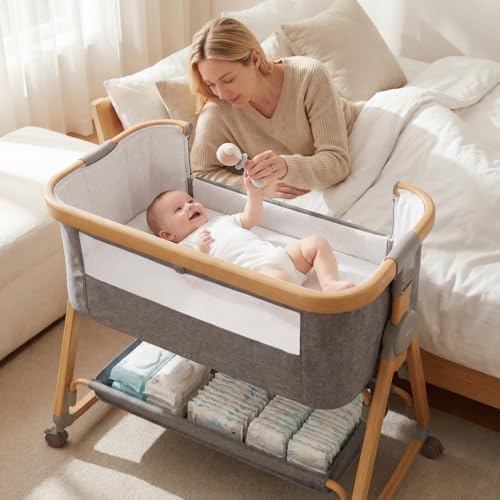
The rest is well judged rather than flashy: a rocking cradle mode created by folding the wheels away for a gentle limited swing, quiet braked wheels for moving it room to room, breathable mesh windows on both sides for airflow, an under-bed storage basket, and a premium alloy frame with a natural wood-grain finish and grey textiles that does not look like hospital equipment. It includes a firm mattress, a mosquito net and the securing straps, and it assembles without tools. The listed maximum weight is 22.68 kg, well beyond the point you move to a cot. At just 6.8 kg the frame is light enough to carry between rooms, and at 4.5 stars from 53 Australian ratings it ties the BABY JOY on rating and holds the deepest review base of any bedside sleeper in this guide.
Flaws but not dealbreakers
The price is the flaw. It is a big outlay for a bed with a twenty week working life when you are also finding a pram, a cot and a car seat in the same month. The rocking mode is a gentle limited swing rather than a full cradle motion, so if you want to rock the baby vigorously this is not it. And while 53 Australian ratings is the deepest base of any bedside sleeper in this guide, it is still a younger review history than the Graco's.
Which bassinet is the best value under $250?
The BABY JOY 4-in-1 is the one we would buy with our own money. It does the same core job as the Darling Child, and among the lower priced bassinets where most Australian bassinet buying happens it has the deepest review base.
Four modes is the marketing line, and for once it is close to honest: bedside sleeper, standalone bassinet, rocking cradle, and an infant bed with the net fitted. Six height levels cover most Australian beds.
The build is metal tube on a U-shaped base rather than plastic, with mesh on all four sides, a storage basket, four lockable swivel wheels and a carry bag. The mattress is 83 by 49 by 2.5 cm and comes out for cleaning. Rated to 9 kg and listed for 0 to 6 months, the honest window for this whole category.
It sits at 4.5 stars from 47 Australian ratings, tied with the Darling Child. Reviewers single out two things: it is easy to assemble, and wheeling it from the bedroom to the living room for daytime naps is the feature they use most. If you buy one bassinet from this page and you are not made of money, buy this one.
Flaws but not dealbreakers
The wheels are the weak point. More than one Australian reviewer said they do not roll smoothly, which matters when you are moving a sleeping newborn across a carpet edge. The same reviewers flagged that the leg height locks allow a little flex, and that a shaky bassinet occasionally woke the baby. Neither is a safety problem, but temper your expectations. At 9.5 kg it is not a travel unit either.
Which bassinet costs the least without feeling flimsy?
The ManKami 3-in-1 is the budget option of our six picks, and light at 8 kg. If the budget is tight and it will spend its life beside one bed, it does the job.
On paper it gives up almost nothing to the other units. Six height levels, and unusually the listing publishes the actual heights rather than just the count: 70.5, 73, 75.5, 78, 80.5 and 83 cm. You can measure your own mattress with a tape and know before you order whether it will line up. Very few listings tell you that.
You also get fully breathable mesh on all sides rather than mesh windows set into padded fabric, which is the configuration Red Nose guidance points toward. Setup needs no tools. There are four lockable 360 degree wheels, a storage basket and a removable mosquito net. Listed capacity is 15 kg, above the BABY JOY's 9 kg. It holds the highest star rating of the six at a perfect 5.0, and Australian reviewers call it sturdy, easy to assemble alone and light enough to move between rooms.
Flaws but not dealbreakers
The rating is the flaw, and you should look straight at it. Those 5.0 stars come from just 8 Australian ratings, the thinnest review base in this guide, and almost all landed within a few weeks of each other in mid-2026. That is a pattern worth being sceptical about. Nothing in the reviews contradicts the specifications, but 8 ratings is not the evidence that 47 or 53 is, and ManKami has no track record here. If you want a deep review base, choose the BABY JOY.
Which bassinet soothes the baby back to sleep for you?
The Graco SmartSense is the premium bassinet in this guide, and the only one that tries to do the settling for you. It listens for the baby stirring and responds with a mix of white noise, vibration and gentle rocking or swaying.
The format is familiar for the price band: six height levels, a zippered side panel that drops so you can reach the baby without getting out of bed, mesh on all sides, an included firm mattress and a removable mosquito net. It works as a bedside sleeper, a standalone cot and a lounger, with a footprint of 86 by 56 by 88 cm and a unit weight of 10 kg. It also carries a published manufacturer warranty against defects, at six months, which is short but is more than most sellers in this pool put in writing at all.
It sits at 4.4 stars from 28 Australian ratings, and those reviews are unusually detailed about the side panel, the tilt for reflux, and wheeling it into the living room. One reviewer summed the whole category up better than we could: it does the job for newborns, but you will be shopping for a real cot in about five months, so judge the price against a short working life.
Flaws but not dealbreakers
The mattress is the recurring complaint, the same one on almost every bassinet under $220 in Australia. Reviewers call it firm enough but basic. More than one buyer said they never used the mosquito net. And 28 ratings, while healthy, is a smaller base than the BABY JOY. Assembly is required, though reviewers say it is straightforward.
Which bassinet is easiest to set up on the day it arrives?
The PlayPals 3-in-1 is the only bassinet here whose listing states that no assembly is required. If you are thirty-eight weeks pregnant, or your partner is, and the box has just landed, that is not a small thing.
It folds up and down with a single mechanism and no tools. Six height levels, a drop-down mesh side, swivel wheels that fold up to convert it into a rocking cradle, a storage basket, a removable washable cover and a mosquito net. The frame mixes alloy steel, aluminium and polyester with a triangular brace the listing rates to 25 kg, the highest load figure quoted by any bassinet here, and PlayPals publishes a one-year warranty, the longest here.
It carries 4.2 stars from 37 Australian ratings. Buyers praise the value, the wheeling and the drop-down side. One compared it against a bassinet from a bricks and mortar chain and said the PlayPals felt sturdier.
Flaws but not dealbreakers
4.2 stars is the lowest rating of the six aside from the Graco, and the reason sits in the reviews: the mattress. Multiple Australian buyers said the included foam is thin and cheap, that its odd size makes a fitted cover hard to find, and that they bought a replacement, pushing the real price up. At 16.6 kg it is also the heaviest unit here, so "portable" is doing a lot of work. Budget for a proper mattress and this becomes a much better buy.
What should you look for in a bassinet?
Answer first: a firm flat mattress, mesh on all four sides, a height range that matches your bed, and a base wide enough that it cannot tip. Everything else is optional.
- Firm and flat, every time. Red Nose guidance is clear: baby on their back on a firm, flat, level surface with no pillows, soft bedding, bumpers or toys. If a bassinet arrives with a pillow in the box, and one here does, that pillow does not go in the sleep space. Never pack padding under the mattress to raise the head end.
- Measure your bed before you order. Measure floor to the top of your mattress, topper included, then check that number sits inside the bassinet's published height range. Most listings quote a level count rather than actual heights, which is useless. The ManKami is the exception.
- Mesh on all four sides, not mesh windows. Full mesh gives airflow and lets you see the baby. Padded rails with a mesh panel set into them are less breathable, and one Australian reviewer of a bassinet we did not pick stopped using it after finding their baby's face against a padded edge.
- Check the bed attachment. A bedside sleeper is only safe strapped tight to the adult bed with no gap between the two mattresses. If your bed has drawers, check for retractable feet.
- Assume the mattress is the weak link. Across the less expensive bassinets here, the mattress is the number one Australian complaint: thin foam, odd dimensions, no compatible sheets. Budget for a firm replacement and treat it as part of the price.
- Do not take standards claims on trust, and know the exit date. Since 19 January 2026 bassinets must meet the mandatory Australian standards for infant sleep products, and a listing that simply asserts compliance is still a seller claim until the supplier shows evidence for that model. And every bassinet here is rated 0 to 6 months: you stop the moment the baby can roll or push up on hands and knees.
Bassinet or cot: what is the difference, and when do you swap?
Answer first: a bassinet is a short-term bed beside you for the first four to six months, a cot is the bed your child sleeps in for the next four years. The bassinet is smaller, lower and portable, and it is meant to sit within arm's reach of your bed. A cot is bigger, taller-sided and built to hold a child who can stand up in it.
The swap is triggered by movement, not by a birthday. You move the baby to a cot as soon as they can roll over, push up on hands and knees, or sit unassisted, even if that happens at three months. Every bassinet in this guide is listed for 0 to 6 months. Have the cot built and the mattress in it before you think you need it, because the change usually arrives in a week you did not plan for, and keep the baby monitor mounted where it can see both sleep spaces.
What is a co-sleeper bassinet?
A co-sleeper, also called a bedside sleeper, is a bassinet with one side that folds or unzips so it opens onto your adult bed. Straps hold the frame against the bed and the height adjusts so the two mattresses sit level with no gap. Five of our six picks work this way. The baby still sleeps on their own firm flat surface, which is what Red Nose guidance asks for, but you can feed and settle without standing up. Nothing hangs over the sleep space: keep a baby mobile for the change table or awake time instead.
What about Kmart, Big W and the shop-brand bassinets?
Kmart sells bassinets under its Anko label and Big W stocks the Childcare range, and both come up constantly when Australian parents shop this category. We do not price or rate them here because our picks are Amazon Australia listings with a live star rating we can verify, and we do not publish figures we cannot check. Judge a shop-brand bassinet on the same four things as any other: a firm flat mattress with no gap at the edges, breathable mesh on all four sides, a stable base wide enough that it cannot tip, and a height that lines up with your bed. Since 19 January 2026 bassinets must meet mandatory Australian standards for infant sleep products, so ask for evidence covering the exact model rather than trusting the label on the box.
How do you get a newborn to sleep in a bassinet?
Answer first: warm the surface, put the baby down drowsy rather than asleep, and expect the swap from your arms to take several attempts a night in the first fortnight.
Newborns wake on the transfer because the bassinet mattress is cold and flat while your chest is warm and moving. Lay your hand on the mattress for a minute before the transfer, lower the baby bottom first with their back on your forearm, and keep a hand on their chest for twenty seconds after they land. White noise at a steady low level helps because it covers the household sounds that cut through a light sleep cycle. Feed sitting up with a nursing pillow so you are not holding the whole weight, which makes the last five minutes before the transfer far calmer.
Daytime is different. Plenty of Australian newborns will contact nap and refuse a flat surface for weeks, and a baby carrier is the honest answer for those hours. What does not change is the overnight rule: back, firm, flat, nothing loose in the bassinet.
How do you clean and maintain a bassinet?
Answer first: wash the fabric cold, wipe the frame, and check the height locks and wheel brakes every fortnight.
Nearly every bassinet here has a removable washable cover, and you will use it far more than you expect, because newborns leak. Wash it cold or on a delicate cycle and air dry it, because heat wrecks the elastic and the mesh. Several listings specify hand washing for the mesh, so when in doubt hand wash the mesh and machine wash the rest. Buy a spare set of fitted sheets before the baby arrives, and put a waterproof protector under the sheet to save the mattress, which on most of these units is a cheap foam slab you cannot easily replace.
The maintenance that actually matters is mechanical. Once a fortnight, check each leg is locked at the same height, the locking collars have not crept, and the wheel brakes still engage. In bedside mode, re-tension the straps holding the bassinet to your bed, because they loosen over weeks and a gap between the two mattresses is precisely what you are trying to prevent. One Australian reviewer reported wheels working loose over time. Two minutes a fortnight catches all of it.
What else will you want alongside the bassinet?
Answer first: two sets of fitted sheets, a waterproof protector, and nothing else in the sleep space. Two is the working minimum and three is more comfortable, because a newborn will leak through a sheet at 2am and you need a dry one on the mattress before the wash is done.
What you do not want: cot bumpers, pillows, positioners, wedges and loose blankets. None belong in a bassinet, and none are on this list.
What else did we consider, and what got cut?
Plenty. The Amazon Australia bassinet pool is around fifteen buyable models and only six survived our checks. Four of the cut listings have no Australian rating at all, and we will not recommend on specifications alone in a category this close to a baby's face.
A well-known American portable rocking bassinet came up early with a strong rating and hundreds of reviews, but it was listed at more than double what the same product sells for through Australian retailers, and its reviews were almost entirely from overseas shoppers. That gap is a grey-import signature.
A bedside co-sleeper crib showing 131 ratings and 4.4 stars looked like the best-reviewed thing in the category until we opened the listing. Both the product description and the review text described a door finger-pinch guard. Those reviews belong to a different product.
A second PlayPals model with a drop-down side sits at 3.6 stars from 38 Australian ratings, the lowest in the pool. One Australian reviewer stopped using it after finding their baby's face pressed against the non-breathable padded section beside the mesh. That is the whole argument for full-mesh sides.
Cotton-rope Moses baskets and folding travel pods are all over this category and photograph beautifully. They are carriers and travel beds, not overnight sleep spaces.
Bassinet questions Australian parents actually ask
How long can a baby use a bassinet?
Most babies are out of a bassinet between four and six months. The hard rule is not age, it is movement: you stop as soon as the baby can roll or push up on their hands and knees, even if that happens at three months. Every product here is listed for 0 to 6 months, and the weight limits of 9 to 15 kg are almost never what ends it. Plan on twenty weeks and have the cot sorted before you need it.
Is a bedside sleeper safer than a standalone bassinet?
Neither is inherently safer. Red Nose recommends a baby sleeps in their own safe sleep space, on a firm flat surface, in the same room as a parent for at least six months. Both formats achieve that. A bedside sleeper makes night feeds easier, a real benefit for a recovering parent, but only if it is strapped tightly to the adult bed with no gap between the two mattresses. A poorly attached one with a gap is worse than a standalone bassinet across the room.
Do bassinets have a mandatory safety standard in Australia?
Yes. Australia has mandatory standards for household cots and folding cots, and since 19 January 2026 the mandatory infant sleep product standards cover bassinets, cradles and co-sleepers as well. A listing claiming it "meets AS/NZS safety standards" is making a seller claim we cannot verify from the listing data. Judge the product instead: a firm flat mattress, breathable mesh on all sides, a wide stable base, and a secure attachment in bedside mode.
What should go in the bassinet with the baby?
The baby, a fitted sheet, and nothing else. No pillows, positioners, wedges, bumpers, cot toys or loose blankets. To keep the baby warm, use a safe sleeping bag or a tuck sheet rather than anything loose. If a bassinet ships with a pillow in the box, and at least one here does, that pillow is not for the sleep space.
How much should I spend on a bassinet in Australia?
On Amazon Australia the more affordable bedside sleepers are fully functional, with adjustable height, mesh sides, wheels and a mattress. Stepping up, the Darling Child 3-in-1 adds adjustable height and a folding side wall. Above that again, the Graco SmartSense adds automated soothing that may or may not work on your baby. Whatever you spend, budget for sheets and a protector, because on the cheaper units the included mattress is the weakest part.
Can I use a mattress from another brand in my bassinet?
Sometimes, but the fit has to be exact. A replacement must be firm, flat and sized so there is no gap around the edges, because a gap is an entrapment risk. Many bassinets in this band use non-standard mattress dimensions, and Australian reviewers repeatedly complain they could not find a sheet or replacement that fits. Measure the mattress well first, and if nothing fits, keep the original.
What is the difference between a bassinet and a cot?
A bassinet is a small enclosed bed for the first four to six months that sits beside your bed. A cot is the full-size bed your child then uses for years, with higher sides for a baby who can stand. The bassinet is lower, lighter and portable; the cot is fixed and built for a mobile child. You move across as soon as the baby can roll, push up on hands and knees or sit unassisted, which for most babies lands between four and six months.
How many bassinet sheets do you need?
Two fitted sheets is the working minimum and three is more comfortable. Newborns leak through a sheet overnight, so you want a dry one to put on the mattress while the other is in the wash. Buy the sheets sized for your bassinet rather than a cot, because most units in this price band use non-standard mattress dimensions and a loose sheet is an entrapment risk. A waterproof protector under the sheet saves the foam mattress.
Do you actually need a bassinet?
No, a cot in your room does the same job, and Red Nose guidance asks only that the baby sleeps on a firm flat surface in the same room as a parent for the first six months. A bassinet earns its place on convenience: it fits beside a bed in a small room, it moves between rooms during the day, and a bedside model lets you settle the baby without standing up. If your bedroom fits a cot, you can skip it.
What is the best bassinet for a newborn baby?
For most families, our pick is the Darling Child 3-in-1 Bedside Co-Sleeper: it straps to your bed, adjusts in height to line up with your mattress and has a side wall that folds down so you can reach the baby. The BABY JOY 4-in-1 does the same core job for less. Whichever you choose, the newborn sleeps on their back on a firm, flat mattress.
Can SIDS happen in a bassinet?
Yes, no bassinet design rules SIDS out, so how your baby sleeps in it matters more than which model you buy. Follow Red Nose safe sleep guidance every time: baby on their back on a firm, flat, level surface with no pillows, soft bedding, bumpers or toys, in their own safe sleep space in the same room as a parent for at least six months.
Can a baby sleep in a bassinet all night?
Yes. A bassinet is built as a bed that sits beside yours, unlike the Moses baskets and folding travel pods this guide treats as carriers and travel beds. Keep the overnight rule every time: baby on their back on a firm, flat mattress with nothing loose in the bassinet, and move to a cot once the baby can roll, push up on hands and knees or sit unassisted.
What else should you sort before the baby arrives?
The bassinet is one line on a long list. These are the guides worth reading next, roughly in the order you will need them.
About the author
Anish Puri founded NestPath in 2026 after going through the Australian first-home-buyer process himself. NestPath focuses on Australian first-home buyers because the existing review sites are American, generic, or both. Anish handles editorial selection across the homeowner hub. Reach out: hello@nestpath.com.au