Which colander should most Australians buy in 2026?
If you want one straight answer, buy the E-far 3-Quart Stainless Steel Colander. It hits the sweet spot that almost everyone is actually looking for: small enough holes that orzo and rice do not escape, a heavy gauge of steel that does not flex when you tip a full pot into it, and welded handles that will not snap off. It sits at 4.6 stars across 769 Amazon Australia reviews, which is a strong signal for a humble piece of kitchen kit.
That said, a colander is a personal tool. The right one depends on whether you cook for one or for five, whether you rinse a lot of rice and quinoa, how much bench and cupboard space you have, and whether you care about matching a dark or stainless kitchen. This guide breaks the field into clear use cases so you can match a drainer to your kitchen rather than just chasing the highest star rating.
We are a small Australian team writing for first-home buyers, so every pick below is in stock on Amazon Australia, priced in Australian dollars, and backed by a real star rating and review count that we checked rather than guessed. No imported United States pricing, no invented specs.
The quick answer: our top colander picks at a glance
Short on time? Here is the TL;DR before the detail. These six picks cover the most common reasons Australians buy a colander, from a daily pasta drainer to a fine mesh set for rinsing grains.
- Best overall: E-far 3-Quart Stainless Steel Colander, $34.05, 4.6 stars. The do-everything drainer.
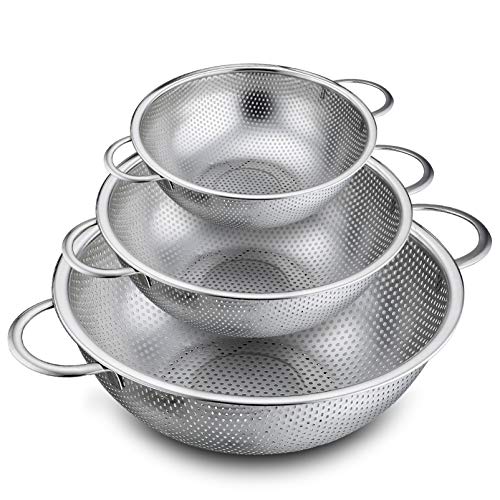
- Best value: P&P Chef Stainless Steel Colander Set of 3, $29.99, 4.4 stars. Three sizes, one low price, and the most reviewed pick here.
- Best budget: Avanti Perforated Stainless Steel Strainer with Handles, $19.95, 4.5 stars. Wide bowl, under twenty dollars.
- Best for comfort and longevity: OXO Good Grips Stainless Steel Colander 2.8L, around $49.95, 4.7 stars. Soft handles, five feet, built like a tank.
- Best deep bowl for big pasta nights: Avanti Deep Stainless Steel Colander 25cm, $33.95, 4.4 stars. A tall 4.8-litre bowl.
- Best for rice, grains and tea: Eleen Fine Mesh Strainers Set of 3, around $18.00, 4.7 stars. Three sieves for fine work.
Last updated June 2026. Prices and ratings move, so treat the figures here as a snapshot and confirm the live price on Amazon before you buy.
How does a colander compare across these six picks?
Before the individual write-ups, it helps to see the trade-offs side by side. The headline tension in this category is holes versus drainage speed. Bigger holes drain water faster but let small foods slip through, while micro-perforated and mesh designs hold everything back but drain a little slower. The other big choice is stainless steel versus plastic, and whether you want a single bowl or a nesting set. The picks below are spread deliberately across those choices so there is a sensible option whatever your kitchen looks like.
How did we evaluate these colanders?
We are an aggregator, not a laboratory. We do not run physical drainage trials in our own kitchen. Instead we study the evidence that already exists and pull it together for an Australian audience. Here is exactly what shaped this list.
- We pulled live Amazon Australia listings to confirm each colander is in stock, sold in Australian dollars, and carries a genuine star rating with at least a handful of reviews behind it.
- We read the verified Australian reviews on each product, not just the headline score, looking for repeated themes like rust, flimsy steel or handles falling off.
- We cross-checked the wider expert consensus from major review sites that do hands-on testing, including The Spruce Eats, Serious Eats and Food Network, to see which features they reward.
- We compared specifications copied directly from each listing, including capacity, diameter, hole size and material, so the numbers in this guide match the product page.
- We checked Australian search demand to make sure the use cases here, like pasta draining, rice rinsing and sink colanders, reflect what people actually shop for.
Where a product has a known weakness, we say so in its own Flaws but not dealbreakers section rather than hiding it.
Best colander overall: E-far 3-Quart Stainless Steel Colander
The E-far is the colander we would point most people to first. It is a single 3-quart bowl in food-grade stainless steel with micro-perforated 2.5mm holes punched across the base and sides. That hole size is the quiet hero here: it drains pasta water quickly but still holds back short pasta, sliced vegetables and most rice, which is exactly the balance a daily-use colander needs. It rates 4.6 stars across 769 Amazon Australia reviews.
What lifts it above the cheap crowd is build quality. The steel is a heavier gauge than the flimsiest budget bowls, so it does not buckle when you tip a full pot of boiling water and spaghetti into it. The handles are D-shaped and solidly welded rather than spot-soldered, which matters because welded handles are the single most common failure point in this category. Three small feet lift the base off the sink so drained food is not sitting in dirty sink water, and the same feet let it rest neatly inside a mixing bowl.
At a compact 3-quart size it suits one to three people comfortably and still copes with a family pasta night if you drain in two goes. Reviewers consistently mention that it cleans up easily and shows no rust after weeks of use, and it is dishwasher safe for the nights you cannot face hand washing.
Flaws but not dealbreakers
This is a single mid-sized bowl, so a large household cooking big batches may find it a touch small and want a 5-quart instead. One Australian reviewer received a dented unit and felt the steel was thin for the price, which reads like a packaging issue rather than a consistent fault, but it is worth checking yours on arrival. There is no rubber grip on the handles, so wear an oven mitt if your pot water is scalding.
Best value colander: P&P Chef Stainless Steel Colander Set of 3
If you would rather not choose a single size, the P&P Chef set solves the problem by giving you three. You get 1-quart, 3-quart and 5-quart stainless steel colanders that nest inside each other, all with micro-perforated 0.5mm holes, double handles and triple feet. For roughly the price of one mid-range colander, this is the most flexible buy on the list, and with 2476 Amazon Australia reviews it is the most reviewed pick in this guide.
The three sizes genuinely earn their cupboard space. The little 1-quart is ideal for rinsing a handful of berries or capers, the 3-quart handles everyday vegetables and single-serve pasta, and the 5-quart takes a full family drain. The very fine 0.5mm holes mean almost nothing slips through, so this set is a strong choice if you wash a lot of rice, quinoa or small pasta shapes. They stack down to almost nothing when stored, which is a real win in a small first-home kitchen.
Australian reviewers who switched from plastic are enthusiastic, describing the set as better than expected and easy to clean. The micro-perforation does mean slightly slower drainage than a large-holed bowl, but for most cooking that is a fair trade for never fishing pasta out of the sink.
Flaws but not dealbreakers
This is a budget-friendly set, and the steel is lighter than a premium single colander, so the largest size can feel a little flimsy under a heavy load. A small number of buyers have reported a handle working loose on the big colander over time, and one noted a later batch arrived with a yellowish tint and early rust spots, which suggests some quality-control variation. Hand drying after each wash and avoiding long soaks will help them last.
Best budget colander: Avanti Perforated Stainless Steel Strainer with Handles
For under twenty dollars, the Avanti Perforated Strainer is the easiest cheap recommendation we can make, and it is the cheapest of our three headline picks. It is a wide 25.5cm stainless steel bowl with a perforated base, looped handles on each side and small wire feet for stability. It rates 4.5 stars across 132 Amazon Australia reviews.
The standout here is the generous diameter. At 25.5cm it is wide enough to drain a family-sized pot of pasta or rinse a big bowl of salad leaves in one go, which is more than you usually get at this price. The looped handles give you a secure two-handed grip when the bowl is heavy and hot, and the wire feet keep it steady in the sink. One Australian reviewer summed it up neatly, calling it a better colander than a store-bought one that cost ten dollars more.
It is dishwasher safe, and several reviewers specifically tested it in the dishwasher and reported no rust or discolouration, which is reassuring at this price. If you want a no-fuss everyday drainer and do not want to overthink it, this is a smart first colander.
Flaws but not dealbreakers
The holes are a standard perforated size rather than micro-perforated, so this is not the strainer for washing rice or fine grains, which will slip straight through. The build is lightweight, and one reviewer reported a handle breaking on first use, so this is a value tool rather than an heirloom. For draining pasta, potatoes and rinsing vegetables, though, it does the job well for the money.
Best for comfort and longevity: OXO Good Grips Stainless Steel Colander 2.8L
If you are happy to spend more for a colander that feels lovely to use and should outlast everything else in the drawer, the OXO Good Grips stainless steel colander is the one. It is a 2.8-litre stainless steel bowl with OXO's signature soft, non-slip elevated handles and five feet on the base for stability in the sink and on the bench. It rates 4.7 stars across 699 Amazon Australia reviews. The OXO Australia price sits at around $49.95, so this is a deliberate spend-up.
The handles are the reason to buy it. They are raised and cushioned, so a heavy, hot bowl is genuinely comfortable to carry, and they sit high enough to nest the colander inside an OXO mixing bowl for catching pasta water. International and Australian reviewers repeatedly describe the steel as thick and the whole thing as built like a tank, with one calling it the best colander they have ever owned. The five-foot base is more stable than the usual three feet.
This is the pick for someone furnishing a kitchen they plan to keep, who values comfort and a long lifespan over saving twenty dollars. It is dishwasher safe and the perforations drain quickly while still holding back standard pasta.
Flaws but not dealbreakers
The obvious one is price. At around $49.95 it costs more than twice the budget pick, and the holes are a regular perforated size, so like most single bowls it is not the tool for fine rice rinsing. The 2.8-litre capacity is moderate rather than huge, so very large households may prefer the bigger OXO size. None of this changes the core appeal, which is comfort and durability.
Best deep bowl for big pasta nights: Avanti Deep Stainless Steel Colander 25cm
Some cooks just want a tall, deep bowl that swallows a full pot without water splashing back over the edge. The Avanti Deep is built for exactly that. It is a 25cm stainless steel colander with a deep 4.8-litre capacity, a mirror interior and satin exterior finish, generously sized handles and a pedestal base. It rates 4.4 stars across 34 Amazon Australia reviews and is frequently an Amazon Choice in the category.
Depth is the whole point. A shallow colander overflows when you tip in a big pot of pasta and water, whereas this deep bowl contains it. Avanti has left off the rolled edges, which makes it easier to clean and to pour from, and the pedestal base gives it a stable footing in the sink. The large holes drain water fast, so a heavy load empties quickly. Australian reviewers describe it as solid, well made and a good weight, with one happy that they were finally off plastic.
This is the pick for a household that cooks pasta or potatoes in large batches and wants a single roomy bowl rather than a set. It is dishwasher safe and the deep shape doubles nicely as a rinsing bowl for big salads.
Flaws but not dealbreakers
The large holes mean small foods like rice and orzo will slip through, so pair it with a mesh strainer for fine work. A small number of Australian reviewers have reported rust appearing after about a year, so dry it thoroughly after each wash rather than leaving it wet, and one noted the drainage holes pool slightly to one side. With a 4.4-star average it is well liked overall, just not flawless.
Best for rice, grains and tea: Eleen Fine Mesh Strainers Set of 3
A colander and a fine mesh strainer are not the same tool, and if most of your draining is rice, quinoa, tea, stock or icing sugar, you actually want the latter. The Eleen set gives you three stainless steel mesh sieves in 8cm, 12cm and 18cm sizes, each with a long non-slip handle and a hanging ear for storage. It rates 4.7 stars across 1555 Amazon Australia reviews and, at around $18.00, it is the cheapest pick on this entire list.
The fine woven mesh is what a perforated colander cannot match. Nothing the size of a rice grain or a tea leaf gets through, so you can rinse grains, sift flour, strain a sauce or drain a small portion of pasta with precision. The three sizes cover everything from a single cup of tea to washing a bowl of vegetables, and they stack down for storage or hang from the included loops. Reviewers praise the variety of sizes, the mirror finish and how easily they clean.
Think of this as the partner to a colander rather than a replacement. Many kitchens are best served by one good perforated colander for pasta and vegetables plus a mesh set like this for fine grains and baking.
Flaws but not dealbreakers
Mesh strainers are inherently more delicate than a solid bowl. The handles are the weak point, and a couple of reviewers report a handle loosening or detaching after repeated heavy use, so avoid wedging a fully loaded strainer over a pot for long stretches. The largest sieve at 18cm is smaller than a full colander, so it is not ideal for a big family pasta drain. For its actual job, fine straining, it is excellent value.
What should you look for when buying a colander?
A few features separate a colander you will love from one you will quietly replace. Here is what matters.
Are plastic or stainless steel colanders better?
For most people, stainless steel is the better long-term choice. It tolerates boiling pasta water without warping, resists staining and odours, and lasts for years. Plastic colanders are cheaper, lighter and quieter in a steel sink, and a good one like an OXO plastic model is perfectly fine for cold rinsing, but cheaper plastic can crack or warp under very hot water over time. If you drain a lot of just-boiled pasta, lean steel.
What hole size do you actually need?
Bigger holes drain faster but let small foods escape. If you mostly cook long pasta and rinse vegetables, standard perforations are fine. If you wash rice, quinoa, couscous or small pasta shapes, choose a micro-perforated colander like the E-far or P&P Chef, or pair a regular colander with a fine mesh strainer.
How big should your colander be?
Match capacity to your household. A 2.8 to 3-quart bowl suits one to three people and rinsing jobs, while a 5-quart or a deep 4.8-litre bowl is better for family pasta nights. A nesting set sidesteps the decision by giving you several sizes at once.
Do feet and handles matter?
Yes, more than people expect. Feet lift drained food off the dirty sink base and add stability, and most failures in this category are handles snapping or working loose. Look for welded steel handles or cushioned, securely attached grips, and treat handle complaints in reviews as a genuine warning sign.
How do you care for a colander so it lasts?
Colanders are low maintenance, but a couple of habits make a real difference, especially for the rust complaints that show up on cheaper stainless steel. Rinse and dry your colander promptly after use rather than leaving it sitting wet in the sink, since pooled water and trapped food are what start surface rust on budget steel. Most picks here are dishwasher safe, but hand washing with a soft brush gets food out of micro-perforations more reliably. Avoid abrasive steel wool, which can scratch the finish and create spots where rust takes hold. For mesh strainers, tap out trapped particles and let them air dry fully before stacking. Store nesting sets stacked or hang them from their loops to keep handles from being bent under weight in a crowded drawer.
What else will you want with a new colander?
A colander rarely works alone. These are the companions that round out a draining and food-prep setup, all from the same homeowner hub.
- Mixing bowls that a footed colander can nest inside to catch pasta water or starchy rinse water you want to keep.
- A cutting board for the chopping that happens right before everything goes into the colander.
- A salad spinner to dry the leaves and herbs you just rinsed, since a colander drains but does not dry.
- A cheese grater for finishing the pasta you just drained.
- A knife set for the prep work that fills the colander in the first place.
- A kitchen scale for portioning rice and pasta before they hit the pot.
- Food storage containers for the leftovers after the meal.
The competition: other colanders we considered
A few other colanders show up constantly in Australian searches and shopping results, and they are worth a quick word. The OXO Good Grips Plastic Colander is a genuinely good plastic option with a strong 4.8-star rating, ideal if you want something light and quiet for cold rinsing, though we kept our picks weighted toward steel for hot pasta. Big-name picks from overseas testing such as the Bellemain and LiveFresh micro-perforated colanders win United States roundups, but they are not reliably stocked on Amazon Australia, so we left them off rather than send you chasing imports. In stores, Kmart and IKEA colanders like the IKEA IDEALISK are cheap and popular, and fine for occasional use, but they tend to be basic plastic without the welded handles or fine perforations of our steel picks. Finally, collapsible silicone colanders save cupboard space but drain slowly and can feel flimsy, so we only suggest them if storage is your single biggest constraint.
Frequently asked questions about colanders
What is the best type of colander to use?
For most Australian kitchens, a stainless steel colander with micro-perforated holes, welded handles and feet is the best all-round choice, because it drains pasta fast, holds back small foods, resists rust and lasts for years. Our top pick, the E-far 3-Quart, fits that description. If you mainly rinse rice and grains, a fine mesh strainer set is a better fit.
Are plastic or stainless steel colanders better?
Stainless steel is generally better for longevity and for handling very hot pasta water, since it will not warp, crack or stain the way cheaper plastic can. Plastic colanders are cheaper, lighter and quieter, and a quality plastic model is fine for cold rinsing, but steel is the safer long-term buy if you drain boiling pasta often.
What is the difference between a colander and a strainer?
A colander is a bowl with larger holes or perforations designed to drain liquid quickly from solid food like pasta and vegetables. A strainer, especially a fine mesh one, has a much finer weave that catches tiny particles, so it suits rice, quinoa, tea, stock and sifting flour. Many kitchens keep both, which is why our list includes a mesh set alongside the colanders.
Do colanders need feet?
Feet are not essential but they help. They lift drained food off the base of the sink so it does not sit in dirty water, and they make the colander more stable when you set it down. A colander with three or five feet, like the OXO Good Grips, is more practical for in-sink draining than a flat-bottomed bowl.
Why does my stainless steel colander rust?
Cheaper stainless steel can develop surface rust if it is left wet with food residue, washed with abrasive steel wool, or repeatedly exposed to very salty water. The fix is simple: rinse and dry it promptly after use, avoid steel wool, and do not leave it soaking. A few of the budget picks in this guide have occasional rust complaints, which good drying habits largely prevent.
What size colander do I need?
For one to three people, a 2.8 to 3-quart colander handles everyday draining and rinsing. For families or batch cooking, step up to a 5-quart or a deep 4.8-litre bowl so a full pot of pasta does not overflow. If you are unsure, a nesting set of three sizes covers every situation and stores compactly.
About the author
Anish Puri founded NestPath in 2026 after going through the Australian first-home-buyer process himself. NestPath focuses on Australian first-home buyers because the existing review sites are American, generic, or both. Anish handles editorial selection across the homeowner hub. Reach out: hello@nestpath.com.au