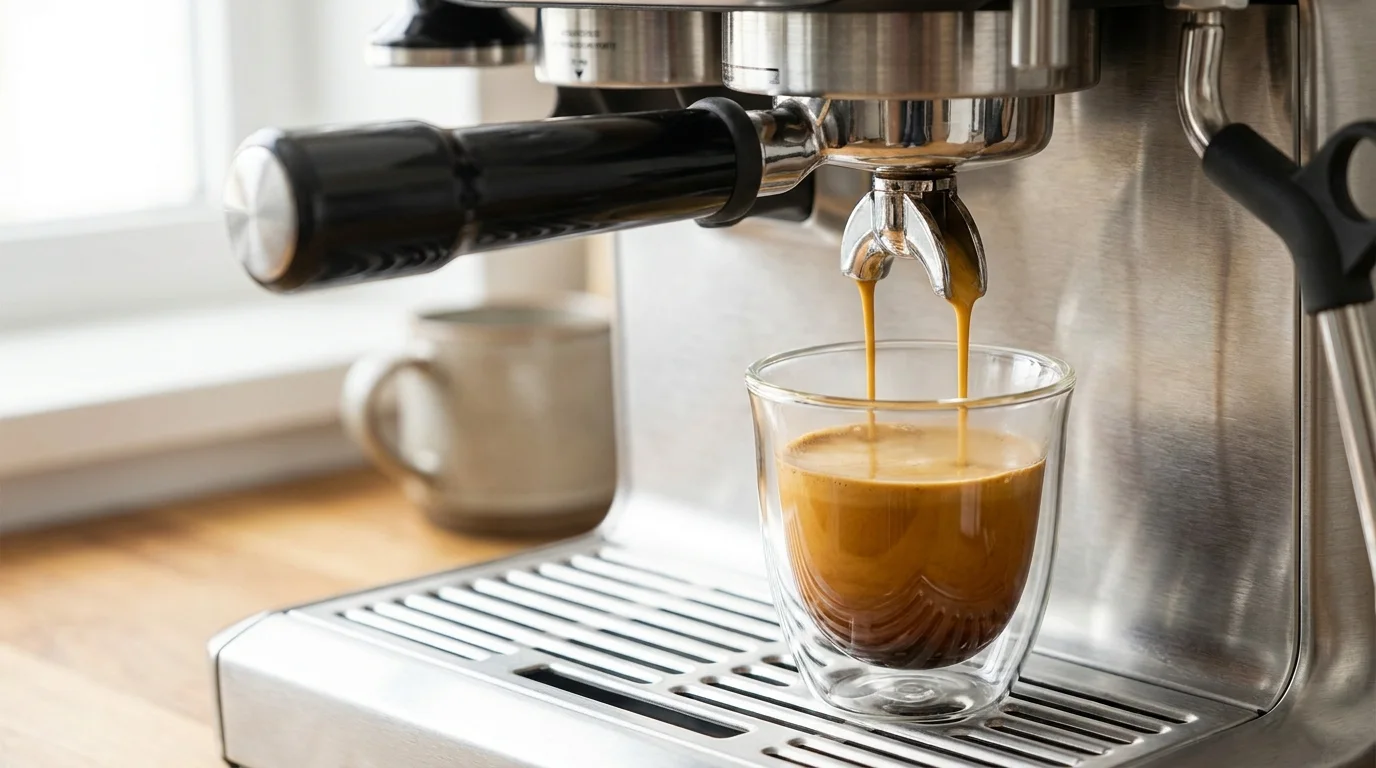
The best home espresso machine for most Australians is the Breville Barista Express BES870 at about $598, because its grinder is built in and the grind is the single biggest factor in shot quality. The De'Longhi Dedica Arte EC885.M at about $197 is the cheapest real manual machine and is only 15cm wide, and the Breville the Dual Boiler BES920 at about $1,218 steps up to a commercial 58mm portafilter with separate brew and steam boilers.
Australia has one of the strongest coffee cultures in the world, and at some point most of us look at the daily cafe spend and think: could I just make this at home? The good news is yes: a real espresso machine on your bench can pull cafe-quality shots and texture milk for a flat white. The honest news is that espresso has a genuine learning curve, and the machine is only half the story; the grind matters just as much.
This guide cuts through it. We cover the three types of home coffee machine so you choose the right category first, the all-important grinder question, the specs that actually matter (and the marketing numbers that do not), and three verified picks across budget, best-for-most, and premium. If you are still deciding between espresso, pods and bean-to-cup more broadly, our wider coffee machine guide compares all three side by side.
The Three Types of Home Coffee Machine: Choose This First
Before you compare models, decide which kind of machine suits how you actually drink coffee. Get this wrong and even an expensive machine will frustrate you.
- Manual / semi-automatic pump espresso (all three of our picks): you grind, dose, tamp and pull the shot, and texture the milk yourself. This gives you the most control and the real barista experience, and a real learning curve. It is the choice for people who want to make great espresso as a hobby and a craft, not just a caffeine delivery system.
- Automatic bean-to-cup (for example the De'Longhi Magnifica S, around $479): a push-button machine that grinds the beans and brews automatically. Far more convenient and consistent for an everyday cup, with much less of the craft, and usually pricier than an entry-level manual machine. Great if you want fresh-ground coffee with none of the fiddle.
- Pod / capsule (Nespresso and similar): the easiest and most consistent. Drop in a capsule, press a button, done. No skill needed and quick, but pods cost more per cup, create capsule waste, and give you almost no control over the result.
The quick chooser: want the craft, the best espresso, and you do not mind learning? Go manual / semi-automatic. That is what this guide is about. Want fuss-free everyday coffee with fresh beans? An automatic bean-to-cup machine is your friend. Want the simplest, most consistent cup with zero effort? Pods win. Everything below assumes you have chosen the manual / semi-automatic path.
Key Specs Explained Simply
Espresso machine marketing is full of numbers. Here is what actually matters, in plain terms.
- 15-bar pump: this is largely a marketing number. Around 9 bar of pressure is what actually extracts espresso well; almost every pump machine on the market is rated to 15 bar, so it tells you very little when comparing models.
- PID / digital temperature control: this keeps the brew water at the right temperature shot after shot. Temperature stability is one of the biggest drivers of consistency, so a machine with PID control is far more forgiving day to day.
- Pre-infusion: gently wets the coffee grounds at low pressure before the full extraction begins, which helps the water flow evenly and reduces channelling. It is a quiet but genuine quality feature.
- Portafilter size: Breville's home machines use a 54mm portafilter, while the Dual Boiler steps up to a commercial-spec 58mm, the same size used in many cafe machines, holding a larger dose. Bigger is not automatically better for a beginner, but 58mm opens the door to commercial accessories.
- Single vs dual boiler: a single boiler has to switch between brewing and steaming, so you wait between pulling a shot and texturing milk. A dual boiler has separate boilers for each, so you can brew and steam at the same time with no wait. That convenience is the main reason to pay up to the premium tier.
- Steam wand: textures milk into microfoam for milk drinks. Manual wands give you control and reward practice; some automatic machines texture the milk for you with less skill required. All three picks here use a manual wand.
- Heat-up time and tank size: practical day-to-day factors: how long before the first coffee, and how often you refill. The Barista Express carries a 2L tank, which is plenty for a household.
Milk and Latte Art
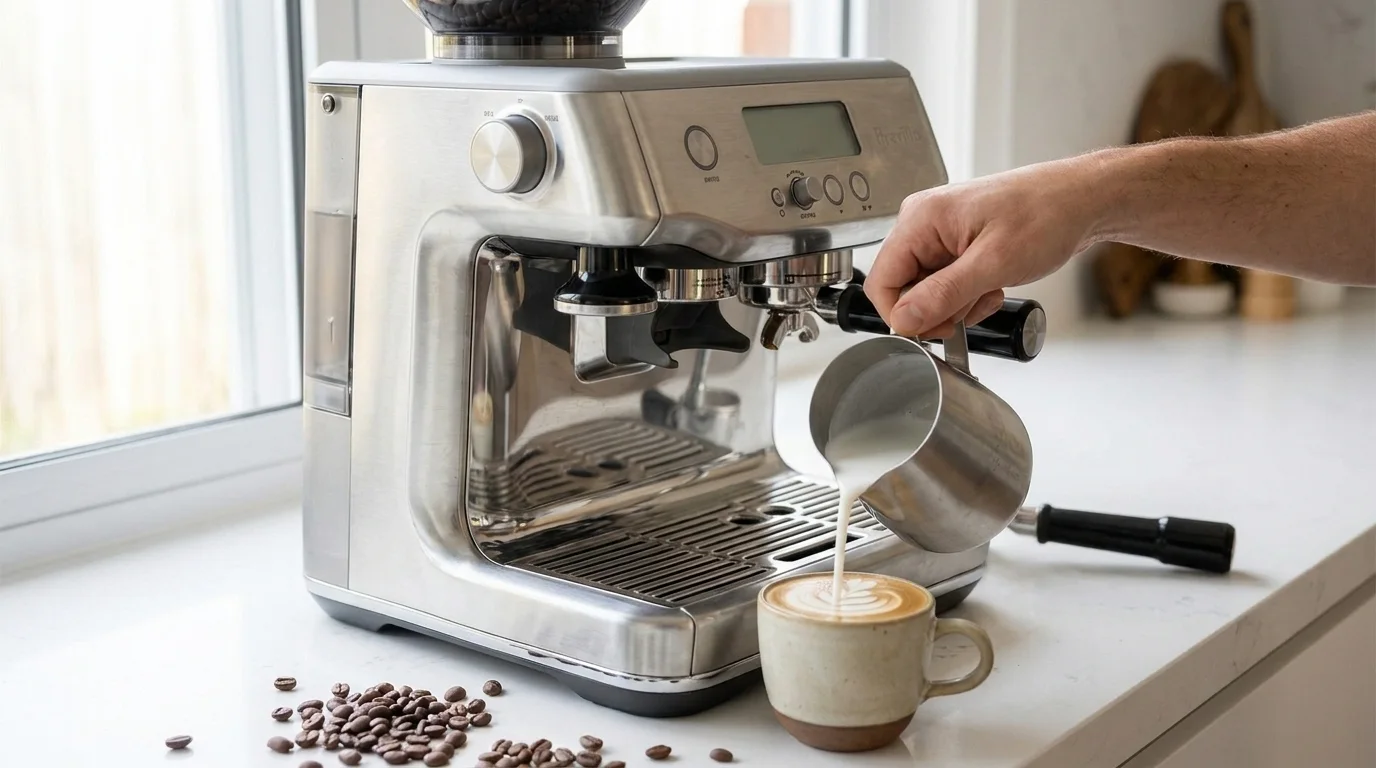
For a lot of people, milk is the whole point: cappuccinos, flat whites and lattes. The steam wand turns cold milk into silky microfoam by injecting steam and spinning the milk into a glossy, paint-like texture. Pour that correctly and you get latte art; more importantly, well-textured milk simply tastes sweeter and feels better in the cup.
Manual steam wands, which all three of our picks have, reward a bit of practice: you learn the angle, the depth and the timing. It takes a few weeks to get consistent, but it is one of the most satisfying parts of home espresso. If a tidy rosetta on top of a flat white is your goal, a manual wand is what gets you there.
The Australian Brand Landscape
Two of our three picks are Breville and the budget pick is De'Longhi, and that reflects reality: Breville and De'Longhi are the two dominant home-espresso brands in Australia, stocked everywhere and supported locally. That is not the whole market though, and it is worth knowing the main alternatives you will run into.
- Sunbeam makes capable, often cheaper manual machines (the Cafe and Barista range) that undercut the big two on price, a reasonable starting point if budget is the priority.
- De'Longhi's own automatic bean-to-cup machines (such as the Magnifica S, around $479) are the push-button, grind-and-brew option if you decide the manual workflow is not for you after all.
- Nespresso pod machines are the easiest and most consistent of all, but pods cost more per cup and give you the least control. For zero-effort coffee they are hard to beat.
For the manual espresso path, though, Breville and De'Longhi genuinely earn their place, which is why our three picks land where they do.
How the three home espresso machines compare
Whether the grinder is built in, and how big the portafilter is, are the two specs that separate these three. Prices are what the listings showed at the time of writing and move around.
| Pick | Best for | Key spec | Price band | Rating |
|---|
| De'Longhi Dedica Arte EC885.M | Best budget way in | Manual pump, 15cm wide, manual steam wand, no grinder | about $197 | 4.4 |
| Breville Barista Express BES870 | Best for most people | Built-in grinder, 54mm portafilter, 2L tank | about $598 | 4.6 |
| Breville the Dual Boiler BES920 | Best premium | Dual boiler, 58mm commercial portafilter, PID control | about $1,218 | 4.6 |
Our Three Picks
Best budget way in: De'Longhi Dedica Arte EC885.M, about $197
The Dedica Arte is the affordable entry to real manual espresso from a recognised brand. It is a traditional 15-bar manual pump machine, and despite being only 15cm wide (slim enough to tuck onto any bench), it gives you full manual control: you tamp your own ground coffee and control the shot, just like a barista. The My Latte Art steam wand textures milk into microfoam for cappuccinos, flat whites and lattes, and a bonus metal tamper is included in the box. The stylish metal body looks the part too.
The one honest limitation: the Dedica does not have a built-in grinder. You use pre-ground coffee or pair it with a separate grinder. If you are happy to start on pre-ground (or already own a grinder), it is the cheapest credible route into genuine barista-style espresso.
- Pros: Genuine 15-bar manual pump espresso, only 15cm wide, My Latte Art steam wand for microfoam, full manual control, metal tamper included, smart metal styling, recognised brand with local support
- Cons: No built-in grinder (needs pre-ground coffee or a separate grinder), small single-boiler machine so you wait between brewing and steaming, learning curve to dial in
- Best for: Someone who wants real espresso without a big outlay and does not mind adding pre-ground coffee or a separate grinder
Check price on Amazon AU →
Best for most people: Breville Barista Express BES870, about $598
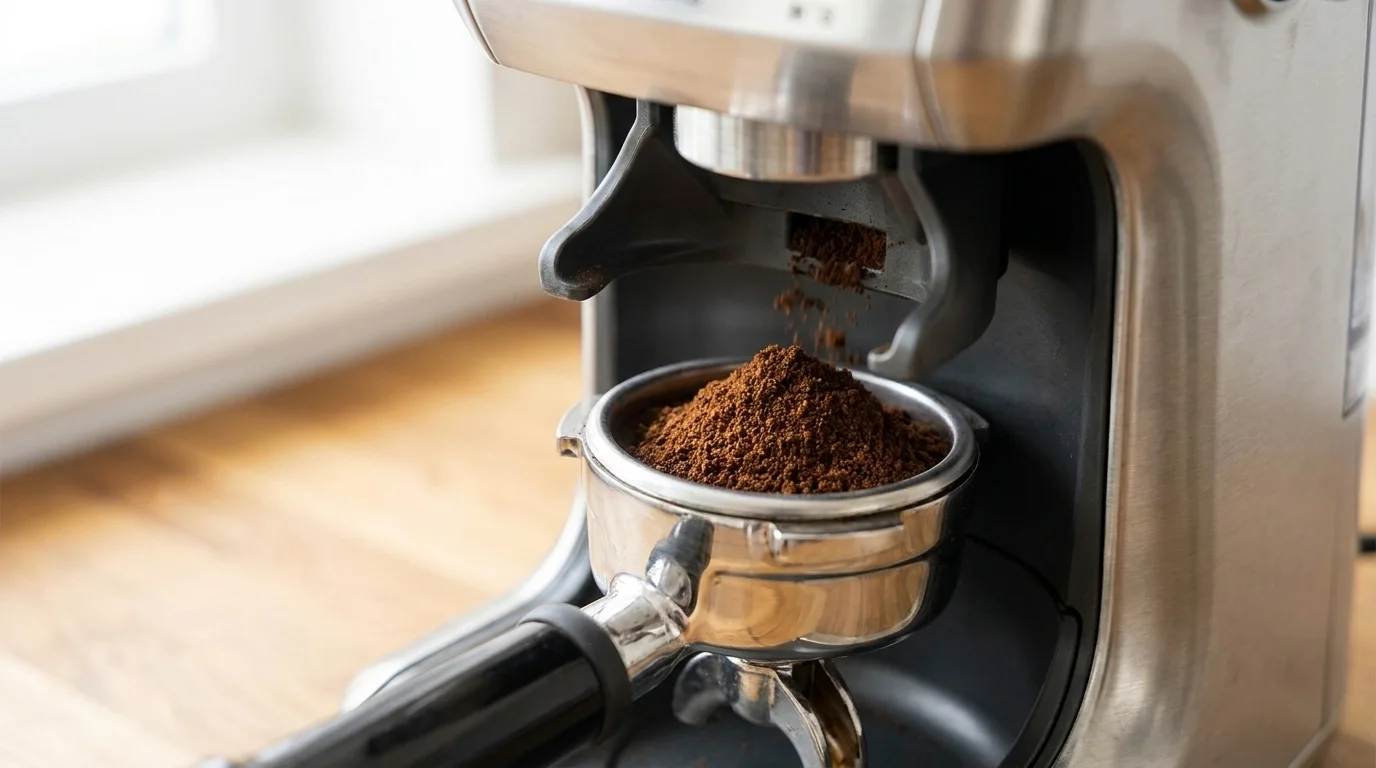
The Barista Express is the iconic Australian first real espresso machine, and for good reason: it is the all-in-one. An integrated precision conical burr grinder grinds beans on demand straight into the portafilter, so grind, dose, tamp and pull all happen at one machine. You never need to buy a separate grinder. A grind-size dial and dose control let you tune the grind, PID digital temperature control keeps shots consistent, and low-pressure pre-infusion eases into a full extraction for even shots. The manual microfoam steam wand handles latte art, the bean hopper holds 250g, the tank is 2L, and it does single or double shots from an 1850W heater, backed by a 2-year warranty.
The built-in grinder is the headline. Because you do not need a separate grinder, you get cafe-quality espresso plus milk texturing in a single bench unit, which is exactly why this is the default recommendation for most home baristas.
- Pros: Built-in conical burr grinder grinds straight into the portafilter, grind-size dial and dose control, PID temperature control, pre-infusion, manual microfoam steam wand, 250g hopper, 2L tank, 2-year warranty
- Cons: Single boiler so you wait briefly between brewing and steaming, takes bench space, the dial-in process still takes practice
- Best for: Most home baristas, anyone who wants one machine that does everything without buying a separate grinder
Check price on Amazon AU →
Best premium for enthusiasts: Breville the Dual Boiler BES920, about $1,218
The Dual Boiler is the prosumer pick for people who take espresso seriously. Its defining feature is in the name: separate boilers deliver simultaneous extraction and steam, with a heated group head and PID control, so there is no waiting between pulling a shot and steaming milk. It uses a commercial-spec 58mm stainless steel portafilter holding a 22g dose, low-pressure pre-infusion that leads into a 9-bar extraction via a 15-bar Italian pump, and a manual microfoam steam wand. Volumetric or timed shot control, an LCD screen and a pressure gauge let you dial in with precision.
The honest limitation: it does not include a built-in grinder. It is designed to be paired with a separate dedicated grinder: the enthusiast path, where a standalone grinder out-performs a built-in one. Budget for a good grinder alongside it. This is a machine for people who will keep it for years and enjoy the craft.
- Pros: Dual boilers brew and steam at once with no wait, heated group head, commercial-spec 58mm portafilter (22g dose), 9-bar extraction via 15-bar Italian pump, pre-infusion, manual steam wand, volumetric or timed shots, LCD and pressure gauge
- Cons: No built-in grinder (pair with a dedicated grinder, an extra $150 to $400+), most expensive pick, larger footprint, the most to learn
- Best for: Serious enthusiasts who want commercial-style consistency and will pair it with a good standalone grinder
Check price on Amazon AU →
The Honest Trade-offs
Home espresso is genuinely rewarding, but it is worth going in with eyes open. Real espresso has a learning curve: dialling in the grind, dose and tamp takes practice, and your first week of shots will not taste like your local cafe. A machine without a grinder needs a separate grinder budgeted in, which adds cost and bench space. Pods are easier and cost more per cup while wasting capsules. And every espresso machine needs regular cleaning and descaling to keep tasting good. Skip it and the coffee turns bitter and the machine clogs.
None of that should put you off; it just sets expectations. If you want the craft and you are willing to learn, the payoff is cafe-quality coffee at home for a fraction of the daily spend. While you are setting up the bench, our kettle guide, the milk frother guide and the full kitchen essentials checklist cover the rest of the everyday appliances most homes need running on day one.
Frequently Asked Questions
Should I get a manual espresso machine, an automatic, or a pod machine?
It comes down to how much you enjoy the process. A manual or semi-automatic pump machine gives you the most control and the best espresso, but you grind, dose, tamp, pull and texture milk yourself. It is a craft with a real learning curve. An automatic bean-to-cup machine grinds and brews at the press of a button, which is far more convenient and consistent for an everyday cup but gives you far less control. A pod machine is the easiest and most consistent of all, though pods cost more per cup and offer almost no control. Want the craft and the best result and do not mind learning? Go manual. Want fuss-free everyday coffee? Go automatic. Want the simplest cup with zero effort? Go pods.
Do I need an espresso machine with a built-in grinder?
You do not strictly need one, but for most people a built-in grinder is the easiest choice. The grind is the single biggest factor in espresso quality, so you want it fresh and consistent. A machine with a built-in grinder, like the Breville Barista Express, handles that in one unit with no separate purchase. The alternative is a machine without a grinder, like the De'Longhi Dedica or the Dual Boiler, paired with a separate dedicated grinder. A good standalone grinder out-performs most built-ins, which is why enthusiasts go that way, but it adds roughly $150 to $400 or more in cost. You can also start on pre-ground coffee, which is cheapest but goes stale fast.
Is the Breville Barista Express worth it?
For most home baristas, yes. It is the iconic all-in-one in Australian kitchens because the built-in conical burr grinder means you do not need to buy a separate grinder. You grind, dose, tamp and pull at one machine. Add PID temperature control for consistency, pre-infusion for even shots, and a manual steam wand for milk, and you have a complete cafe-style setup on one bench. It is the default recommendation here precisely because it removes the biggest extra cost and complication for a beginner, which is sourcing a good grinder separately.
What is a dual boiler and do I need one?
A dual boiler has two separate boilers (one for brewing and one for steaming), so you can pull a shot and texture milk at the same time with no waiting. A single-boiler machine has to switch between the two, so you pause between brewing and steaming. The simultaneous brew-and-steam convenience, plus the consistency it brings, is the main reason to pay up to a machine like the Breville Dual Boiler. Do you need one? Only if you make milk drinks often, value the no-wait workflow, and take espresso seriously enough to keep the machine for years. For most people a good single-boiler machine is plenty.
Can I use pre-ground coffee in an espresso machine?
Yes. Any of these machines will work with pre-ground espresso coffee, and it is a perfectly reasonable way to start. It is the cheapest route and avoids buying a grinder up front. The catch is that pre-ground coffee goes stale quickly once the bag is opened, so it is the biggest compromise on quality over time. The De'Longhi Dedica and the Dual Boiler are designed to run on either pre-ground coffee or a separate grinder, while the Barista Express grinds fresh beans itself. If you fall for home espresso, grinding fresh is the upgrade that makes the most difference.
Do these machines make milk drinks and latte art?
Yes, all three picks have a manual steam wand that textures milk into silky microfoam for cappuccinos, flat whites and lattes. A manual wand gives you control over the milk and rewards a few weeks of practice with the skill to pour latte art. Well-textured milk also simply tastes better, sweeter and smoother, even before you attempt any patterns on top. If milk drinks are your main reason for buying an espresso machine, the steam wand is the feature to focus on.
Which espresso machine should I buy?
For most people the Breville Barista Express is the best buy because the built-in grinder makes it a complete all-in-one with no separate grinder to source. If you want real espresso on a budget and do not mind adding pre-ground coffee or a separate grinder, the De'Longhi Dedica Arte is the slim, affordable way in. If you are a serious enthusiast who wants to brew and steam at once with a commercial-spec 58mm portafilter, the Breville Dual Boiler is the premium choice. Just pair it with a good dedicated grinder, as it has none built in. Match the machine to how involved you want to be and what you are willing to spend up front.
Does hard water damage an espresso machine in Australia?
Scale is the main thing that kills a home machine, and water hardness varies a lot between Australian cities and even between suburbs on different supplies. Hard water leaves mineral deposits in the boiler and the group head, which slow the flow, throw the brew temperature out and eventually block it. Use the filter that comes in the water tank and replace it on schedule, or fill with filtered water, and descale on the interval in the manual rather than when you notice a problem.
Is a Moka pot a better first purchase than an espresso machine?
For some people, yes. A stovetop Moka pot costs a fraction of any machine here, makes a strong concentrated coffee that is close enough for a milk drink, and teaches you how grind size changes the cup. What it cannot do is real crema, proper pressure or textured milk. If you drink black coffee and want to spend under $60, start there. If you want flat whites at home, no Moka pot substitutes for a pump machine and a steam wand.
How much should a home espresso machine cost in Australia?
Three bands cover the market. About $200 buys a real manual pump machine such as the Dedica Arte, but you supply the grinder or the pre-ground coffee. Around $600 buys the all-in-one with the grinder built in, which is where most households should land. Above $1,000 you are paying for a dual boiler, PID temperature control and a 58mm commercial portafilter, which matters if you make several milk drinks back to back.