The KitchenAid Classic 5KHBV53ABM is our light, simple alternative. Amazon AU describes lightweight construction, a removable blending arm, a 700 ml jar with lid, a stainless steel blade and a pan guard.
The listing gives a 153 cm cord. Its jar and lid suit cooks looking for a compact blending setup.
5KHBV53ABM is on Level 3 EESS record E2020029489, certificate ULL-101944, KitchenAid Australia, rated 220 to 240 V, 50/60 Hz and 180 W, with registration to 31 October 2030.
The Amazon AU rating was 4.4 out of 5 from 24 ratings.
How we picked these stick blenders
Of 35 stick blender listings we checked on Amazon Australia on 2 October 2026, 6 cleared both checks: sold and shipped by Amazon AU, and the exact model on a current EESS registration.
We read the featured offer's seller and dispatcher, any import notice, the exact model row, registration status and expiry date. We then checked specifications against the Amazon listing, Braun's manual and Australian maker pages. The recommended offers had no Global Store notice.
The Braun offers the attachment set and speed dial we wanted for the overall pick. The Kenwood fills the budget role, with its small rating count stated plainly. Star ratings are dated customer feedback, not a measurement of blending performance.
Registrations carry expiry dates. Before buying, re-check the exact model in the EESS public register and look for the RCM mark on the appliance. An Amazon Australia web address alone does not identify the seller or confirm the model match.
Stick blender vs countertop blender: which do you actually need?
Choose a stick blender if you want to blend food in the vessel you are using. Choose a countertop blender if you want a jug and powered base. Start with the job you want to do, then check the exact appliance's instructions for that job.
A stick blender has a motor handle and a blending shaft. Braun's manual tells you to position the wand deep in a beaker or bowl before switching on. It also describes blending directly in a saucepan. That makes the handheld format a useful choice when soup and sauces are the reason you are shopping.
The Braun MultiQuick 5 Vario MQ5237BK comes with a 600 ml beaker, but that is an included container size, not a stated maximum for a saucepan. Match the container and quantity to the instructions for your model. Do not turn a beaker capacity into a claim about how much soup the motor can handle.
For drinks, be specific about the ingredients. Braun lists drinks and milkshakes among the wand's uses. That supports choosing it for those jobs; it does not turn the wand into an ice crusher. If frozen drinks are your priority, use the best blender Australia guide to compare appliances whose instructions cover the ingredients you plan to use.
Think about preparation as well as blending. Braun's chopper instructions cover onions, herbs, garlic, carrots and nuts. Slicing and shredding belong to a different food processor accessory in the manual. Braun's manual also gives a maximum operation time of 2 minutes for the chopper, which suits short preparation jobs. If those are your main tasks, compare a food processor before choosing a wand set.
A stick blender also does not replace the cooking step for soup. If you want an appliance that combines those jobs, read our soup maker guide. For a drink you want to blend away from a kitchen power point, compare the format and ingredient limits in our portable blender guide.
You do not need to buy both formats by default. Write down your recurring jobs, such as soup, milkshakes or chopping onions, and choose the appliance and attachments that cover them.
What a Stick Blender Is Great At (and What It Isn't)
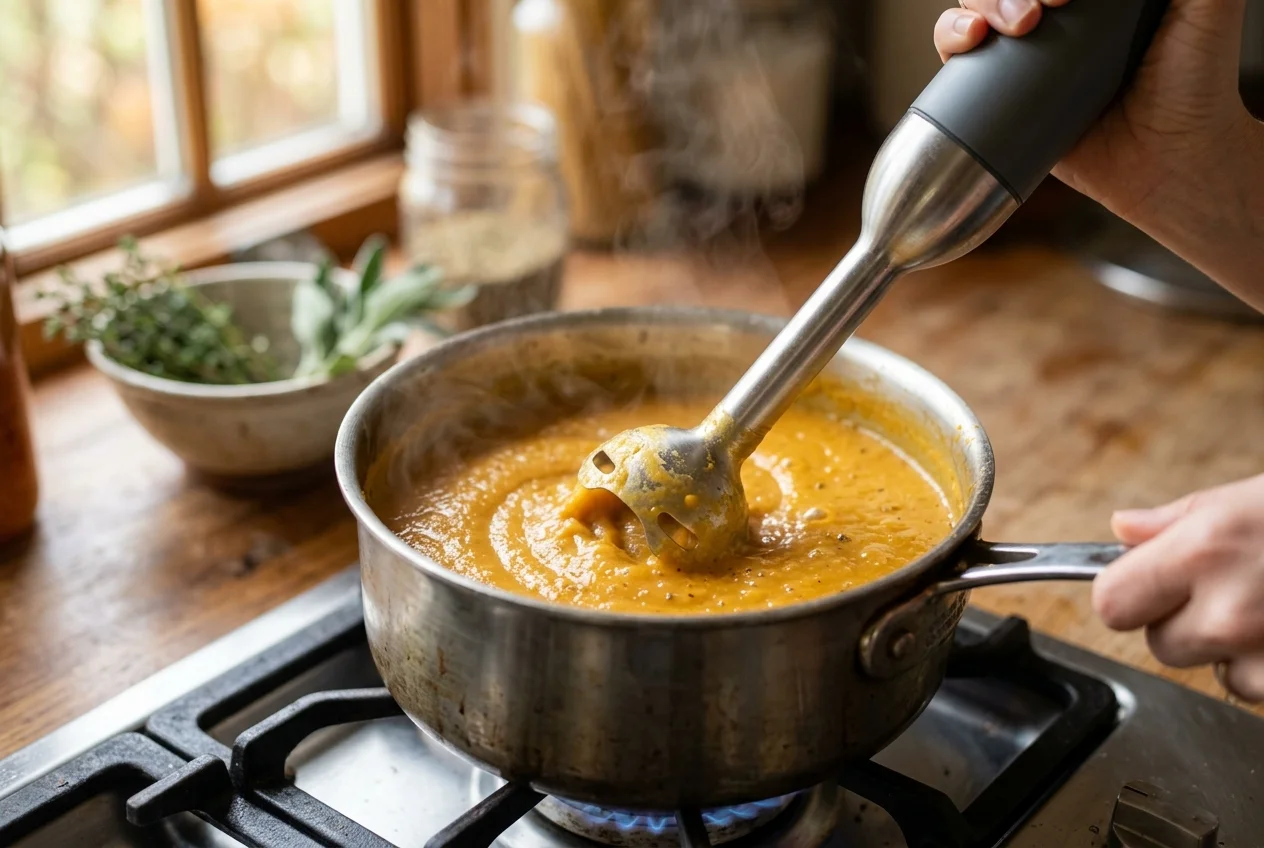
Soup, sauces and drinks are a good starting point for a stick blender. Braun's manual explicitly lists dips, sauces, soups, mayonnaise, baby food, drinks and milkshakes as uses for its hand blender. Treat those as jobs for the wand, then use the appropriate attachment for other preparation.
- Soup: blend in the saucepan using the method in your appliance's instructions. Braun's manual says to remove the pan from the stove before blending.
- Sauces and dips: the Braun wand is intended for these mixtures. Choose a suitable beaker or bowl and position it deep in the mixture as the manual directs.
- Mayonnaise: Braun supplies a beaker method using the wand. Follow the recipe and method for your appliance instead of assuming a short blending time guarantees a result.
- Drinks and milkshakes: these are listed wand uses. Check the ingredients and quantity against the instructions for your model.
- Cream and egg whites: use the whisk. Braun assigns these tasks to that attachment, along with sponges and ready mix desserts.
- Chopped ingredients: Braun's chopper instructions cover foods including onions, herbs, garlic, carrots and nuts. This is a different attachment from the blending shaft.
The attachment matters as much as the motor. A wand, whisk, chopper and masher have different instructions. The Braun set includes these tools, but that does not mean the blending shaft takes over their jobs.
Ice is a useful example. Braun's manual identifies the MQ 40 accessory for ice crushing; it also warns against chopping extremely hard food such as ice cubes. Do not assume that an included chopper or the wand can crush ice because another accessory in the same manual can.
For potatoes, Braun describes the masher for cooked vegetables and fruit. Its instructions say to cook and drain first. Choose the masher when that is the result you want, and keep the blending shaft for the jobs assigned to it.
For frozen drinks or slush, compare the stated ingredient limits of a countertop blender or a slushie machine. For slicing, shredding or dough preparation, look at the required attachment before buying. An accessory count on the box is useful only when it includes the tools your cooking needs.
Power and speed: what wattage do you actually need?
Do not choose a stick blender by wattage alone. Match its listed uses and attachments to your meals, then decide how much speed control you want. A wattage figure is a specification, not a measured result for soup texture, chopping quality or splashing.
Amazon AU lists the Braun MultiQuick 5 Vario MQ5237BK at 1000 W. Amazon AU lists the Kenwood Triblade HDP101WG at 600 W. Those figures tell you the stated electrical input; they do not show how the two appliances perform on the same recipe.
The clearer everyday difference is the control layout. Braun has 21 speeds plus turbo, with a variable speed regulator described in the manual. Kenwood's listing gives one speed plus turbo. Choose the dial if you want to adjust the setting during blending; choose the simpler controls if that suits your cooking.
Use the speed instructions for the attachment as well as the recipe. Braun's manual recommends the highest speed for blending. For whipped cream, it says to begin at a low speed and increase while whipping. The appropriate starting setting therefore depends on the job.
Check the tool before comparing the number on the motor. A whisk for cream, a chopper for onions and a masher for cooked potatoes change what you can prepare. More stated watts do not add an attachment that is absent from the set.
For soup and sauces, our overall choice is the Braun because of its adjustable controls and included tools. For a simpler wand and beaker setup, the Kenwood is the budget choice. Pick between those setups before using wattage as a deciding factor.
Attachments: whisk, chopper, masher and what's worth it
Choose attachments by the jobs you repeat. The Braun MultiQuick 5 Vario MQ5237BK listing includes a blending shaft, 600 ml beaker, chopper, whisk and masher. The Kenwood Triblade HDP101WG title identifies a wand and beaker setup. That difference is more useful than an accessory count without a list of the tools.
The wand handles the soup, sauces, dips and drinks described in Braun's manual. If those are your jobs, start by comparing the controls and included container. You do not need a whisk or masher simply to choose a blender for soup.
The whisk is for a different kind of preparation. Braun lists whipping cream, beating egg whites, mixing sponges and ready mix desserts. Its cream instructions start at low speed and increase during whipping. If these are regular tasks, a set with a whisk gives you an attachment intended for them. For frothing milk for coffee, compare the jug, handheld and stovetop models in our milk frother guide.
A whisk attachment does not give a stick blender the same equipment as a hand mixer with beaters. For recipes that call for that setup, compare the attachments in our hand mixer guide. Decide from the recipe and included tools, not the phrase 'all in one'.
The chopper handles ingredients such as onions, herbs, garlic, carrots and nuts in Braun's instructions. The manual calls for preparation such as cutting larger ingredients and removing herb stems and nut shells. Follow the quantity and speed tables for the attachment you have.
The masher is intended for cooked vegetables and fruit, including potatoes and sweet potatoes. Braun says to cook and drain the ingredients before using it. It is useful if those dishes are part of your routine; it is an extra tool to store if they are not.
Finally, distinguish chopping from slicing and shredding. Braun describes those latter jobs under a food processor accessory, which is not listed among the MQ5237BK set's included components. Compare a food processor if that is the preparation you need. Choose the set with the right tools, then check their assembly and cleaning instructions.
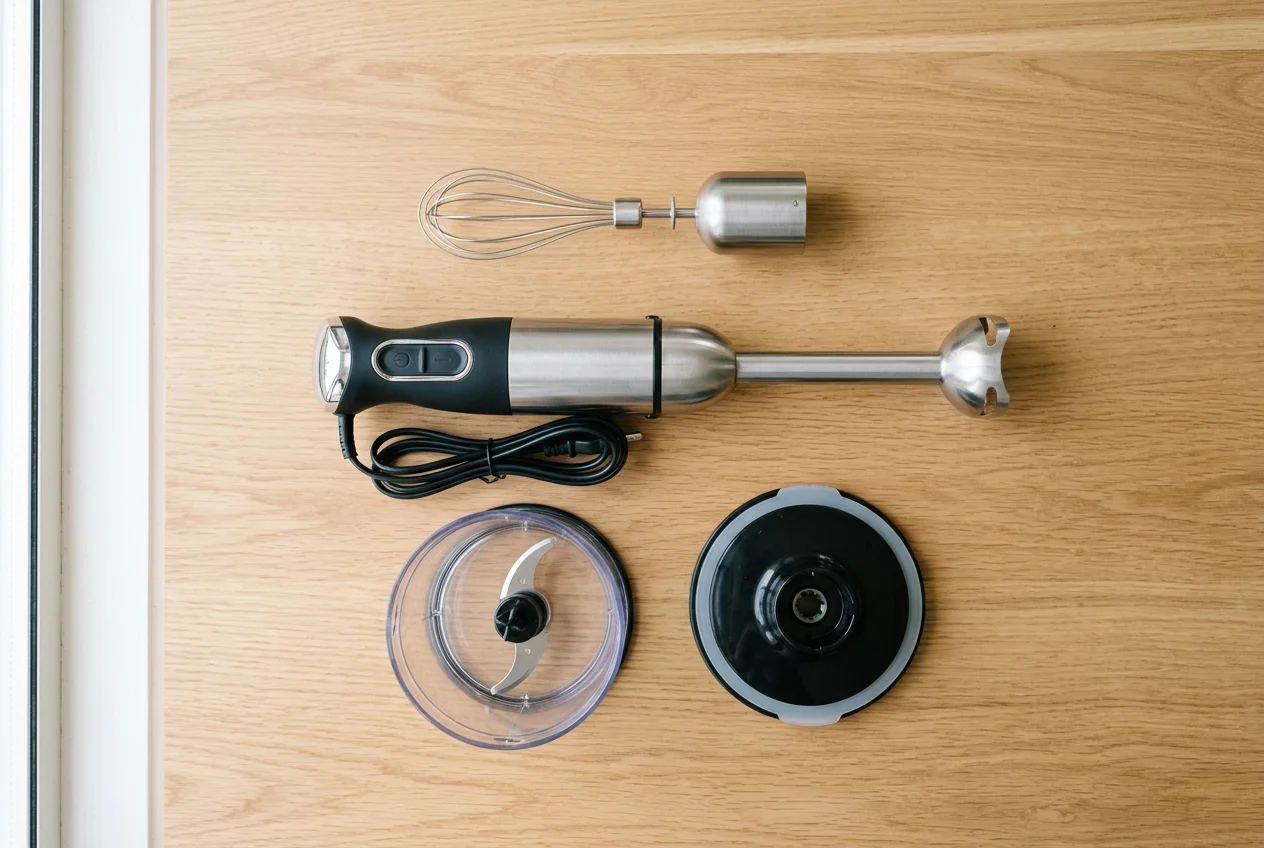
The guard around the blade is worth checking, but it cannot promise a spotless bench. Amazon AU describes the Braun MultiQuick 5 Vario MQ5237BK as having a bell shaped shaft and SplashControl technology. That is a design feature, not a reason to skip the maker's technique instructions.
The Kenwood Triblade HDP101WG listing describes a shaped foot and internal ribs that direct ingredients towards its three angled blades. Both descriptions explain the design around the cutting area. Neither gives a measured comparison of splashing between the two models.
For the Braun, begin with the manual's practical instruction: position the blender deep in the beaker or bowl, then switch it on. This matters more than assuming the shape of the guard will compensate for a wand held near the surface.
Container choice is part of the setup. The Braun includes a 600 ml beaker, and the Kenwood lists a 600 ml beaker. For a saucepan, follow the instructions for the appliance you use. Braun specifically says to remove the pan from the stove before blending to avoid splashing boiling liquid.
Look at the guard and controls together when choosing. The Braun offers its bell shaped shaft with a speed dial; the Kenwood combines Triblade blades with one speed and turbo. Choose the controls you want, then use the positioning and container instructions that belong to that model.
A splash control feature is useful information on a listing. It is not a guarantee that a particular recipe, vessel or movement will produce no splashes.
Corded vs Cordless Stick Blenders
Choose corded if you want to use a power point without managing a battery charge. Choose cordless if freedom to move is the reason you are shopping, then check the stated run time and charging requirements. We have no cordless pick this time, for the reason below.
A corded wand keeps you within reach of its lead. A cordless wand has a finite battery run time, and its power specification can differ from a corded model. Compare the actual appliances, not a claim that one format delivers the same performance as the other.
Breville's All in One Cordless Stick Mixer LSB150 illustrates the trade. Breville AU specifies 200 W, an 11.1 V battery and up to 30 minutes of operation. Its stated power is below the listed Braun and Kenwood figures, but that comparison does not measure blending quality.
Breville also says battery life varies with the recipe, attachments, battery age and usage patterns. Treat the 30 minute figure as an upper claim with those conditions, not a promise for each mixture.
The LSB150 was sold by Amazon AU, but the only register entries we found for it had expired, so we could not confirm a current registration.
If you are checking cordless models yourself, read the featured offer's seller, any import notice, the exact model code and the current public register entry. Then check the maker's run time conditions and charging instructions. Choose cordless for a practical benefit in your kitchen layout, with those limits understood.
Why there is no 2-in-1 pick this time
Every 2-in-1 and 3-in-1 hand blender and mixer listing we found on Amazon AU on 2 October 2026 was sold by Amazon UK with a notice that it may need a plug adapter: Ninja Foodi CI090UK, Ninja Foodi CI100UK and a second Ninja Foodi 3-in-1 listing. We could not confirm an Australian version, so there is no recommendation in this slot.
If your recipes call for a hand mixer, compare the required attachments in our hand mixer guide.
How to Use a Stick Blender Without Making a Mess
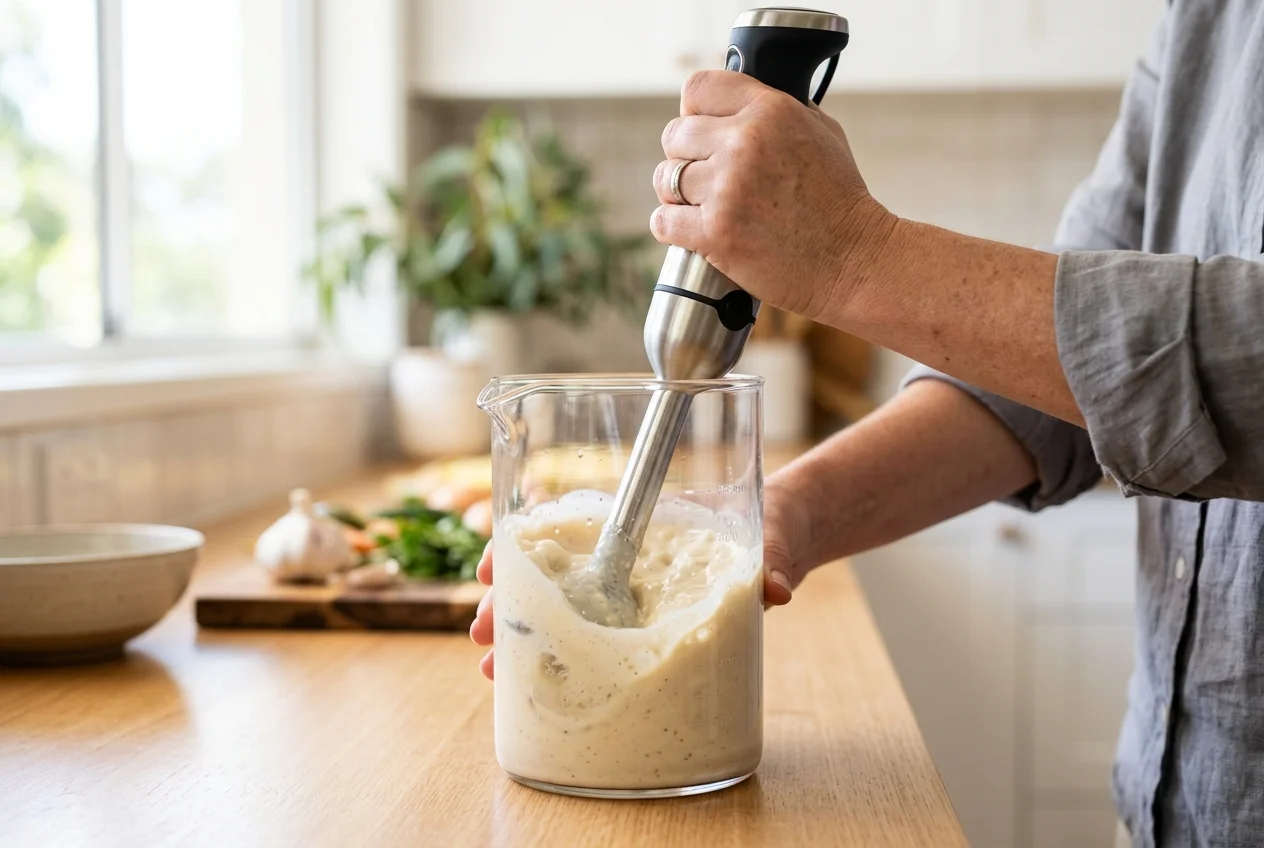
Start with the instructions for the appliance and attachment you are using. Braun's manual gives a practical sequence for its blending shaft: attach it to the motor, position the wand deep in a beaker or bowl, then switch on. Use that order before trying to change the texture of the mixture.
- Prepare the right vessel. Braun's instructions describe a beaker, bowl or saucepan. Choose the vessel for the job and position the wand deep in the food before starting the motor.
- Take a saucepan off the stove first. Braun gives this instruction to avoid splashing boiling liquid. A splash control foot does not replace it.
- Use the setting for the job. Braun recommends the highest speed for blending. Its cream instructions use a low starting speed with the whisk, followed by an increase. Do not assume one setting suits both tools.
- Follow the recipe's movement. Braun's mayonnaise method begins at the bottom of the beaker, holding the wand there until the oil starts emulsifying. It then calls for slowly moving the shaft through the mixture.
- Finish before changing attachments. Braun directs users to switch off and disconnect the appliance before changing accessories. After blending, unplug it and use the release buttons to detach the motor.
For the chopper, Braun says to hold the motor with one hand and the bowl with the other during processing. For the whisk, place it in the bowl before switching on. Those are attachment specific steps, so read the relevant instructions before moving from soup to chopping or whipping.
Bamix, Braun MultiQuick 7 and the stick blenders we left out
At our 2 October 2026 check, Bamix Mono had no Amazon AU featured offer. Bamix Deluxe was sold by the third party Household and Luxury. Neither became a card recommendation.
Bamix Australia's website describes its appliances as handmade in Switzerland and lists blades, accessories and service support. Those details do not support a claim that a particular Bamix will last for decades or outperform the Braun.
The Braun MultiQuick 7 MQ7077X and MQ7087X were both sold by Amazon AU. MQ7077X is listed on the Braun registration we found, and MQ7087X is not, so only MQ7077X cleared both checks. We did not card MQ7077X: it had 31 ratings, and its register entry gives 850 W against the 1000 W on the listing.
Russell Hobbs Desire RHSM5BLK also cleared both checks, but we did not make it a card pick because its rating was 3.9 out of 5 and its registration runs only to 11 November 2026.
Cleaning and Care
Read the cleaning instructions for each attachment before putting it in the sink or dishwasher. Braun's manual gives different methods for the motor, gearboxes, lids and other parts. The detachable tools do not share one washing rule.
For the Braun MultiQuick 5 Vario MQ5237BK, the manual says to clean the motor and the whisk and masher gearboxes with a damp cloth only. It allows the lids to be cleaned under running water, but says not to immerse them or put them in a dishwasher.
The same cleaning section permits the other parts in the dishwasher. Use that instruction for the Braun parts it covers; check another model's own directions before applying it to a different set.
For food that has dried onto the masher, Braun describes removing the paddle and soaking it with the bottom of the shaft in warm water before washing. It also allows removal of the chopper bowl's anti-slip ring for a more thorough clean.
Braun instructs users to disconnect the appliance before cleaning or disassembly. Follow the assembly directions when putting the tools back together, so the next job begins with the correct attachment ready.
Our verdict
The Braun MultiQuick 5 Vario MQ5237BK remains our overall pick for its 21 speeds plus turbo and its beaker, chopper, whisk and masher. Choose the Kenwood Triblade HDP101WG for a simpler wand and beaker setup; KitchenAid Classic 5KHBV53ABM is also good for a light setup with a jar and pan guard.
Our recommended exact models were on current EESS registrations and sold and shipped by Amazon AU; re-check the public register and look for the RCM mark before buying.
Frequently Asked Questions
What is the best immersion blender in Australia?
Our pick is the Braun MultiQuick 5 Vario MQ5237BK for its 21 speeds plus turbo and included chopper, whisk and masher. An immersion blender is another name for a stick blender.
What is the best hand blender (or stick mixer) in Australia?
The Braun MultiQuick 5 Vario MQ5237BK is our overall hand blender pick, with a speed dial and a beaker, chopper, whisk and masher. The Kenwood Triblade HDP101WG is our budget choice for one speed plus turbo and a 600 ml beaker. It had only 39 ratings.
What is the best stick blender for soup in Australia?
Our soup pick is the Braun MultiQuick 5 Vario MQ5237BK, whose manual lists soup as a use and describes blending directly in a saucepan. Its 21 speeds plus turbo offer adjustable controls. Braun says to remove the pan from the stove before blending to avoid splashing boiling liquid.
What is the difference between a stick blender and a countertop blender?
A stick blender is a handheld wand used in a beaker, bowl or saucepan; a countertop blender uses a jug on a powered base. Braun lists soups, sauces and milkshakes among its wand uses. For the jug format, see our best blender Australia guide and check the instructions for your intended ingredients.
What wattage stick blender do I need?
Choose by the listed jobs, attachments and controls, not a wattage target alone. Amazon AU lists the Braun MultiQuick 5 Vario MQ5237BK at 1000 W and the Kenwood Triblade HDP101WG at 600 W. Those specifications do not measure how the two blend the same recipe.
Can a stick blender crush ice or make smoothies?
The Braun MultiQuick 5 Vario MQ5237BK manual lists drinks and milkshakes as wand uses, but do not assume the wand or included chopper can crush ice. The manual identifies the MQ 40 accessory for ice crushing, and that accessory is not listed in this set's included components. Check the instructions for the exact attachment and ingredients before making a frozen drink.
Corded vs cordless stick blender: which is better?
Choose corded if you want to use a power point without managing a battery charge; choose cordless if freedom of movement matters more to you. Breville AU specifies up to 30 minutes for its All in One Cordless Stick Mixer LSB150, with battery life affected by recipe, attachments, battery age and usage. Compare the stated power and run time of the exact models you are considering.
Can you use a stick blender directly in the pot?
Yes, Braun's manual describes using its blending shaft directly in a saucepan. It says to remove the pan from the stove first to avoid splashing boiling liquid. Position the wand deep in the mixture before switching on, following the instructions for your appliance.
What attachments do you actually need on a stick blender?
For the soup, sauces and drinks listed in Braun's manual, use the blending wand. Its whisk is intended for cream and egg whites, its chopper for ingredients including onions, herbs and nuts, and its masher for cooked vegetables and fruit. Choose the set that includes the tools for your recurring jobs.
Are stick blenders worth it?
Yes, if the jobs you want include blending soup in a saucepan or preparing sauces and milkshakes with a wand. Braun's manual lists those uses and assigns chopping, whipping and mashing to different attachments. Choose from those jobs, then check which tools come in the set.
Can you whip cream with a stick blender?
Yes, with the whisk attachment: Braun's manual specifically assigns whipping cream to that tool. It directs users to place the whisk in the bowl before switching on, start at low speed and increase while whipping.
How do you make mayonnaise with a stick blender?
Use a beaker and follow your model's mayonnaise recipe. Braun's manual places the wand at the bottom, uses turbo and holds it there until the oil starts emulsifying. It then directs you to raise and lower the shaft slowly through the mixture to incorporate the remaining oil.
Can you make pesto with a stick blender?
Yes, the Braun MultiQuick 5 Vario MQ5237BK's chopper offers a way to prepare pesto ingredients. Its manual lists herbs, garlic and nuts as suitable foods for that attachment. Follow your recipe and the chopper's quantity and speed instructions.
Is a Braun better than a Bamix?
We have no measured comparison that supports a blanket verdict between the brands. Our overall pick is the Braun MultiQuick 5 Vario MQ5237BK because its set includes 21 speeds plus turbo, a beaker, chopper, whisk and masher. At our 2 October 2026 check, Bamix Mono had no Amazon AU featured offer and Bamix Deluxe was sold by a third party.
Is there a difference between a stick blender and an immersion blender?
No, they are names for the same handheld blending format. Hand blender and stick mixer are also used for the wand that blends directly in a beaker, bowl or saucepan.
Can I use a stick blender instead of a food processor?
For some chopping jobs, yes, with the right chopper attachment. Braun lists onions, herbs, garlic, carrots and nuts among its chopper uses. Its manual assigns slicing and shredding to a different food processor accessory, so compare the required tools in our food processor guide.
What is the best cordless stick blender in Australia?
We have no cordless pick. Breville's All in One Cordless Stick Mixer LSB150 was sold by Amazon AU, but the only EESS entries we found had expired, so we could not confirm a current registration. Check who sells it and the stated run time before choosing one.
Who makes the best stick blender?
Our overall pick is the Braun MultiQuick 5 Vario MQ5237BK. We chose this model for its 21 speeds plus turbo and its included beaker, chopper, whisk and masher, which cover several preparation jobs.
Is the Anko stick blender any good?
This guide has not reviewed Anko stick blenders and holds no owner feedback on them, so it cannot report what buyers say. Our picks had to be sold and shipped by Amazon AU with the exact model on a current EESS registration. For any Anko model, recheck the EESS public register, look for the RCM mark on the appliance, then compare its speeds, beaker and attachments.