Why a good TV antenna still matters when you have just moved in
If you have just picked up the keys and the lounge TV shows nothing but a "no signal" message, an indoor antenna is the fastest, cheapest way to get free-to-air television running before your streaming subscriptions and NBN are even sorted. Whether an indoor antenna works at your address comes down to two things: how far you sit from the transmitter, and whether your area broadcasts on VHF or UHF, which is mostly VHF in the capital cities and often UHF in regional and infill areas. Australian free-to-air is genuinely good value: you get ABC, SBS, Seven, Nine, Ten and their multichannels in full HD, at no monthly cost, the moment a working aerial is plugged in and scanned. For a first-home buyer watching every dollar, that is a strong reason to spend $20 to $40 on an antenna rather than $0 and going without the news, the footy or a rainy-Sunday movie.
The honest catch is that no indoor antenna is magic. Reception depends on how far you sit from your local transmission tower, what is between you and it (hills, tall buildings, thick brick, foil-backed insulation) and where you place the antenna inside the room. The same $25 aerial can pull 30 crisp channels in one suburb and two glitchy ones a few kilometres away. That is physics, not a faulty product, and it is why this guide leans on placement advice as heavily as it does on the hardware. We researched the antennas that Australians can actually buy on Amazon AU today, then ranked six of them on rating, review volume, price and what each one is genuinely good at.
What is the best TV antenna in Australia right now?
For most Australian homes within a reasonable distance of a transmitter, the UltraPro Portable HD Antenna is the best all-rounder: it holds the highest customer rating of our six picks, its magnetic monopole shape is easy to reposition until the picture locks in, and it is already built for the newer ATSC 3.0 broadcast standard. If you want the crowd favourite instead, the August DTA240 is the most-reviewed antenna here by a wide margin and adds a handy magnetic base, while the DAANT Indoor Antenna is the cheapest pick and throws in a USB signal booster, which makes it the natural starting point if your signal is weak or your budget is tight. Every antenna in this guide is a genuine free-to-air aerial, the picks are re-checked against Amazon AU stock regularly, and each card below carries the current price.
How do our six TV antenna picks compare at a glance?
The table below lines up all six on the numbers that actually separate them. Prices are the Amazon AU figures at the time of writing and move around, so treat them as a guide rather than a promise. "Amplified" means the antenna has a powered booster to lift a weak signal; it does not create signal where there is none.
| Antenna | Rating | Reviews | Price | Best for |
|---|
| UltraPro Portable HD | 4.4 | 100 | $31.76 | Best all-rounder, easy to move |
| August DTA240 | 3.1 | 38,499 | $24.95 | Most reviewed, magnetic base |
| DAANT Indoor 900 Miles | 4.0 | 3,796 | $21.50 | Cheapest, includes a booster |
| August DTA180 | 3.3 | 9,190 | $22.95 | Tiny mini aerial, strong-signal rooms |
| August DTA420 | 3.2 | 997 | $27.95 | Flat window aerial, tidy look |
| Sansai ATN228C | 3.4 | 62 | $29.05 | Amplified tabletop unit |
A pattern worth noticing: the average customer rating for indoor antennas sits lower than most product categories, and that is not because they are all bad. It is because reception is so location-dependent that the same model earns five stars from a city apartment 5 km from the tower and one star from a valley 40 km away. Read the low reviews as a warning to check your own signal situation first, not as proof the antenna is a dud.
How did NestPath choose these TV antennas?
NestPath does not run a signal lab, and we are upfront about that. We are an editorial team that researches and studies the market so a first-home buyer does not have to. For this guide we pulled the live Amazon AU catalogue of indoor digital antennas, filtered to models that are actually in stock and buyable in Australia, and then screened each candidate against a consistent set of checks.
First, the antenna had to be a true digital free-to-air aerial for VHF and UHF television, not a car aerial, FM radio whip or satellite dish. Second, it needed a real customer rating backed by at least a handful of reviews, so we could see how it behaves in Australian homes rather than trusting the marketing. Third, the price had to be sane for the category: indoor antennas are a commodity, so a listing priced at two or three times the going rate is usually a reseller artefact, and we dropped those. Finally, we read the reviews (the glowing and the furious) and the manufacturer specs to work out who each antenna genuinely suits: a renter after the simplest possible setup, a household in a fringe area needing a booster, or someone who just wants the tidiest look behind the TV. Reception-range figures quoted here come straight from each listing, and we flag them as claims because real range always depends on your distance to the transmitter and the terrain in between.
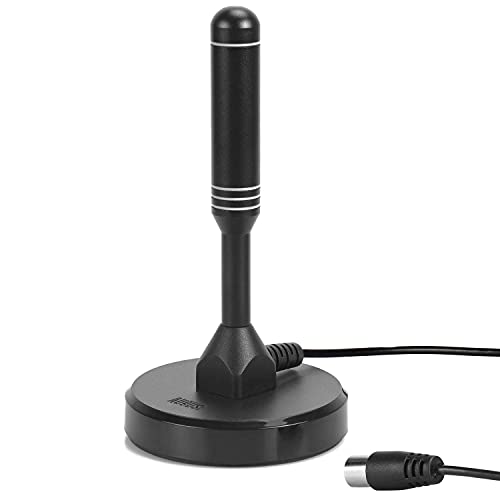
The best all-rounder for most Australian homes: UltraPro Portable HD Antenna
The UltraPro Portable HD is our top pick because it does the ordinary things well and carries the highest customer rating of our six picks at 4.4 stars. It is a slim magnetic monopole, which sounds technical but just means a compact upright antenna on a magnetic base that grips onto anything metal and is very easy to nudge around until the signal locks in. UltraPro quotes an omnidirectional 360 degree pattern and a range of about 20 miles (around 32 km) from the broadcast source, so it is aimed squarely at metro and suburban buyers rather than deep-rural ones.
What makes it stand out for a first-home buyer is flexibility. There is nothing to mount and no bracket to screw into a wall, so it is completely renter-friendly and moves house with you in a drawer. The magnetic base means you can stick it to a metal window frame, a filing cabinet or the back of the TV bracket, which are often the exact spots that pull the cleanest signal. It is also one of the few affordable antennas already listed as NEXTGEN TV (ATSC 3.0) compatible, the newer over-the-air broadcast standard, so it is a little more future-proof than the rest of the field even if that standard is still rolling out.
At $31.76 it is not the cheapest here, but it is still firmly in impulse-buy territory, and the rating tells you most buyers got what they expected. If you are close enough to a transmitter to use an indoor antenna at all, this is the one we would reach for first.
Flaws but not dealbreakers
The 20 mile range claim is modest by the standards of some rivals that shout "900 miles" on the box, though those bigger numbers are mostly marketing. If you live in a genuine fringe or valley area, the UltraPro alone may not be enough and you would want to pair it with a booster or step up to a roof aerial. Its review count of 100 is also the second smallest here, so the 4.4 rating rests on a smaller sample than the August models. For a metro or suburban home, none of that should put you off.
The most-reviewed antenna here with a magnetic base: August DTA240
If you want the antenna the most people have already bought, the August DTA240 is it, with 38,499 ratings, easily the most-reviewed of our six picks. August is a recognised name in portable digital aerials, and the DTA240 is its everyday magnetic model: a small, light puck-and-cable design with a 2 m lead, a magnetic base and a built-in 4G and 5G filter to keep mobile-phone interference out of your picture.
The magnetic base is the practical selling point. You can clamp the DTA240 onto a metal window frame, a heater, a shed purlin or a caravan panel, which is exactly where reception is usually best, and its typical gain of 3.0 dBi is a step up from a bare mini aerial. Reviewers who live in decent signal areas and take a few minutes to find the sweet spot report a full set of free-to-air channels including the HD multichannels. It covers VHF 170 to 230 MHz and UHF 470 to 860 MHz, which is the range Australian broadcasts use, and at $24.95 it sits in the middle of our price ladder.
The honest read on that giant review pile is that it averages 3.1 stars, the lowest rating of our six, because so many buyers try it in marginal locations. Treat the sheer volume as evidence the DTA240 is a known quantity that works well when the signal is there, not as a promise it will fix a fundamentally weak-signal home.
Flaws but not dealbreakers
At 3.1 stars this is the lowest-rated pick in the guide, and the reason is placement sensitivity rather than build quality: the passive design has no booster, so in a weak-signal room it can drop channels that a powered antenna would hold. The 2 m cable is also on the short side if your TV sits far from a good window. If your home is a fair way from the tower, the DAANT or Sansai below will serve you better.
The cheapest amplified antenna worth buying: DAANT Indoor Antenna
The DAANT Indoor Antenna is the cheapest of our six picks at $21.50, and unlike the other budget options it ships with a USB-powered signal booster in the box, which is a lot of antenna for the money. It is a thin flat-panel design you stick to a wall or window, with a long coax lead of about 5 m (16 ft) and a claimed 360 degree reception pattern, and it has gathered 3,796 ratings at a solid 4.0 average.
Flat-panel antennas like this are popular with renters because they are almost invisible: you can tuck one behind the TV, tape it flat to the glass, or hide it under a bookshelf, and there are no rabbit-ear rods to arrange. The included amplifier is the reason it punches above its price. In a room where a passive antenna gives you a patchy signal, plugging the booster into a USB port can be the difference between a channel that locks and one that pixelates, and Australian reviewers repeatedly mention getting a full channel list once they moved the panel high onto a window and switched the amp on.
The "900 miles" on the packaging is pure marketing (no indoor antenna reaches anywhere near that), so ignore the number and judge it on what it is: a cheap, discreet, amplified panel that is the sensible first thing to try. If it cannot pull your channels, very little at this price will, and you will know it is time to consider a roof aerial.
Flaws but not dealbreakers
The booster helps with weak signal but cannot overcome having no signal at all, and a minority of reviewers in poor-reception spots found it did nothing for them, which is true of every antenna in this class. The flat panel also relies on double-sided tape or the supplied stand, so it is less "grab and reposition" than a magnetic model once it is stuck down. For the price, and with the amp included, it remains the easiest pick to recommend to someone starting from scratch.
The tiny mini aerial for a strong-signal second room: August DTA180
The August DTA180 is the little one: a genuinely tiny magnetic aerial with a short 1.5 m lead, aimed at second TVs in rooms that already have strong signal, like a kitchen bench, a bedroom or a study close to a good window. It is the second cheapest pick at $22.95 and has racked up 9,190 ratings at 3.3 stars.
Its appeal is size and simplicity. At around 31 grams it disappears behind a small TV, the magnetic base lets you stick it to any nearby metal, and there is no power lead to deal with because it is a passive antenna. In a home close to the transmitter it can pull a surprisingly full channel list, and several Australian reviewers in metro suburbs report all their free-to-air stations from it once positioned high and vertical on a window. Think of it as the "spare room" antenna: cheap enough to buy two, small enough to forget it is there.
Be realistic about its limits, though. The listing quotes a typical gain of only about 1 dBi, the lowest of the August range, so this is not the antenna for a difficult location. It is a strong-signal-area convenience buy, and judged on that job it is a tidy, inexpensive little unit.
Flaws but not dealbreakers
The low gain and short cable are the honest weak points: put the DTA180 in a fringe area or a room without a good window and it will struggle where a larger or amplified antenna would cope. One reviewer near the Sydney CBD still found it weak on a hilltop, which shows placement matters even close to town. Keep it for the easy rooms and it earns its keep.
The flat window aerial for a clean look: August DTA420
The August DTA420 is the option for buyers who care about how the antenna looks in the room. It is a thin flat sheet you attach to a window or wall, with a generous 3 m cable and a higher typical gain of 5 dBi, plus the same built-in 4G and 5G filter as the rest of the August line. It costs $27.95 and holds a 3.2 star average across 997 ratings.
Because it is flat and can sit flush against glass, the DTA420 is the least obtrusive antenna here once it is in place, which matters if your lounge window is on show. The longer 3 m cable gives you real freedom to run it up to the top corner of a window (usually the best reception spot) while the TV sits across the room. Its higher rated gain than the mini aerials means it holds up a bit better in mid-strength signal areas, and reviewers who spend a few minutes trying it in both horizontal and vertical orientations tend to get the best result.
Unlike the magnetic models it has no metal base and no amplifier, so it leans entirely on placement rather than power. In the right window, that is all it needs; in a weak spot, you would want the DAANT's booster or the Sansai's amplifier instead.
Flaws but not dealbreakers
With no magnetic base you are committed to tape or the window itself, so repositioning is fiddlier than with the DTA240, and the passive design offers no help when signal is genuinely weak. A few buyers found it only worked once placed right at the window or partly outside, which is common for flat aerials. If a discreet look is your priority and your signal is reasonable, it does that job neatly.
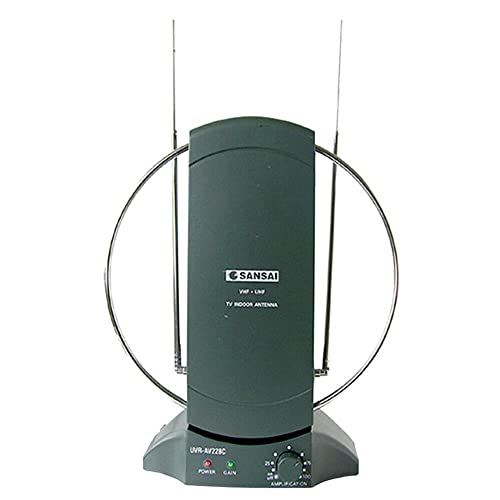
The amplified tabletop unit made in Australia: Sansai ATN228C
The Sansai ATN228C is one of the pricier of our six picks at $29.05 and the most old-school in shape: a powered tabletop antenna with a built-in amplifier, adjustable gain control and a tilting element, listed with an Australian country of origin and a one-year warranty. It carries a 3.4 star average, though from the fewest reviews here at 62.
This is the pick for someone who wants a self-contained unit that sits on top of the TV cabinet or a shelf and can be dialled in. The amplifier and adjustable gain let you wind the signal up or down to suit your area, which can tame both weak signal and the over-amplification that sometimes causes dropouts closer to a tower. It covers UHF, VHF, HDTV and FM bands, and its physical dials make it approachable for anyone who would rather turn a knob than fiddle with placement. The one-year warranty and local brand presence are small but real reassurances at this price.
It sits at the pricier end of the guide and its review count is thin, so it is a slightly less proven quantity than the August models. But for a buyer who specifically wants a powered, adjustable tabletop antenna rather than a stick-on panel, it is the natural fit.
Flaws but not dealbreakers
At $29.05 it costs more than the DAANT while offering broadly similar amplified reception, so you are partly paying for the tabletop form and the adjustable dials. The small review base of 62 means less collective evidence than the big-name August aerials. If you like the powered-and-adjustable idea but want to spend less, the DAANT panel with its included booster covers much of the same ground.
What should you look for in an indoor TV antenna?
The single biggest factor is not the antenna at all, it is your distance to the transmitter and what is in the way. Before you buy anything, put your address into the Australian Government's mySwitch tool, which tells you which towers serve you, how far away they are and whether your area is VHF, UHF or both. That one check prevents most disappointment.
With that in hand, a few features actually matter. Amplified versus passive is the main choice: a passive antenna has no power and is simplest, and is all you need close to a tower, while an amplified antenna adds a booster to lift a weak signal in fringe areas, at the cost of a USB or mains power point. A 4G and 5G filter is worth having, because mobile-phone signals can pixelate your picture and a built-in filter blocks them; several of our picks include one. Cable length is underrated: a longer lead lets you run the antenna to the best window while the TV stays put, so 3 m beats 1.5 m for flexibility. A magnetic base makes repositioning trivial, which matters because finding the sweet spot is trial and error. Finally, VHF and UHF coverage should span roughly VHF 170 to 230 MHz and UHF 470 to 860 MHz, the bands Australian free-to-air uses; every antenna here does.
Ignore the giant "mile range" numbers on the packaging. A claim of 300, 900 or even 3,500 miles is not physically meaningful for an indoor antenna and tells you nothing useful. Rating, review volume, whether it is amplified and your own distance to the tower are far better guides.
VHF or UHF: which band does your area broadcast on?
Australian digital television runs on VHF band 3 and on UHF bands 4 and 5, and the band your local tower uses decides which antenna shape works. Capital-city transmitters are largely VHF, which needs the longer elements you see on a monopole or a rod aerial. Many regional transmitters and the smaller infill sites that cover valleys and pockets of the suburbs run on UHF, which suits a short, flat or panel antenna. Check your own address on the ACMA MySwitch site before you buy: it names your transmitter, the channels it carries and the distance from you. A flat window aerial in a UHF area and a monopole in a VHF area both work; swap them over and neither does.
How do you set up and look after an indoor antenna?
Getting the most from any of these comes down to placement, and it is worth ten patient minutes. Start high and near a window facing your nearest tower, because glass and height both help. Try the antenna both vertically and horizontally, since Australian towers broadcast in different polarisations and one orientation often clearly beats the other. After each move, run a full channel rescan from your TV's menu rather than trusting the old list, and check the signal-strength meter many TVs show in their tuner settings. Keep the antenna away from other electronics, metal shelving and the TV's own power brick, which can all add noise.
How do you connect a TV antenna?
- Screw or push the coax lead into the aerial socket on the back of the TV, which is usually labelled ANT IN or RF IN. Australian wall plates use a PAL connector and most antennas ship with an F-type plug, so an F-to-PAL adapter is often the missing piece.
- If the antenna is amplified, plug its USB lead into the TV or a phone charger. Nothing happens on an amplified unit until it has power.
- Put the antenna high, near a window, on the side of the house facing your transmitter.
- On the TV, open Settings, choose the tuner or broadcast menu and run Auto Tune or Channel Scan. Pick antenna rather than cable if the TV asks.
- If the scan finds fewer channels than you expect, move the antenna a metre, rotate it 90 degrees and rescan. Every move needs a fresh scan, because the TV keeps the old channel list otherwise.
Maintenance is minimal. Indoor antennas have no moving parts, so there is nothing to service; an occasional dust and a check that the coax plug is finger-tight on the back of the TV is all they need. If channels that used to work start dropping out, the usual causes are a loosened connector, a new source of interference (a phone charger or LED light placed nearby) or a nearby mobile tower upgrade, in which case a 4G and 5G filter can help. Amplified models draw power from USB or the mains, so if a booster stops helping, check the power connection before blaming the antenna. And if you have genuinely tried several windows and orientations with a rescan each time and still cannot get a stable picture, that is your sign the location needs a roof aerial rather than any indoor unit.
Which accessories are worth buying with your antenna?
A few cheap extras make antenna life much easier, and all of these are small buys on Amazon AU. If your picture pixelates near a mobile tower, a Philips LTE 4G and 5G filter inline on the cable can clean it up. To lift a weak signal without changing antennas, a USB-powered aerial signal booster adds gain from any USB port. If you want to feed two or three TVs from one aerial, a 3-way coaxial antenna splitter saves running separate cables, and a sturdier 2-way coaxial splitter covers the simpler two-TV case. When the supplied lead is too short or the wrong shape, a right-angle 3 m RG6 coaxial cable keeps the run tidy behind wall-mounted sets, and a F-to-PAL adapter kit bridges the two connector types you will inevitably run into between older Australian wall plates and newer antennas.
What about the antennas we did not pick?
Plenty of other antennas turn up when you search, and most were left out for good reasons rather than because they are terrible. The big-box outdoor aerials from brands like Matchmaster, Kingray and Antsig are excellent, and if you have tried indoor options without success they are the right next step, but they need roof mounting and often an installer, which puts them outside the scope of a plug-and-play indoor guide. Very cheap no-name panels advertising "3,500 mile" or "5,000 mile" range flood the listings with inflated claims and thin, volatile review histories, so we steered around them in favour of models with a track record. Caravan and marine antennas such as the omnidirectional dome units are great on the road but overkill and overpriced for a fixed home. And the classic supermarket rabbit-ears still work in strong-signal areas, but they add nothing over the magnetic mini aerials here and look busier in the room. If your home genuinely cannot get a stable indoor signal after honest trial and error, the answer is not a more expensive indoor antenna, it is a roof aerial, and that is money well spent once rather than repeatedly.
How do you watch free-to-air TV without an antenna in Australia?
Every Australian free-to-air network streams its channels live and free over the internet, so if your reception is hopeless or you are renting somewhere with no aerial point, you do not have to buy anything. ABC iview, SBS On Demand, 7plus, 9Now and 10 Play all carry live channels plus catch-up, all are free, and all need only a login and about 5 Mbps. Freeview pulls the lot into one guide. A smart TV can run those apps directly; an older set needs a streaming device plugged into HDMI. The trade-offs are real: streams run a minute or two behind the broadcast, which matters for live sport, the picture drops when the NBN is busy, and the data comes out of your plan. An antenna costs about $25 once and never buffers, which is why most homes end up with both.
TV antenna questions from first-home buyers, answered
Do I really need an antenna if I have a smart TV?
Yes, if you want free-to-air channels. A smart TV streams apps over your internet, but it needs an aerial plugged into its tuner to receive broadcast television like ABC, SBS, Seven, Nine and Ten. The streaming apps and the free-to-air tuner are separate systems, so an antenna gives you live local TV without using any data or subscription.
Will an indoor antenna work in my home?
It depends on your distance to the nearest transmission tower and what is between you and it. In metro and suburban areas within roughly 30 km of a tower, an indoor antenna usually works well once placed near a window. In fringe, hilly or heavily built-up locations it may struggle, and no indoor model can guarantee reception. Check your address on the Government's mySwitch tool first to set expectations.
What is the difference between an amplified and a passive antenna?
A passive antenna has no power and simply collects whatever signal reaches it, which is all you need close to a tower. An amplified antenna adds a powered booster to strengthen a weak signal, which helps in fringe areas but cannot create signal where there is none, and can occasionally overload very close to a tower. Our DAANT and Sansai picks are amplified; the August models are passive.
Why do TV antennas have so many bad reviews?
Because reception is location-specific, the same antenna genuinely earns five stars in one home and one star a few kilometres away. Most one-star antenna reviews come from homes too far from a tower for any indoor aerial to work, not from faulty products. Read the ratings alongside your own signal situation rather than in isolation.
Does a more expensive antenna get more channels?
Not necessarily. Above a basic quality bar, a $40 antenna does not receive channels that a $22 one cannot, because the channels available are set by your location, not your spend. Extra money buys conveniences like an amplifier, a magnetic base, a longer cable or a tidier shape, not more stations. Placement matters far more than price.
What TV antenna gets the most channels?
The one matched to your band and pointed at your transmitter, not the most expensive one. Every free-to-air channel in your area comes off the same tower, so an antenna either receives that multiplex or it does not; there is no aerial that unlocks extra networks. If you are missing channels, the fix is almost always placement, band or a rescan rather than a bigger purchase. In a weak-signal area an amplified model such as the DAANT Indoor Antenna lifts what is already arriving, and if nothing works after several windows and rescans, the answer is a roof aerial.
Kitting out the rest of your new place
An antenna is one small piece of setting up a first home, and the same research-first approach applies to the bigger buys around it. If you are still choosing the screen itself, our guide to the best TVs in Australia pairs naturally with this one, and once it arrives the best TV mounts get it safely on the wall. For sound, the best soundbars lift free-to-air and streaming alike, while a streaming device fills in everything broadcast TV does not carry. Protect the lot with one of the best surge protectors, and if you are working through the whole place, our new-home checklist keeps the moving-in weeks in order.
About the author
Anish Puri founded NestPath in 2026 after going through the Australian first-home-buyer process himself. NestPath focuses on Australian first-home buyers because the existing review sites are American, generic, or both. Anish handles editorial selection across the homeowner hub. Reach out: hello@nestpath.com.au