Which utensil holder should you actually buy in 2026?
If your wooden spoons, spatulas and whisks are living in a drawer or rattling around in a pot, a good utensil holder is one of the cheapest upgrades a new kitchen can get. It keeps the tools you reach for ten times a day standing up, visible and within arm's reach of the stove. The catch is that "utensil holder" covers everything from a five-dollar Kmart tub to a sixty-dollar Le Creuset jar, and the search results are a wall of retailer category pages and American review sites that name products you cannot actually buy here.
This guide fixes that. We focused on holders that are genuinely in stock on Amazon Australia right now, carry real star ratings from real buyers, and cover the full spread of materials and styles people search for: rotating bamboo, brushed stainless steel, classic porcelain, chip-resistant ceramic, open wire and multi-compartment wood. Every price, rating and spec below was pulled from the live Australian listing, not guessed. For the impatient: the rotating bamboo gorsent crock is the all-rounder most people should buy, the LIBODOUR stainless steel caddy is the value option, and the Maxwell & Williams Epicurious is the tidy, dishwasher-safe budget pick.
The short version: top, value and budget in one breath
Here is the whole guide compressed into three sentences. The gorsent rotating bamboo holder ($35.99, 4.8 stars) is our top pick because the spinning base and large opening suit almost any kitchen and any utensil set. The LIBODOUR stainless steel holder ($26.70, 4.7 stars) is the value pick, giving you a rotating base and three compartments for well under thirty dollars, and it has the highest review count of the three headline picks. The Maxwell & Williams Epicurious porcelain holder ($23.95, 4.7 stars) is the budget pick, the cheapest of the trio and the only one that is dishwasher safe.
Below those three you will find five more holders worth knowing about, including the most reviewed option in the whole guide and an extra large four compartment crock for serious batch cooks. Last updated June 2026. Prices and stock move around, so treat the figures as a guide and check the live listing before you buy.
How do these eight holders compare at a glance?
The quick way to read the field: pick your material first, then your size, then decide whether a rotating base matters to you. Wood and ceramic look warm and weighty but cannot go in the dishwasher unless the listing says so. Stainless steel and porcelain are the easy-clean options. A rotating base sounds like a gimmick until you have one, then digging through a static pot to find the right ladle feels prehistoric. The table below lines up all eight picks by material, rotation, capacity and the live Amazon AU price so you can see the trade-offs without scrolling through every review.
We have kept the comparison honest about what each holder is for rather than crowning a single winner on every axis. The most-reviewed holder is not the largest, the largest is not the cheapest, and the cheapest is not the most stylish. Match the holder to your bench space, your utensil set and how often you want to wash it.
How we chose the best utensil holders
NestPath is an Australian first-home buyer hub, so our job is to cut through the American review sites and retailer category dumps and tell you what is actually worth buying here. We research and study products using live marketplace data and verified buyer reviews. We do not run a physical lab, and we never claim to. Here is what shaped this list:
- In stock on Amazon Australia. Every holder here was confirmed available on the Australian Amazon site at the time of writing, with a live AUD price. No US-only listings, no parallel imports we cannot stand behind.
- Real ratings, real review counts. We only included holders with a genuine star rating and at least a handful of ratings. Most of our picks carry hundreds or thousands. We pulled every figure from the live Australian listing.
- Material and style spread. We deliberately covered bamboo, acacia, stainless steel, porcelain, ceramic and wire so that whatever your kitchen looks like, there is a match.
- Capacity and stability. A holder that tips over when you pull out a heavy ladle is useless, so we weighted base design, non-slip feet and realistic utensil capacity heavily.
- Honest about flaws. Every pick gets a "flaws but not dealbreakers" note so you know the trade-off before it arrives, not after.
Best utensil holder overall: gorsent rotating bamboo crock
The gorsent rotating bamboo holder is the one we would put on most kitchen benches without a second thought. It pairs a warm, natural bamboo look with a genuinely useful 360-degree spinning base, and the large 7.3 inch by 5.9 inch opening swallows roughly 10 to 15 utensils, including the long-handled spatulas and ladles that tip smaller pots over. At $35.99 it is the dearest of our three headline picks, but it is also the most versatile, and a 4.8-star average across 989 ratings tells you Australian buyers are not just tolerating it, they are recommending it.
What makes the rotation more than a novelty is everyday speed. Instead of rummaging through a packed pot, you give the base a flick and the tool you want rotates to the front. Reviewers single this out again and again, describing it as spinning smoothly while still feeling sturdy and not tipping under weight. The bamboo is lacquered so a damp cloth wipes it clean, and the two-tone black and wood styling on some versions sits comfortably in both modern and farmhouse kitchens.
It is also carrying the Amazon's Choice badge in the Utensil Crocks category, which is a small signal but a real one: it reflects a combination of price, rating and reliable shipping. For a first kitchen where you want one holder that handles everything from a balloon whisk to a fish slice, this is the safe, satisfying choice. If you have a very small bench, measure first, because the generous capacity comes from a generous footprint.
Flaws but not dealbreakers
It is bamboo, so it is not dishwasher safe and you should wipe it dry rather than leave wet tools sitting in it long term. It is also the most expensive of our top three. Neither is a problem for most people, but if you want a set-and-forget dishwasher option, the porcelain pick below will suit you better.
Best value utensil holder: LIBODOUR stainless steel rotating caddy
If you want the rotating trick without paying the premium, the LIBODOUR stainless steel holder is the smart buy. For $26.70 you get a 360-degree spinning base, three divided compartments to sort your tools, and brushed steel that resists fingerprints and will not rust or stain the way wood and ceramic can. It is also the most-reviewed of our three headline picks, carrying a 4.7-star average across 1,250 ratings, which is a lot of evidence for a holder at this price.
The three compartments are the underrated feature here. They let you keep metal tongs away from silicone spatulas away from wooden spoons, so you are not fishing through a single crowded well every time you cook. Four non-slip rubber feet keep it planted on the bench when you spin it or yank out a heavy tool, and the base has drainage holes so anything you put away slightly damp dries instead of pooling water. At 15.9 cm wide and 20.3 cm tall it holds about 15 large-handled tools while still keeping a modest footprint.
Steel is the practical material if your kitchen sees a lot of action. It does not absorb oil, it does not chip, and it cleans up with a quick wipe. The brushed finish hides marks well, though it is worth noting the listing itself is inconsistent about dishwasher safety, so we would treat it as hand wash to be safe. For a renter or a first-home buyer who wants maximum function for minimum spend, this is the holder that punches above its price.
Flaws but not dealbreakers
The product listing contradicts itself on dishwasher safety, so play it safe and hand wash. A couple of reviewers also note the rotating base can be lifted off if you grab the whole thing by the rim, so lift from the bottom. Minor quirks on an otherwise excellent value holder.
Best budget utensil holder: Maxwell & Williams Epicurious porcelain
The Maxwell & Williams Epicurious is the cheapest of our three headline picks at $23.95, and it is the one we would hand to someone who just wants a tidy, no-fuss holder that cleans itself. It is premium porcelain with a matte black finish, it is genuinely dishwasher safe, and it comes from Maxwell & Williams, an Australian homewares brand that has been making this kind of thing since 1996. A 4.7-star average across 103 ratings backs it up.
The appeal is simplicity. It is a clean cylinder, 12 cm wide and 17.5 cm tall, with a slim footprint that suits cramped benches and a 1.52 litre capacity that still holds a full set of everyday tools. The matte black finish hides splashes and fingerprints, and because it is porcelain it does not stain or hold smells the way some ceramics do. Reviewers describe it as sleek, minimalist and sturdy, with several surprised at how much it holds for a compact shape.
The dishwasher-safe part is the quiet hero. Of our three headline picks, this is the only one you can simply put on the bottom rack and forget about, which matters more than it sounds when you are washing oily wooden spoons. It also arrives gift boxed, so it doubles neatly as a housewarming present. If you want something understated, easy to clean and from a name you will recognise, this is the budget pick to beat.
Flaws but not dealbreakers
Porcelain can chip or crack if you drop it, so it is less forgiving than steel. It also has no rotating base and no compartments, so it is a plain well rather than a sorting system. For the price and the easy cleaning, those are fair trade-offs.
Best heavyweight wooden holder: Segtenant acacia rotating crock
If you love the rotating-wood idea but want something denser and more solid than bamboo, the Segtenant acacia holder is the upgrade in feel. Acacia is a heavier, tighter-grained timber, so this crock sits planted on the bench and resists being knocked over, and it carries a 4.8-star average across 307 ratings at a keen $26.59. It is a close cousin of our top pick but trades the lighter bamboo for a more substantial hardwood.
The 360-degree base spins as smoothly as you would hope, and the 7.2 inch tall well holds more than 15 cooking tools, so a full utensil set fits with room to spare. Reviewers repeatedly mention how stable it feels and how the natural acacia grain warms up stone benchtops and white cabinetry. The oil-rubbed finish gives it a slightly richer, more farmhouse look than the lacquered bamboo, and a damp cloth keeps it clean.
Because acacia is a natural timber, the grain varies piece to piece, which most people see as a feature rather than a flaw. It is the holder to choose if you want the spinning convenience of the top pick but prefer a weightier, more premium-feeling wood under your hand. Pair it with a wooden spoon set and a chopping board in the same timber for a coordinated bench.
Flaws but not dealbreakers
Like all our wooden picks it is not dishwasher safe and benefits from an occasional wipe of food-safe oil to keep the grain from drying out. As a natural product it can crack if it is left soaking or stored somewhere very dry, so treat it as you would a good wooden board.
Best open wire holder: InterDesign Austin
The InterDesign Austin is the most-reviewed holder in this entire guide, with a remarkable 7,792 ratings and a 4.8-star average, so if you take comfort in the wisdom of crowds, this is the safest bet on the page. It is an open matte-black wire basket rather than a solid pot, and that open design is the whole point: tools stay visible, air circulates, and anything you put away slightly damp dries quickly instead of sitting in a puddle at the bottom.
At roughly 15 cm square and 17.8 cm tall it fits neatly on a benchtop or a pantry shelf, and the rust-resistant metal construction means it shrugs off kitchen splashes. The matte black finish is a deliberate match for black appliances and modern fittings, and reviewers note it is tall enough to keep longer utensils from tipping and sturdy enough to stay upright with heavier ladles and spatulas inside. It holds around 10 tools comfortably.
The open wire look will not be for everyone, and it does nothing to hide a messy collection of mismatched tools, but it is brilliant in a kitchen where airflow and visibility matter. It is the natural companion to a set of wire fruit bowls or a wall organiser from the same range if you like a coordinated industrial look. For a renter who wants something light, durable and almost impossible to break, it is hard to argue with eight thousand near-perfect ratings.
Flaws but not dealbreakers
The open wire offers no privacy, so everything inside is on display, and very small or fine-handled tools can slip through the gaps. If you prize a clean, hidden look, a solid crock suits you better. For everyone else, the airflow is a genuine plus.
Best vintage ceramic holder: Comfify Mason Jar crock
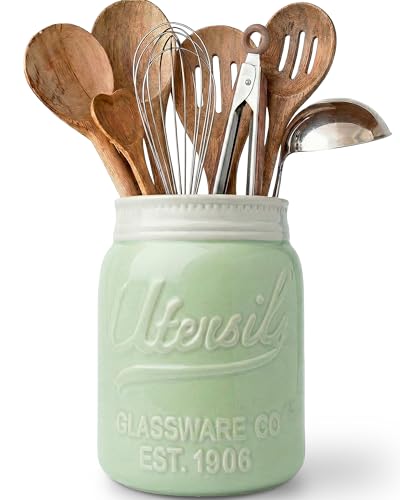
For a warmer, more characterful look, the Comfify Mason Jar holder brings vintage charm without sacrificing function. It is chip-resistant ceramic shaped like a wide-mouth mason jar with an embossed design, it is dishwasher safe, and it is backed by more than 5,000 ratings at a 4.8-star average. That is a huge amount of buyer feedback for a decorative piece, and it tells you the looks are matched by durability.
The wide mouth is the practical highlight. It flares from a 4 inch entry to about 5 inch below the neck, so you can drop in 10 or more standard utensils without cramming them, and the 7 inch height keeps longer tools standing tall. The thick ceramic is treated to resist chipping and fading, so it holds its look over years of daily use, and because it is dishwasher safe you are not stuck hand washing a decorative item.
This is the holder for kitchens with a traditional, shabby chic or country feel, and it comes in a range of colours to match a splashback or a tea-towel palette. It is heavier than the wire or porcelain options, which helps it stay put, and the mason-jar silhouette is a recognisable design that reads as homewares rather than storage. If your kitchen leans cosy rather than clinical, this is a lovely, hard-wearing choice.
Flaws but not dealbreakers
Ceramic this thick is reassuringly solid but still breakable if you knock it off the bench, so it is not the pick for a household of clumsy mornings. The vintage styling is divisive too, so make sure the look suits your kitchen before you commit.
Best two-compartment wood holder: PUERSI rustic caddy
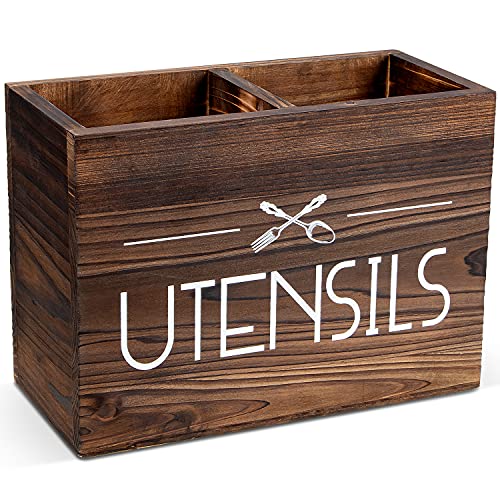
The PUERSI is the holder for cooks who hate mixing their tools together. It is a rustic torched-wood caddy with two separate compartments, so you can keep metal in one side and silicone or wood in the other, and it carries a 4.6-star average across 682 ratings. That is the lowest rating of any pick in this guide, but it is still a strong score, and the dual-compartment design is genuinely useful in a way the single-well crocks are not.
At roughly 9 inch long, 4.5 inch wide and 6.5 inch tall, the rectangular footprint tucks neatly against a wall or splashback better than a round crock, and the two bays give you plenty of room for a full utensil set sorted by type. The torch-treated wood grain gives each piece a unique, slightly charred farmhouse look, and reviewers like that the compartments let them group utensils by colour or material. PUERSI even pitches it as a dual-use wine or oil-bottle holder, which gives it a second life if you ever swap out your tools.
The honest weak spot, flagged by a couple of buyers, is that the base can be a touch slippery on smooth stone benches, so it is worth adding a few stick-on silicone feet if yours slides. Beyond that it is a characterful, practical holder that solves the one problem single-well crocks cannot: keeping your tools actually sorted.
Flaws but not dealbreakers
It is the lowest rated pick here at 4.6 stars, and the base can slide on slick benchtops until you add grip feet. It is also wood, so it is hand wash only. For the sorting it offers, those are easy compromises to live with.
The Rodelna is the most organised and the most expensive holder in this guide at $40.00, and it earns the premium if you cook in volume. It is an extra-large acacia crock with four removable dividers, built-in carry handles and drainage holes, holding a 4.8-star average across 176 ratings. Where the others give you one well or two, this gives you four, so metal, silicone, wood and baking tools each get their own bay.
At 1.18 kg it is the heftiest holder on the list, which makes it rock-solid on the bench, and the built-in handles mean you can lift the whole thing and carry it to the stove or the sink without it tipping. The dividers pop out for cleaning, the waterproof varnish finish protects the wood, and it can even be wall-mounted with the included hooks if you want to free up bench space entirely. Reviewers describe it as thick, heavy-duty and bigger than expected, which is exactly what you want when you are storing a serious tool collection.
This is the holder for a keen home cook with a lot of gear, or for a household where two people cook and the utensil count is high. It is overkill for a minimalist kitchen, but for anyone who has ever wished their crock had more sorting, it is a genuine step up. One thing to note: as a thicker wooden piece, it needs careful packaging in transit, and one Australian reviewer received a cracked unit, so inspect yours on arrival.
Flaws but not dealbreakers
It is the priciest pick here and its size is too much for a small bench. As a chunky wooden item it can arrive damaged if the courier is rough, though buyers report quick refunds when that happens. For a big, busy kitchen the capacity is worth it.
What should you look for in a utensil holder?
The right holder comes down to four questions: what is it made of, how big is it, does it rotate, and how will you clean it. Get those right and the rest is styling.
Does the material actually matter?
Yes, more than you would think. Stainless steel and porcelain are the easy-clean materials, they do not stain or hold smells, and porcelain is usually dishwasher safe. Wood, whether bamboo or acacia, looks warm and feels premium but is hand wash only and benefits from the occasional oiling. Ceramic sits in between, often dishwasher safe but breakable if dropped. Open wire is the most durable and the best for airflow but offers no privacy. Pick the material that matches both your kitchen's look and your tolerance for washing up.
How big should a utensil holder be?
Most quality holders fit somewhere between 10 and 15 standard utensils. Count what you actually use daily, then add a couple. Taller holders, around 17 to 20 cm, stop long-handled tools from tipping the whole thing over, while a wider base adds stability. If your bench is tight, measure the footprint before you buy, because the roomier crocks earn their capacity with a bigger base.
Is a rotating base worth it?
For most people, yes. A 360-degree base means you spin the holder to bring the tool you want to the front rather than digging through a packed pot. It sounds minor and becomes one of those features you miss the moment you go back to a static crock. If you cook often and keep a lot of tools, it is the single upgrade most worth paying for.
Should you get one with compartments?
Compartments keep metal, silicone and wooden tools separated so you grab the right thing first time. Two compartments suit a normal household, four suit a serious cook with a big collection. If you keep your utensil count low, a single well is perfectly fine and usually cheaper.
How do you keep a utensil holder clean?
The cleaning routine depends entirely on the material, and matching your habits to it will save you grief. For porcelain and most ceramic holders, the dishwasher does the work, so a periodic run on the bottom rack is all you need. For stainless steel, a wipe with a damp cloth handles daily marks, and a little vinegar or bicarb shifts any water spots; most steel holders are best hand washed even when the listing hints otherwise, just to protect the finish.
Wooden holders, whether bamboo or acacia, are the highest maintenance but still easy. Wipe them out with a damp cloth, never leave them soaking, and dry them properly so the grain does not swell or crack. Every month or two, rub in a thin coat of food-safe mineral oil or a dedicated wood conditioner to keep the timber from drying out and to refresh the colour. If a wooden holder has drainage holes, check them occasionally for trapped crumbs.
Whatever the material, give the inside an occasional empty-and-wipe, because crumbs and a little cooking oil inevitably collect at the bottom. Holders with removable dividers, like the Rodelna, make this far easier because you can lift everything out and clean each bay. A two-minute wipe once a week keeps any holder looking like the day it arrived.
What else will you want for the bench?
A utensil holder rarely arrives alone. If you are kitting out a first kitchen, these are the companion buys that pair naturally with it, and each links straight through to its product on Amazon Australia.
- A set of cooking utensils to fill it. A holder is only as good as the tools in it, so a coordinated wooden or silicone utensil set finishes the look and keeps everything matching.
- A chopping board in the same timber. Match a acacia or bamboo board to a wooden holder for a coordinated bench.
- Non-slip silicone feet. A cheap pack of stick-on bumper feet stops any lighter holder sliding on stone benchtops.
- Food-safe wood oil. A bottle of mineral oil or board conditioner keeps bamboo and acacia holders from drying out.
- A spoon rest for the stovetop. Keep your most-used spatula off the bench with a ceramic spoon rest next to the holder.
- A matching canister set. If you love the Maxwell & Williams or mason-jar look, a coordinated canister set ties the whole counter together.
- A drawer organiser for the overflow. Tools that do not earn a spot on the bench live tidily in an expandable drawer organiser.
What about Kmart, IKEA, Le Creuset and the rest?
It is worth being upfront about the holders we did not include, because they show up constantly in Australian searches. Kmart and Anko holders are genuinely cheap, often five to seventeen dollars, and fine as a stopgap, but they are sold in-store and through Kmart's own site rather than on Amazon, and the build quality is basic. If budget is the only concern, they will do the job; we focused on holders you can order online with verified ratings.
At the premium end, the Le Creuset Signature Utensil Jar is a beautiful piece of stoneware with a near-perfect rating and a price to match, usually around sixty to eighty dollars, and Joseph Joseph makes clever stainless and compartmented pots in the forty-dollar bracket. Both are excellent if you want a statement piece and are happy to pay for the brand. We left them off the main list because our budget-to-premium picks deliver most of the function for less, but if you want the heritage names, they are worth a look through Kitchen Warehouse or David Jones.
IKEA's holders are simple and affordable but, like Kmart, tied to their own retail channel. The pattern across all of these is the same: plenty of good holders exist outside Amazon, but for an online buyer who wants a verified rating, a clear price and reliable shipping, the eight picks above are the ones we can stand behind with real data.
Frequently asked questions
What is the best material for a utensil holder?
It depends on your priorities. Stainless steel and porcelain are the most practical because they resist stains and porcelain is usually dishwasher safe. Wood like bamboo or acacia looks warmest and feels most premium but needs hand washing and occasional oiling. Ceramic offers a vintage look and is often dishwasher safe but can break if dropped. Open wire is the most durable and best for airflow.
How many utensils does a holder fit?
Most quality holders in this guide fit between 10 and 15 standard utensils. Larger crocks like the Rodelna four-compartment model hold more and sort them by type, while slim porcelain cylinders like the Maxwell & Williams Epicurious suit a tighter set on a smaller bench. Count what you use daily and add a couple for breathing room.
Are rotating utensil holders worth it?
For most cooks, yes. A 360-degree rotating base lets you spin the holder to bring the tool you want to the front instead of digging through a packed pot. Our top pick, the gorsent bamboo holder, and the LIBODOUR stainless steel value pick both rotate, and reviewers consistently rate the feature as more useful than they expected.
Can you put a utensil holder in the dishwasher?
Only some. The Maxwell & Williams Epicurious porcelain holder and the Comfify ceramic mason jar are dishwasher safe. Wooden holders such as the gorsent, Segtenant and Rodelna are hand wash only. Stainless steel holders are usually best hand washed to protect the finish even when the listing suggests otherwise.
Where is the best place to put a utensil holder?
Within arm's reach of the stove but not so close it gets splattered with hot oil, usually just to the side of the cooktop or against the splashback. Keep it away from the very edge of the bench so it cannot be knocked off, and on a tight bench consider a wall-mountable model like the Rodelna to free up counter space.
What is a utensil crock versus a utensil holder?
They are the same thing. "Crock" is the more traditional term, usually implying a solid ceramic or stoneware pot, while "holder" is the broader word that covers steel, wood, wire and porcelain as well. Whichever word a listing uses, you are buying a container that keeps your cooking tools upright and within reach.
Complete the kitchen bench
A utensil holder is one piece of a well-organised kitchen. If you are setting up a first home, these NestPath guides cover the companion buys, all written for Australian buyers with verified ratings and live pricing:
About the author
Anish Puri founded NestPath in 2026 after going through the Australian first-home-buyer process himself. NestPath focuses on Australian first-home buyers because the existing review sites are American, generic, or both. Anish handles editorial selection across the homeowner hub. Reach out: hello@nestpath.com.au