Best Action Camera Australia 2026: DJI, Insta360, AKASO and Hiwoor Compared
By Anish Puri·6 June 2026·Last updated 27 October 2026·15 min read
The best action camera in Australia starts with the DJI Osmo Action 4 for its listed sensor, recording modes and mounting equipment. Compare it with AKASO, Insta360 and Hiwoor cameras, plus DJI’s Pocket gimbal, by water housing requirements, included accessories and the way you want to film.
Prices checked 27 October 2026 on Amazon AU and subject to change.
How to choose the best action camera in Australia
The DJI Osmo Action 4 is our best overall action camera for Australia. Its Amazon AU listing shows 4.6 stars from 5,164 ratings, with a 1/1.3 inch sensor in the title and 4K/120fps recording that the description qualifies as 16:9. Start there for action footage, then compare the housing requirements, recording modes and included accessories below.
Choose around the filming job. The AKASO Brave 7 LE bundles a remote, rechargeable batteries and a waterproof housing. The DJI Osmo Pocket 3 offers mechanical stabilisation for vlogging. The Insta360 X5 lets you choose angles after recording. Those are different capabilities, so the next step is deciding which one you will actually use.
For beginners, the box contents matter as much as the camera name. A memory card, a mount and a housing are separate things to check. The Hiwoor S02 lists a memory card among its included accessories, while the AKASO description explicitly says its Micro SD card is not included. Compare the exact bundle before planning a trip.
How the action cameras compare at a glance
This table uses the titles, bullets and product information on the Amazon AU listings. It separates video modes from the accessories included, and keeps water conditions beside the depth figures. Recording resolutions are listing specifications, not results from a picture quality test.
Camera
Video wording
Water wording
Included equipment
DJI Osmo Action 4
Title: 4K/120fps; description: 4K at 120fps uses 16:9
Product table: waterproof up to 18m; follow the cover and housing conditions below
Standard Combo description: battery, protective frame and adapter mount
AKASO Brave 7 LE
Bullets: 4K 30fps
Bullets: IPX7 body and 40m with included housing; table: Waterproof
Bullets: two batteries, remote, housing and mounting kits
DJI Osmo Pocket 3
Description: 4K/120fps only in Slow Motion mode
Product table: Not Water Resistant
Description: protective cover, wrist strap and handle
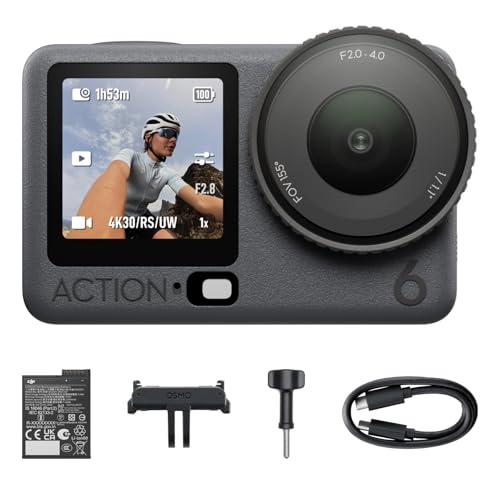
DJI Osmo Action 6
Title and bullets: up to 8K; product table Video Resolution: 4K
Bullets: up to 20m without a case, with a listing footnote
Standard Combo description: curved adhesive base
Insta360 Ace Pro 2 Xplorer Bundle
Bullets: 8K30fps and 4K60fps Active HDR
Expanded bullet: waterproof to 12m
Bullets: grip, utility frame and wrist strap
Insta360 X5
Bullets: 8K30fps 360° video and InstaFrame flat video
Expanded bullet: 15m without a case
Invisible Selfie Stick sold separately
Hiwoor S02
Bullets: full HD 1080P
Title and table say waterproof; bullets require the housing for 30m and say the body is not waterproof
Product table: 64GB memory card and mounting accessories
Best overall: DJI Osmo Action 4 Action Camera
Top pick
DJI
DJI Osmo Action 4 Action Camera
4.6(5,164)
The DJI Osmo Action 4 listing shows 4.6 stars from 5,164 ratings, sold by Amazon AU. Its title names a 1/1.3 inch sensor and 4K/120fps recording; the description qualifies 4K at 120fps as 16:9. The Standard Combo description lists a battery, protective frame, adapter mount and curved adhesive base. The description requires the protective frame for vertical shooting.
$358.00
Amazon.com.au price as of 03:38 pm AEDT, subject to change
As an Amazon Associate, NestPath earns from qualifying purchases.
The DJI Osmo Action 4 Standard Combo combines a 1/1.3 inch sensor and 4K/120fps recording in its title. Its listing shows 4.6 stars from 5,164 ratings and Amazon AU as the seller. Those listed recording features and the included mounting equipment are the reasons it leads this comparison.
The bullets describe a Magnetic Quick Release for switching camera position, three stabilisation modes and 10 bit colour. The description says the Standard Combo includes a battery, a protective frame, an adapter mount and a curved adhesive base. It also says the protective frame is required for vertical shooting, so keep that condition with plans to switch orientation.
Its product table says waterproof up to 18m, but the description adds practical conditions: close the battery cover and USB C port cover and tighten the Glass Lens Cover before use. DJI recommends a Waterproof Case for prolonged underwater recording or high water impact pressure. It says not to use the camera in hot springs or extreme underwater environments, or let it contact corrosive or unknown liquids.
The headline frame rate also has a condition. The description specifies 16:9 for 4K at 120fps. Its wider field of view setting has separate recording and stabilisation restrictions, so choose the mode from the instructions rather than assuming every advertised setting works together.
Waterproof depth and the housing distinction
A housing depth describes the camera inside its protective case. It is not automatically the rating of the camera body. The Hiwoor bullets make that distinction explicit: underwater recording reaches up to 30 meters with the included housing, and the camera itself is not waterproof without it.
The AKASO bullets describe an IPX7 body for rain, snow and splashing, then give 131FT/40M with the included waterproof housing. Its product table uses the broader word Waterproof. Keep both descriptions in view and fit the supplied housing for underwater use. Its description also says the camera does not record sound while in that case.
The Action 6 bullets specify up to 20m without a case and attach a footnote to that claim. The X5 expanded bullet gives 15m without a case, while the Ace Pro 2 expanded bullet says waterproof to 12m. The Pocket 3 product table instead says Not Water Resistant. These listing statements support different uses; they do not establish universal diving instructions.
AKASO Brave 7 LE Action Camera
Budget pick
AKASO
AKASO Brave 7 LE Action Camera
4.4(138)
The AKASO Brave 7 LE listing shows 4.4 stars from 138 ratings, sold by AKASO-TECH. Its bullets list 4K 30fps, dual screens, two rechargeable batteries and a waterproof housing. The bullets describe an IPX7 body and 40m with the housing, while the product table says Waterproof. Its description says the camera does not record sound inside the waterproof case and a Micro SD card is not included.
$239.99
Amazon.com.au price as of 03:38 pm AEDT, subject to change
As an Amazon Associate, NestPath earns from qualifying purchases.
The AKASO listing shows 4.4 stars from 138 ratings, with AKASO-TECH as seller and Amazon as shipper. Its bullets specify 4K 30fps video, 20MP photos, dual colour screens and a rear touch screen. Electronic Image Stabilization 2.0 is the listed stabilisation system; the maker describes it as improved six axis EIS.
The accessories bullet lists two rechargeable batteries, a remote, a waterproof housing and mounting kits. Its description adds that a Micro SD card is not included and instructs buyers to format the card in the camera before use. An external microphone is supported but not included, according to the description. The product information gives a two year warranty.
For casual recording, that combination is worth comparing with the other bundles. The concrete limitation for water filming is sound: the description says recording in the waterproof case does not capture audio. Use the housing as directed, and do not treat its inclusion as evidence of underwater sound recording or untested image quality.
Action camera or gimbal camera for vlogging
A gimbal camera uses mechanical stabilisation: that is the term in the Pocket 3 bullets. The same listing describes holding the camera while moving or setting it on a tripod for ActiveTrack. By comparison, the Action 4 bullets emphasise its Magnetic Quick Release, and the Hiwoor bullets list helmet and bicycle mounts.
Choose according to where the camera will sit. A screen you can rotate, a grip you can hold and a mount you can attach solve different practical problems. The Ace Pro 2 bullets describe a flip touchscreen and the Xplorer grip. For recording a fixed area at home, see our best security camera in Australia guide.
DJI Osmo Pocket 3 Vlogging Camera
Also great
DJI
DJI Osmo Pocket 3 Vlogging Camera
4.5(3,780)
The DJI Osmo Pocket 3 listing shows 4.5 stars from 3,780 ratings, sold by Amazon AU. Its bullets describe a 1 inch CMOS sensor, three axis mechanical stabilisation and a rotating touch screen. The description restricts 4K/120fps to Slow Motion mode and says footage is saved to an inserted microSD card. Its product table says Not Water Resistant.
$498.00$599.00
Save 17%
Amazon.com.au price as of 03:38 pm AEDT, subject to change
Available to order at Amazon AU, ships after a lead time, last verified on 26 October
As an Amazon Associate, NestPath earns from qualifying purchases.
The DJI Osmo Pocket 3 listing shows 4.5 stars from 3,780 ratings and Amazon AU as seller. Its bullets describe a 1 inch CMOS sensor, three axis mechanical stabilisation, ActiveTrack 6.0 and stereo recording. The rotating touch screen supports horizontal and vertical shooting, so framing is part of this camera's appeal for vlogging.
Read the mode qualification before choosing it for slow motion. The title advertises 4K/120fps, but the description says that combination is supported only in Slow Motion mode. This is more precise than treating the title as a promise that every recording mode runs at the headline frame rate.
The product table says Not Water Resistant. Its description lists a protective cover, wrist strap and handle in the standard package and confirms that footage is saved to an inserted microSD card. That makes the recording and storage requirements concrete without promising that a protective cover provides waterproofing.
Sensors and stabilisation from the listings
The Action 4 title names a 1/1.3 inch sensor, the Pocket 3 bullets name a 1 inch CMOS sensor and the Action 6 bullets name a 1/1.1 inch square sensor. The Ace Pro 2 product table lists a 1/1.3 inch sensor. These figures describe the listed hardware; they are not a ranking from comparative low light testing.
Stabilisation terminology also differs. AKASO names EIS 2.0 in its bullets, Pocket 3 names mechanical stabilisation, and the Action 6 product table lists RockSteady and HorizonSteady among its shooting modes. The X5 bullets describe FlowState Stabilization and Horizon Lock. Compare the intended mode and camera format before treating a brand's stabilisation name as a quality score.
4K and 8K recording choices
The Ace Pro 2 bullets list 8K30fps alongside 4K60fps Active HDR. The X5 bullets list 8K30fps for 360° video, which is a different capture format. The Action 6 title and bullets advertise up to 8K, while its product table's Video Resolution row says 4K. That discrepancy remains visible in this comparison.
For the other cameras, the Action 4 description qualifies 4K at 120fps as 16:9, the Pocket 3 description restricts 4K/120fps to Slow Motion mode, and the AKASO bullets list 4K 30fps. Hiwoor lists full HD 1080P. Start with the recording format you need rather than assuming the largest resolution label settles the whole purchase.
DJI Osmo Action 6 Action Camera
Also great
DJI
DJI Osmo Action 6 Action Camera
4.6(460)
The DJI Osmo Action 6 listing shows 4.6 stars from 460 ratings, sold by Amazon AU. Its bullets list a 1/1.1 inch square sensor, variable aperture from f/2.0 to f/4.0 and 50GB of built in storage. The aperture claim carries a listing footnote. The description identifies the curved adhesive base as part of the Standard Combo.
$662.31
Amazon.com.au price as of 03:38 pm AEDT, subject to change
As an Amazon Associate, NestPath earns from qualifying purchases.
The Action 6 listing shows 4.6 stars from 460 ratings, sold by Amazon AU. Its bullets specify a variable aperture from f/2.0 to f/4.0 and a 1/1.1 inch square sensor. They also describe 50GB of built in storage, gesture and voice controls, and connection to two DJI microphone transmitters without a receiver.
The title and bullets give up to 8K video, but the product table's Video Resolution field says 4K. Keep that difference in mind rather than presenting one field as the undisputed specification. Its aperture, video, underwater, microphone and control claims carry footnote markers in the bullets, so the associated conditions matter when selecting a mode or accessory.
The description distinguishes bundles: the Standard Combo adds a curved adhesive base, while the Enhanced Combo includes an extra battery and more accessories. The card here is the Standard Combo. Do not assume that an accessory shown for a different combo is included in this one.
Insta360 Ace Pro 2 Action Camera
Also great
Insta360
Insta360 Ace Pro 2 Action Camera
4.5(1,637)
The Insta360 Ace Pro 2 listing is the grey Xplorer Bundle and shows 4.5 stars from 1,637 ratings, sold by Insta360 Official Store AU. Its bullets list 8K30fps video, Leica optics and a 2.5 inch flip touchscreen. The Xplorer accessories include a grip, utility frame and wrist strap. The expanded box contents bullet lists two batteries.
$829.99
Amazon.com.au price as of 03:38 pm AEDT, subject to change
As an Amazon Associate, NestPath earns from qualifying purchases.
This listing is the grey Xplorer Bundle. It shows 4.5 stars from 1,637 ratings, sold by Insta360 Official Store AU and shipped from Amazon. Its bullets describe Leica optics and colour profiles, a dual AI chip system, 8K30fps video and a 2.5 inch flip touchscreen.
The Xplorer accessories are part of the decision: the bullets name a grip, utility frame, wrist strap and decorative cold shoe accessories for street photography and urban travel. The expanded box contents bullet also lists a Wind Guard and two batteries. The Wind Guard is described as removable, rather than an accessory that must remain attached in every situation.
Its expanded water bullet says waterproof to 12m. The useful comparison with Pocket 3 is the listed camera format and water wording, not an untested claim that either produces sharper footage. Likewise, the listing's image processing descriptions do not establish a measured advantage over every other camera here.
360 video and choosing angles later
The X5 bullets define the practical appeal of 360 capture: record the surroundings and choose angles afterwards using reframing. They also describe InstaFrame Mode, which produces a flat video immediately with automatic framing or a fixed angle. Editing and reframing are options in this listing, not compulsory steps for every clip.
The advertised invisible selfie stick effect has an accessory condition: the Invisible Selfie Stick is sold separately. Include that in your equipment plan if the effect is why you are choosing this camera. The listing's replaceable lens feature is a separate consideration from the reframing workflow.
Insta360 X5 360 Action Camera
Runner-up
Insta360
Insta360 X5 360 Action Camera
4.6(1,967)
The Insta360 X5 listing shows 4.6 stars from 1,967 ratings, sold by Insta360 Official Store AU. Its bullets list 8K30fps 360° recording, replaceable lenses and InstaFrame Mode for flat video. They also describe choosing angles later through reframing. The Invisible Selfie Stick is sold separately.
$929.00
Amazon.com.au price as of 03:38 pm AEDT, subject to change
As an Amazon Associate, NestPath earns from qualifying purchases.
The X5 listing shows 4.6 stars from 1,967 ratings, sold by Insta360 Official Store AU and shipped from Amazon. Its bullets describe 8K30fps 360° video, replaceable lenses, FlowState Stabilization and Horizon Lock. They also name a microphone array with a Wind Guard for reducing wind interference.
The expanded bullet gives 15m waterproofing without a case. Its product table lists a one year manufacturer warranty. If you want conventional flat video as well as reframing, read the InstaFrame options above; the listing supports both approaches. The Invisible Selfie Stick remains a separate purchase.
Hiwoor S02 Action Camera
Also great
Hiwoor
Hiwoor S02 Action Camera
5.0(12)
The Hiwoor S02 listing shows 5.0 stars from only 12 ratings, sold by Hiwoor. Its bullets list 1080P video and a 1.47 inch touch display; the product table includes a 64GB memory card. The title says Waterproof 30M and the table says Waterproof, but the bullets require the housing for 30m and say the camera itself is not waterproof without it. The up to eight hours usage claim includes the charging case.
$139.98
Amazon.com.au price as of 03:38 pm AEDT, subject to change
As an Amazon Associate, NestPath earns from qualifying purchases.
The Hiwoor S02 listing shows 5.0 stars from only 12 ratings, sold by Hiwoor and shipped from Amazon. That is a small rating sample. Its bullets describe full HD 1080P recording and a 1.47 inch touch display, while the product table lists a 64GB memory card in the box.
The title says Waterproof 30M and the product table says Waterproof, but the bullets explicitly say the camera itself is not waterproof without its housing. The housing supports underwater recording up to 30 meters. Keep that qualification with the camera when planning swimming, snorkelling or other water recording described in the bullets.
The bullets list a helmet mount, bicycle mount and magnetic pendant, and describe a magnetic clip for attachment to clothing or metal surfaces. Its up to eight hours usage claim includes the charging case; it is not presented here as uninterrupted recording from the camera battery alone. The product table gives a twelve month warranty.
Batteries, storage and accessories to budget for
Battery wording needs care. The Action 4 title and product table give 160 minutes, while a bullet gives up to 150 minutes in its cold weather description. The Special Feature row also says over 2.5 hours. The Pocket 3 product table gives 166 minutes. The Action 6 bullet gives up to four hours in normal conditions and its table gives 240 minutes. These are listing figures rather than our runtime measurements.
The X5 title says three hours, its product table says 185 minutes, and an expanded bullet advertises up to 208 minutes with the upgraded battery and asks users to update firmware to v1.3.0 or later. Those are different statements with different qualifications. The Hiwoor bullet's up to eight hours includes its charging case, even though its table simply lists eight hours.
Storage also varies. The Hiwoor product table includes a 64GB card, the Action 6 bullets list 50GB of built in storage, the Pocket 3 description says footage saves to an inserted microSD card, and the AKASO description says a card is not included. Our microSD card guide is a related starting point; use the camera's own requirements when selecting a card.
Budget choices and reasons to consider another format
For a first action camera, compare the AKASO package with the Hiwoor package on what you need to record. AKASO lists 4K 30fps and two rechargeable batteries, while Hiwoor lists 1080P and an included memory card. Both attach their underwater depth claim to the supplied housing. Neither specification proves reliability or image quality against the other.
The DJI Osmo Action 4 leads this guide for its listed 1/1.3 inch sensor, 4K/120fps recording in 16:9 and mounting equipment, with 4.6 stars from 5,164 ratings. Consider Pocket 3 for its mechanical gimbal, Ace Pro 2 for its flip screen and Xplorer grip, or X5 for reframing. Spend for the feature that serves your filming plans.
GoPro, other brands and subscriptions
This comparison covers DJI, Insta360, AKASO and Hiwoor. GoPro models are outside the product set, so there is no GoPro performance ranking here. The camera descriptions above concern their listed recording features, accessories and restrictions. They do not establish that every app feature or cloud service is included indefinitely.
If subscriptions matter to your choice, identify the particular app or service you intend to use and read its terms before relying on it. A camera's recording modes and the terms of a separate service are different questions. This guide makes no blanket promise about subscriptions across brands.
How we checked these action cameras
We compared the Amazon AU listings, including their titles, bullets, product information, descriptions and manufacturer content. Specs come from the maker's bullet points and the product information on each listing. We have not tested these cameras. Ratings and counts are the listing values, while camera comparisons separate stated features from measured performance.
Where listing sections disagree, we show both or leave out the disputed figure. We keep housing, recording mode and accessory conditions beside the advice they affect. Seller names identify the listed offer; the product cards provide the current offer details. The comparison includes action, gimbal and 360 cameras so readers can choose the appropriate format.
Last checked: 26 October 2026.
Frequently Asked Questions
What is the most recommended action camera?
The DJI Osmo Action 4 leads this guide because its listing combines a 1/1.3 inch sensor, 4K/120fps video and mounting equipment. It shows 4.6 stars from 5,164 ratings. The description qualifies 4K at 120fps as 16:9, while the other cameras offer different recording formats and accessory bundles.
What are the top 5 best action cameras?
Start with the DJI Osmo Action 4: 4.6 stars from 5,164 ratings and a listed 1/1.3 inch sensor. Compare the AKASO Brave 7 LE for its accessory kit, Pocket 3 for mechanical stabilisation, Ace Pro 2 for its flip touchscreen and X5 for reframing. These are different filming options, not a laboratory ranking.
What is the best budget action camera in Australia?
The AKASO Brave 7 LE is the budget option here, with 4.4 stars from 138 ratings. Its bullets list 4K 30fps, two batteries and a 40m housing. They describe the body as IPX7, while the table says Waterproof. Use the housing underwater; the description says sound is not recorded inside it.
Is DJI Osmo worth buying?
Choose the DJI Osmo model that matches your recording plans. Action 4 leads this guide with a listed 1/1.3 inch sensor and 4.6 stars from 5,164 ratings. Action 6 adds variable aperture in its bullets, while Pocket 3 offers mechanical stabilisation but is listed as Not Water Resistant.
DETAILED REVIEWS
Top pick
DJI
DJI Osmo Action 4 Action Camera
4.6(5,164)
The DJI Osmo Action 4 listing shows 4.6 stars from 5,164 ratings, sold by Amazon AU. Its title names a 1/1.3 inch sensor and 4K/120fps recording; the description qualifies 4K at 120fps as 16:9. The Standard Combo description lists a battery, protective frame, adapter mount and curved adhesive base. The description requires the protective frame for vertical shooting.
$358.00
Amazon.com.au price as of 03:38 pm AEDT, subject to change
As an Amazon Associate, NestPath earns from qualifying purchases.
Budget pick
AKASO
AKASO Brave 7 LE Action Camera
4.4(138)
The AKASO Brave 7 LE listing shows 4.4 stars from 138 ratings, sold by AKASO-TECH. Its bullets list 4K 30fps, dual screens, two rechargeable batteries and a waterproof housing. The bullets describe an IPX7 body and 40m with the housing, while the product table says Waterproof. Its description says the camera does not record sound inside the waterproof case and a Micro SD card is not included.
$239.99
Amazon.com.au price as of 03:38 pm AEDT, subject to change
As an Amazon Associate, NestPath earns from qualifying purchases.
Also great
DJI
DJI Osmo Pocket 3 Vlogging Camera
4.5(3,780)
The DJI Osmo Pocket 3 listing shows 4.5 stars from 3,780 ratings, sold by Amazon AU. Its bullets describe a 1 inch CMOS sensor, three axis mechanical stabilisation and a rotating touch screen. The description restricts 4K/120fps to Slow Motion mode and says footage is saved to an inserted microSD card. Its product table says Not Water Resistant.
$498.00$599.00
Save 17%
Amazon.com.au price as of 03:38 pm AEDT, subject to change
Available to order at Amazon AU, ships after a lead time, last verified on 26 October
As an Amazon Associate, NestPath earns from qualifying purchases.
Also great
DJI
DJI Osmo Action 6 Action Camera
4.6(460)
The DJI Osmo Action 6 listing shows 4.6 stars from 460 ratings, sold by Amazon AU. Its bullets list a 1/1.1 inch square sensor, variable aperture from f/2.0 to f/4.0 and 50GB of built in storage. The aperture claim carries a listing footnote. The description identifies the curved adhesive base as part of the Standard Combo.
$662.31
Amazon.com.au price as of 03:38 pm AEDT, subject to change
As an Amazon Associate, NestPath earns from qualifying purchases.
Also great
Insta360
Insta360 Ace Pro 2 Action Camera
4.5(1,637)
The Insta360 Ace Pro 2 listing is the grey Xplorer Bundle and shows 4.5 stars from 1,637 ratings, sold by Insta360 Official Store AU. Its bullets list 8K30fps video, Leica optics and a 2.5 inch flip touchscreen. The Xplorer accessories include a grip, utility frame and wrist strap. The expanded box contents bullet lists two batteries.
$829.99
Amazon.com.au price as of 03:38 pm AEDT, subject to change
As an Amazon Associate, NestPath earns from qualifying purchases.
Runner-up
Insta360
Insta360 X5 360 Action Camera
4.6(1,967)
The Insta360 X5 listing shows 4.6 stars from 1,967 ratings, sold by Insta360 Official Store AU. Its bullets list 8K30fps 360° recording, replaceable lenses and InstaFrame Mode for flat video. They also describe choosing angles later through reframing. The Invisible Selfie Stick is sold separately.
$929.00
Amazon.com.au price as of 03:38 pm AEDT, subject to change
As an Amazon Associate, NestPath earns from qualifying purchases.
Also great
Hiwoor
Hiwoor S02 Action Camera
5.0(12)
The Hiwoor S02 listing shows 5.0 stars from only 12 ratings, sold by Hiwoor. Its bullets list 1080P video and a 1.47 inch touch display; the product table includes a 64GB memory card. The title says Waterproof 30M and the table says Waterproof, but the bullets require the housing for 30m and say the camera itself is not waterproof without it. The up to eight hours usage claim includes the charging case.
$139.98
Amazon.com.au price as of 03:38 pm AEDT, subject to change
Affiliate Disclosure: As an Amazon Associate, NestPath earns from qualifying purchases. This means if you click a product link and buy something, we may receive a small commission at no extra cost to you. We only recommend products we genuinely believe will help new homeowners. This does not influence our recommendations.
CERTAIN CONTENT THAT APPEARS ON THIS SITE COMES FROM AMAZON. THIS CONTENT IS PROVIDED ‘AS IS’ AND IS SUBJECT TO CHANGE OR REMOVAL AT ANY TIME.