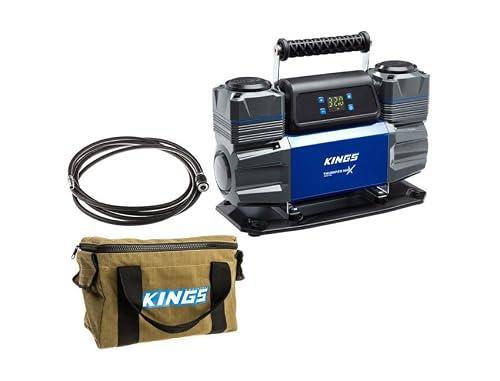
The best tyre inflator in Australia for most drivers is the AstroAI S1Pro 150 PSI Tyre Inflator, a 12V plug-in with a preset-PSI auto-stop and a big backlit screen. The Ryobi 18V ONE+ Inflator (RPI18) has the highest pressure ceiling of the small units at 160 PSI, moves 16 litres a minute and, by its Amazon AU listing, fills a car tyre to 32 PSI in about 42 seconds, and the Kings Thumper Max 12V Air Compressor, whose card carries a dated stock warning, moves around 300 litres a minute and airs a 4WD tyre from 18 to 38 PSI in just over a minute, against the nine to ten minutes a budget unit needs on a large 235 section tyre.
Tyre inflators compared: pressure, flow and how fast each one fills
Flow is the number that decides how long you stand there. Pressure is the number that decides whether the unit can finish the job at all.
Best overall: AstroAI S1Pro 150 PSI Tyre Inflator
The AstroAI S1Pro 150 PSI Tyre Inflator is the best overall pick for most Australian drivers. It plugs into the 12V socket, reaches 150 PSI, and pairs a 4 inch backlit screen with five modes, a saved last setting and a preset PSI auto stop that fills the tyre and shuts itself off. The maker's listing quotes 30 to 36 PSI in 1 minute and 0 to 36 PSI in under 5 minutes on 205/55 R16 and 195/65 R15 tyres, and says it suits tyres up to 26 inches, covering sedans, compact SUVs and MPVs. If you keep a compressor in a ute tray, stop it sliding with retractable ratchet straps for a ute tray.
It comes with a 48cm hose, a 3 metre cord and a 2 year guarantee, and it is sold by AstroAI Direct AU and shipped by Amazon. Its 4.5 stars from 16,343 ratings are pooled global rather than Australian. The trade off is speed on big tyres: one Australian reviewer clocked nine to ten minutes on a large 235 section tyre, so it suits sedans and SUVs better than regular 4WD air ups.
The cheapest bit of car kit that actually saves you money
A portable tyre inflator is one of the cheapest things you can keep in the boot, and it quietly pays for itself. Tyres lose air on their own, around one PSI per month according to Michelin even without a puncture, and under inflated tyres burn more fuel, wear out faster and handle worse in an emergency stop. Keeping every tyre at the correct pressure is the single easiest way to claw back fuel economy, stretch the life of an expensive set of tyres and stay safe, and you cannot do it at home without a way to put air in. For anyone who tows a caravan or heads off the bitumen, an inflator stops being a nice-to-have: airing down on sand and airing back up at the highway is simply part of the job.
There are really only three decisions to make. First, the type of inflator: a cheap 12V plug-in that runs off the cigarette socket, a cordless handheld with its own battery, a tool-platform unit that runs off your existing power-tool batteries, or a high-flow 4WD compressor that clamps to the car battery. Second, the PSI and flow you actually need: how high a pressure it can reach, and how many litres per minute it moves (which decides how fast it fills a tyre). Third, auto-shutoff and accuracy: whether you can set a target pressure and walk away, and how close the gauge really is. Get those three right and the rest is detail. If the battery is the weak point on a trip, a car battery maintainer and charger keeps it topped up between outings.
The types of inflator
Before the picks, it helps to understand the four shapes this category comes in. They are not better or worse than each other. They suit different buyers, and the right one depends on whether you just top up car tyres in the driveway or air up a set of 33s after a beach run.
12V plug-in: the cheapest way in, running off the cigarette socket
This is the classic, cheapest inflator: a small compressor that plugs into the 12V cigarette socket (or the accessory port) and runs off the car. There is no battery to charge and nothing to go flat. As long as the engine is on, it will keep going. AstroAI dominates this end of Amazon AU, and the two cheapest credible picks here are both theirs. The budget H1 caps out at 100 PSI, which is plenty for car and caravan tyres; the S1Pro lifts that to 150 PSI and adds a much bigger screen for the same money.
If you regularly air down for sand or tracks, this is the only type that makes airing back up painless. The trade-off is size, weight and price: these are heavy units that live in a canvas bag, not in the glovebox. If you are building a proper boot kit rather than buying one tool, a jump starter is the other item worth the space.
PSI and flow: what do you actually need?
Two numbers describe an inflator, and people constantly confuse them. PSI is the maximum pressure the unit can reach, meaning how hard it can push. Flow, measured in litres per minute (L/min), is how fast it moves air, meaning how quickly it fills the tyre. They are completely different things, and you need to read both.
On pressure, most car and caravan tyres run somewhere between 28 and 44 PSI, so a 100 PSI unit like the budget AstroAI H1 has plenty of headroom. A 150 PSI ceiling (the S1Pro, UGREEN and Bosch) buys you confidence and the ability to handle higher-pressure applications, but for ordinary tyres you are never near the limit. PSI is rarely the thing that lets you down.
Flow is what people actually feel. A cheap 12V unit moving 15 to 35 L/min is fine for a top-up of a few PSI, but it is slow filling a large tyre from low. One Australian reviewer measured nine to ten minutes to inflate a single large 235-section 4WD tyre on a budget unit. Multiply that by four after a beach run and it is a miserable afternoon. A high-flow 4WD compressor at around 300 L/min does the same tyre in just over a minute. The plain rule: for topping up car tyres in the driveway, a cheap unit is fine; for regular 4WD air-ups, buy a high-flow unit and do not fight a budget inflator.
One test method is worth borrowing when you compare models. Unsealed 4X4's published comparison of 12V portable compressors timed each unit filling five 31 inch tyres to 30 PSI and paid special attention to the last tyre, because the compressor is hottest by then. Its fastest unit on the fifth tyre was the ARB Twin, followed by the Mean Mother Adventurer II and the Ridge Ryder Ultimate, so ask how a budget inflator holds up on tyre four and five, not only tyre one.
Auto-shutoff and accuracy
The feature that turns an inflator from a chore into a set-and-forget tool is a preset-PSI auto-stop. You dial in your target pressure, hit start, and the unit fills the tyre and switches itself off when it gets there, with no standing with your thumb on the trigger, no over-inflating because you got distracted. Every one of the six picks here has this; it is the single feature worth insisting on.
On accuracy, the built-in gauges on these units are generally good to about plus or minus 1 to 2 PSI, which is close enough for road tyres. If precision matters to you, a separate quality pressure gauge is a cheap cross-check. One thing to keep in mind on the spec sheets: the PSI and flow figures manufacturers quote are no-load, rated-up-to numbers measured with the hose open to air, not the pressure or speed you will see filling a real tyre against back-pressure. Treat them as a ceiling, not a promise.
The honest truth: ARB, Mean Mother and the big 4WD compressors are not on Amazon
Here is the disclosure that most "best air compressor" articles quietly skip. If you ask experienced off-roaders which compressors are the gold standard, they will name the ARB Twin, the Mean Mother Adventurer 4, the NOCO Air, Bushranger, and the Makita and Milwaukee tool-platform inflators. Almost none of those are in the Amazon AU buy-box. They sell through ARB stores, Repco, Supercheap Auto, Bunnings, Total Tools and specialist 4WD shops, not through Amazon Australia. The same split applies to tank compressors: the reason most people buy one is to run a pneumatic tool such as a nail gun, and those machines are trade-retailer stock rather than marketplace stock.
We could pretend otherwise and pad this list with parallel-import listings, but that would not help you. Instead, the honest position: if you want an ARB Twin or a Mean Mother, buy it from the channels that actually stock it with a genuine Australian warranty. The one large, well-known Australian 4WD brand you can buy on Amazon AU is Adventure Kings, whose Thumper Max line is a genuine 4WD-community staple. That is why the Thumper Max is the high flow unit on this page, though its card carries a dated stock warning. It is the real high flow option from a brand that lists on Amazon AU, and being the editorial that tells you this plainly is worth more than a longer, dishonest list.
What about McMillan, Pilot Air and the big workshop compressors?
Ask Google for the best air compressor in Australia and the answer it gives is about workshop machines, not inflators: McMillan, whose belt-drive and reciprocating compressors are made in Australia, Pilot Air, and the Ironair 100L 3.0HP Super Quiet. Those are 30 to 150 litre tank compressors for running nail guns, rattle guns and spray guns, and they sell through Total Tools, Sydney Tools and Bunnings, not through Amazon AU. If that is the machine you want, buy it from a trade retailer. Everything on this page is a portable inflator for tyres. Our torque wrench guide covers the tool that sets wheel nuts to their exact figure afterwards.
A note on star ratings
Be a little careful reading the star counts on Amazon AU inflators. Most of these ratings are pooled global: Amazon aggregates reviews across regions, so the AstroAI H1's 68,000-plus and Bosch's 23,000-plus are cross-locale totals, not 68,000 Australians. There are genuine local reviews in those pools, but the headline number is worldwide. At the other extreme, the exact Kings Thumper Max bundle listed on Amazon AU is a brand-new listing with almost no reviews, even though the Thumper Max line itself is a well-reviewed 4WD staple through other retailers. The sensible approach is to weight local reviews and known brands more heavily than a giant global number, and to recognise when a low review count reflects a new listing rather than an unproven product.
Tips for using a tyre inflator
- Check pressures cold. Tyres heat up and read higher after driving. Measure and inflate before you set off, or after the car has sat for a few hours, for an accurate reading.
- Find your placard pressure. The correct PSI for your car is on the tyre placard, usually inside the driver's door jamb or behind the fuel flap. Use that, not the maximum printed on the tyre wall.
- Do not over-inflate. More pressure is not better; it reduces grip and wears the centre of the tread. Set the placard figure and let the auto-stop do its job.
- Let cheap units cool. Small 12V compressors have a duty cycle. Give them a rest between tyres so the motor does not overheat, especially in summer.
- For 4WD, air down then back up. Drop to around 18 to 20 PSI on sand for flotation and grip, then air back up to your road pressure at the bitumen before you get back on the highway.
How we picked
This guide is research, not a hands on test. We compared the six inflators on pressure ceiling, flow, power source and auto stop using each model's Amazon AU listing and the specifications the maker states there, and we checked every card's seller and stock on Amazon Australia. The card we could not buy carries a dated warning, and the one sold through an overseas Global Store says so on its card.
Star ratings and counts come from the Amazon AU listings and are pooled global, so we treat them as a guide rather than a local verdict. For fill times we used the figures on the Amazon listings, one Australian reviewer's timing on a 235 section tyre and the Unsealed 4X4 comparison of 12V portable compressors. For tyre air loss we used Michelin's published guidance, and for workshop compressors the AIMS Industrial sizing guide.
Last checked: 13 October 2026, covering the stock, seller and rating of every listing on Amazon Australia.
Frequently Asked Questions
What is the difference between a 12V plug-in and a cordless tyre inflator?
A 12V plug-in runs off your car: it plugs into the cigarette or accessory socket and draws power while the engine is on, so it never goes flat but it needs the vehicle nearby. A cordless handheld has its own rechargeable battery built in, so it works anywhere with no cords and no car, which is handy for bikes, sports balls and tyres away from the vehicle. The plug-ins are cheaper and never run out mid-job; the cordless units are more convenient but the battery fades after several tyres.
What PSI and flow rate do I need for car versus 4WD tyres?
For ordinary car and caravan tyres, almost any inflator works. They run between about 28 and 44 PSI, and even a 100 PSI unit has plenty of headroom. What separates car use from 4WD use is flow, measured in litres per minute. A cheap 12V unit moving 15 to 35 L/min tops up a car tyre fine but is painfully slow on big, low 4WD tyres. For regular 4WD air-ups you want a high-flow compressor around 300 L/min, which fills a large tyre in about a minute rather than nine or ten.
How long should a portable inflator take to fill a tyre?
It depends entirely on the unit and the tyre. A small 12V or cordless inflator topping up a car tyre by a few PSI takes a minute or two. Filling a large, low tyre from scratch is where cheap units struggle. One Australian reviewer measured nine to ten minutes for a single large 235-section 4WD tyre. A high-flow 4WD compressor does the same job in just over a minute. If you are regularly waiting many minutes per tyre, you have the wrong tool for the job rather than a faulty one.
Can a portable inflator air up big 4WD tyres after off-roading?
It can, but only a high-flow one will do it without testing your patience. Cheap 12V and cordless units will eventually fill a big 4WD tyre, yet they are slow and run hot doing it, so airing up a full set after a beach or track day is a long, motor-stressing chore. A purpose built high flow compressor like the Kings Thumper Max, which clamps to the battery and moves around 300 litres a minute, airs a large tyre from 18 to 38 PSI in just over a minute, though its card carries a dated stock warning. That is the right tool for regular off-road air-ups.
Are ARB, Mean Mother and the big 4WD compressors available on Amazon Australia?
Largely no. The 4WD gold-standard compressors that experienced off-roaders name (ARB Twin, Mean Mother Adventurer 4, NOCO Air, Bushranger and the Makita and Milwaukee tool-platform inflators) are mostly not in the Amazon AU buy-box. They are sold through ARB stores, Repco, Supercheap Auto, Bunnings and specialist 4WD shops with genuine Australian warranties. The one large Australian 4WD brand you can actually buy on Amazon AU is Adventure Kings, whose Thumper Max is a genuine high flow option, though its card carries a dated stock warning.
Do I need auto shut-off on a tyre inflator?
It is the one feature worth insisting on. A preset-PSI auto-stop lets you dial in your target pressure, start the unit and walk away while it fills the tyre and switches itself off at the right pressure, with no holding the trigger, no over-inflating because you got distracted. All six of our picks have it. Without it you have to babysit the gauge and you risk over-pumping, which reduces grip and wears the tread. For set-and-forget convenience, auto shut-off is essential.
Are the star ratings on Amazon tyre inflators trustworthy?
Read them with care, because most are pooled global ratings rather than Australian ones. Amazon aggregates reviews across regions, so the very large numbers (AstroAI's 68,000-plus, Bosch's 23,000-plus) are worldwide totals that include genuine local reviews but are not all Australian. At the other end, a brand-new listing can show almost no reviews even when the product line is well regarded elsewhere, as with the Kings Thumper Max bundle. Weight local reviews and known brands more heavily than a single giant global figure.
What is an air compressor?
An air compressor is a pump that squeezes air into a smaller space and then releases it under pressure to do work. In a portable tyre inflator the compressed air goes straight down a short hose into the tyre, which is why these units have no tank. In a workshop compressor the air is stored in a tank of 30 to 150 litres and drawn off to drive tools such as nail guns, rattle guns and spray guns. Same principle, very different machine, and the pages that rank for one rarely serve the other.
How does an air compressor work?
A motor drives a piston up and down inside a cylinder. On the down stroke a one-way valve lets atmospheric air in; on the up stroke that valve shuts, a second one opens and the air is forced out at pressure. Squeezing air heats it, which is why a small 12V unit gets hot and needs a rest between tyres. The two figures on the box come straight out of that: maximum pressure is how hard the piston can push, and flow in litres per minute is how much air it moves each stroke.
What is an air compressor used for?
The portable kind on this page is used for inflating: car, caravan, trailer and 4WD tyres, bike tyres, sports balls, air mattresses and inflatable boats. A high flow unit like the Kings Thumper Max 12V Air Compressor, whose card carries a dated stock warning, exists to air a set of 4WD tyres back up after a beach or track day. A tank compressor is used for something else entirely: driving pneumatic tools, blowing dust out of a workshop, running a spray gun and seating tubeless tyre beads.
What size air compressor do you need for spray painting?
Not one of these. A spray gun needs continuous airflow, which means a tank compressor rather than a portable inflator, and in practice that starts at a 50 litre tank and goes up from there. The sizes Australian trade retailers stock for this run from 50 litres through 100 to 150 litres, from Total Tools, Sydney Tools and Bunnings. Match the compressor to the air the gun consumes rather than to the tank size alone, and ask the retailer for the figure that matters, which is the airflow at working pressure.
What is the best air compressor brand in Australia?
It depends which machine you mean. For portable tyre inflators, AstroAI has the deepest range on Amazon AU at the cheap end, Ryobi is the pick if you already own 18V ONE+ batteries, Bosch is the premium handheld, and Adventure Kings is the one large Australian 4WD brand you can actually buy in the Amazon AU buy box. For workshop tank compressors, Australian buyers name McMillan, Pilot Air and Ironair, and for 4WD air ARB and Mean Mother, all of which sell through trade retailers rather than Amazon.
What is the best air compressor for a home garage in Australia and what is the price range?
A home garage usually needs a tank compressor rather than a portable tyre inflator. One Australian supplier guide lists 150 to 200 litres a minute of free air delivery and a 24 to 50 litre tank for a home workshop running nail guns, blow off and tyre inflation. Prices rise with tank size, so compare Total Tools, Sydney Tools and Bunnings listings for current ranges.
What is the best 12V air compressor for a 4x4 in Australia?
For a 4x4, a high flow 12V compressor that clamps to the car battery is the best choice. In the Unsealed 4X4 comparison the ARB Twin was fastest on the fifth tyre, ahead of the Mean Mother Adventurer II and the Ridge Ryder Ultimate. Those sell through 4WD and auto retailers, while the Kings Thumper Max is this page's high flow unit, so check its card for stock.
What is the most reliable 12V air compressor?
Experienced off roaders name the ARB Twin and the Mean Mother Adventurer as the gold standard 12V compressors, but they are largely not in the Amazon AU buy box. Of the units you can buy there, the AstroAI S1Pro is our best overall pick, with 4.5 stars from 16,343 ratings pooled globally. No published test we found ranks these listings for long term reliability.
What is the best portable air compressor for reinflating tyres after the beach?
A high flow 12V compressor that clamps to the car battery is the best choice after the beach. It moves 300 litres a minute, airing a 4WD tyre from 18 to 38 PSI in just over a minute, against nine to ten minutes for a budget plug in unit on one large tyre. Check the Kings Thumper Max card for stock, or consider an ARB Twin.