How to choose an aquarium filter in Australia
Choose the filter type for your tank first: an internal filter for a small or turtle tank, a hang on back filter for a typical community tank, and a canister for a large or heavily stocked one. Our best overall is the SunSun HW-3000 canister, rated 4.0 from 656 ratings on Amazon AU, with a 9W UV sterilizer.
| Filter | Type | Flow or tank size on the listing | Rating (count) | Seller on the listing |
|---|
| SunSun HW-3000 UV 9W 5 Stage External Canister Filter (best overall) | External canister with 9W UV sterilizer | Bullets: up to 793 gallons per hour (adjustable). Product information: 1400 Liters Per Hour | 4.0 (656) | Aussie_essentials |
| PYPABL 600L/H Internal Aquarium Filter | Internal, 8W | Max Water Flow 600L/H, for 30 to 180L tanks | 4.1 (100) | PYPABL-AU, ships from Amazon |
| Aqua One ClearView 500 Hang On Filter | Hang on back | 500L/hr, for aquariums up to 120L | 4.1 (32) | IWA Inspire With Aquariums, ships from Amazon |
| Fluval AquaClear AC30 High Performance Filter | Back filter, 4 stage | Title lists 38 to 114L | 4.1 (474) | Amazon Germany |
| Fluval FX6 High Performance Canister Filter | Canister | Bullets: pumps out 925 US Gal (3,500 L) of water per hour. Description: pump output of 925 gallons of water, filter circulation of 563 GPH. Title says up to 400 Gal. | 4.5 (3,344) | Your Online Pet Store |
A filter is the heart of a healthy aquarium. It does three jobs at once: mechanical filtration traps debris and uneaten food, biological filtration hosts the beneficial bacteria that run the nitrogen cycle that actually keeps your fish alive, and chemical filtration (usually activated carbon) pulls dissolved nasties and discolouration out of the water. The category splits first by type, and getting the type right for your tank matters more than any single spec. Internal filters suit nano tanks, shrimp, fry and turtles, and the PYPABL listing says it is suitable for a 30 to 180L fish and turtle tank. Hang on back (HOB) filters clip onto the back of the tank, and the Aqua One ClearView description says hang on filters are designed to be clipped onto the back of your aquarium. Canister filters sit outside the tank, and the SunSun HW-3000 and the Fluval FX6 are the canisters on this page. The Fluval AquaClear lists a patented back filter system with 4 stage filtration. This guide covers all three types and says plainly where a listing does not state a plug or a voltage.
PYPABL 600L/H Internal Aquarium Filter: match the type to your tank
Match the type to the tank before you compare flow rates. An internal filter sits inside the tank, and the PYPABL listing says it is suitable for a 30 to 180L fish and turtle tank. A hang on back filter clips onto the back of the tank, and the Aqua One ClearView description lists aquariums up to 120L. A canister sits outside the tank, and the SunSun HW-3000 and the Fluval FX6 are the canisters here. An internal filter sits entirely inside the tank, which makes it a natural match for shrimp, fry and turtle tanks where the water volume is modest. A hang on back filter keeps its media in a box on the back of the tank, so it is easy to reach and maintain without opening a cabinet. A canister holds its media in a separate sealed body outside the tank, which is why it is the type to consider for planted, turtle or heavily stocked tanks. Do not put a giant canister on a 30 L nano tank or a tiny internal on a 300 L display tank: the type has to fit the tank, and the rest follows from there. If you are choosing the tank as well, compare fish tanks before settling on a filter size.
Aqua One ClearView 500 Hang On Filter and the flow rate rule
Flow rate, measured in litres per hour (L/h), is the second axis, and there is a simple rule of thumb: aim for a filter rated at roughly four to six times your tank volume in litres every hour. So a 200 L tank wants somewhere around 800 to 1,200 L/h of turnover. The flow figure on a listing is the maker's headline rating, so size up rather than buy exactly to spec. Heavily stocked or messy fish (goldfish, cichlids) want the higher end of the range, and planted tanks with low stock can sit lower so they do not blast the plants. The ClearView description lists a Max. Flow Rate of 500L/hr and a flow regulator that can be used to adjust the water flow through the filter. A filter that is too strong for a small tank creates a current the fish cannot rest in, so for a nano tank look at the lower flow listings first.
Every good filter runs water through three kinds of media, and understanding them makes maintenance far less mysterious. Mechanical media, such as foam and filter wool, physically traps debris, and it is the part you rinse most often. Biological media, such as ceramic balls and rings, hosts the beneficial bacteria that convert toxic ammonia and nitrite into far less harmful nitrate, so you never replace all of it at once or you risk crashing the cycle. Chemical media, usually activated carbon, is optional and removes dissolved organics, odour and discolouration, but it exhausts and needs replacing periodically.
The listings on this page name the stages in different ways. The AquaClear lists 4 stage filtration (2 x mechanical, chemical, biological), the PYPABL lists activated carbon cotton, biochemical cotton and ceramic balls, the ClearView lists a combination of wool, carbon and bio grid, and the FX6 lists all filter media included, mechanical, chemical and biological. The SunSun HW-3000 comes with white filter pads, and its listing says the filter media is sold separately. A bigger filter is largely about how much media it can hold, and the FX6 lists stackable media baskets that hold a total of 1.5 US Gal (5.9 L) of media. The AquaClear listing says CycleGuard preserves the biological balance of your aquarium through a separate media change that avoids disruption of the nitrogen cycle.
The AquaClear is sold by Amazon Germany, and on 20 October 2026 its buy box showed the notice: Imports from Germany may differ from local products. Additional terms apply.
Ocellaris Canister Filter (1400LH) could not be bought on 20 October 2026
Amazon AU listed the Ocellaris Canister Filter (1400LH) as currently unavailable and its page had no add to cart button, so we do not recommend it. Its listing describes a high quality external filter with all media included, a quick release tap system and an easy start manual primer, and it shows 4.6 stars from 4 ratings. The brand shown on the listing is Brown's Pet Range.
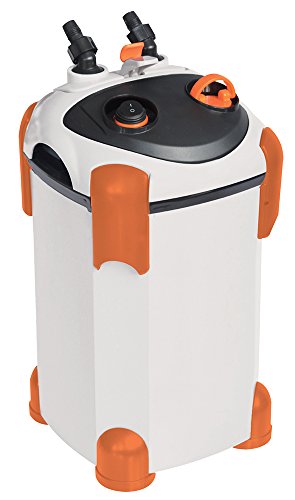
Best overall: SunSun HW-3000 UV 9W 5 Stage External Canister Filter
The SunSun HW-3000 is our best overall pick, shown at 4.0 stars from 656 ratings on Amazon AU and sold by Aussie_essentials. The reason is the combination on its listing: a 5 stage external canister, a 9W UV sterilizer, an LCD display that lets you adjust the flow rate and the duration of the UV light, and a stated voltage of 220 to 240V/50Hz, for any freshwater and saltwater aquarium. None of the other listing titles or bullet points we saved mention UV.
A UV steriliser is an optional extra, and the listing describes the 9W unit as perfect for maintaining a clean and clear Aquarium. The same listing says the LCD display allows users to adjust the flow rate of the pump and the duration of the UV light.
The listing says the unit can be used for any freshwater and Saltwater aquariums and comes with white filter pads. The honest notes: the listing says the filter media is sold separately, so budget for media on top of the unit; its bullets give the flow rate as up to 793 gallons per hour (adjustable) while its product information table lists a flow rate of 1400 Liters Per Hour, so the two figures differ on the same listing; it states the voltage but not which plug is fitted; and its product information table lists a Horsepower of 30 Watts, separate from the 9W UV sterilizer.
Fluval FX6 High Performance Canister Filter: noise and maintenance
The last things to weigh are how the filter lives in your home day to day. The PYPABL listing gives a Noise Level of under 40dB and says the water level cannot be lower than its Minimum Water Level. The FX6 listing says its Smart Pump microchip technology continuously monitors and optimizes pump performance, trapped air is automatically evacuated every 12 hours, and water changes need no heavy buckets because you attach hosing to the output. It also lists a compact 21 in (53 cm) tall design that fits under most aquariums, and its title says it suits aquariums up to 400 Gal. The FX6 is sold by Your Online Pet Store, and its listing does not state a plug or a voltage. The ClearView description says carbon filter cartridges should be replaced every 6 to 8 weeks to maximise efficiency. Match the noise and maintenance rhythm to where the tank lives and how much fiddling you want to do, and the filter will fade into the background the way a good one should.
If a new canister leaks on first setup, the usual first check is the large rubber O ring around the lid. Open the unit, make sure the ring is clean, free of debris and sitting evenly in its groove, and seat the lid squarely again before clamping it down. Also check that the hose connections and taps are pushed fully home and that the clamps sit evenly, then run the filter and watch the joins before you leave it.
Which filter type for which tank
Pick an internal filter for a small tank or a turtle, a hang on back filter for a typical community tank, and a canister for a large or heavily stocked tank. The PYPABL lists 30 to 180L, the Aqua One ClearView lists aquariums up to 120L, and the Fluval FX6 title says up to 400 Gal.
To put the types side by side: choose an internal or sponge filter for nano tanks, shrimp, fry and turtles, where you want something gentle and self contained. Choose a hang on back filter for everyday community tanks where you want easy maintenance you can reach without opening a cabinet. Choose a canister for big, planted or heavily stocked tanks where you want the most media. The mistake to avoid runs both ways: do not put a giant canister on a 30 L nano tank, where it may create a current the fish cannot rest in, and do not put a tiny internal on a 300 L display tank, where it is unlikely to keep up with the bio load. Size the type to the tank and you have made the most important decision before you compare specs.
For planted tanks, the useful feature is a flow you can turn down, because delicate plants can be blasted by a strong current. The ClearView description lists a flow regulator that can be used to adjust the water flow through the filter, and the SunSun LCD display lets you adjust the flow rate of the pump. Large tanks need the media capacity of a canister, and turtle tanks produce a heavy bio load that wants serious filtration, so size up for turtles and heavily stocked tanks. For a small turtle or nano planted tank, an internal filter like the PYPABL, which names turtles in its listing, or a hang on back filter can be enough.
Will an imported aquarium filter work in Australia
It depends on the listing. Of the filters here, the PYPABL lists an Australia Standard Plug, the ClearView description lists Voltage: 230V/50Hz, and the SunSun HW-3000 lists Voltage: 220 to 240V/50Hz. The Fluval AquaClear AC30 and FX6 listings we saved state no plug or voltage, so check the listing before you buy.
Some filters are sold from overseas or carry an imports notice: the AquaClear shows Amazon Germany as the seller, with an Amazon notice that imports may differ from local products. Check that the voltage on the listing suits Australian mains power, and where the plug is not stated, ask the seller before you buy. Take particular care with the two Fluval filters on this page, because neither listing states a plug or a voltage.
Matching flow to your tank
The turnover rule is worth working through with a real example. The target is a filter rated at roughly four to six times your tank volume in litres per hour, so a 200 L tank wants somewhere around 800 to 1,200 L/h. The flow figure on a listing is the maker's headline rating, so leave some headroom and size up rather than buy exactly to spec. Among the filters here, the ClearView lists 500L/hr and the PYPABL lists a Max Water Flow of 600L/H. The SunSun bullets list up to 793 gallons per hour (adjustable) while its product information table lists 1400 Liters Per Hour, so check which figure applies, and convert any figure in gallons to litres before you compare it with the others. The FX6 lists two different measures: its bullets say it pumps out 925 US Gal (3,500 L) of water per hour, while its description gives a pump output of 925 gallons of water and a filter circulation of 563 GPH, so name which one you are comparing. For a 200 L tank, the ClearView and the PYPABL list less than 800 L/h, and the FX6 lists a pump output above 1,200 L/h next to a filter circulation of 563 GPH, a figure in gallons that you convert to litres before you compare it with the target. Slightly over filtering is safer than finding the filter undersized once the tank is set up.
Rinse mechanical media (foam and wool) in old tank water, never under the tap. Chlorine in tap water kills the beneficial bacteria living on the media, and those bacteria are the nitrogen cycle, so killing them can crash the tank. When you do a water change, swish the foam in the bucket of removed tank water and put it straight back. Never replace all the biological media at once: swap at most half at a time and let the new media colonise before touching the rest, or you risk an ammonia spike that can kill your fish. Clean the filter at a water change so the removed tank water is on hand for rinsing, and clean it sooner if the flow visibly slows, because a clogged filter moves less water than the figure on the listing. The AquaClear listing says its CycleGuard feature uses a separate media change that avoids disruption of the nitrogen cycle, and the ClearView description says carbon filter cartridges should be replaced every 6 to 8 weeks to maximise efficiency. For household drinking water, the separate water filter guide covers kitchen filtration.
A note on Eheim
Enthusiasts will rightly ask where Eheim is. We have no Eheim listing saved for this guide, so we cannot say how an Eheim compares with the Fluval filters here. The two Fluval filters on this page are the AquaClear AC30, rated 4.1 from 474 ratings, and the FX6, rated 4.5 from 3,344 ratings. If you already own an Eheim, the media advice on this page still applies: rinse mechanical media in old tank water and never replace all the biological media at once.
How we checked these filters
We read each filter's Amazon AU listing, including the title, the bullet points, the product information, the description, the star rating, the number of ratings and the seller shown. Specs come from the maker's bullet points and the product information on each listing. Where a listing does not state a plug or a voltage, we say so rather than guess.
Last checked: 20 October 2026
Frequently Asked Questions
What is the best filter for a 5 gallon aquarium?
None of the listings we saved states a minimum tank size that small. The lowest minimum is 30L, on the PYPABL internal filter, which says it is suitable for a 30 to 180L fish and turtle tank. The Aqua One ClearView lists aquariums up to 120L but gives no minimum, so check before buying for a five gallon tank.
Do turtles need filters in their tanks?
A turtle tank needs its water kept clean, and a filter does that job. Of the filters here, only the PYPABL internal filter names turtles: its listing says it is suitable for a 30 to 180L fish and turtle tank. The other listings we saved do not mention turtles, so check the tank size range before you buy.
Which is better, Eheim or Fluval?
We cannot compare them, because we saved no Eheim listing. Two Fluval filters are on this page: the AquaClear AC30, rated 4.1 from 474 ratings, and the FX6, rated 4.5 from 3,344 ratings. Neither Fluval listing states a plug or voltage, so check before you buy.