Best Egg Incubator Australia 2026: 8 Backyard Hatching Machines Compared
By Anish Puri·18 July 2026·Last updated 7 October 2026·12 min read
Eight auto turning egg incubators for Australian backyard poultry, covering the Chickcozy 25 Egg and the KEBONNIXS 12 Egg, with honest coverage of thin review bases, the trade of adding water by hand and what actually decides a hatch.
Prices checked 17 October 2026 on Amazon AU and subject to change.
The Chickcozy 25 Egg Incubator turns the clutch every hour and has a water drawer you refill without lifting the lid. The KEBONNIXS 12 Egg Incubator is the most reviewed of these picks, and the KEPTFIT 6 Egg Incubator is the lowest cost way to try a hatch among the priced picks here. Whichever you buy, chicken eggs need 37.5 degrees Celsius for 21 days, at 45 to 55 percent humidity for the first 18 days and 65 percent or more for the last three.
Hatching your own chicks is one of those backyard projects that sounds complicated until you realise the machine does most of the work. A modern egg incubator holds a steady temperature of around 37.5 degrees Celsius, turns the eggs on a schedule the way a broody hen would, and gives you a clear dome to watch the whole thing unfold over 21 days. For a family that has just moved into a place with a bit of land, it is a genuinely magical first project, and most of the good options cost less than a flat-pack chicken coop.
The catch is that the egg incubator aisle on Amazon Australia is a minefield of near-identical clear domes with wildly different quality control. Some hold temperature within half a degree for three weeks straight. Others drift enough to ruin a whole clutch of fertile eggs. The review bases are thin on many listings, so picking blind is a real gamble.
We dug through the ratings, specifications and Australian buyer reviews on every incubator currently sold on Amazon AU to separate the reliable hatchers from the lucky dips. Six models made the cut when we first wrote it, from a small starter unit up to a 25 egg machine with a two year warranty, and we have since added a 30 egg and a 12 egg machine. Here is where your money goes furthest.
The quick answer: which egg incubator should you buy?
For most Australian backyards, the Chickcozy 25 Egg Incubator turns eggs every hour the way a hen naturally shuffles her clutch, and its water drawer lets you manage humidity without ever lifting the lid. It is the most expensive of the currently priced picks.
The KEBONNIXS 12 Egg Incubator is the most reviewed of our picks, with an external water top up and a turner that automatically stops three days before hatch. On a tighter budget, the KEPTFIT 6 Egg Incubator is the lowest priced of these picks and still auto turns, though you add water by hand.
How the top egg incubators compare at a glance
All eight picks turn eggs automatically. Where they differ is capacity, how humidity is managed, and how much review history backs them up.
The original six and the MATICOOPX are fan forced rather than still air; the M12H listing does not mention a fan. All eight include a candler. The Chickcozy, the KEBONNIXS, the MATICOOPX and the M12H shared the highest rating here at 4.4 stars, and the KEBONNIXS was by far the most reviewed.
How we evaluated these egg incubators
NestPath researches and studies product listings, specifications and buyer reviews rather than running hatches ourselves. For this guide we pulled the Amazon Australia data for every egg incubator we could find when this guide was researched, then applied four filters. First, availability: every pick had to be in stock with a real AUD price at the time of writing, and we dropped anything priced like a reseller markup. Second, review integrity: we recomputed every star rating and review count from the listing at research time rather than trusting search page snippets, and we tell you plainly when a pick's review base is thin. Third, automation: every pick auto-turns its eggs, because manual turning three to five times a day for 18 days is the single most common point of failure for beginners. Fourth, category fit: we excluded reptile-specific incubators, standalone brooder plates and heat lamps, and anything that is really a chicken coop accessory.
One honest caveat that applies to every machine on this page: an incubator creates the conditions for a hatch, it cannot guarantee one. Hatch rates depend on starting with genuinely fertile eggs, placing the unit somewhere with a stable room temperature away from draughts and direct sun, and resisting the urge to open the lid in the final days. Any hatch-rate figures we mention come from manufacturer listings and buyer reviews, not from a promise we can make on their behalf.
Every pick's Amazon AU listing was last checked on 7 October 2026 for stock, sellers and ratings. Two of the original picks, the KEBONNIXS and the Sindarhor, were out of stock on Amazon AU that day.
How the Chickcozy 25 Egg compares
The Chickcozy 25 Egg Incubator is the machine we would put on the bench for a keeper who did not want to think about it again. The design decisions all point the same way: fewer reasons to ever open the lid mid hatch.
Also great
Chickcozy
Chickcozy 25 Egg Incubator
4.4(515)
A 25 egg unit with hourly egg turning, a spill free pull out water drawer for lid closed humidity control, and a two year warranty, backed by more than 500 ratings. Australian compatibility or compliance could not be verified for this listing at the 7 October 2026 check.
$202.72
Amazon.com.au price as of 05:01 pm AEDT, subject to change
As an Amazon Associate, NestPath earns from qualifying purchases.
The headline feature is the watering system. A drawer pulls out from the side so you top up without lifting the dome, and the base has four separate water zones, so you can run two for normal incubation and add the C and D zones when you need to push humidity up for lockdown. That kind of graduated control usually only shows up on specialist machines from poultry supply stores. The egg tray rotates the clutch once every hour, mimicking the frequent small shuffles of a real hen rather than the two-hourly turns most budget units use.
The practical touches hold up too. There is a built in candler for checking development, a clear dome with a genuine 360 degree view, an anti slip mat, and a raised guard wall of about 5 centimetres so newly hatched chicks do not tumble off the tray. The top fan detaches and the base rinses out, which matters more than it sounds: post hatch cleanup is genuinely messy. Chickcozy backs it with a two year warranty. A recent Australian owner reports strong hatch rates with it, and reviewers in colder climates single out how steadily it holds temperature and humidity.
Flaws but not dealbreakers
It is the most expensive of the priced picks here, which is a lot for a first experiment if you are not yet sure backyard poultry is your thing. It is also a 3.54 kilogram unit at 35.6 centimetres wide, so it wants a permanent spot on a bench rather than a cupboard shelf. And a handful of reviewers report the eggs rocking slightly in the turner; one fixed it by padding the slots with cut cloth, which is a cheap tweak but worth knowing about.
Is the KEBONNIXS 12 Egg worth it?
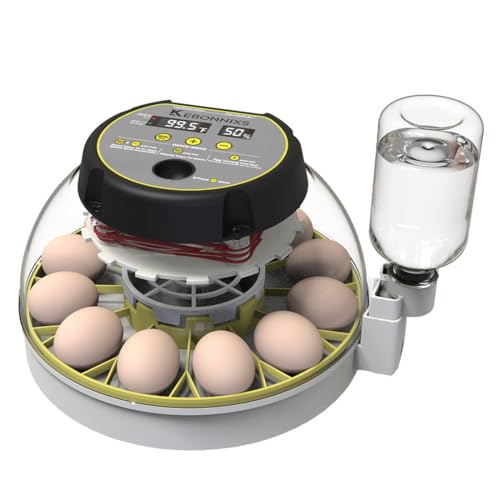
The KEBONNIXS 12 Egg Incubator is the most reviewed of our picks by a wide margin, and it has been on sale since 2020. Amazon AU listed it as out of stock at our 7 October 2026 check.
KEBONNIXS
KEBONNIXS 12 Egg Incubator
4.4(5,169)
With more than 5,000 ratings it is the most reviewed of our picks, with an auto stop turner and external water top up. It was unavailable on Amazon AU on 9 October 2026.
As an Amazon Associate, NestPath earns from qualifying purchases.
The feature set explains the staying power. A circulating fan pushes air evenly around the dome, so there are no hot or cold corners, which is the quiet killer in cheap still-air incubators. Humidity is displayed on screen, so you are not buying a separate hygrometer just to know what is happening inside. Water top-up happens through an external port, meaning the lid stays shut and the temperature never takes a hit while you maintain it. The built-in candler lets you check which eggs are developing without any extra kit.
It includes an auto stop turner. Turning must stop for the final three days of incubation so chicks can position themselves for hatching, and forgetting to switch it off is a classic beginner mistake. The KEBONNIXS stops itself on schedule. For a 12 egg clutch, which is the size most backyard keepers actually hatch.
Flaws but not dealbreakers
Twelve chicken eggs is a real ceiling, and hatch maths is unforgiving: if two thirds of a dozen fertile eggs hatch you have eight chicks, so anyone planning to grow a flock quickly will want the Chickcozy or the 24 egg Sindarhor instead. There is also a familiar minority report for this category: some buyers found the humidity readout runs optimistic and cross checked it with a cheap standalone hygrometer, which we would recommend doing with any incubator at this price.
What is the best budget egg incubator?
The KEPTFIT 6 Egg Incubator is the lowest priced buyable pick here and the honest way to find out whether hatching is a hobby you will love before committing real money. It holds 4 to 6 eggs, turns them automatically every 2 hours, and weighs just 830 grams with a fully transparent shell that doubles as the viewing window.
Also great
KEPTFIT
KEPTFIT 6 Egg Incubator
3.8(19)
The lowest priced of the currently priced picks here, a budget unit that pairs genuine auto turning with an adjustable digital thermostat; water is added by hand, and its review base is thin but mostly positive from Australian buyers.
$25.89
Amazon.com.au price as of 11:01 am AEDT, subject to change
As an Amazon Associate, NestPath earns from qualifying purchases.
For the price, the essentials are covered surprisingly well. The LED display shows the set temperature with two buttons to adjust it, the silica gel heating wire and circular air duct spread warmth evenly through the small chamber, and the clear housing means kids can watch every stage without touching anything. One Australian buyer reports hatching eight quail in it and lining up chicken eggs next; another reviewer highlights how simple the setup is out of the box, with a cable that plugs into any USB port. At 30.5 by 20.3 centimetres it also takes up almost no bench space, which makes it a natural fit for a kitchen corner or a classroom demonstration.
Be clear eyed about what you are getting: this has the thinnest review base of our picks, and it sits at the bottom of our set on both rating and review count. We kept it anyway because it is the only pick at this low a price that combines genuine auto turning with an adjustable digital thermostat and mostly positive Australian reviews.
Flaws but not dealbreakers
Water is added by hand, so unlike every other pick here you will briefly disturb the chamber each time humidity drops; do it quickly and the temperature recovers in minutes. There is no humidity readout, so budget for a mini hygrometer to sit inside. The maker also notes it is not suitable for goose eggs, and six eggs is a tiny clutch: expect three or four chicks from a good run, not a flock.
Which incubator is best for set and forget humidity?
The SUBOSI 12 Egg Incubator exists to answer the most common complaint in this category: having to fuss over water channels every day or two. It connects two independent moisture trays to external 500 millilitre reservoirs, and the maker rates a fill as lasting 5 to 7 days. In practice that means two to four refills across an entire 21 day chicken hatch.
Also great
SUBOSI
SUBOSI Fully Automatic Egg Incubator 12
4.3(91)
The set and forget humidity pick: dual moisture trays fed by external 500 millilitre reservoirs run 5 to 7 days per fill, backed by more than 90 ratings; note the turning tray must be removed by hand three days before hatch.
$121.57
Amazon.com.au price as of 11:01 am AEDT, subject to change
As an Amazon Associate, NestPath earns from qualifying purchases.
It is one of the higher rated machines in this guide. The rest of the spec sheet keeps pace with units well above its price: a display that shows both temperature and humidity, a candler, 360 degree air circulation to eliminate hot spots, and a fully transparent dome. The egg turner rotates the clutch every two hours, and the adjustable vent system helps you dump excess humidity late in the hatch when condensation starts building on the dome.
If your household is the kind where the incubator would otherwise be checked twice a day by an enthusiastic child with the lid off, the sealed, bottle fed water system is worth the price of admission on its own. It is a good choice for busy households, and for anyone incubating over a stretch that includes a few nights away from home.
Flaws but not dealbreakers
The turner does not stop automatically: the maker instructs you to physically remove the red turning tray three days before hatch day, so set a phone reminder for day 18 or you risk chicks tangling with a moving tray. The brand also notes the vents should stay closed until humidity climbs above 80 percent, which is the opposite of some rival designs and worth reading the manual for. And SUBOSI is a generic brand with a listing page that is rough around the edges, even if the hardware reviews well.
Which incubator is best for hatching bigger clutches on a budget?
The Sindarhor 24 Egg Incubator holds double the eggs of the mid sized picks, though Amazon AU listed it as out of stock at our 7 October 2026 check. If your goal is a proper laying flock rather than a science experiment, starting with 24 eggs instead of 12 roughly doubles your expected chicks, and it costs less than the SUBOSI despite the extra capacity.
Sindarhor
Sindarhor 24 Egg Incubator with Automatic
3.9(33)
Double the capacity of the mid range picks, with a low humidity alert, auto stop turning and a universal tray that grips quail through goose eggs; a thin review base, so pair it with a standalone hygrometer. It was unavailable on Amazon AU on 9 October 2026.
As an Amazon Associate, NestPath earns from qualifying purchases.
The spec sheet reads like a much more expensive machine. The LCD tracks temperature, humidity, day count and turning status, and a built in alert sounds if humidity falls below 40 percent, a useful safety net. Dual external water bottles feed A and B humidity trays, so like the SUBOSI you refill it only a few times per hatch without opening the lid. The turner stops itself three days before hatch, the tray auto adjusts to grip quail, chicken, duck and even goose eggs, and the LED candler is built into the design.
A recent reviewer reports hatching 26 quail from 40 eggs in it, and another praises the low-humidity alarm for catching problems early. For classrooms, or for anyone who wants one machine that can move between quail and chicken clutches, the universal tray makes it unusually flexible at this price.
Flaws but not dealbreakers
The review base is the trade off: a thin record for a newer listing, and the critical reviews are real, including one buyer whose temperature and humidity readings ran well off calibration. A cheap standalone hygrometer is a must have companion here. Reviewers also note the chamber is fairly low, so hatched chicks need moving to a brooder promptly, and the lid lacks a handle, which makes removing the turner tray at lockdown slightly awkward.
Which incubator is the best starter kit for kids?
The Aymerox 12 Egg Incubator leans into what hatching actually is for most Australian families: a three week event for the kids. Its listing bundles the machine with a plush chick house of about 10 by 10 by 10 centimetres for the newly hatched arrivals, and the listing describes a quiet fan, so it can live in a bedroom or classroom corner without becoming background noise.
Also great
AYMEROX
AYMEROX 12 Egg Incubator for Hatching
3.9(81)
The family starter kit: automated temperature and humidity control, auto water refill, a whisper quiet fan and a bundled plush chick house; run its 24 hour empty test first, as some units are reported with inconsistent temperature control.
$79.99
Amazon.com.au price as of 05:01 am AEDT, subject to change
As an Amazon Associate, NestPath earns from qualifying purchases.
Underneath the family framing is a properly specified machine: automated temperature and humidity control, an automatic egg turner, an auto water refill system fed from outside the unit, and a clear LED panel that displays temperature, humidity and turn settings at a glance. The transparent cover gives an unobstructed view of the action on hatch day. It sits mid pack in this guide, and the strongest reviews are convincing: one Australian owner runs it as a second incubator and reports hatch rates matching a large name brand machine that cost several times as much.
It undercuts the SUBOSI while matching its headline automation features, which is exactly the slot a family first pick should occupy.
Flaws but not dealbreakers
The mixed reviews reflect genuine variance: a minority of buyers received units with inconsistent temperature control, and Amazon's returns window is your safety net there, so run the machine for 24 hours with a hygrometer inside before trusting it with fertile eggs. The plush chick house is a comfort aid, not a brooder; chicks still need a proper heat source once they leave the incubator. And like most units this size, 12 chicken eggs is the hard ceiling.
Which incubator holds the most eggs?
The MATICOOPX 30 Egg Incubator is the biggest machine on this page, with a circulating fan, a humidity display, a built-in candler and an external water top up, and its turner stops by itself three days before hatch. Its listing does not say how the temperature is set, so check that with the seller before you buy. Its listing gives the unit's weight as 4.15 kg. At our 7 October 2026 check it held 4.4 stars from 1,959 ratings and ships from Amazon US through the Amazon Global Store, and the listing notes that international products may differ from local ones, including plugs, so you may need an adapter.
MATICOOPX
MATICOOPX 30 Egg Incubator
A 30 egg unit with a circulating fan, a humidity display, a built-in candler and an external water top up, and its turner stops by itself three days before hatch. Its listing does not say how the temperature is set. At our 7 October 2026 check it ships from Amazon US through the Amazon Global Store, and the listing notes that international products may differ from local ones, including plugs, so you may need an adapter.
$193.06
Amazon.com.au price as of 11:01 am AEDT, subject to change
As an Amazon Associate, NestPath earns from qualifying purchases.
Which incubator tops up its own water?
The TRIOCOTTAGE M12H 12 Egg Incubator adds water automatically and shows humidity on an LED display, and you can adjust the temperature from its LED panel. It turns the eggs automatically under a clear dome, but its listing does not mention a fan, so it may not spread heat as evenly as the fan forced picks. At our 7 October 2026 check it held 4.4 stars from 365 ratings and ships from Amazon US through the Amazon Global Store, and the listing notes that international products may differ from local ones, including plugs, so you may need an adapter.
TRIOCOTTAGE
TRIOCOTTAGE M12H 12 Egg Incubator
A 12 egg unit with an LED temperature display you can adjust, a humidity display, automatic water top up and automatic turning, under a clear dome. Its listing does not mention a fan. At our 7 October 2026 check it ships from Amazon US through the Amazon Global Store, and the listing notes that international products may differ from local ones, including plugs, so you may need an adapter.
$104.44
Amazon.com.au price as of 11:01 am AEDT, subject to change
As an Amazon Associate, NestPath earns from qualifying purchases.
What should you look for in an egg incubator?
Six specifications decide whether a machine hatches reliably or becomes landfill after one heartbreaking attempt.
Automatic turning with auto-stop. Eggs must be turned several times daily until day 18, then left completely still. Every pick here auto-turns, but only some, like the KEBONNIXS and Sindarhor, stop themselves; others, like the SUBOSI, need the tray removed by hand.
Forced air over still air. A circulating fan keeps the whole chamber within a fraction of a degree. Every pick in this guide is fan-forced; the still-air units we excluded are where the horror stories live.
External water top-up. Opening the lid drops temperature and humidity instantly. Machines with external ports or bottle reservoirs, like the KEBONNIXS, SUBOSI and Sindarhor, protect the hatch from your own maintenance. The budget KEPTFIT is the only pick that requires hand-watering.
A humidity readout, or room for a hygrometer. Chicken eggs want roughly 45 to 55 percent humidity for the first 18 days and 65 percent or more for the final stretch. A humidity display is ideal; a mini hygrometer fixes any machine that lacks one.
Built-in candler. Candling at day 7 and day 14 lets you remove undeveloped eggs before they spoil. All eight picks include one, though owners of dark-shelled eggs note built-in candlers can struggle, and a standalone high-intensity torch does a better job.
Honest capacity. Egg slots are sized for average chicken eggs. Bantam and quail eggs fit more densely, duck eggs less so. The Sindarhor's auto adjusting tray handles a wide range of egg sizes.
How do you care for an incubator and get a good hatch?
The machine is half the equation; routine is the other half. These habits separate strong hatches from disappointments.
Run it empty for 24 hours first. Set the unit up where it will live, away from windows, draughts and air conditioning vents, and let it stabilise with a hygrometer inside before any eggs go in. This catches a miscalibrated unit inside the returns window rather than 10 days into a hatch.
Set eggs pointy end down or on their side, and only incubate clean, uncracked eggs less than about 10 days old from a flock that includes a rooster.
Top up with warm water, not cold, so the chamber temperature barely moves during refills.
Candle on day 7 and day 14 and remove any clear or failed eggs. A rotten egg can burst and contaminate the entire hatch.
Lock down on day 18 for chickens: stop or remove the turner, raise humidity, and do not open the lid until hatched chicks have fluffed up completely. Chicks can rest in the incubator for a day or more on absorbed yolk, so patience costs nothing.
Strip and clean after every hatch. Hatching leaves down, shell and residue everywhere. Detachable-fan designs like the Chickcozy and removable trays like the Sindarhor's make this a five-minute job with warm water and a mild disinfectant, and a thorough dry before storage prevents mould.
You'll also want
An incubator gets chicks out of the shell; these cover the first weeks after, plus the two cheap instruments that de-risk the hatch itself.
Chick brooder heating plate: chicks need a warm refuge for their first weeks out of the incubator, and a heating plate they can shelter under is safer and cheaper to run than a hanging heat lamp.
TempPro TP50 digital hygrometer: the single best thing you can spend on hatching. Sit it inside any incubator to check the built in sensors.
Govee H5075 Bluetooth hygrometer: the upgrade option that logs temperature and humidity to your phone, so you can see exactly what happened overnight.
High-intensity egg candler: built in candlers struggle with dark and green shelled eggs; this dedicated torch shows veining clearly from day 7.
Automatic poultry waterer cups: gravity fed cups for when the chicks graduate to the coop, and they fit any bucket or PVC line.
The competition
The Jkwiwe 12 Egg Incubator earns a genuine mention: standout Australian reviews including one owner who logged its temperature stability with calibrated equipment, and a bundled set of four feeders and waterers. It showed no live price at the time of writing, so we could not confirm what you would actually pay; if it is buyable when you look, it belongs on your shortlist. The howooiua 12 egg auto watering unit is in the same boat: well liked, currently without a listed price.
We passed on most of the rest of the budget field. The small four to six egg mini units that dominate the search results mostly sit near the bottom on rating with single digit review counts, and one popular low cost model carries a weak average across a small number of ratings and patchy availability, which is a poor bet when living embryos are the test load. The Advwin range spans everything from 10 to 400 eggs, but nearly every listing has fewer than 10 ratings, so there is no meaningful track record to assess. Reptile egg incubators, brooder plates sold as incubators, and cabinet machines for commercial breeders all fall outside this guide's backyard poultry scope.
Finally, the brands poultry forums recommend most, Brinsea, Janoel and the Origin series, are barely represented on Amazon Australia and sell mainly through specialist poultry retailers at higher prices. They are excellent machines with local support, and if your budget stretches well beyond the picks here, a specialist store is where to spend it. For everything up to that point, the eight picks above are the ones covered in this guide.
What about Brinsea, Janoel and the Nurture Right 360?
Ask Google for the best egg incubator in Australia and the answer names the Nurture Right 360, not anything on this page. Alongside it the Australian market runs on Brinsea, whose Maxi 24 Advance and Mini II Eco are the machines poultry keepers cite most, and Janoel, whose Model 24 is one of the best ranked product pages on this search. All three are excellent and all three sell through specialist poultry retailers such as Uneek Poultry, Aussie Chook Supplies, Poultry Australia and Nesty Boxes rather than through the Amazon AU buy box. If your budget stretches to the premium specialist machines and you intend to hatch every season, buy a Brinsea or a Nurture Right from a poultry specialist and get local parts and support with it. Every pick above is chosen for the buyer shopping on Amazon Australia.
Frequently asked questions about egg incubators
How long do chicken eggs take to hatch in an incubator?
Chicken eggs start pipping around day 19 and finish hatching by day 21. Quail are faster at about 16 to 18 days, pigeons take about 16 to 17 days, and duck eggs run 26 to 28 days. Count from the day the eggs reach incubation temperature, not the day they were laid, and remember the KEPTFIT is not suited to goose eggs.
What temperature should an egg incubator be set at?
About 37.5 degrees Celsius for chicken eggs in a fan-forced incubator, which covers all eight of our picks. The original six and the M12H let you adjust the setpoint digitally (the MATICOOPX listing does not say how), and it is worth verifying against an independent thermometer: several reviewers across brands found factory sensors reading up to half a degree off, which is exactly why we recommend a 24-hour empty test run.
Do I need to turn eggs myself with these incubators?
No. All eight picks turn eggs automatically, the original six typically every one to two hours. The difference is at lockdown: the KEBONNIXS stops turning by itself three days before hatch, while machines like the SUBOSI require you to lift out the turning tray on day 18. Either way you do nothing daily; you just need to know which type you own.
What common mistakes ruin egg incubation?
The big four are opening the lid during the final three days, letting water channels run dry, placing the incubator where room temperature swings, and forgetting to stop the turner at lockdown. Machines with external water top-up, like the KEBONNIXS and Chickcozy designs, remove the most common trigger for lid-opening, which is why we weight that feature so heavily.
Can I hatch duck or quail eggs in these incubators?
Yes for the original six picks, which each list duck and quail compatibility; the TRIOCOTTAGE M12H lists chicken and quail eggs, and the MATICOOPX listing names chickens only. The 12 egg machines typically hold around 24 quail eggs in place of 12 chicken eggs. The Sindarhor auto adjusting tray handles a wide size range, from quail up to goose eggs, while the compact KEPTFIT handles quail and chicken but excludes goose eggs.
Do cheap egg incubators work?
Some do, and the price is not what tells you which. What separates a reliable machine from a lucky dip is a circulating fan rather than still air, a temperature that holds within about half a degree over three weeks, and a water top up that does not need the lid opened. The KEPTFIT 6 Egg Incubator is fan forced and turns the eggs automatically, which is why it is here, and its one compromise is topping up water by hand. What you cannot buy cheaply is a long review history, and with living embryos as the test load that history is worth paying for.
Which company makes the best egg incubator?
There is no single best brand for every budget. Among the picks in this guide, the KEBONNIXS has the most ratings, with more than 5,000, and the Chickcozy is one of the more thoughtfully engineered machines here with its four water zones and a two year warranty. Above the premium price point the answer changes: Brinsea is the reference brand in this category worldwide, Janoel and Nurture Right are the names Australian poultry keepers recommend, and all three sell through specialist poultry retailers rather than Amazon.
How do you use an egg incubator?
Set the machine up where it will stay, away from windows, draughts and air-conditioning vents, and run it empty for 24 hours with an independent hygrometer inside to confirm it holds 37.5 degrees. Add clean, uncracked, fertile eggs less than about 10 days old, pointy end down or on their side. Top up water with warm water, never cold. Candle on day 7 and day 14 and remove any clear eggs. On day 18 stop the turner, raise humidity, and do not open the lid again until the chicks have fluffed up.
How much electricity does an egg incubator use?
Very little, because the heater only runs to hold 37.5 degrees rather than to reach it. A tabletop incubator draws its rated power for a few minutes at start-up and then cycles on and off for the rest of the 21 days, and the warmer and steadier the room, the less it works. The practical figure is on the rating plate on the base of your machine. The bigger cost lever is placement: an incubator in a cold garage cycles far more often than the same machine on a bench inside, and it holds temperature less steadily while it does.
Can you hatch eggs without an incubator?
Only with a broody hen, and that is genuinely the better method when you have one. A hen holds temperature and humidity better than any machine, turns the eggs herself and raises the chicks afterwards, which saves you a brooder as well. The home experiments you will find online, using a lamp, a towel or a heat pad, do not hold 37.5 degrees within the half a degree the embryo needs across 21 days, and they fail far more often than they work. If you have no broody hen, buy the cheapest fan-forced incubator rather than improvising one.
Which eggs should I incubate?
Incubate clean, uncracked eggs less than about 10 days old from a flock that includes a rooster, so they are fertile. Set them pointy end down or on their side, then candle on day 7 and day 14 and remove any clear or failed eggs, because a rotten egg can burst and contaminate the hatch.
What are the different types of incubators?
For backyard poultry, the main split is still air versus fan forced, because a circulating fan keeps the whole chamber within a fraction of a degree. Incubators also differ in turning, with or without an automatic stop before hatch, and in water top up: by hand, through an external port or automatically. Cabinet machines for commercial breeders and reptile egg incubators are separate types.
Complete your backyard setup
A hatching project rarely travels alone; it usually arrives alongside a bigger plan for the yard. Include a compost bin in that plan if you intend to compost coop bedding. If chickens are step one, these guides cover the rest of a productive Australian backyard:
Anish Puri founded NestPath in 2026 after going through the Australian first-home-buyer process himself. NestPath focuses on Australian first-home buyers because the existing review sites are American, generic, or both. Anish handles editorial selection across the homeowner hub. Reach out: hello@nestpath.com.au
DETAILED REVIEWS
Also great
Chickcozy
Chickcozy 25 Egg Incubator
4.4(515)
A 25 egg unit with hourly egg turning, a spill free pull out water drawer for lid closed humidity control, and a two year warranty, backed by more than 500 ratings. Australian compatibility or compliance could not be verified for this listing at the 7 October 2026 check.
$202.72
Amazon.com.au price as of 05:01 pm AEDT, subject to change
As an Amazon Associate, NestPath earns from qualifying purchases.
KEBONNIXS
KEBONNIXS 12 Egg Incubator
4.4(5,169)
With more than 5,000 ratings it is the most reviewed of our picks, with an auto stop turner and external water top up. It was unavailable on Amazon AU on 9 October 2026.
As an Amazon Associate, NestPath earns from qualifying purchases.
Also great
KEPTFIT
KEPTFIT 6 Egg Incubator
3.8(19)
The lowest priced of the currently priced picks here, a budget unit that pairs genuine auto turning with an adjustable digital thermostat; water is added by hand, and its review base is thin but mostly positive from Australian buyers.
$25.89
Amazon.com.au price as of 11:01 am AEDT, subject to change
As an Amazon Associate, NestPath earns from qualifying purchases.
Also great
SUBOSI
SUBOSI Fully Automatic Egg Incubator 12
4.3(91)
The set and forget humidity pick: dual moisture trays fed by external 500 millilitre reservoirs run 5 to 7 days per fill, backed by more than 90 ratings; note the turning tray must be removed by hand three days before hatch.
$121.57
Amazon.com.au price as of 11:01 am AEDT, subject to change
As an Amazon Associate, NestPath earns from qualifying purchases.
Sindarhor
Sindarhor 24 Egg Incubator with Automatic
3.9(33)
Double the capacity of the mid range picks, with a low humidity alert, auto stop turning and a universal tray that grips quail through goose eggs; a thin review base, so pair it with a standalone hygrometer. It was unavailable on Amazon AU on 9 October 2026.
As an Amazon Associate, NestPath earns from qualifying purchases.
Also great
AYMEROX
AYMEROX 12 Egg Incubator for Hatching
3.9(81)
The family starter kit: automated temperature and humidity control, auto water refill, a whisper quiet fan and a bundled plush chick house; run its 24 hour empty test first, as some units are reported with inconsistent temperature control.
$79.99
Amazon.com.au price as of 05:01 am AEDT, subject to change
As an Amazon Associate, NestPath earns from qualifying purchases.
MATICOOPX
MATICOOPX 30 Egg Incubator
A 30 egg unit with a circulating fan, a humidity display, a built-in candler and an external water top up, and its turner stops by itself three days before hatch. Its listing does not say how the temperature is set. At our 7 October 2026 check it ships from Amazon US through the Amazon Global Store, and the listing notes that international products may differ from local ones, including plugs, so you may need an adapter.
$193.06
Amazon.com.au price as of 11:01 am AEDT, subject to change
As an Amazon Associate, NestPath earns from qualifying purchases.
TRIOCOTTAGE
TRIOCOTTAGE M12H 12 Egg Incubator
A 12 egg unit with an LED temperature display you can adjust, a humidity display, automatic water top up and automatic turning, under a clear dome. Its listing does not mention a fan. At our 7 October 2026 check it ships from Amazon US through the Amazon Global Store, and the listing notes that international products may differ from local ones, including plugs, so you may need an adapter.
$104.44
Amazon.com.au price as of 11:01 am AEDT, subject to change
Affiliate Disclosure: As an Amazon Associate, NestPath earns from qualifying purchases. This means if you click a product link and buy something, we may receive a small commission at no extra cost to you. We only recommend products we genuinely believe will help new homeowners. This does not influence our recommendations.
CERTAIN CONTENT THAT APPEARS ON THIS SITE COMES FROM AMAZON. THIS CONTENT IS PROVIDED ‘AS IS’ AND IS SUBJECT TO CHANGE OR REMOVAL AT ANY TIME.