We link to Amazon Australia listings, and sellers vary. Please check the seller, plug, voltage and warranty on the listing before you buy.
Festoon lights are the cheapest upgrade your backyard will ever get
Move into a new place in Australia and the backyard is usually the last thing that gets any love. The inside gets painted, the kitchen gets sorted, and the outdoor area sits there as a slab of concrete or a patch of lawn you walk past. A single string of festoon lights changes that faster and for less money than almost anything else you can buy. Hang one run of warm bulbs over a deck, a pergola or a courtyard and suddenly you have somewhere people want to sit after dark. The best festoon lights in Australia for most backyards are the Roccar 22M, a plug-in run of 25 shatterproof bulbs whose listing states an Australian plug and 220 to 240 volts and that links up to eight sets from one power point, with the Roshin 31M the long run for a big pergola and the solar Quntis the answer when there is nowhere to plug in.
Festoon lights are the fat, spaced-out globes you see strung above beer gardens and wedding marquees, not the fine fairy-light wire and not the spike lights you push into garden beds. The bulbs sit about half a metre to a metre apart on a heavy cable, they throw a soft glow rather than a flood, and the good ones survive an Australian summer of sun, wind and the odd storm. Most sets on Amazon AU are modestly priced, which is why this is one of the easiest first-home purchases to justify.
We looked at the sets Australians are actually buying and reviewing, checked each one on Amazon AU for stock, the seller and a real star rating, and sorted them by how you would actually use them: the all-rounder, the long run, the full-length IP65 run, the split 2-packs, and the two solar options for anyone without an outdoor power point. The two Roccar sets that led this guide before were out of stock at the 5 October 2026 check, so they sit at the end; the Roccar 30M is back in stock.
What are the best festoon lights in Australia right now?
For most people the answer is the Roccar 22M Festoon Lights. It carries 25 shatterproof ST38 bulbs plus a spare about 0.8m apart, it is the one set here whose listing states an Australian plug and 220 to 240 volts, and because it plugs into mains power you can link up to eight sets end to end from a single power point. It was sold by CDW-AU and shipped by Amazon.
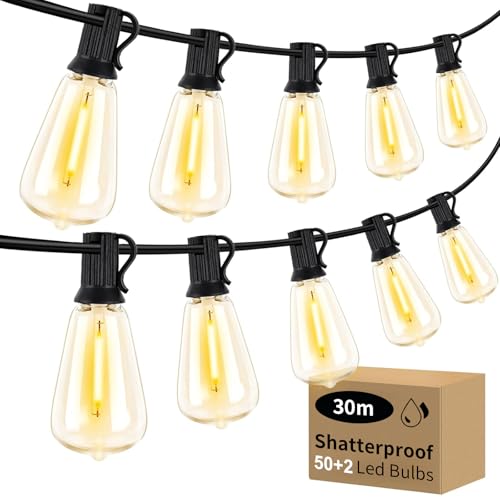
If you want a longer single run for a covered pergola, the Roshin 31M gives you 31m and 50 bulbs. For a full 30m run rated IP65, the Cozylady 30M is the one to look at. If you want two shorter runs you can split between spaces, the Roccar 2 x 15M and the Roshin 2 x 15M ST38 packs do that. If you have nowhere to plug in, the solar Quntis Outdoor Lights is the pick, with a USB-C backup for cloudy weeks. Every rating and review count below was read from Amazon AU, not guessed.
How the festoon light sets compare at a glance
The quickest way to narrow this down is to decide two things first: can you reach an outdoor power point, and how long a run do you need. Plug-in sets are brighter and link together for big spans; solar sets go anywhere but are dimmer and shorter. This table lines up every set on those points so you can see where each one lands before reading the full write-ups.
| Set | Power | Length | Weather | At our 5 October 2026 check |
|---|
| Roccar 22M | Plug-in, 220 to 240V, Australian plug per the listing | 22m, 25 ST38 bulbs | IP65 per the listing | In stock, ships from Amazon |
| Roshin 31M | Plug-in | 31m, 50 G40 bulbs | IP45 | In stock, ships from Amazon |
| Cozylady 30M | Plug-in | 30m, 50 G40 bulbs | IP65 | In stock, ships from Amazon |
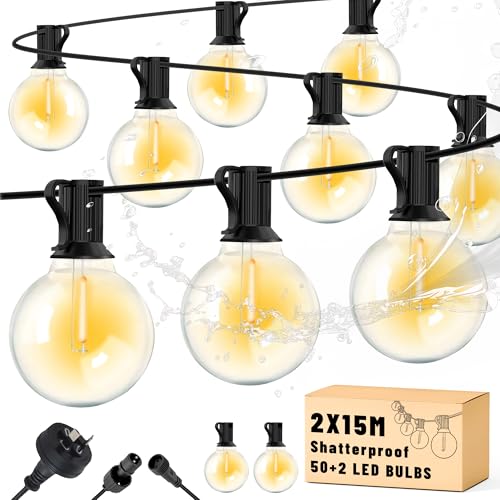
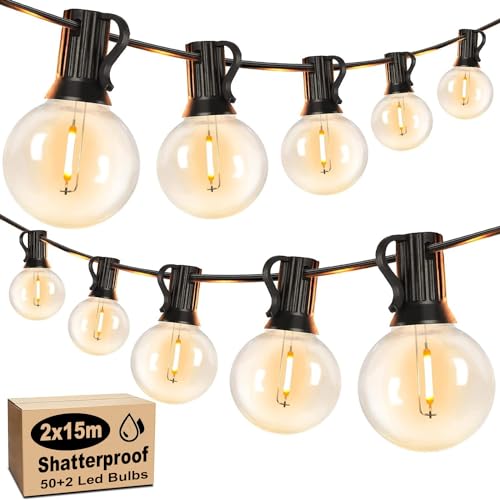
| Roccar 2 x 15M | Plug-in | Two 15m strings, 50 G40 bulbs in total | IP45 | In stock, ships from Amazon |
| Roshin 2 x 15M ST38 | Plug-in, 220V | Two 15m strings, 15 ST38 bulbs each | IP45 in the listing's bullets | In stock, ships from Amazon |
| Quntis Solar | Solar plus USB-C | 10m, 10 bulbs | IP65 | In stock, ships from Amazon |
| Spacelumen Solar | Solar plus USB-C | 15m, ST38 bulbs | Waterproof | In stock, ships from Amazon |
| Roccar 30M | Plug-in | 30m, 50 bulbs | IP65 | In stock, ships from Amazon |
| Roccar Dimmable | Plug-in low-voltage | 30m, 50 bulbs | IP44 | Out of stock |
How we picked these festoon lights
NestPath does not run a lighting lab, and we are not going to pretend a set of party lights spent a month on our own pergola. What we do is study the evidence that already exists at scale, then filter it hard so you are not reading a list padded with reseller listings and fake five-star noise.
We started with the sets that actually rank and sell on Amazon Australia for festoon and outdoor string lighting, then checked each candidate directly against the Amazon AU listing in English for Australian shoppers. Every set that made this page had to be genuinely in stock, hold a real star rating with a meaningful number of reviews behind it, and sit at a sane price for the category. Where a listing showed a price two or more times the category median, we treated it as a reseller artefact and dropped it rather than passing the inflated number on to you.
From there we read the Australian reviews rather than the global ones, because a light that survives a British summer is not the same as a light that survives Queensland sun. That is where the useful detail lives: which bulbs yellow in the heat, which cables are too long between linked sets, which solar panels still charge on a short winter day. We weighted four things: weather rating and real-world durability, brightness and warmth of the light, how easy the set is to hang and extend, and the balance of price against run length. The picks below are ordered by use case, not by price, so you can jump straight to the one that fits your space.
Every listing on Amazon Australia was checked on 5 October 2026 for stock, the seller and who ships it, and we took bulb counts, lengths, weather ratings and voltages from the manufacturer's details on each listing. At the 5 October 2026 check the Roccar 30M and the dimmable Roccar that led this guide before were out of stock, so they sit at the end of the page; the dimmable listing now opens a different Roccar set, and the Roccar 30M is back in stock. The Roshin 15M we called the cheapest set worth buying was gone from Amazon Australia, its listing returning Page Not Found, so it is no longer compared. We added the Roccar 22M, the Cozylady 30M and two 2 x 15M packs from Roccar and Roshin, all shipped by Amazon, so the page keeps seven sets you can order now.
Best overall: Roccar 22M Festoon Lights Outdoor, 25+1 ST38 Bulbs
The remote offers four brightness levels, 25, 50, 75 and 100 percent, plus four lighting modes and a timer that switches the string off automatically after 6 or 8 hours. That combination is genuinely useful outdoors: full brightness for a party, a soft 50 percent for a quiet dinner, and a timer so the lights are not still burning at 3am. It runs on safe low voltage rather than direct 240V and carries 50 G40 bulbs across 30m spaced about 0.57m apart. Australian buyers single out being able to dim and cycle the lights from inside the house through the remote, and the reassuringly tough plastic bulbs that survive being stepped on.
It is weather rated IP44, a shade below the top pick, so like the Roshins it prefers a covered spot to a fully exposed one. And because the dimming electronics live in the controller, this set cannot be linked to others to extend the run. What you buy is a self-contained 30m string you control by remote.
Flaws but not dealbreakers
No linking is the thing to weigh, so this is for people who value control over chaining sets. The remote needs its own AAA batteries, not always included, and a few buyers found the bulbs smaller than pictured. For a fixed run you want to dim and time, it was the clear choice while it was in stock.
What to look for when buying festoon lights in Australia
Answer these questions before you spend, and you will avoid the two most common regrets: buying a set that is too short, and buying one that dies after one summer.
Solar or plug-in? Plug-in sets are brighter, more consistent and link together for long runs, but they need an outdoor power point. Solar sets go anywhere and cost nothing to run, but they are dimmer, shorter and depend on your panel catching real sun. If you have a socket, plug in. If you do not, go solar and accept it is ambient rather than bright light.
How long a run do you actually need? Measure the path the cable will take, not the straight-line distance, because festoon lights swag and zig-zag. A pergola perimeter or a fence line adds up fast. Our picks span 10m to 31m, and the plug-in sets link, so if in doubt buy one that links and add a second set later rather than buying one long set you cannot extend.
What does the IP rating mean? The number after IP tells you how weatherproof the set is. IP65 (our Roccar 22M top pick, the Cozylady and the Quntis) means fully protected against rain and exposed positions. IP44 and IP45 (the Roshins and the Roccar 2 x 15M) are fine under a pergola, patio roof or eaves but happier not fully exposed to driving rain. Match the rating to how covered your spot is.
Bulb type and colour. G40 bulbs are the round golf-ball shape; S14 and ST38 are the longer Edison teardrop. It is mostly looks. Colour temperature matters more: 2200K to 2700K is the warm, golden glow almost everyone wants outdoors, and every set here sits in that range.
Shatterproof bulbs and hooks. Plastic shatterproof bulbs survive being dropped, stepped on and blown against a wall, which matters far more outdoors. Built-in hooks on each holder, which most of our picks have, turn hanging from a fiddly job into a quick one.
How do you hang festoon lights?
Answer first: run a tensioned catenary wire between two fixed points, hang the light cable from it with S-hooks, and let the electrical cable carry none of the weight. Everything else is a variation on that.
Plan the run before you touch a ladder. Measure the path the cable will actually take, including the swag, rather than the straight-line distance, and work out where the power point is so the lead reaches without the plug dangling in the weather. Then pick your method.
- Over a pergola or between two posts. Fix an eye bolt or a screw hook into solid timber at each end, run stainless catenary wire between them and tension it with a turnbuckle until it is firm but not banjo tight. Clip the light string to the wire with S-hooks or cable ties every metre or so. This is the method that survives wind, because the wire takes the strain and the light cable just hangs there.
- Along a wall or under an eave. Screw-in cup hooks or adhesive outdoor hooks at even spacing, then hang the cable straight off them. Keep the spacing even, because the eye reads uneven swags as a mistake long before it notices the bulbs.
- Across a courtyard with nothing to fix to. Free-standing light poles with a weighted base, or a pole bolted to a planter box filled with sand, give you the anchor point you do not have. Two poles and a catenary wire turn a bare concrete slab into a lit space in an afternoon.
- Without drilling, for renters. Heavy-duty outdoor adhesive hooks on smooth, clean render or brick will hold a light string, though not a tensioned wire. Gutter hooks that clip over the lip of a gutter take no fixings at all. Tension rods, existing pergola beams, deck posts and even a sturdy tree branch all work as anchors. The rule is that adhesive hooks hold a hanging cable, not a pulled wire, so keep the swag generous and the tension low.
- On a Colorbond fence. Do not drill it, and never drill a fence you share with a neighbour. Strong outdoor magnets stick straight to the steel and hold a light cable happily; fence-top clips that hook over the capping do the same job without magnets. Keep the run on your side of the fence and leave enough slack that the cable moves with the fence in wind instead of pulling against it.
Two rules apply whatever method you pick. Take the weight on the cable or the wire, never on the bulbs, and leave slack so a gust moves the string instead of tugging at the sockets. And if the lead does not reach the socket, use an outdoor-rated lead, not an indoor one: our guide to the best extension cords in Australia covers the difference, and a weatherproof cover over the plug and socket is worth the few dollars it costs.
How far apart should festoon bulbs be?
Spacing decides whether a run reads as a glow or as a line of dots. Around 50 cm between bulbs gives dense, even light and suits a dining table or a small courtyard where the run is short. Between 90 cm and 1 metre gives a softer, more spread-out canopy and covers a much bigger area for the same number of bulbs, which is what you want over a large deck or a long fence line. Our picks sit inside that band: the Spacelumen solar set spaces its bulbs about 0.75m apart and the Roccar 22M about 0.8m. Work out your run length first, then divide by the spacing you want to see how many bulbs you need.
Which brand of outdoor festoon lights is best in Australia?
Our picks are Amazon Australia sets, where Roccar, Roshin, Quntis and Spacelumen carry the deepest Australian review bases in this category. Off Amazon, Bunnings sells the Lytworx range, which is the connectable budget option most Australians meet first, and SolaGarden is the solar brand that comes up most often in Australian searches. Specialist retailers such as Festoon House and Mr Festoon Lights sell heavy commercial rubber-cable runs, which are the right buy for a permanent installation and well past what most first-home backyards need. We do not quote prices for those brands because we only publish figures we can pull from a live listing we check. Brand matters less here than the IP rating, the run length and whether the set links.
Caring for festoon lights so they last more than one summer
Festoon lights are low maintenance, but a few habits stretch their life well past a single season. Before you hang any set, plug it in and test every bulb, then tighten each one in its socket. The single most common review complaint across every brand is a bulb that looked dead but had simply worked loose in transit, and thirty seconds of tightening prevents it.
When you hang them, take the weight on the cable, not the bulbs. Run the string along a catenary wire or cable-tie it to a tensioned line rather than letting the electrical cable carry the strain over a long span, which stops it stretching and the sockets pulling. Leave a little slack so wind can move the string without tugging at the connections.
Clean the bulbs occasionally. Dust, spider webs and salt haze dull the output, and a wipe with a damp cloth (lights off and cool) brings the sparkle back. For solar sets, keep the panel clean and angled at the sun, because a grimy or shaded panel is the usual reason a solar string stops lasting the night. Over a wet winter, or if a set is only IP44 or IP45 and your spot is exposed, it is worth taking it down or unplugging it during the worst weather. And for any 240V set strung near water, run it through a plug-in RCD. Keep the spare bulbs somewhere you will find them next year.
You will also want these to finish the job
A string of lights is the start. These extras make the difference between lights that dangle awkwardly and a run that looks like it was installed on purpose, and each link below is tagged to Amazon Australia.
The competition and what we left off
A few categories of light kept coming up that we deliberately did not include here. Fine-wire fairy lights and battery-operated micro-strings are lovely for wrapping a tree or a table, but they are a different product to festoon lights and throw far less usable glow, so they belong in their own guide. Solar spike and pathway lights, and solar spotlights, are also a separate job entirely: they light the ground and garden beds, not the space above your table, and we cover those under garden lighting.
Among actual festoon sets, we passed over listings that were clearly reseller-inflated in price, sets with only a handful of reviews where the rating could swing on a single buyer, and a couple of very long commercial-grade runs that push well past this category's budget. Specialist Australian lighting stores sell heavy-duty rubber-cable commercial kits that are excellent if you want a permanent, professionally installed run and have the budget for it. For the majority of first-home buyers who want a great-looking backyard this weekend, the sets above earn their place.
Festoon lights: your questions answered
Are solar or plug-in festoon lights better for an Australian backyard?
It depends on one thing: whether you can reach an outdoor power point. Plug-in sets like the Roccar 22M are brighter, more consistent night to night, and link together for long runs, which makes them the better choice if you have a socket. Solar sets like the Quntis go anywhere with no cabling and cost nothing to run, but they are dimmer and shorter and rely on the panel catching real sun. The best solar sets now include a USB-C backup so you can top them up on cloudy stretches, which closes much of the gap.
Do festoon lights need an electrician to install?
No. Every set in this guide is plug-and-play: the mains sets plug into an outdoor power point (check the plug on the listing; the Roccar 22M states an Australian plug), and the solar sets need no wiring at all. You only need an electrician if you want a brand new outdoor socket installed, or a permanent hard-wired run. For a normal hang-it-yourself festoon string, it is a job you can do with hooks, cable ties and an afternoon.
What does the IP rating on festoon lights actually mean?
IP is the weatherproofing rating. The higher the second number, the better it resists water. IP65, on our Roccar 22M top pick, the Cozylady and the Quntis solar set, means fully protected against rain and suited to exposed positions. IP45, on the Roshin sets and the Roccar 2 x 15M, is fine under a pergola, patio roof or eaves but are happier not fully exposed to driving rain. Match the rating to how covered your spot is: open sky needs IP65, a covered patio is fine with IP44 or IP45.
How many festoon lights do I need for my space?
Measure the actual path the cable will follow, not the straight-line distance, because festoon lights swag between fixing points and that adds length quickly. As a rough guide, a small balcony or one corner is happy with a 10m to 15m set, such as one string from a 2 x 15M pack or the solar options; a typical pergola or deck perimeter wants 30m like the Cozylady. If you are unsure, buy a plug-in set that links to others, so you can add a second run later rather than being stuck with one that is too short.
Can you leave festoon lights outside all year in Australia?
The higher-rated sets are built for it. An IP65 set like the Roccar 22M, the Cozylady or the Quntis solar string is designed to stay up through sun, rain and wind year-round. Lower-rated IP44 and IP45 sets can also live outdoors under cover, but in an exposed spot through a wet winter it is worth taking them down or unplugging them during the worst weather to extend their life. Keeping bulbs and, for solar sets, the panel clean makes the biggest difference to longevity.
How do you hang festoon lights on a Colorbond fence?
Without drilling it. Strong outdoor magnets stick straight to the steel sheet and hold a festoon cable well, and fence-top clips that hook over the capping rail do the same job with no fixings at all. Never drill a fence you share with a neighbour. Keep the run on your own side, leave the cable slack enough to move with the fence in wind, and take the weight along the cable rather than on individual bulbs.
How do you hang festoon lights without drilling?
Use heavy-duty outdoor adhesive hooks on clean, smooth render or brick, gutter hooks that clip over the lip of the gutter, or existing anchors such as pergola beams, deck posts and a sturdy tree branch. Free-standing light poles with a weighted base give you an anchor where there is nothing to fix to. The limit is tension: adhesive hooks will hold a hanging cable but not a tensioned catenary wire, so keep the swag generous and the pull light.
How many metres of festoon lights do you need?
Measure the path the cable will actually take, including the dip in each swag, not the straight-line distance across the space. A pergola perimeter or a fence line adds up faster than people expect. Then decide the look: about 50 cm between bulbs for dense light over a table, or 90 cm to 1 metre for a softer canopy over a bigger area. Our picks run from 10m to 31m, and the plug-in sets link, so buying a set that links and adding a second later beats buying one long run you cannot extend.
What are the best outdoor festoon lights in Australia?
For most Australian backyards, our pick is the Roccar 22M: a plug in run of 25 shatterproof ST38 bulbs whose listing states an Australian plug and 220 to 240 volts, linking up to eight sets from one power point. The Roshin 31M is the long run for a covered pergola, and the solar Quntis suits spots with nowhere to plug in.
What is the best brand of outdoor string lights?
Brand matters less than the IP rating, the run length and whether the set links. Among the Amazon Australia festoon sets, Roccar, Roshin, Quntis and Spacelumen carry the deepest Australian review bases. Off Amazon, Bunnings sells the Lytworx range, the connectable budget option most Australians meet first, and SolaGarden is the solar brand that comes up most often.
What are the best garden lights in Australia?
It depends on the job. For light above a deck, pergola or outdoor table, a festoon set such as the Roccar 22M is our pick for most backyards, or the solar Quntis where there is no power point. Solar spike, pathway and spot lights light the ground and garden beds instead, and our solar garden lights guide covers those.
What is the difference between festoon lights and string lights?
Festoon lights are a kind of outdoor string light with fat, spaced out globes on a heavy cable, the kind strung above beer gardens and wedding marquees. The bulbs sit about half a metre to a metre apart and throw a soft glow. Fairy lights use fine wire and suit wrapping a tree or a table rather than lighting the space above it.
Do festoon lights use a lot of electricity?
Not much. Most plug in LED sets here quote about 1W per bulb in their listings, which puts a 25 bulb run like the Roccar 22M at roughly 25W. Treat listing figures as a guide, since the Cozylady's do not add up. Solar sets such as the Quntis cost nothing to run, and a plug in timer stops a mains set running all night.
Can I buy these festoon lights in Australia?
Yes. Every set compared in this guide is listed on Amazon Australia, and the sets we recommend were shipped by Amazon. Check the plug and voltage before you buy: the Roccar 22M's listing states an Australian plug and 220 to 240 volts. Use the product cards to see which sets you can order.
Set the whole backyard up, not just the lights
Festoon lights are one piece of a backyard that works after dark. If you are building the space out, these NestPath guides pair naturally with your new string of lights. For shade over the same outdoor table by day, our guide to outdoor umbrellas compares cantilever and market umbrellas.
About the author
Anish Puri founded NestPath in 2026 after going through the Australian first-home-buyer process himself. NestPath focuses on Australian first-home buyers because the existing review sites are American, generic, or both. Anish handles editorial selection across the homeowner hub. Reach out: hello@nestpath.com.au