How the fitness trackers compare
Redmi Watch 5 Active leads this best fitness tracker Australia comparison. This guide compares Amazon AU listings, so every figure below is a maker claim or a listing detail, not a result from our own wear test. Start with the screen, the activity features and the listing details you want to confirm before choosing, then read the section for the model you like.
In this guide a fitness tracker is a band or a watch whose listing describes fitness tracking. The product information tables label the Xiaomi bands and the Fitbit Charge 6 as an Activity Tracker, and the Redmi, the Amazfit Bip 6 and the Garmin vivoactive 5 as a Smart Watch under Wearable Computer Type. The comparison separates the models rather than assuming a band or a watch gives you the same experience across a brand. Rings are a different kind of wearable, and no ring is among the cards here, so this page compares bands and watches only.
Read a battery duration as a listing claim with its stated conditions. Do not turn a band length into a guaranteed wrist measurement, or assume a navigation label establishes every mapping feature. Where one listing gives two answers, the comparison points you to that difference instead of choosing the more attractive figure, and the sections below name which part of the listing each figure comes from.
Phone compatibility is part of the choice too. The listings name different requirements, from Android devices to specific iOS and Android versions, so check your own phone against the listing before you buy. A fitness tracker is a consumer wellness gadget and not a medical device, and the health section below says what the listings do and do not claim.
| Model | Listing rating | Display | Battery as listed | Read before choosing |
|---|
| Redmi Watch 5 Active | 4.5 from 29,198 ratings | 2 inch LCD | 18 days | GPS rows and screen resolution differ within the listing |
| Xiaomi Smart Band 9 Active | 4.0 from 9,616 ratings | LCD, size differs within the listing | Bullets say up to 18 days, the product table says 12 hours | Its section carries a dated note |
| Xiaomi Smart Band 10 | 4.4 from 15,072 ratings | 1.72 inch AMOLED | Up to 21 days | GPS wording and weight figures differ |
| Amazfit Bip 6 Smart Watch | 4.3 from 7,149 ratings | 1.97 inch AMOLED | Up to 14 days | Charging base listed without a USB Type C cable |
| Fitbit Charge 6 Fitness Tracker | 4.1 from 21,805 ratings | 1.04 inch AMOLED | 7 days in the product table | Its section carries a dated note; Google features have country and language limits |
| Garmin vivoactive 5 Smartwatch | 4.3 from 12,289 ratings | AMOLED | Up to 11 days in smartwatch mode | Health metrics described as close estimations |
One more card, the Amazfit Active 3 Premium GPS Watch (has a dated note), is not in this table; its own section further down explains why.
Best overall: Redmi Watch 5 Active
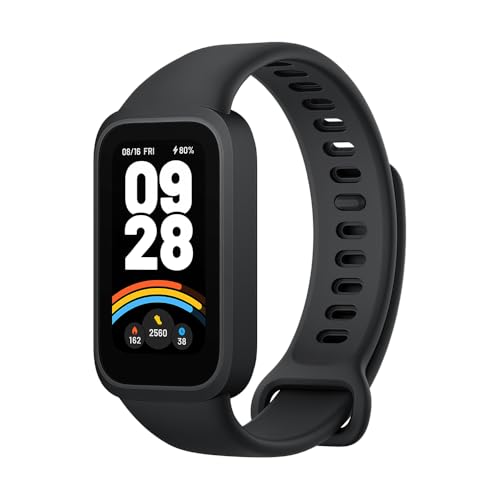
Redmi Watch 5 Active is the leading choice in this comparison. Its Amazon AU listing shows a rating of 4.5 from 29,198 ratings, the largest ratings count of the cards on this page, and the featured seller is Amazon AU. The listing describes a 2 inch LCD display, Bluetooth calling and 140+ sports modes, which makes it a relevant starting point when you want a watch that includes fitness tracking.
The maker's bullets describe 18 day battery life and a 470mAh battery, and the product information table also gives an average battery life of 18 days. Treat that duration as the maker's claim rather than a result from our own wear test. The Bluetooth calling bullet describes dual mic noise reduction and says you can answer and make calls from your wrist, naming commuting, exercising and times when your phone is not within reach.
The listing gives some details two ways. The display bullet gives a 320×385 resolution, while the product information table gives 320 x 340, and we do not choose between those figures or use either to rank the screen. The table says No GPS under GPS Geotagging Functionality, yet it names GPS under Supported Satellite Navigation System and under Supported Application. That conflict is a reason to confirm route recording before relying on this watch for mapping.
Phone compatibility is stated two ways as well. The product description names Android 8.0+ and iOS 12.0+, while the Compatible Phone Models row in the product information table says Compatible with Android devices. Confirm your phone with the maker before buying rather than choosing between those wordings.
For water exposure, the maker's bullet names 5ATM water resistance and mentions handling rain and hand washing alongside daily wear. The product information table gives a Water Resistance Depth of 50 Meters and a Waterproof Rating of IP68. Keep those uses and ratings together with the claim rather than extending them into advice about swimming or diving.
On the wrist, the table lists a silicone band, an aluminium case, a deployant clasp, a touchscreen, a band width of 22 millimetres and an item weight of 81 grams, and the A+ text names 200+ watch faces. Choose it for the documented features you need, with the unresolved GPS and resolution details in mind.
Xiaomi Smart Band 9 Active
Xiaomi Smart Band 9 Active gives this comparison a band option, but its listing gives several figures two ways. The longer product title says 1.74 inch TFT display, while the bullets, the product information table and the product description say 1.47 inch. The longer title and the product description say 50+ sports modes, while the bullets say 50 different sports modes. We do not choose between these values, so the comparison table says only LCD. It is rated 4.0 from 9,616 ratings on Amazon AU.
On 24 October 2026 this listing was sold by Amazon Japan and showed a notice that Japan imports may differ from local products and that additional terms apply.
Battery claims need an explicit qualification here. The bullets say the battery lasts up to 18 days when used normally, and the A+ section also names an 18 day battery. The product description says up to 18 day battery life. The product information table instead says Battery Average Life 12 hours. We cannot settle that difference from the listing, so this guide does not present 18 days as an uncontested specification or a reason to rank it above another model.
The physical measurements also need care. One bullet heading says 9.99 mm thin, while the same bullet describes a 3.99mm body, and the product description says a lightweight 16.5 g body. The product table gives Item Weight 30 Grams and two different sets of item dimensions, 20 x 20 x 14 centimetres and 15D x 15W x 10H centimetres. We leave thickness, weight and overall dimensions out of the comparison.
The table describes a silicone band with a band width of 20 millimetres and a band length of 215 millimetres. Those are strap measurements, not a wrist circumference range. Its Built In Media row lists the main unit, charging wire and instruction manual, with English language not guaranteed, so read that language qualification alongside the overseas note above when you think about setup. The table lists compatibility with iOS and Android devices.
On water, the bullets describe 5ATM water resistance to 50m submersion and say you do not have to take it off when you swim, and the table gives a Water Resistance Depth of 50 Meters and a Waterproof Rating of 5ATM. For health, the bullets mention heart rate and sleep monitoring, and the product description names heart rate, SpO₂, sleep and stress. The table lists an Optical Heart Rate Sensor and an Accelerometer under Metrics Measured.
Xiaomi Smart Band 10
Xiaomi Smart Band 10 is the Xiaomi band with an AMOLED display in this comparison. Its bullets specify a 1.72 inch screen with 212 x 520 resolution and 1500nits peak brightness, and the product information table repeats the screen size and resolution. Those figures describe the listing's display specification; they are not evidence that we measured outdoor readability. It is rated 4.4 from 15,072 ratings on Amazon AU, and the listing shows Amazon AU as the seller.
The maker claims up to 21 days of use on a single charge, with fast recharging in around 1 hour, and the product description says up to 21 days of battery life on typical use. The bullets list over 150 workout types including swimming, running and yoga, and the title names 150+ sports modes. The water resistance bullet says Rated 5ATM waterproof, perfect for pool use or rainy day workouts; keep those named uses with the claim rather than inferring a broader water use guarantee.
GPS needs particular care here. The product information table labels GPS Geotagging Functionality as built in GPS and lists GPS under Supported Satellite Navigation System, but the title and bullets do not mention GPS. A table label alone does not describe how routes are recorded, so we do not turn it into a promise about mapping without a phone. If mapping is your deciding feature, confirm the exact model before choosing.
Weight also appears differently across the listing. Its product table says Item Weight 0.03 Kilograms, while an A+ image description says 15.95g Lightweight and comfortable. We omit a weight figure rather than assume whether one includes the strap.
The product table lists a band width of 22 millimetres, a band length of 210 millimetres, a rubber band material and an aluminium alloy case, and the bullets mention easy swap multi material straps. The title and the table name iOS and Android compatibility, and the product description lists SpO₂, stress, women's health and sleep monitoring alongside 24/7 heart rate. The table gives a 2 Years warranty description, with a charging cable and user manual as built in media.
Amazfit Bip 6 Smart Watch, the previous pick
Amazfit Bip 6 Smart Watch was our previous pick. Its listing gives a distinct set of mapping features: free downloadable maps with turn by turn directions, and support from 5 satellite systems, while the product information table names built in GPS. It is rated 4.3 from 7,149 ratings, and the listing shows it ships from Amazon and is sold by au amazfit official store.
The satellite count is given two ways. The bullets say support from 5 satellite systems, while the Supported Satellite Navigation System row in the product table names BeiDou, GLONASS, GPS and Galileo. We do not rank the watch on either count.
The title names a 1.97 inch AMOLED display and 140+ workout modes. Its bullets specifically include HYROX Race and Strength Training in those modes, plus personalized AI coaching. The battery bullet gives up to 14 days, described as up to two weeks of training and recovery with no nightly charging needed. That is a listing claim rather than our measured result.
The box contents are worth checking. The product table lists the smartwatch, a user manual and a magnetic charging base, with no USB Type C cable in the Built In Media row. Check the cable you need before setup rather than assuming a charging base means every cable is supplied. No claim about an included wall charger follows from that list.
For phone compatibility, the product table names Android 7.0 and above and iOS 14.0 and above, and the product description says Compatible with Android 7.0+ and iOS 14.0+ smart devices. The title also names Bluetooth call and text, and the table lists Notification, Phone Call and Text Message under Communication Feature. Those statements do not prove that every messaging feature works the same way on both phone systems, so check the particular function you intend to use.
The table lists a metal band material, a band width of 22 millimetres, a band length of 195 millimetres and a maximum display brightness of 2,000 Nit, with water resistance to 50 Meters and a 1 year warranty description. The bullets also describe 24/7 health monitoring of heart rate, sleep, blood oxygen and stress, in the maker's words.
Fitbit Charge 6 Fitness Tracker
Fitbit Charge 6 Fitness Tracker brings Google Maps directions and Google Wallet into the comparison through its own listing bullets. Those bullets also name 40+ exercise modes, built in GPS, 24/7 heart rate, a stress management score and a personalized nightly Sleep Score. It is rated 4.1 from 21,805 ratings on Amazon AU.
On 24 October 2026 this listing was sold by Amazon US and showed a notice that US imports may differ from local products and that additional terms apply.
The description qualifies the Google features: Google apps and services are not available in all countries or languages, and data rates may apply. Keep that qualification beside any mention of those functions. The exercise machine feature is conditional too. The bullets say you can see your heart rate in real time when you link the Charge 6 to compatible exercise machines, like treadmills, ellipticals and more.
The product table gives a 1.04 inch AMOLED display and an average battery life of 7 days. It names iPhones running iOS 15 or higher and Android devices running OS 9.0 or higher under Compatible Phone Models. Use those exact version requirements when checking a phone, rather than assuming it works with any iPhone or Android device.
The listing's additional title text names a 3 month Google Health Premium membership included. The title, bullets and description do not set out eligibility or continuing access terms, so check them before relying on an included trial. For water, the product table gives a Water Resistance Depth of 5 Meters and a Waterproof Rating of IP67; we leave swimming advice out rather than turn those labels into a promise about how you can use the tracker.
The product table lists ECG among its Additional Features, and the bullets describe no ECG function, so this guide makes no health claim from that label. The table also lists a silicone band, a porcelain case, a buckle clasp and a band length of 220 millimetres, with the device, band and charging cable as built in media. It gives no band width row.
Amazfit Active 3 Premium GPS Watch
This retained reference section describes the listed model without recommending it for purchase. It has a dated note. The title identifies an Apex Silver watch with a 1.32 inch AMOLED sapphire display, offline maps and 170+ workouts, and the listing shows a rating of 4.5 from 455 ratings. The bullets name precise GPS with 5 satellite systems and describe free offline maps with turn by turn directions and automatic rerouting.
The training bullet names built in running workouts and Zepp Coach plans for runs from 5K to full marathon. Another bullet lists posture, running power, lactate threshold and ground contact time among its training information. Those are feature descriptions from the maker, not evidence that the watch improves running technique or gives more accurate readings than another device.
The maker's colour note matters for recognising the product. It says packaging may use the previous colour names Gold/Black, Dark Blue and Gold/White, which correspond to Apex Silver, Atlas Blue and Aero White, and that the product itself is the same, with only the colour names updated. Do not mistake a packaging colour name for a different feature set.
The product table lists a smartwatch, a charging dock and a manual. The messaging bullet says speech to text replies to instant messages are Android compatible, and that condition must stay attached to any mention of those replies. This section keeps identification information only; the model does not appear in the buying comparison, the opening recommendation or any list of suggested purchases.
Garmin vivoactive 5 Smartwatch
Garmin vivoactive 5 Smartwatch combines listed activity features with an AMOLED screen. It is rated 4.3 from 12,289 ratings on Amazon AU, with Amazon AU as the seller. Its bullets claim battery life of up to 11 days in smartwatch mode, a condition that matters when comparing that duration, and the product table gives a Battery Average Life of 11 days. The title and product table identify an AMOLED GPS smartwatch, so compare those documented features with the activities you want to record.
The activity bullet names more than 30 built in indoor and GPS sports apps, including walking, running, cycling, HIIT, swimming and golf. A separate wheelchair mode bullet says it tracks pushes rather than steps and includes push and handcycle activities with preloaded workouts for strength, cardio, HIIT, Pilates and yoga. Match your activity to the named functions rather than assuming every listed workout is the same kind of tracking.
The maker describes Body Battery energy monitoring, a sleep score with personalized sleep coaching and HRV status, and qualifies each by saying the data presented is intended to be a close estimation of metrics tracked. That limitation stays with these descriptions. A sleep score or energy label is a feature to understand, not proof of clinical accuracy.
The product description adds that, when paired to your smartphone, it makes it easy to receive texts, emails and other smart notifications, and names music storage and Garmin Pay contactless payments. The product table names a silicone band, a touchscreen, an included charging and data cable with documentation, a band width of 20 millimetres and a band length of 220 millimetres, with water resistance to 50 Meters and a Waterproof Rating of IPX8. It lists Android and iOS devices as compatible phone models without giving minimum versions in that row, so confirm your particular phone.
GPS and mapping
Separate a GPS label from the route features described for the exact model. The Bip 6 bullets name free downloadable maps and turn by turn directions as well as 5 satellite systems. The Charge 6 bullets separately name built in GPS and turn by turn directions from Google Maps. Those are distinct statements, and neither justifies assuming every tracker has offline maps.
Several listing details need particular caution. The Redmi table says No GPS in one row and names GPS in others, and the Smart Band 10 table describes built in GPS while its bullets do not explain how routes are recorded. The Smart Band 9 Active table says No GPS under GPS Geotagging Functionality. The Garmin vivoactive 5 title calls it a GPS smartwatch and its table lists built in GPS. We leave unresolved navigation claims out of the comparison rather than turn those labels into a promise about leaving your phone behind.
Decide on mapping before anything else if you run or ride outdoors. The Garmin vivoactive 5 and Amazfit Bip 6 titles both name GPS, the Charge 6 bullets name built in GPS, and the Redmi and Smart Band 10 tables give GPS wording that their bullets do not explain. Use the section for the model you like to see exactly where each wording sits.
Battery claims and screen settings
Battery durations should carry the wording and conditions the listing provides. The Redmi bullets describe 18 day battery life, the Smart Band 10 claims up to 21 days, and the Bip 6 claims up to 14 days. The Fitbit Charge 6 product table gives 7 days, and the Garmin bullet gives up to 11 days specifically in smartwatch mode. These are listing figures, not a common battery test.
The Smart Band 9 Active needs different treatment because its own listing conflicts: up to 18 days in the bullets, the A+ material and the product description, but 12 hours in the product table. Do not smooth that into a single figure. Its bullet also qualifies the figure with when used normally, and the Smart Band 10 product description says up to 21 days on typical use.
Screen settings are not described the same way either. The product tables give maximum display brightness figures of 300 Nit for the Redmi, 1500 Nit for the Smart Band 10, 2,000 Nit for the Bip 6 and 400 Nit for the Garmin. These are brightness ratings, not battery tests, so they do not tell you how a battery figure changes when the screen is kept lit.
Band width and wearing fit
Compare the measurement the listing actually labels. The Redmi, Smart Band 10 and Bip 6 product tables each give a band width of 22 millimetres, while the Smart Band 9 Active and Garmin vivoactive 5 tables give 20 millimetres. The Fitbit Charge 6 table gives no band width row. Those are band widths, not supported wrist circumference ranges, and they do not establish comfort for every wearer.
| Model | Band width | Band length | Band material |
|---|
| Redmi Watch 5 Active | 22 millimetres | No row in the table | Silicone |
| Xiaomi Smart Band 9 Active | 20 millimetres | 215 millimetres | Silicone |
| Xiaomi Smart Band 10 | 22 millimetres | 210 millimetres | Rubber |
| Amazfit Bip 6 Smart Watch | 22 millimetres | 195 millimetres | Metal |
| Fitbit Charge 6 Fitness Tracker | No row in the table | 220 millimetres | Silicone |
| Garmin vivoactive 5 Smartwatch | 20 millimetres | 220 millimetres | Silicone |
The Redmi, Smart Band 9 Active and Smart Band 10 titles say for Men Women. The Redmi table lists Unisex Adults, Unisex Kids and Unisex Youth under Target Audience, and the Bip 6, Charge 6 and vivoactive 5 tables list Unisex Adults. Those rows say who a listing is aimed at, not how a band fits a particular wrist. The Smart Band 9 Active table gives dimensions two ways and the Smart Band 10 gives its weight two ways, so check fitting instructions for the exact device rather than inferring fit from a category label.
App access and subscriptions
Do not assume that naming a companion app establishes unlimited access to every function. A named app, a free map download or an included membership period is not the same statement as lifetime access to every feature. For the Charge 6, discuss the Google functions the bullets name and keep the description's country and language qualification beside them.
The Bip 6 listing explicitly calls its downloadable maps free; do not extend that word to every service. The Charge 6 title names a 3 month Google Health Premium membership included, which describes a trial length and not what you can use afterwards. Choose on the documented functions, then check current membership terms before depending on features that may need an account or plan.
Phone compatibility and charging
Phone compatibility is more useful when it includes the versions in the exact listing. The Bip 6 product table names Android 7.0 and above and iOS 14.0 and above, and the Charge 6 table names iPhones running iOS 15 or higher and Android devices running OS 9.0 or higher. The Redmi gives its compatibility two ways, a description naming Android 8.0+ and iOS 12.0+ against a table row naming Android devices. The Smart Band 9 Active and Smart Band 10 tables say compatible with iOS and Android devices, and the Garmin table lists Android and iOS devices without versions. Check those requirements against the phone you intend to keep using.
Box contents deserve a separate check. The Bip 6 lists a magnetic charging base without the USB Type C cable. The Garmin lists a charging and data cable, the Charge 6 lists a charging cable with the device and band, the Smart Band 9 Active lists a charging wire, the Smart Band 10 lists a charging cable, and the Redmi lists a charging cable and a user manual. Those details help with setup without inventing a charging connector, wall plug type or voltage for any model.
Running and gym sessions
Choose activity features by their named uses. The Bip 6 explicitly includes Strength Training and HYROX Race in its workout modes. The Garmin bullets name walking, running, cycling and HIIT among its sports apps, and its wheelchair mode description adds preloaded workouts for strength, cardio, HIIT, Pilates and yoga. The Smart Band 10 names swimming, running and yoga, and the Redmi bullets say it supports running, walking and cycling. These examples give you concrete starting points without claiming one watch is the most accurate.
For exercise equipment, the Charge 6 bullets say you can see your heart rate in real time when you link it to compatible exercise machines, like treadmills, ellipticals and more. Keep compatible in that sentence: a machine type alone is not a compatibility guarantee. The listings do not provide a shared test of weightlifting accuracy, so this guide does not rank models on that unmeasured outcome.
Walking and home office routines
For a walking routine, compare features you expect to use during the activity and afterwards. The Redmi bullets name walking among the supported activities, and the Garmin sports app bullet also names walking. A screen, a named activity mode and a charging arrangement are separate choices; none of them establishes that buying a tracker will increase your daily movement.
At a desk, notifications matter. The Redmi display bullet mentions checking notifications, fitness data and calls at a glance during work, the Bip 6 title names Bluetooth call and text, and the Garmin product description names texts, emails and other smart notifications when paired to your smartphone. If your routine includes a walking pad, keep the equipment choice separate from the tracker choice; our walking pad guide can help you compare that equipment. For a watch you also intend to wear away from exercise, our guide to watches for women covers another style of wristwear. Those links add context without promising a result from combining products.
Health readings and their limits
Read health features as the maker describes them. The Redmi bullets name 24/7 heart rate, SpO₂ and sleep monitoring, the Bip 6 bullets name heart rate, sleep, blood oxygen and stress, and the Charge 6 bullets name 24/7 heart rate, a stress management score and a personalized nightly Sleep Score. The Garmin bullets describe the data as intended to be a close estimation of metrics tracked. None of those descriptions is a comparative accuracy test.
A fitness tracker is not a medical device. This guide does not turn an ECG label, a sleep category or a blood oxygen feature into a diagnosis or a clinician endorsement, and it makes no comparison with chest straps or cold weather accuracy. For blood pressure readings, see our blood pressure monitor guide. If you have a health concern, ask your doctor.
How we checked these fitness trackers
Last checked: 24 October 2026.
We used two sources: the Amazon AU listing for each model and the makers' own wording on that listing, including its bullet points, product information table, description and A+ material. Specs come from the maker's bullet points and the product information on each listing. No separate maker page or manual forms part of this review, and we compared documented features rather than conducting a wear test, battery trial or clinical accuracy assessment.
Where a listing gives conflicting figures, this guide either explains both with their source or leaves the figure out of the comparison. Ratings and counts are reported where each listing gives them; they do not replace an assessment of whether the stated functions fit your needs. Each model keeps its own section so that qualifications about compatibility, included accessories and listing detail remain attached to the correct product. The Amazfit Active 3 Premium GPS Watch (has a dated note) is described in its own section only.
Frequently Asked Questions
What is the best fitness tracker in Australia?
Redmi Watch 5 Active leads this comparison, rated 4.5 from 29,198 ratings on its Amazon AU listing, which describes a 2 inch LCD display, Bluetooth calling and 140+ sports modes. Compare the alternatives by their documented functions, and read the individual sections before relying on battery or GPS claims.
Is a Fitbit or Garmin better?
Choose by the functions you want to use. The Fitbit Charge 6 listing names Google Maps directions and Google Wallet, with country and language limits in its description. The Garmin vivoactive 5 lists more than 30 sports apps and up to 11 days of battery life in smartwatch mode.
What brand is the most accurate fitness tracker?
No brand can be named as the most accurate from these listings, because they carry the makers' own claims rather than a shared accuracy test. Garmin's bullets describe several tracked metrics as a close estimation of the metrics tracked. Compare the functions you need, and do not treat a sleep score as proof of clinical accuracy.
What fitness tracker do cardiologists recommend?
None of the listings in this guide says a cardiologist recommends it. They describe functions such as heart rate and sleep monitoring, and those descriptions are not clinician endorsements. A fitness tracker is not a medical device, so choose one for its documented activity features and ask your doctor about any heart concern.
What is the best fitness tracker for weightlifting?
The Amazfit Bip 6 listing specifically names Strength Training among its 140+ workout modes. The Garmin vivoactive 5 bullets name strength workouts only in their wheelchair mode description, which is a different context. Neither listing offers a weightlifting accuracy test, so compare the named activity support without expecting a measured winner.