Best Hand Mixers in Australia 2026: Sunbeam, Breville and KitchenAid Compared
By Anish Puri·3 June 2026·Last updated 8 October 2026·9 min read
A hand mixer is the cheap, light, drawer-friendly tool that handles almost all home baking: cream, meringue, creaming butter and cake batter. Here's which electric beater is actually worth buying in Australia, and when a stand mixer is the better call.
Prices checked 18 October 2026 on Amazon AU and subject to change.
A hand mixer is the most quietly useful baking tool most Australian kitchens will ever own, and one of the most over-thought at the point of purchase. The best hand mixer in Australia for 2026 is the Breville the Mix and Store Turbo, with the KitchenAid 9-Speed Artisan the premium pick for keen bakers and the Sunbeam Mixmaster Hand Mixer Pro the best budget buy. Search for a mixer and you will be shown two very different appliances: a light handheld beater you hold over a bowl, and a heavy stand machine that does the work for you. They share a word and a job and almost nothing else. This guide is about the handheld one, the hand mixer, also called an electric beater.
The appeal is simple. A hand mixer is cheap, light, stores in a drawer and handles the vast majority of home baking: whipping cream, beating egg whites and meringue, creaming butter and sugar, mixing cake batters, even mashing potato. You grab it, beat for a couple of minutes, rinse the beaters and put it away. For everyday and occasional baking it is the right tool, full stop, and only a minority of bakers genuinely need to step up to a stand mixer.
Here is what a hand mixer is great at, where a stand mixer earns its bench space instead, how many speeds and how much power you actually need, what each attachment does, and which models are worth buying in Australia in 2026 across budget, best overall and premium.
Top pick
Breville
Breville the Mix & Store Turbo Hand Mixer
4.6(83)
$79.96$89.95
Save 11%
Amazon.com.au price as of 05:01 pm AEDT, subject to change
As an Amazon Associate, NestPath earns from qualifying purchases.
Our picks: the best rated hand mixers in Australia
If you have been searching for a recommended hand mixer, a good hand mixer or the top rated hand mixers, these are the picks worth your money and the reasons why.
Pick
Best for
Key spec
Rating
Sunbeam Mixmaster Hand Mixer Pro
Best budget, the Australian name
7 speeds, beaters and dough hooks
4.5
Breville the Mix & Store Turbo Hand Mixer
Best overall, for most kitchens
5 speeds plus Turbo, beaters, hooks and whisk, cord tidy
4.6
KitchenAid 9-Speed Artisan Hand Mixer
Best premium, for keen bakers
9 speeds, 85W soft start motor
4.3
Best overall: Breville the Mix and Store Turbo
Five speeds plus a Turbo button, with beaters, dough hooks and a wire whisk in the box, plus a cord tidy so it goes back in the drawer neatly. Breville's Australian product page lists it at 200 watts, with a storage case that keeps the attachments together. For occasional and everyday baking this is the sensible middle, and the one most kitchens should buy.
Best premium: KitchenAid 9-Speed Artisan Hand Mixer
Nine speeds and an 85W soft start motor, which means the beaters ease into the bowl instead of firing flour across the bench. It is the most capable hand mixer sold here without stepping up to a stand machine, and it is the one to buy if you bake most weeks.
Best budget: Sunbeam Mixmaster Hand Mixer Pro
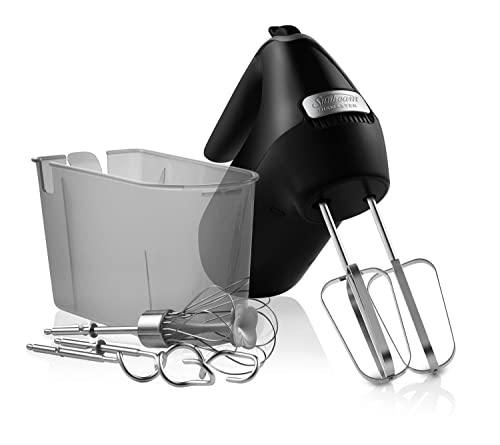
Mixmaster is the Australian household word for this appliance, and the Hand Mixer Pro is the handheld version of that name at seven speeds with beaters and dough hooks. If you want the best Mixmaster in Australia without stepping up to the stand machine, this is it.
How we picked these hand mixers
We compared the cards here on what each Amazon AU listing states (speeds, motor, attachments and storage) and on what Australian owners report in their reviews. We rechecked each listing on 7 October 2026: the Sunbeam, Breville and KitchenAid were in stock and sold by Amazon AU. Prices have moved since we wrote this guide, so the price on each card is the one to trust. The ratings in the table are the Amazon AU averages. We also checked the speeds and the attachments in the box against each maker's Australian product page (Sunbeam, Breville and KitchenAid).
Hand Mixer vs Stand Mixer: Which Do You Actually Need?
This is the question that decides which kind of mixer to buy, so it is worth getting straight before anything else. They are different tools for different bakers, and most home cooks need only one of them.
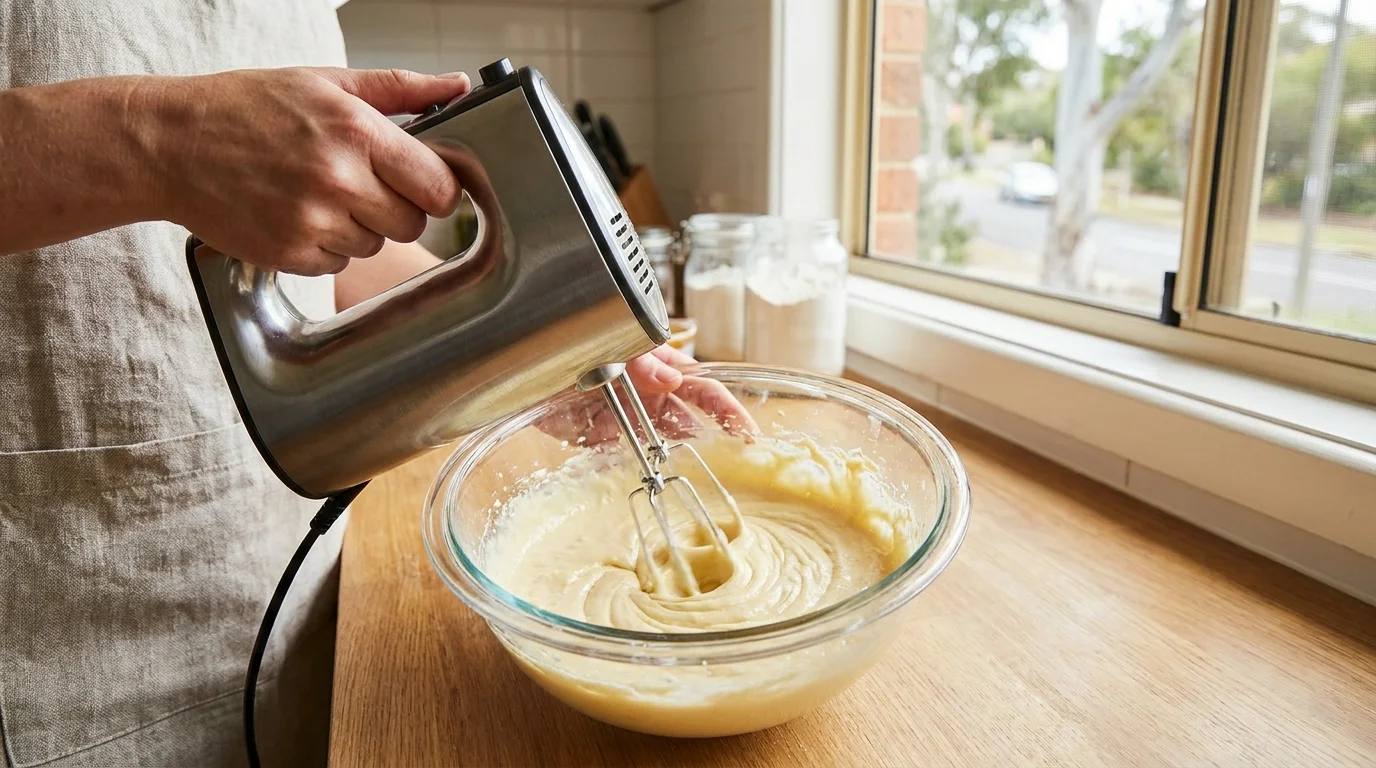
A hand mixer is a light handheld unit with two beaters you hold over a bowl. It is cheap, weighs next to nothing, stores in a drawer, and is perfect for everyday and occasional baking: whipping cream, beating egg whites and meringue, creaming butter and sugar, mixing cake and biscuit batters, and mashing potato. You are in control of where the beaters go, which is genuinely handy for folding and for scraping the bowl as you mix. For the great majority of home bakers, this is the right and far cheaper tool.
A stand mixer is a heavy, motorised machine with a fixed bowl that does the mixing hands-free while you do something else. It is far more powerful, built for heavy bread doughs and frequent, high-volume baking, and it frees up your hands for long mixes. The trade-offs are real: it is bulky, it lives on the bench or in a cupboard you have to lift it out of, and it costs many times more. For most casual bakers it is overkill.
The honest rule of thumb: if you bake cakes, biscuits, slices and the occasional batch of cupcakes (and want to whip cream and meringue without fuss), a hand mixer is the right buy and you may never need anything else. Only step up to a stand mixer if you knead stiff bread dough regularly or bake in big batches week after week. If that is you, see our companion best stand mixer Australia guide. Plenty of people land here specifically wanting a simple, drawer-friendly beater for everyday baking, and that is exactly what a hand mixer is best at.
What a Hand Mixer Is Great At (and What It Isn't)
A hand mixer earns its place on the small and medium baking jobs that a stand mixer makes feel like overkill. Knowing where it shines (and where it quietly struggles) saves you both money and a burnt-out motor.
What it is brilliant at:
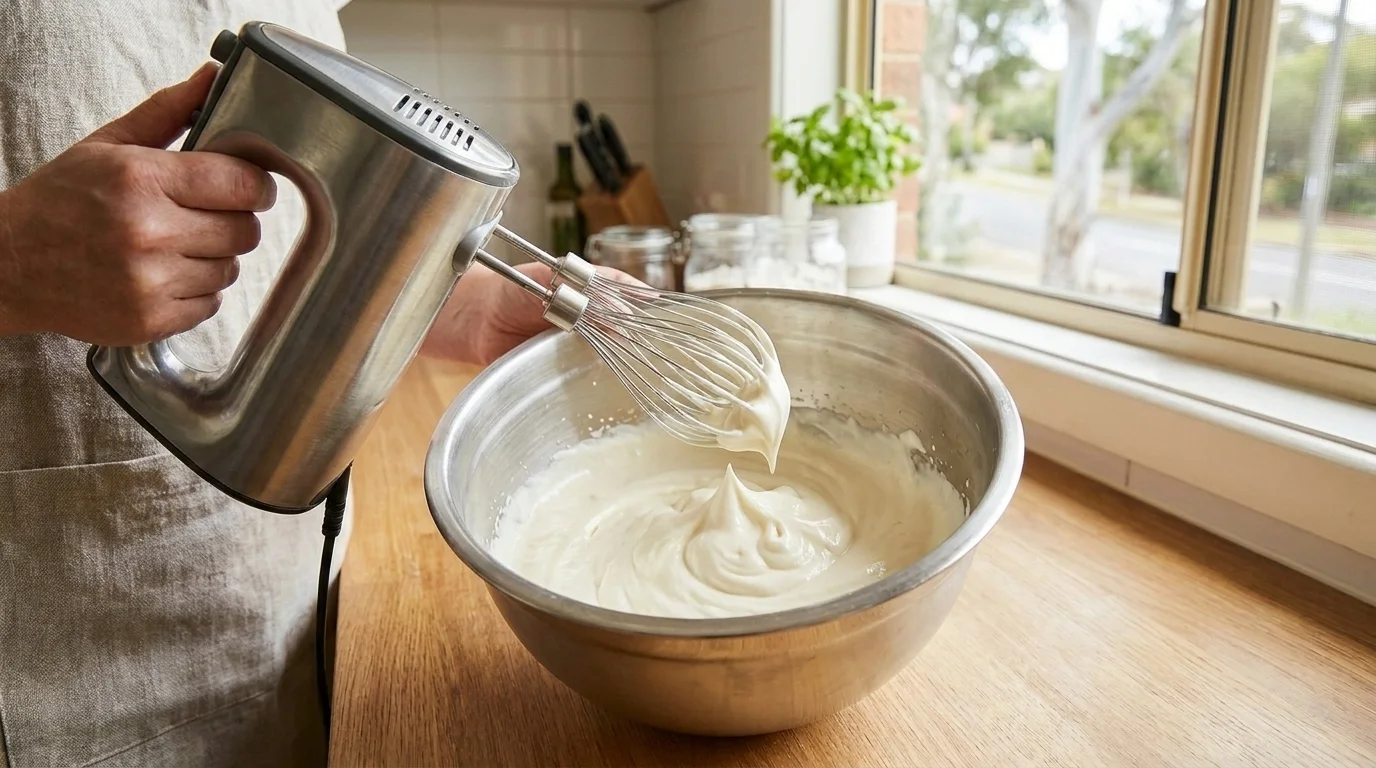
Whipping cream: a bowl of cream goes from pouring to soft peaks in under a minute, especially with a whisk attachment.
Egg whites and meringue: a hand mixer whips whites to stiff, glossy peaks far faster and more evenly than a hand whisk ever will.
Creaming butter and sugar: the foundation of most cakes and biscuits, done light and fluffy in a couple of minutes.
Cake and biscuit batters: the everyday mixing job a hand mixer was made for.
Mashed potato: a quick beat gives smooth mash (just do not overwork it, or it turns gluey).
Light, soft doughs: scone and pizza doughs handle fine on the dough hooks, in modest amounts.
What it is poor at:
Stiff bread dough: heavy, kneaded bread dough needs the torque of a stand mixer. Forcing it through a hand mixer strains and can burn out the motor.
Big batches: large quantities are slow and tiring when you are holding the mixer the whole time; the stand machine exists for a reason.
Long, heavy mixes: the cheapest, lower-watt models can overheat on extended, demanding tasks, so match the power to how seriously you bake.
If that bottom list describes your most common baking, step up to a stand mixer, but for cakes, cream, meringue and the everyday stuff, a hand mixer does the job with almost no setup and a single pair of beaters to rinse.
Budget pick
Sunbeam
Sunbeam Mixmaster Hand Mixer Pro
4.5(166)
$57.95
Amazon.com.au price as of 11:01 am AEDT, subject to change
As an Amazon Associate, NestPath earns from qualifying purchases.
Speeds and Soft Start: Why Control Beats Raw Speed
The number of speeds is the spec buyers compare first, and it matters more than you might think: not because you need the top speed, but because of the bottom one.
More speeds give you finer control. The low speeds are where the value is: you start slow so flour does not fly out of the bowl in a cloud, and so a runny batter does not splatter up the beaters and across the bench. Then you ramp up. High speeds are for whipping cream and beating meringue, where you want as much air in as fast as possible. A mixer with a good range of speeds lets you fold gently at one end and whip hard at the other, all from the same tool.
The premium upgrade on this front is a soft-start feature, like the one on the KitchenAid. Instead of jumping straight to your chosen speed, it ramps the beaters up gradually over the first second or two, which means no flour cloud and no splatter when you switch on into a bowl of dry ingredients. It is a small thing that you notice every single time you bake, and it is one of the genuine reasons to pay up for the dearer model.
The takeaway: do not fixate on the top speed. A mixer with a gentle low speed (or a soft start) and a strong high speed covers everything, and the low end is where you will quietly thank it.
Power: What Wattage Do You Actually Need?
Wattage is the number on the box buyers worry about, and for most baking it matters less than the marketing implies, until you hit the heavy jobs, where it suddenly matters a lot.
For light work (cream, egg whites, cake batter, creaming butter), almost any hand mixer has enough power. Where wattage earns its keep is on the thicker, heavier mixing: a full batch of cookie dough, a stiff biscuit dough, or a double batch of cake mix. A higher-watt motor pushes through that without straining or overheating, while a cheaper, lower-watt mixer can bog down, slow under load, and get hot if you push it too long.
So the rule is to match the power to how seriously you bake. If you make the occasional cake and whip cream now and then, a modest motor is plenty and you should not pay for power you will not use. If you bake often and regularly mix thick doughs, the extra grunt of a stronger motor (like the KitchenAid's) is worth it, because it is the difference between a tool that lasts and one you cook to death on heavy mixes.
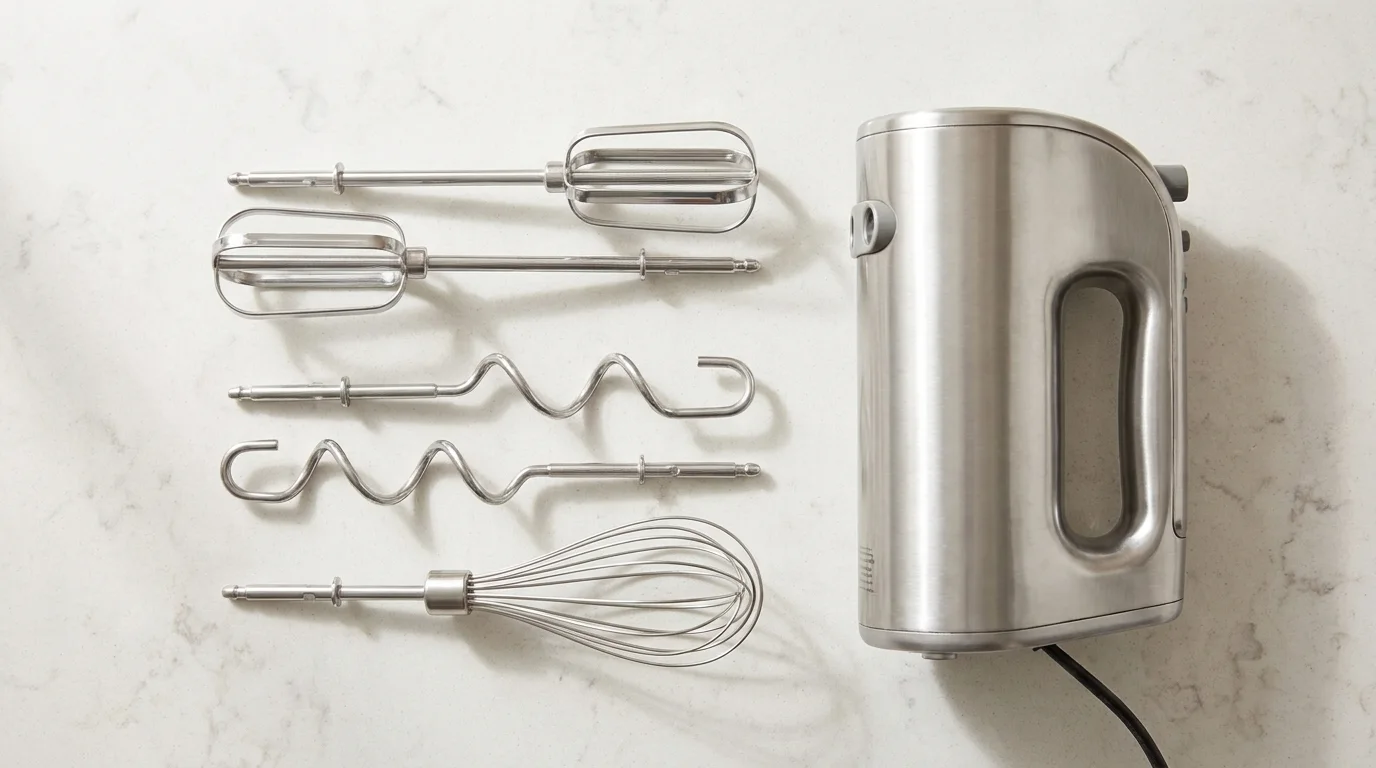
Attachments: Beaters, Dough Hooks and the Whisk
Hand mixers are sold as sets, and the attachments are a big part of the pitch. The beaters are the core tool; everything else is a bonus you should weigh against how often you will really use it.
Twin beaters are the standard, all-round attachment, the pair you reach for most. They handle general mixing and creaming: cake batters, biscuit dough, creaming butter and sugar, mashing potato. Every hand mixer comes with them, and for a lot of bakers they are the only attachment that ever leaves the drawer.
Dough hooks are for kneading light and soft doughs (scones, soft bread rolls, pizza bases) in modest amounts. They are genuinely useful for those, but they are not a licence to knead stiff bread dough: that is still a stand mixer's job, and pushing a hand mixer through heavy dough on the hooks is how you burn out the motor.
A whisk attachment is the one that transforms what the mixer can do. A balloon-style whisk whips cream, egg whites and meringue much faster and fluffier than beaters, because it folds in far more air. If you make pavlova, mousse, or whipped cream more than occasionally, a whisk is the most valuable add-on in the box, and the Breville and KitchenAid both include one, where many cheaper sets do not. If the milk you want to whip is for coffee, a dedicated frother is the tool, and our milk frother guide compares jug, handheld and stovetop frothers.
A storage case that holds the mixer, all the attachments and the cord keeps a cluttered drawer tidy and stops the beaters going walkabout, and the Sunbeam, Breville and KitchenAid all include one, which is rarer than it should be at the budget end. The honest advice: decide which attachments you will actually use rather than paying for a box that lives in a drawer, but a whisk is the one worth seeking out if you bake at all.
Handy Features Worth Looking For
Beyond speeds and attachments, a handful of small design touches separate a hand mixer you enjoy using from one that mildly annoys you every time.
A turbo or burst-of-power button gives a momentary kick of extra speed for thick batter. Both the Sunbeam's Burst of Power and the Breville's Turbo Boost do exactly this.
A beater-eject lever lets you release the attachments at the push of a button, so you are not pulling batter-coated beaters out with your fingers.
A retractable or swivel cord keeps the lead out of the way while you mix and tidies up fast afterwards. The Breville's retractable cord stores at the touch of a button.
A soft-grip handle matters more than it sounds on a longer mix, where a slim hard handle gets uncomfortable to hold steady.
One feature worth knowing about if you bake on impulse: Sunbeam's pricier Mixmaster models carry a patented HeatSoft technology that blows warm air over the beaters to soften cold butter roughly twelve times faster: fridge-cold to creaming-ready in a couple of minutes, instead of waiting for butter to come to room temperature. If spur-of-the-moment baking is your thing, that is a genuinely clever feature-led alternative to consider, though it sits above the budget pick here.
An Australian Baking Staple, and the Honest Trade-offs
Baking is a fixture in Australian homes, and the hand mixer is the appliance that quietly does most of it. The Sunbeam Mixmaster is the iconic local name (the beater a lot of us grew up watching a parent use), and a hand mixer is genuinely a first-kitchen essential, slotting in alongside a microwave and a kettle as a week-one buy for a new home. It is cheap enough to own from day one and useful enough that you will reach for it constantly.
But it is worth being honest about the limits so you buy the right tool. A hand mixer cannot handle stiff bread dough the way a stand mixer can. Do not force it, because you will burn out the motor on a dough it was never built to knead. You also have to hold it through the whole mix, which is fine for a couple of minutes of cake batter but tiring on a long, heavy job. It will not chop, slice or make pastry either, which is a food processor job. And the cheapest models can overheat on extended, demanding tasks. None of that is a reason to skip a hand mixer, it is a reason to match the power and the price to how seriously you bake, which is exactly what the picks below are chosen to do.
If you find yourself constantly hitting those limits (kneading bread weekly, baking in big batches), that is your signal to add a stand mixer, not to buy a bigger hand mixer. For everyone else, a good hand mixer is one of the best-value tools in the kitchen.
Also great
KitchenAid
KitchenAid 9-Speed Artisan Hand Mixer
4.3(30)
$176.66$239.00
Save 26%
Amazon.com.au price as of 05:01 pm AEDT, subject to change
As an Amazon Associate, NestPath earns from qualifying purchases.
How to Get the Best Results From a Hand Mixer
Two things make more difference than the mixer itself: a deep, stable bowl and accurate quantities, so a set of mixing bowls and a kitchen scale are worth having first. Accurate quantities also depend on measuring cups, so our measuring cups guide compares the sets we picked. A hand mixer is easy to use, but a few habits get you better results and a tidier bench every time.
Start on the lowest speed. Begin slow so dry ingredients do not fly out of the bowl and batter does not splatter, then ramp up once everything is moving. A slow start is the single best defence against mess.
Use a deep bowl. A tall, narrow bowl contains the splatter far better than a wide, shallow one, and lets the beaters reach everything without flinging it out.
Keep the beaters submerged. Lifting the beaters toward the surface while they spin throws mixture up and out. Keep them down in the bowl and let the food come to them.
Move it around and scrape down. Walk the beaters around the bowl and stop to scrape the sides with a spatula so nothing is left unmixed at the edges.
Switch off before you lift it out. Always stop the motor before the beaters break the surface, so you do not spray the last of the mixture across the kitchen.
Do not push it through stiff dough. If the motor is straining and slowing, stop. That job belongs to a stand mixer, and pushing on is how a hand mixer dies.
Cleaning and Care
The quick cleanup is part of the appeal, and keeping a hand mixer in good shape is straightforward.
On every model the beaters and attachments eject from the body for washing. Use the eject lever rather than yanking them out. Rinse them straight after use so batter does not dry on, which is far harder to remove later. Many beaters, hooks and whisks are dishwasher-safe, but check your model first, as it varies. The rule that applies to every hand mixer without exception: never put the motor body in water. The housing wipes clean with a damp cloth; submerging it will ruin the appliance. Eject the beaters, wash the beaters, wipe the body: that is the whole routine. Store it with the attachments in its case so the next bake is a grab-and-go.
Frequently Asked Questions
What is the difference between a hand mixer and a stand mixer?
A hand mixer is a light handheld unit with two beaters that you hold over a bowl, it is cheap, stores in a drawer, and handles the great majority of home baking such as whipping cream, beating egg whites and meringue, creaming butter and sugar, and mixing cake batters. A stand mixer is a heavy, motorised machine with a fixed bowl that does the mixing hands-free, is far more powerful, and is built for stiff bread doughs and frequent, high-volume baking, but it is bulky, expensive and overkill for most casual bakers. For everyday and occasional baking a hand mixer is the right and far cheaper tool; only step up to a stand mixer if you knead stiff bread dough regularly or bake in big batches.
What attachments do I need on a hand mixer?
The twin beaters are the only essential, they handle general mixing and creaming, including cake batters, biscuit dough, and mashing potato, and on a basic mixer they are all you get. Beyond that, a whisk attachment is the most valuable add-on if you bake at all, because a balloon whisk whips cream, egg whites and meringue much faster and fluffier than beaters by folding in far more air. Dough hooks are useful for kneading light, soft doughs like scones and pizza bases in modest amounts, though not for stiff bread dough. A storage case that holds everything keeps a drawer tidy. The honest advice is to decide which you will actually use, but a whisk is the one worth seeking out.
How many speeds and how much power do I need in a hand mixer?
More speeds give finer control rather than just more grunt, the low speeds let you start gently so flour does not fly out of the bowl, and the high speeds whip cream and meringue fast. A soft-start feature, which ramps the beaters up gradually, is a genuinely nice touch that stops flour clouds and splatter. On power, almost any hand mixer copes with light work like cream and cake batter; higher wattage only matters for thick cookie doughs and heavier mixing, where a stronger motor pushes through without straining or overheating. Match the power to how seriously you bake, a modest motor for occasional baking, more grunt if you regularly mix thick doughs.
Can a hand mixer knead bread dough?
A hand mixer can knead light, soft doughs, scones, soft rolls, pizza bases, in modest amounts using its dough hooks, but it cannot handle stiff, heavy bread dough the way a stand mixer can. Kneaded bread dough needs serious torque, and forcing it through a hand mixer will make the motor strain, slow and overheat, and can burn it out entirely. If you bake bread regularly, that is exactly the job a stand mixer is built for, and it is the main reason to own one. Use the dough hooks for the light stuff, and do not push a hand mixer through anything it is clearly straining against, listen to the motor and stop if it bogs down.
What is the whisk attachment for on a hand mixer?
The whisk attachment is the one that whips air into things. A balloon-style whisk whips cream to soft or stiff peaks, beats egg whites and meringue to glossy stiffness, and lightens mousses and batters, all much faster and fluffier than the standard twin beaters, because the open wire design folds in far more air. If you make pavlova, mousse, whipped cream or meringue more than occasionally, the whisk is the most useful attachment in the box, and it is one of the reasons to choose a set that includes one. The Breville and KitchenAid picks both come with a wire whisk, where many cheaper hand mixers ship with beaters and hooks only.
Do I need a storage case, and which hand mixer should I buy?
A storage case that holds the mixer, the attachments and the cord is genuinely worth having, it keeps a cluttered drawer tidy, stops beaters going missing, and makes the next bake a grab and go, and the Sunbeam, Breville and KitchenAid all include one. As for which to buy: the Breville Mix & Store is the best for most choice, with twin beaters, dough hooks, a wire whisk, a turbo button and a retractable cord. The Sunbeam Mixmaster Hand Mixer Pro is the budget pick from the iconic Australian brand, with seven speeds and a full attachment set. The KitchenAid 9-Speed is the premium pick for keen, frequent bakers who want soft start power and extra attachments.
Is the KitchenAid hand mixer worth it?
The KitchenAid 9-Speed Artisan is worth it specifically if you bake often and want a tool that lasts. You are paying for nine speeds, an 85W DC motor, a Soft Start that ramps the beaters up gradually to avoid flour clouds and splatter, extra attachments including a pro-whisk and a liquid-blending rod, and KitchenAid's build quality, the kind of mixer that shrugs off heavier mixing and years of regular use. If you bake the occasional cake and whip cream now and then, you do not need it, and the Breville or Sunbeam will serve you well for far less. But for a frequent baker who wants the nicest daily-use experience and a mixer that will not wear out, it is a justifiable upgrade.
What brand makes the best hand mixer in Australia?
Breville, for most kitchens: the Mix and Store Turbo is our best overall pick because it includes every attachment. KitchenAid makes the most capable machine: the 9-Speed Artisan has the widest speed range and a soft start motor that no cheaper model matches, which is why it is our premium pick. Sunbeam is the Australian name and owns the budget end with the Mixmaster. Dualit, Cuisinart and Kenwood all sell here too and sit between the Breville and the KitchenAid on price.
What is the best alternative to KitchenAid?
The Breville the Mix and Store Turbo, which comes with beaters, dough hooks and a whisk in the box. You give up four speeds and the soft start, which matters if you cream butter often and hate flour on the bench. If you want a budget option, the Sunbeam Mixmaster Hand Mixer Pro does the same core jobs.
Which hand mixer is best for meringue?
One with a balloon whisk attachment and a slow first speed. Egg whites need to start slow to build small, stable bubbles, then step up, and a mixer that jumps straight to a fast speed gives you a coarse foam that collapses. The Breville the Mix and Store Turbo is the pick here with its wire whisk in the box, and the KitchenAid 9-Speed does it best of all because the soft start motor eases in on its own.
Is a cordless hand mixer worth it?
Only if you regularly mix somewhere without a power point, because you pay for the battery in both money and power. A cordless model typically gives 15 to 30 minutes of mixing per charge and runs at lower sustained wattage than a corded one at the same price, which shows up on anything heavier than cake batter. For a normal kitchen bench a corded mixer is the better buy.
Is the Sunbeam Mixmaster a good hand mixer?
Yes, for the money. The Mixmaster Hand Mixer Pro gives you seven speeds with beaters and dough hooks from the brand most Australian kitchens already recognise, and it handles cream, cake batter and creaming butter without complaint. It also comes with a Super Aerator whisk, which Sunbeam says whisks up to 30% faster. What it does not have is a soft start, which only the KitchenAid offers here, so it can throw flour as it starts into a full bowl. As a first hand mixer it is hard to fault at the price.
What is the best hand mixer in Australia?
Our pick is the Breville the Mix and Store Turbo: five speeds plus a Turbo button, with beaters, dough hooks and a wire whisk in the box and a storage case. The KitchenAid 9-Speed Artisan, with nine speeds and an 85W soft start motor, is the premium pick for keen bakers, and the Sunbeam Mixmaster Hand Mixer Pro is the budget pick.
DETAILED REVIEWS
Top pick
Breville
Breville the Mix & Store Turbo Hand Mixer
4.6(83)
$79.96$89.95
Save 11%
Amazon.com.au price as of 05:01 pm AEDT, subject to change
As an Amazon Associate, NestPath earns from qualifying purchases.
Sunbeam
Sunbeam Mixmaster Hand Mixer Standard
A Sunbeam Mixmaster with six variable speeds and a Burst of Power button for thick batters. It comes with stainless steel beaters, dough hooks and a storage case that holds the mixer, attachments and cord.
$35.96$44.95
Save 20%
Amazon.com.au price as of 05:01 pm AEDT, subject to change
As an Amazon Associate, NestPath earns from qualifying purchases.
Russell Hobbs
Russell Hobbs RHMX5BLK
A 350W Russell Hobbs mixer with five speeds plus a turbo function, two beaters and two dough hooks. It can stand on its base for upright storage and has an eject button for the attachments.
$49.00$59.95
Save 18%
Amazon.com.au price as of 05:01 pm AEDT, subject to change
As an Amazon Associate, NestPath earns from qualifying purchases.
Cuisinart
Cuisinart Power Advantage HM7BSCXA Hand
A 200W Cuisinart with seven speeds, beaters with no centre post, dough hooks, a chef's whisk and a clear storage case that snaps onto the base. It has a quick release lever and a swivel cord for left or right handed use.
$55.00$69.00
Save 20%
Amazon.com.au price as of 11:01 pm AEDT, subject to change
As an Amazon Associate, NestPath earns from qualifying purchases.
Cuisinart
Cuisinart Cordless Hand Mixer
A cordless Cuisinart with a 7.4V lithium ion battery that the listing says gives up to 20 minutes of continuous mixing, charged by USB in 2 hours. It has five speeds, an LED display for speed and battery level, and dishwasher safe beaters.
$49.00
Amazon.com.au price as of 05:00 pm AEDT, subject to change
As an Amazon Associate, NestPath earns from qualifying purchases.
Kenwood
Kenwood QuickMix+ Hand Mixer HMP50.000BK
A 650W Kenwood QuickMix+ with variable speed, a pulse function, stainless steel beaters and dough hooks. The listing describes a compact, light body with removable beaters for easy cleaning.
$99.00$129.00
Save 23%
Amazon.com.au price as of 05:01 pm AEDT, subject to change
Affiliate Disclosure: As an Amazon Associate, NestPath earns from qualifying purchases. This means if you click a product link and buy something, we may receive a small commission at no extra cost to you. We only recommend products we genuinely believe will help new homeowners. This does not influence our recommendations.
CERTAIN CONTENT THAT APPEARS ON THIS SITE COMES FROM AMAZON. THIS CONTENT IS PROVIDED ‘AS IS’ AND IS SUBJECT TO CHANGE OR REMOVAL AT ANY TIME.