Prices checked 18 October 2026 on Amazon AU and subject to change.
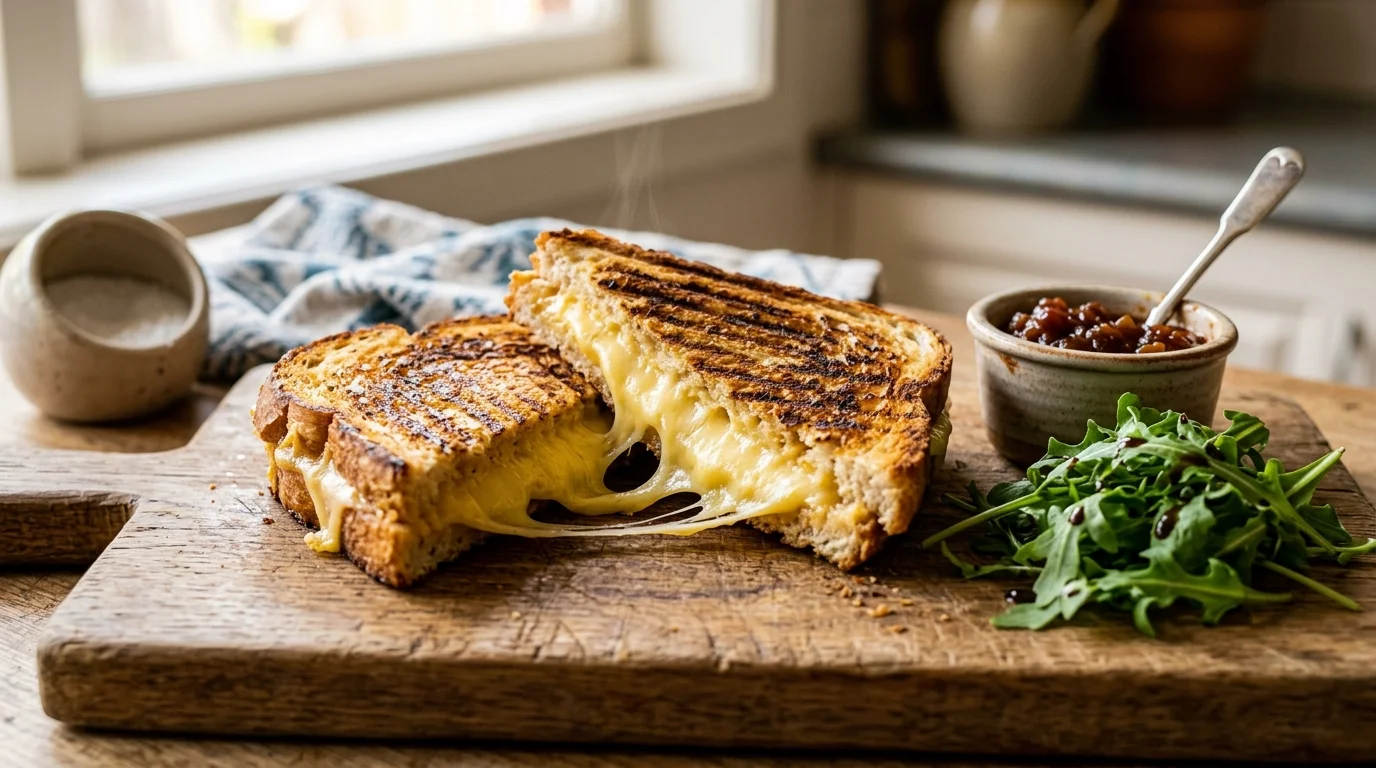
On a cold Melbourne night when it's dark by 5pm, the last thing anyone wants to do is cook a proper dinner. This is exactly the moment a sandwich press earns its bench space: two slices of bread, a handful of grated cheese, maybe some leftover roast chook or a slice of ham, and four minutes later you've got a golden, crunchy toastie. It's the comfort food the cold months were made for, and a sandwich press does it better, faster and with less washing-up than a frypan or a grill.
A sandwich press earns its place on an Australian benchtop by how often it gets used. Unlike a slow cooker that you plan a meal around, a press is grab-and-go: breakfast jaffles, lunch melts, a quick panini, reheating last night's pizza so the base actually crisps. We've researched the sandwich presses genuinely worth buying in Australia for 2026 (from a budget workhorse to family-sized 4-slice and 6-slice presses), and explained the one distinction most buyers get wrong before they even start shopping.
How do the six sandwich presses compare?
Pick
Best for
Slices
Plates
Breville the Toast & Melt 2-Slice
Best overall
2
Deep-fill flat, titanium-reinforced non-stick
Russell Hobbs Sandwich Press (RHSP801BLK)
Best budget
4
Non-stick flat, 2100W
Breville the Toast & Melt 4-Slice
Premium and family
4
Deep-fill flat, titanium-reinforced non-stick
Sunbeam Cafe Style 2-Slice
Sunbeam alternative
2
Non-stick, AnyHeight height lever
Sunbeam Cafe Style 6-Slice
Big household
up to 6 sandwiches
Non-stick, AnyHeight height lever, drip tray
Breville the Perfect Press (BSG600BSS)
Light pressing, soft bread
not stated on the listing
Flat non-stick, counterweight hinge
How we picked these sandwich presses
We compared the presses on the hinge (floating and height-adjustable or fixed), plate type and non-stick coating, capacity, wattage and how they store. Specifications come from each Amazon AU listing and from the makers' product pages (Breville and Russell Hobbs), the brand satisfaction result comes from Canstar Blue's 2026 grills and sandwich presses ratings, and we checked stock, sellers and ratings on the Amazon AU listings on 7 October 2026 (8 October 2026 for the two Sunbeam presses and the Perfect Press). We did not test these presses ourselves, so every specification is attributed to the listing or maker that states it.
Best overall: Breville the Toast & Melt 2-Slice
For most kitchens the Breville the Toast & Melt 2-Slice is the press to buy: its floating top plate self-levels to whatever you load and the height dial stops it over-compressing, so thick paninis and single melts both cook evenly. Breville's Australian site marks the BSG520 as discontinued, but Amazon AU still had it in stock at our 7 October 2026 check, so it stays our pick while that lasts.
Top pick
Breville
Breville the Toast & Melt 2-Slice Sandwich Press
4.6(811)
$78.00$89.95
Save 13%
Amazon.com.au price as of 11:01 am AEDT, subject to change
As an Amazon Associate, NestPath earns from qualifying purchases.
Sandwich press vs jaffle iron vs toaster: get this right first
The best sandwich press in Australia is the Breville the Toast & Melt 2-Slice, with the Russell Hobbs RHSP801BLK the budget buy and the Breville 4-Slice for a family. These three appliances get lumped together, but they make completely different food. Buying the wrong one is the single most common sandwich-press mistake, so here's the plain-English version before you spend a cent.
A sandwich press has two flat or ribbed heated plates with a floating top hinge that comes down and presses your sandwich flat. Think paninis, cheese melts, flat toasties, quesadillas, grilled veg, halloumi, and crisping up leftover pizza. The fillings stay where you put them; the edges stay open. This is what this whole guide is about.
A jaffle iron (or pie maker) has sealed, scalloped pockets that crimp and seal the bread edges shut, trapping a molten filling inside, the classic sealed jaffle that explodes with hot baked beans or apple. It's a different food entirely. A sandwich press cannot make a sealed jaffle, and a jaffle iron can't press a flat panini.
A flat toaster just browns plain bread slices: no fillings, no pressing. Great for a slice of Vegemite toast; useless for a cheese melt. If that's all you want, see our best toaster guide instead.
In Australian kitchen vernacular "toastie" usually means the flat, pressed kind that comes out of a sandwich press, while "jaffle" strictly means the sealed, crimped pocket kind, though plenty of people use the words interchangeably. If you want sealed jaffles, stop here and buy a jaffle iron. If you want flat, melty, café-style toasties and paninis, read on: a press is your appliance.
What a sandwich press is brilliant at (and what it isn't)
A press is one of the most versatile cheap appliances in the kitchen. Once you have one, you'll use it for far more than ham-and-cheese:
Toasties and melts: the core job. Cheese, ham, tomato, chutney; tuna melts; the leftover-roast toastie that turns Sunday's dinner into Monday's lunch.
Paninis and Turkish bread: the floating hinge handles thick, crusty bread that a toaster can't fit.
Quesadillas: tortilla, cheese, whatever's in the fridge; the flat plates seal the cheese without sealing the edges.
Grilled veg and halloumi: zucchini, eggplant, capsicum, a slab of halloumi; ribbed plates give you char-grill marks without firing up the BBQ in winter.
Reheating pizza: the one trick everyone discovers: a press crisps the base instead of going soggy like the microwave does.
What it's not: a sandwich press is not a full contact grill for thick steaks or chops. The floating hinge and plate wattage are tuned for sandwiches, not searing a 3cm porterhouse. It handles paninis, halloumi and thin grilled veg happily, but for serious grilling you want a dedicated contact grill or the BBQ. And, again, it does not make sealed jaffles. Know those two limits and a press will outperform almost any appliance for the price.
Budget pick
Russell Hobbs
Russell Hobbs Sandwich Press (RHSP801BLK)
4.6(1,125)
$55.00$59.95
Save 8%
Amazon.com.au price as of 05:01 am AEDT, subject to change
As an Amazon Associate, NestPath earns from qualifying purchases.
Flat plates vs ribbed (grill) plates
If what you actually want is char lines rather than a pressed sandwich, you are shopping for a contact grill, and our electric grill guide covers those instead.
The plate surface changes both the look and the job:
Flat plates give you full, even contact across the whole sandwich. That means the most even melt, the crispiest full-surface toastie, and the easiest cleaning. There are no grooves for cheese to weld itself into. Flat plates are the right default for classic toasties and melts, which is why both Breville Toast & Melt models and the Russell Hobbs budget pick use flat plates.
Ribbed (grill) plates stamp char-grill lines across the food: that café-panini look, and the visual cue people associate with a "proper" grilled sandwich. They're better for halloumi, grilled veg and paninis where you want the marks and a bit of fat to drain into the grooves. The trade-off: slightly less even melting (the ridges only touch part of the bread) and more fiddly cleaning.
Some presses offer reversible or interchangeable flat/ribbed plates so you get both, but for most Australian households a quality flat-plate press is the more useful single appliance. It does melts perfectly and still handles a panini fine. Buy ribbed only if the grill marks genuinely matter to you, and if it is waffles you actually want, that is a waffle maker, not a press.
The floating, height-adjustable hinge: the spec that actually matters
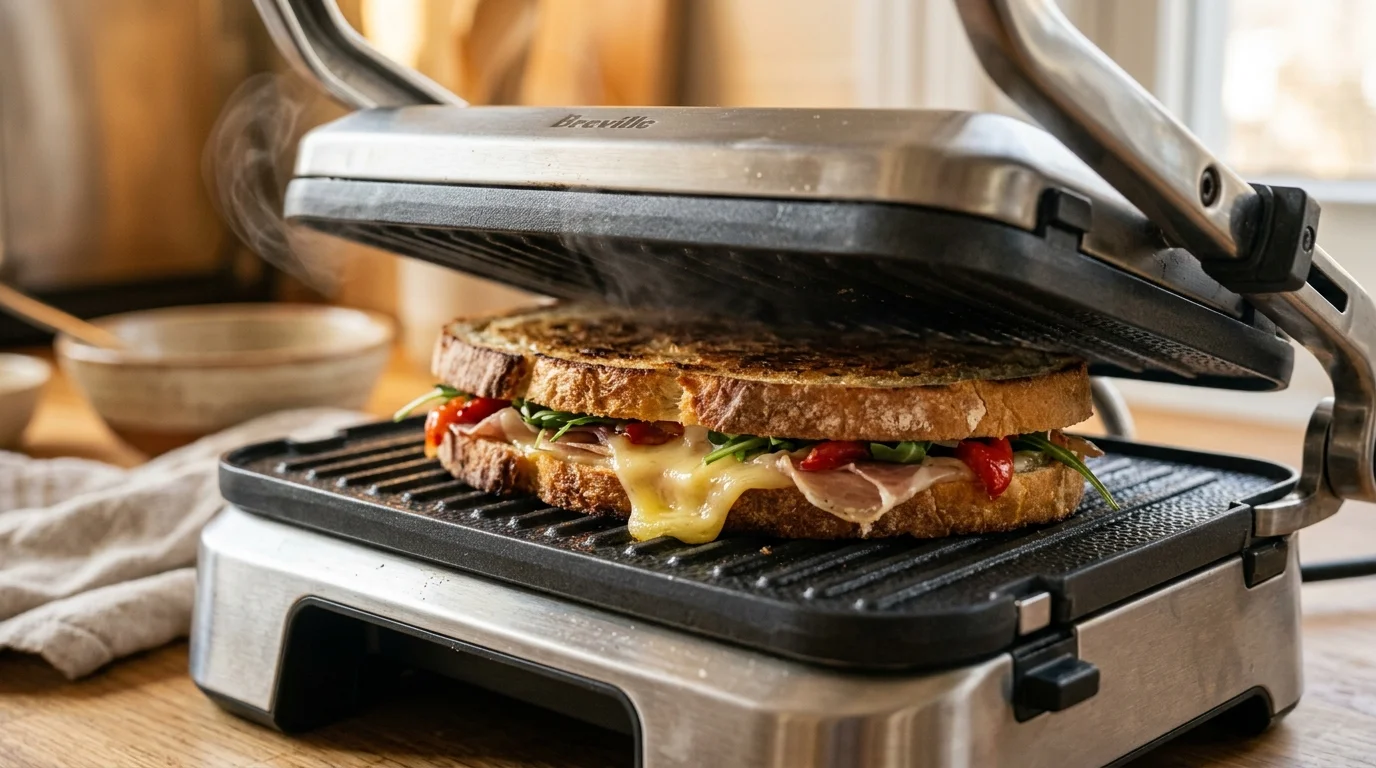
If you only check one thing before buying, make it the hinge. A cheap press has a top plate on a fixed pivot: load a thick sandwich and the front edge crushes the filling out the sides while the back stays raw, or vice versa. A good press has a floating hinge that lets the top plate stay parallel as it rises to meet whatever thickness you've loaded, so a fat panini and a single slice of cheese both get even contact top-to-bottom.
Better presses add height adjustment on top of the float: you set a maximum height, and the top plate presses down to that point but no further. That's the difference between a sandwich that's pressed and one that's squashed. You compress the bread enough to seal and crisp it, without flattening a generous toastie into a cracker. The Breville Toast & Melt models stand out here because their floating top plate self-levels and the height dial stops over-compression. The budget Russell Hobbs has a floating hinge and lid lock too, which is why it punches above its price; it just doesn't give you the same fine height control.
Non-stick and removable/dishwasher-safe plates: the cleaning reality
Cleaning is a common complaint with sandwich presses, and it comes down to the plates. Melted cheese and buttery crumbs bake onto a hot surface fast, so two features decide how much you'll dread the cleanup:
Quality non-stick coating: a good PFOA-free non-stick (the Breville models use a titanium-reinforced coating) means a wipe with a damp cloth once the plates have cooled usually does it. Cheaper coatings wear through after a couple of years of metal-utensil abuse, so always use a wooden or silicone tool to lift your toastie, never a knife.
Removable / dishwasher-safe plates: the gold standard. If the plates pop out and go in the dishwasher, the worst cleaning job becomes a non-event. Most fixed-plate presses (including the Russell Hobbs and both Toast & Melt models; none of the added listings mentions removable plates) instead rely on you wiping the plates while still slightly warm and never submerging the body: perfectly manageable, just less hands-off than removable plates.
A drip channel or grease tray is the other cleaning helper: it catches the fat and melted cheese that escapes a panini so it doesn't pool on your bench. Wipe the plates after every use while warm (never when cold and set) and a press stays good for years.
2-slice vs 4-slice: who needs which
Capacity is the main fork in the road once you've picked a brand:
2-slice presses make one large sandwich, or two if they're small, right for singles, couples, and anyone with limited bench space. The Breville Toast & Melt 2-Slice sits here.
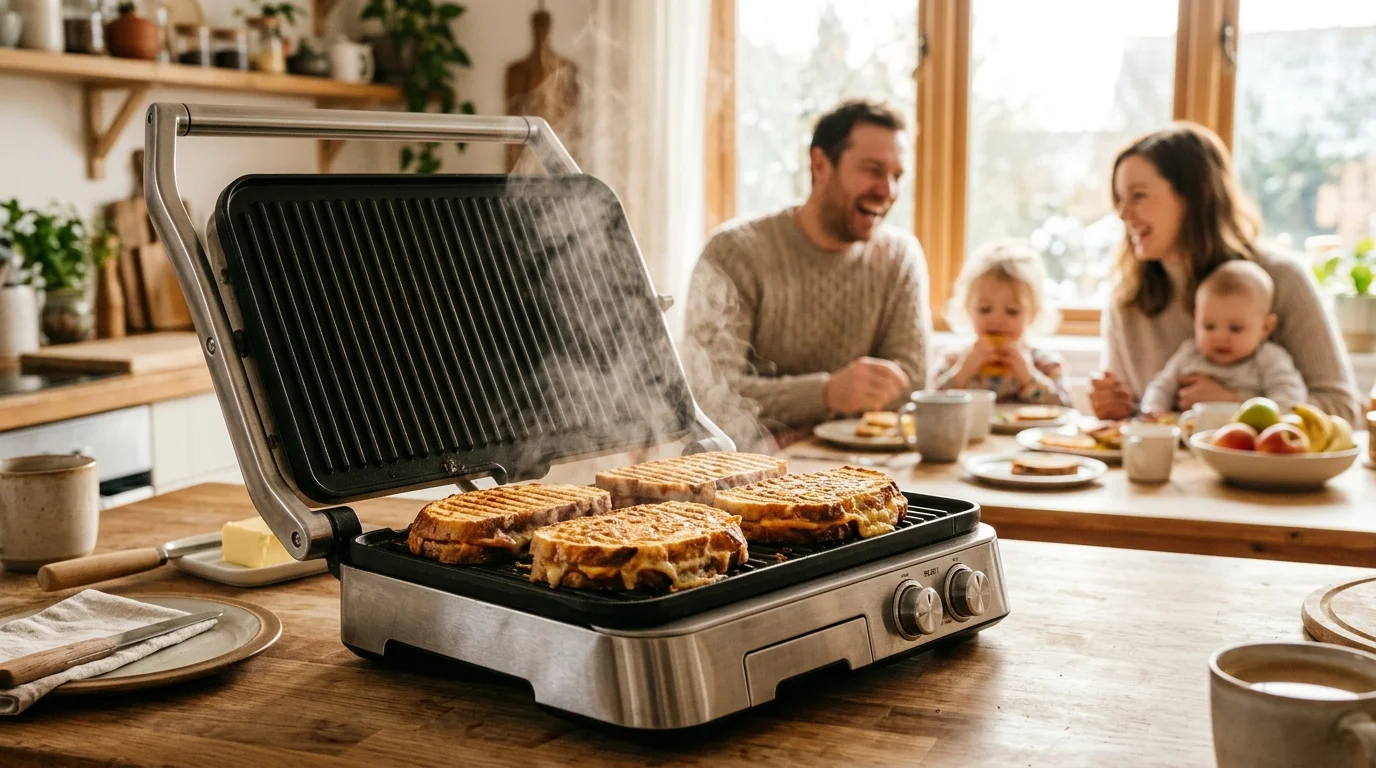
4-slice presses do two full toasties (or four slices' worth) in one go: the family pick, or for anyone who hates doing toasties in shifts. If you're feeding kids on a winter weekend or making batch lunches, the 4-slice Breville saves you the second round. The cost is a bigger footprint on the bench and in the cupboard. Russell Hobbs lists the RHSP801BLK as a 4 slice press at 2100 watts on its Australian product page, and its Amazon AU listing says the plates fit up to 4 slices, so it sits here too.
If you cook for one or two, the 2-slice is plenty and stores more easily on its side. If toasties are a regular family event, the jump to a 4-slice is worth it just to feed everyone at once.
Also great
Breville
Breville the Toast & Melt 4-Slice Sandwich Press
4.6(164)
$127.00$149.95
Save 15%
Amazon.com.au price as of 05:01 pm AEDT, subject to change
As an Amazon Associate, NestPath earns from qualifying purchases.
Power and heat-up speed
Most sandwich presses sit between roughly 700W and 2100W. Higher wattage mainly buys you faster heat-up and quicker recovery between batches, handy if you're making toasties back-to-back on a busy morning. The budget Russell Hobbs is a punchy 2100W and heats up notably fast, which is a genuine selling point at its price. The Breville models prioritise even, well-distributed heat across the plates over a single headline wattage number, which is what gives you a uniform golden colour edge-to-edge rather than a hot spot in the middle.
One small quirk worth knowing: most sandwich presses (including the Russell Hobbs and both Toast & Melt models) have no on/off switch. They start heating the moment they're plugged in and run on a thermostat, so you switch them off at the wall and unplug when done. It's not a fault, just how the category works.
Where Kmart, Big W and Sunbeam fit
Two names come up constantly in Australian sandwich press searches. Kmart sells the cheapest way into the category and it will brown a sandwich, but without a floating hinge or height control a thick roll gets squashed rather than pressed. Sunbeam Cafe Style presses are stocked through Harvey Norman, Big W and the supermarkets and are a fair saving on a Breville at the same slice count. Kmart sells through its own stores and website rather than Amazon Australia, so it is not a pick here. Amazon AU does sell two Sunbeam Cafe Style presses, the 2-slice and the 6-slice, so both sit in our picks below beside the Breville and Russell Hobbs presses.
Our six picks in detail
Best budget: Russell Hobbs Sandwich Press (RHSP801BLK)
The no-fuss value workhorse. The Russell Hobbs gives you a 2100W element for fast heat-up, non-stick flat plates, a floating hinge that adjusts to varied sandwich thickness, and a lid lock so it stores upright to save space. Russell Hobbs won Canstar Blue's 2026 Most Satisfied Customers award for grills and sandwich presses, a survey of Australian owners rating the brand rather than this model. It doesn't have the fine height-control dial of the Breville, and the build is lighter, but for a sharehouse, a rental, or a first kitchen it does the core job, crispy, even toasties, for roughly half the price of the Breville. If you're not sure you'll use a press often enough to justify a premium one, start here.
Best for most: Breville the Toast & Melt 2-Slice
This is the one we'd point most buyers to. The Toast & Melt's floating top plate self-levels to whatever you load and the height dial stops it over-compressing, so thick paninis and single-slice melts both get even contact. The deep-fill flat plates and titanium-reinforced non-stick coating deliver a café-grade, edge-to-edge golden toastie and wipe clean easily. Brushed-stainless build and upright side-storage. It's not the cheapest, and there's no separate thermostat dial, but for the combination of even results and build quality it's our pick. Pair it with a quality kettle and you've covered the two appliances a winter breakfast actually needs.
Premium and family: Breville the Toast & Melt 4-Slice
The same Toast & Melt design scaled to four slices. You get the identical floating hinge, height adjustment, deep fill flat plates and titanium reinforced nonstick, just a wider footprint that presses two full toasties (or four slices' worth) at once. This is the family buy: nobody waits for the second round on a Saturday, and batch winter lunches happen in one go. The only honest catch is size: it takes up more bench and cupboard space than the 2-slice, so only step up if you'll genuinely use the extra capacity. If it's usually just one or two of you eating, save the money and the bench space with the 2-slice.
Sunbeam alternative: Sunbeam Cafe Style 2-Slice
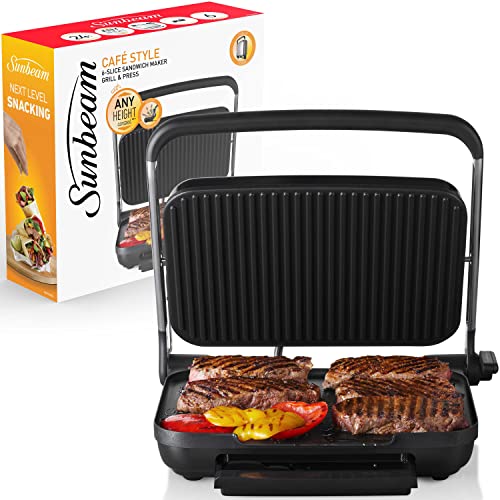
If you would rather a Sunbeam, the Cafe Style 2-slice is the one we can point you to on Amazon AU. Its listing says it fits two sandwiches and uses Sunbeam's AnyHeight control lever, which sets the top plate at several heights and locks it there, so a thick toastie is held rather than squashed. The listing also describes non-stick plates with curved corners for wiping out, heat-up in 2 minutes, and fold-up stand-up storage with the cord wrapped into the base. It does not describe a floating hinge, so the lever does the work the Breville's self-levelling plate does: set it before you close the lid. It was in stock and sold by Amazon AU.
Sunbeam
Sunbeam Cafe Style 2-Slice Sandwich Press
The Sunbeam Cafe Style 2-slice fits two sandwiches, per its listing, and uses Sunbeam's AnyHeight lever to set the top plate at several heights and lock it there, so a thick toastie is held rather than squashed. The listing also describes non-stick plates with curved corners and fold-up stand-up storage with a cord wrap in the base. It was in stock and sold by Amazon AU.
$55.00$69.95
Save 21%
Amazon.com.au price as of 11:01 pm AEDT, subject to change
As an Amazon Associate, NestPath earns from qualifying purchases.
Big household: Sunbeam Cafe Style 6-Slice
The 6-slice is the same Cafe Style design on bigger plates. Its listing says it fits up to 6 sandwiches, with the same AnyHeight lever and plate lock, non-stick plates and a pull-out drip tray for the fat from steaks and fritters. Buy it if toasties are a weekend production line for a big household, since the Breville 4-slice presses two full toasties at a time. The trade-off is size: it takes more bench and cupboard room than any 2-slice press, so measure before you buy. It was in stock and sold by Amazon AU.
Sunbeam
Sunbeam Cafe Style 6-Slice Sandwich Press
The Sunbeam Cafe Style 6-slice fits up to 6 sandwiches, per its listing, with the same AnyHeight height lever and plate lock as the 2-slice, non-stick plates and a pull-out drip tray. It is the batch option for a big household, and it needs more bench and cupboard room than any 2-slice press. It was in stock and sold by Amazon AU.
$79.99$119.00
Save 33%
Amazon.com.au price as of 11:01 pm AEDT, subject to change
As an Amazon Associate, NestPath earns from qualifying purchases.
A different hinge: Breville the Perfect Press (BSG600BSS)
Breville's Perfect Press takes another approach to the hinge. Its listing describes a counterweight hinge with crush control, pitched at lighter, fluffier toasted sandwiches, plus flat plates with a non-stick finish, adjustable height control and a 1500 W element. Choose it over the Toast & Melt if you mostly press soft bread, rolls and wraps and want the lid to sit lightly on top. The listing does not state how many slices it takes, so check the plate size against your usual loaf. It was in stock and sold by Amazon AU.
Breville
Breville the Perfect Press (BSG600BSS)
Breville's Perfect Press BSG600BSS uses a counterweight hinge with crush control, which its listing pitches at lighter, fluffier toasted sandwiches, plus flat non-stick plates, adjustable height control and a 1500 W element. The listing does not state how many slices it takes. It was in stock and sold by Amazon AU.
$149.00$179.95
Save 17%
Amazon.com.au price as of 11:01 pm AEDT, subject to change
As an Amazon Associate, NestPath earns from qualifying purchases.
How to make a great toastie (the technique most people miss)
A good press does most of the work, but a few habits separate a soggy disappointment from a café-grade toastie:
Butter the outside, not the inside. A thin layer of butter (or a smear of mayonnaise, which browns beautifully and won't burn) on the outer faces of the bread is what gives you that crisp, golden, even crust. Buttering the inside just makes it greasy. Soft butter spreads without tearing the bread, which is the whole argument for a covered butter dish on the bench rather than a cold block from the fridge.
Preheat fully before the sandwich goes in. Give the press 3 to 5 minutes to come up to temperature. A cold plate steams the bread instead of crisping it: the difference between pale and golden.
Don't overfill. A mountain of filling won't heat through before the bread burns, and it squeezes out the sides into a mess on the plates. Grate cheese rather than slicing it so it melts fast and evenly, and keep the layer modest.
Let the press do the pressing. Close the lid gently and let the weight and the hinge do the work. Don't lean on it, or you'll squash the filling out and dent the bread.
Rest it for a minute. Molten cheese is lava straight out of the press. A minute's rest also lets the crust set so it stays crisp.
Cleaning and care
Wipe the plates while they're still slightly warm (not screaming hot, not stone cold and set) with a damp cloth or paper towel; warm cheese lifts off in seconds, cold cheese welds on. Never submerge the body of the press in water (the electrics live in there), and never use a metal knife or scourer on the non-stick: a wooden or silicone tool and a soft cloth only. If something's really baked on, lay a damp cloth over the cooled plate for a few minutes to soften it before wiping. Empty the drip tray if your model has one, store the press upright on its side to save space, and the non-stick will last for years. Treat the coating well and a press genuinely outlives most kitchen gadgets.
Where a sandwich press sits in a first-home kitchen
A press is one of those small appliances that earns its place by sheer frequency of use. It's cheaper than a air fryer and gets pulled out almost as often, especially through winter. You get fast weeknight dinners, café-style lunches at home, and a use for every awkward leftover. If you're kitting out a first kitchen from scratch, it belongs on the shortlist right alongside the kettle, the toaster and the slow cooker. See our full kitchen essentials guide for the complete list.
Frequently Asked Questions
What is the best sandwich press in Australia in 2026?
For most Australian households, the Breville the Toast & Melt 2-Slice is the best sandwich press in 2026. Its floating, height-adjustable top hinge presses thick fillings flat without squashing, the deep-fill flat plates melt evenly, and it's the AU benchmark for durability. If you want to spend less, the Russell Hobbs Sandwich Press (RHSP801BLK) is the budget workhorse, and Russell Hobbs won Canstar Blue's 2026 Most Satisfied Customers award for grills and sandwich presses. For families, the Breville Toast & Melt 4-Slice does four slices at once.
What is the difference between a sandwich press and a jaffle iron?
A sandwich press has flat or ribbed heated plates with a floating top hinge that presses a sandwich flat: paninis, melts, flat toasties and quesadillas, with the bread edges left open. A jaffle iron (or pie maker) has sealed, scalloped pockets that crimp and seal the bread edges shut, trapping a molten filling inside, the classic sealed jaffle. They make different food: a press cannot make a sealed jaffle, and a jaffle iron cannot press a flat panini. Choose a press for flat, melty, café-style toasties; choose a jaffle iron for sealed pockets.
Are flat or ribbed plates better for toasties?
Flat plates are better for classic toasties and cheese melts because they give full, even contact for the crispiest, most uniform result, and they're easier to clean because there are no grooves for cheese to stick in. Ribbed (grill) plates stamp char-grill marks across the food and suit halloumi, grilled veg and café-style paninis, but melt slightly less evenly and are fiddlier to clean. For most Australian households a quality flat-plate press is the more useful single appliance.
How do I clean a sandwich press properly?
Wipe the non-stick plates with a damp cloth or paper towel while they're still slightly warm. Warm cheese lifts off in seconds, while cold cheese welds on and is far harder to remove. Never submerge the body of the press in water, and never use a metal knife or scourer on the non-stick coating; use a wooden or silicone tool only. For stubborn baked-on bits, lay a damp cloth over the cooled plate for a few minutes to soften them before wiping. Empty the drip tray if your model has one.
Should I buy a 2-slice or 4-slice sandwich press?
Buy a 2-slice press (like the Breville Toast & Melt 2-Slice) if you cook for one or two people or have limited bench space. It makes one large or two small sandwiches and stores more easily upright. Step up to a 4 slice (like the Breville Toast & Melt 4-Slice, or the Russell Hobbs, which fits up to 4 slices) if you're feeding a family or making batch lunches, so nobody waits for a second round. The trade-off for the 4-slice is a larger footprint on the bench and in the cupboard.
Can you cook more than toasties in a sandwich press?
Yes, a sandwich press is far more versatile than just ham-and-cheese. It handles paninis and Turkish bread, quesadillas, grilled halloumi and thin grilled veg like zucchini and eggplant, and it's the best way to reheat leftover pizza because it crisps the base instead of going soggy like a microwave. What it is not is a full contact grill for thick steaks or chops. The hinge and wattage are tuned for sandwiches, not searing a 3cm porterhouse.
Do sandwich presses have an on/off switch?
Most sandwich presses, including the Russell Hobbs and both Breville Toast & Melt models, do not have a separate on/off button. They start heating the moment they are plugged in and run on a thermostat, so you switch them on and off at the wall socket and unplug when finished. This is normal for the category, not a fault. Always unplug after use and let the press cool before storing it upright.
Is Sunbeam or Breville better?
Both are sold widely in Australian department stores and both make a decent toastie. Breville's case is the floating hinge and the height dial on the Toast and Melt, which keep even contact on a thick sandwich rather than squashing it. Sunbeam usually costs less for the same slice count and its Cafe Style presses are widely stocked. If the sandwiches are thick, buy the Breville. If price decides it, Sunbeam is the safer saving.
Are Kmart sandwich presses good?
For an occasional toastie, yes. A Kmart press is the cheapest way into the category and it will brown a sandwich. What you give up is the floating hinge and the height control, so a thick roll gets squashed rather than pressed, and the thinner plates lose heat between rounds. It is not sold on Amazon Australia, so it is not a pick here. If you make toasties most days, the Russell Hobbs is worth the step up.
Can you put baking paper in a sandwich press?
Yes, and it is the tidiest way to stop cheese welding itself to the plates. Cut the sheet so it sits inside the plate area with nothing hanging over the edge, because paper touching the hot element or the hinge can scorch. It also flattens the ridges on a ribbed plate, so you lose the grill marks. Never use foil in a press: it tears on the plates and it carries heat straight to your fingers.
Are there any sandwich presses made in Australia?
Not in any meaningful sense. Breville, Sunbeam and Russell Hobbs are all long-established brands here with local warranty and support, but the machines themselves are manufactured overseas, as is every press sold in a major Australian retailer. The practical question is local warranty and spare parts rather than the country on the box, and on that the big three are the safe choices.
What kind of sandwich maker is best?
For flat toasties, melts and paninis, the best kind is a sandwich press with flat plates and a floating, height adjustable hinge, such as the Breville the Toast and Melt 2-Slice. Choose a jaffle iron instead if you want sealed, crimped pockets, and ribbed plates only if the grill marks genuinely matter to you.
What is the difference between a sandwich maker and a panini press?
The names overlap in Australian shops: Breville's Perfect Press and both Sunbeam Cafe Style presses are listed as sandwich makers. A panini press is a sandwich press, with heated plates under a floating hinge that press the sandwich flat, often ribbed for grill lines. A jaffle iron is different: it seals the bread edges into crimped pockets.
DETAILED REVIEWS
Top pick
Breville
Breville the Toast & Melt 2-Slice Sandwich Press
4.6(811)
$78.00$89.95
Save 13%
Amazon.com.au price as of 11:01 am AEDT, subject to change
As an Amazon Associate, NestPath earns from qualifying purchases.
Sunbeam
Sunbeam Cafe Style 2-Slice Sandwich Press
The Sunbeam Cafe Style 2-slice fits two sandwiches, per its listing, and uses Sunbeam's AnyHeight lever to set the top plate at several heights and lock it there, so a thick toastie is held rather than squashed. The listing also describes non-stick plates with curved corners and fold-up stand-up storage with a cord wrap in the base. It was in stock and sold by Amazon AU.
$55.00$69.95
Save 21%
Amazon.com.au price as of 11:01 pm AEDT, subject to change
As an Amazon Associate, NestPath earns from qualifying purchases.
Sunbeam
Sunbeam Cafe Style 6-Slice Sandwich Press
The Sunbeam Cafe Style 6-slice fits up to 6 sandwiches, per its listing, with the same AnyHeight height lever and plate lock as the 2-slice, non-stick plates and a pull-out drip tray. It is the batch option for a big household, and it needs more bench and cupboard room than any 2-slice press. It was in stock and sold by Amazon AU.
$79.99$119.00
Save 33%
Amazon.com.au price as of 11:01 pm AEDT, subject to change
As an Amazon Associate, NestPath earns from qualifying purchases.
Breville
Breville the Perfect Press (BSG600BSS)
Breville's Perfect Press BSG600BSS uses a counterweight hinge with crush control, which its listing pitches at lighter, fluffier toasted sandwiches, plus flat non-stick plates, adjustable height control and a 1500 W element. The listing does not state how many slices it takes. It was in stock and sold by Amazon AU.
$149.00$179.95
Save 17%
Amazon.com.au price as of 11:01 pm AEDT, subject to change
Affiliate Disclosure: As an Amazon Associate, NestPath earns from qualifying purchases. This means if you click a product link and buy something, we may receive a small commission at no extra cost to you. We only recommend products we genuinely believe will help new homeowners. This does not influence our recommendations.
CERTAIN CONTENT THAT APPEARS ON THIS SITE COMES FROM AMAZON. THIS CONTENT IS PROVIDED ‘AS IS’ AND IS SUBJECT TO CHANGE OR REMOVAL AT ANY TIME.