The best slow feeder dog bowl in Australia for most dogs is the Outward Hound Fun Feeder Slo Bowl in large, rated 4.6 from 4,763 ratings on its Amazon AU listing. The listing says it holds 4 cups, has a non slip base and is the SLOWER level designed for fast eaters. Silicone, stainless steel, lick mat and a second 4 cup maze bowl are compared below, with the listing facts for each.
Slow feeder dog bowls compared
This table sets the bowls side by side using each Amazon AU listing's own words for type, size and cleaning. Where a listing gives two values for one detail, the cell says so.
| Bowl | Type and material | Size from the listing | Cleaning as listed | Sold by |
|---|
| Outward Hound Fun Feeder Slo Bowl (Large), best overall at 4.6 from 4,763 ratings | Maze bowl, polypropylene | 4 cups, 29.8 cm wide | Top rack dishwasher safe | Amazon AU |
| Bifeaw Silicone Slow Feeder Bowl | Puzzle bowl, silicone | 1 to 2 cups in the bullets, 1.5 cups in the table; 19 cm wide | Dishwasher, freezer and microwave safe | yueqianli |
| Zenify 500ml Slow Feeder Bowl | Maze bowl, ABS | 500 ml; 20.2 cm base | Hand wash only | Zenify AU |
| AIPERRO Stainless Steel Slow Feeder | Stainless steel maze bowl | 4 cups; 24.1 cm wide | Bullets and table say dishwasher safe, care field says hand wash only | WealthWing-AU |
| LickiMat Wobble | Rubber lick mat and bowl | 600 ml | Care field lists both dishwasher safe and hand wash only | LickiMat Australia |
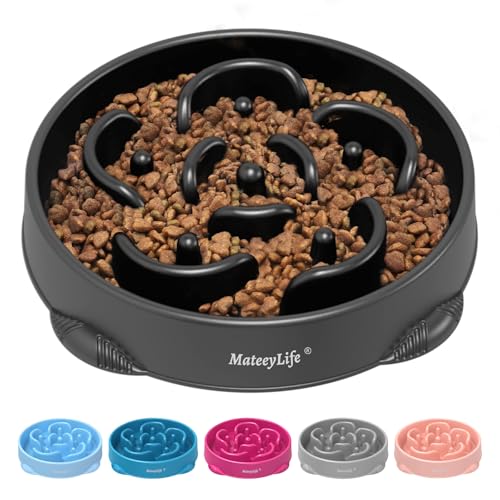
| MateeyLife Large Slow Feeder Bowl | Maze bowl, polypropylene | 4 cups; 26.7 cm wide | Top rack dishwasher safe | Amazon UK (overseas) |
Best overall: Outward Hound Fun Feeder Slo Bowl (Large)
The Outward Hound Fun Feeder Slo Bowl (Large) is the best overall slow feeder dog bowl here for most dogs. It is rated 4.6 from 4,763 ratings and sold by Amazon AU. Its listing says it holds 4 cups of dry or wet dog food, has a non slip base and is top rack dishwasher safe.
The listing calls this the SLOWER level, designed for fast eaters, with a deep dog bowl and a challenging maze design, and says slow feeder bowls help slow down eating up to 10X. That is the maker's claim, not our testing. The product information lists polypropylene and 29.8 by 29.8 by 5.7 centimetres, and the description says over 1 million of these bowls have been sold, in multiple sizes and maze styles.
Size choice matters. The description says the Large or Regular holds up to 4 cups of dry kibble, the Medium or Mini holds 2 cups, and the Small or Tiny holds 3/4 cup. A dog that gives up on a hard pattern may suit an easier maze style. The listing also makes health claims about bloat and digestion, which are the maker's words; ask your vet about any concern with your dog's eating.
How we chose these slow feeder dog bowls
We chose these bowls from Amazon AU listings and from the makers' own information on each listing. Specs come from the maker's bullet points and the product information on each listing, plus the description where the listing has one. We record size, capacity, material and care wording as listed, say where a listing disagrees with itself, and credit health wording to the maker. We do not test bowls with dogs.
Last checked: 21 October 2026.
What a slow feeder dog bowl does
A slow feeder dog bowl has ridges or a maze that makes a dog work around obstacles to reach its food, so a meal takes longer. The Outward Hound listing says its bowls help slow down eating up to 10X, and the Bifeaw listing describes a puzzle design that prolongs mealtime.
The makers add further claims, such as less swallowed air and mental stimulation, but those are their words and we have not tested them. The bowls here fall into four types, each described in the listing's own wording:
- Maze or ridge bowl: the Outward Hound listing says maze design, the Zenify listing describes an internal pattern with curved obstacles, and the MateeyLife listing says ridges and maze patterns.
- Stainless steel: the AIPERRO is listed as 304 food grade stainless steel with a one piece mold.
- Silicone: the Bifeaw is listed as silicone that can also be used as a lick mat.
- Lick mat and bowl: the LickiMat Wobble has a rubber dimpled surface for licking treats, yogurt, peanut butter or wet, dry or raw food.
Level is the maker's word for how hard the pattern is. The Outward Hound listing calls its bowl the SLOWER level, designed for fast eaters, and the AIPERRO listing says to increase the difficulty level to slow eating further.
Bifeaw Silicone Slow Feeder Bowl
The Bifeaw Silicone Slow Feeder Bowl is rated 4.5 from 1,720 ratings and sold by yueqianli. Its title calls it a puppy slow feeder with a non slip design, and the bullets say it suits medium and small dogs.
The bullets give 7.5 inches by 1.2 inches and say it holds 1 to 2 cups of dry, wet or fresh food, while the product information table gives 19 by 19 by 3.5 centimetres and a capacity of 1.5 cups. We use the 19 cm width only, because the height differs between the two. The listing says the silicone is non toxic and food grade, made without plastics, BPA or phthalates, and that the bowl is dishwasher safe and can withstand the freezer and microwave.
The bullets also say it can be used as a lick mat. The trade off is size: it is built for small and medium dogs, so a large dog needs a bigger bowl from this page.
Zenify 500ml Slow Feeder Bowl
The Zenify 500ml Slow Feeder Bowl is rated 4.5 from 1,486 ratings and sold by Zenify AU. The bullets give 20.2 cm base length and width, 4.8 cm height, a 16.5 cm inside diameter and a food volume of 500 ml, and the product information table lists Acrylonitrile Butadiene Styrene (ABS) with a capacity of 500 ml.
The bullets say the bowl is made with food safe, high strength ABS, that the internal pattern has no sharp edges and is bite resistant, and that four anti skid feet give the bowl floor grip. They also say you can feed wet, dry or raw food meals. The care instructions field in the product information says Hand Wash Only, while the bullets say the curved obstacles and smooth finish make the bowl simple to rinse clean after use.
The listing gives the height as 4.8 cm and does not state how deep the pattern is, so check it suits your dog. The description says the maker donates its Zenify Pets regularly to causes throughout Australia, which is the maker's own claim.
AIPERRO Stainless Steel Slow Feeder
The AIPERRO Stainless Steel Slow Feeder is rated 4.4 from 1,815 ratings and sold by WealthWing-AU. Its title says 4 cups for medium and large dogs, but the product information says Dog Breed Size Small and Breed Recommendation Small Dogs. It gives a capacity of 4 cups, stainless steel and 24.1 by 24.1 by 5.1 centimetres.
The bullets call it 304 food grade stainless steel that is sturdy, long lasting, odorless, stain resistant and rust resistant, with a one piece mold that makes cleaning and maintenance easy and a non slip base. They also say the internal barriers are very friendly to a dog's mouth, that you can increase the difficulty level to slow eating, and that the bowl comes in two sizes for different capacities.
Care wording conflicts. The bullets say the dishwasher is also very safe and the table answers yes to dishwasher safe, while the care instructions field says Hand Wash Only. Follow the care label that comes with the bowl.
LickiMat Wobble
The LickiMat Wobble is rated 4.5 from 5,093 ratings and sold by LickiMat Australia. Its title calls it a fun alternative to a slow feed dog bowl, the product information table lists rubber and a capacity of 600 ml, and the bullets say natural rubber with no silicone.
The bullets say the wobbling action adds an extra dimension to the challenge of licking treats, yogurt, peanut butter or wet, dry or raw food from the rubber dimpled surface, and that it is for small and medium sized dogs. The maker also says it helps calm and soothe pets in stressful times such as thunderstorms and fireworks, and that it can promote slower eating. Those are the maker's claims, so ask your vet about anxiety.
The listing says to supervise your pet and that this is not a chew toy; for puppies or known chewers it points to the LickiMat Tuff instead. The care field lists both Dishwasher Safe and Hand Wash Only, so follow the care label that comes with the mat. The listing does not describe a base.
MateeyLife Large Slow Feeder Bowl
The MateeyLife Large Slow Feeder Bowl is rated 4.6 from 2,928 ratings. On 21 October 2026 the buy box showed Amazon UK as shipper and seller, with Amazon's notice that UK imports may differ from local products, and the listing says the item is non returnable.
The title says it is for large breeds and 4 cups, the bullets say it can hold up to 4 cups of kibbles, and the product information table lists polypropylene, a capacity of 4 cups and 26.7 by 26.7 by 4.6 centimetres. The bullets say it slows mealtime up to 10x, has a non slide base, suits dry, wet and raw food diets, and is made of polypropylene that is food safe and non toxic.
The bullets also say the raised parts are low enough and the gaps are wide for pets, so we do not call this maze deep. The description says top rack dishwasher safe. If you want a 4 cup bowl sold by Amazon AU, compare the Outward Hound first.
Which slow feeder suits your dog: size, puppies and breed
Start with how much your dog eats at a meal, then look at the pattern. Listings give capacity in cups or millilitres, so compare like with like and read the section for each bowl above.
Large dogs and Labradors
For a large breed such as a Labrador, start with the bowls whose listings agree on size. The Outward Hound listing says it fits a full meal for large dogs and the MateeyLife title says large breeds. The AIPERRO title says medium and large dogs, but its product information says Dog Breed Size Small and Breed Recommendation Small Dogs, so we do not recommend it for a large dog until the seller clears that up. The Outward Hound is the best overall choice for most dogs, the AIPERRO is the stainless steel option, and the MateeyLife is a second 4 cup maze bowl.
Small dogs and puppies
The Bifeaw title calls it a puppy slow feeder and its bullets say it suits medium and small dogs. The LickiMat listing says it is for small and medium sized dogs. The Outward Hound description lists a Medium or Mini size that holds 2 cups and a Small or Tiny size that holds 3/4 cup; those are separate sizes from the large bowl reviewed on this page.
Flat faced breeds
No listing here says whether its bowl suits a flat faced breed such as a French Bulldog. The product information gives heights of 5.7 cm for the Outward Hound, 5.1 cm for the AIPERRO and 4.6 cm for the MateeyLife, and the Zenify bullets give 4.8 cm, but a height does not tell you how reachable the food is. Ask your vet or breeder about a short muzzled dog.
Wet, dry and raw food
The Zenify bullets say you can feed wet, dry or raw food meals, the MateeyLife bullets say its bowl applies to dry, wet and raw food diets, the Outward Hound bullets say it holds dry or wet dog food, and the Bifeaw bullets say dry, wet or fresh food. The LickiMat bullets describe licking treats, yogurt, peanut butter or wet, dry or raw food from a rubber dimpled surface.
Quick matches
- A large dog that gulps: the Outward Hound large, rated 4.6 from 4,763 ratings, listed at 4 cups and the SLOWER level.
- A small or medium dog or a puppy: the Bifeaw, rated 4.5 from 1,720 ratings, with a puppy slow feeder title.
- A stainless steel bowl: the AIPERRO, rated 4.4 from 1,815 ratings, listed as 304 food grade stainless steel with 4 cups in its title.
- Wet food and treats: the LickiMat Wobble, rated 4.5 from 5,093 ratings, a rubber lick mat of 600 ml.
- A compact 500 ml bowl: the Zenify, rated 4.5 from 1,486 ratings, with four anti skid feet and hand wash only care.
- A second 4 cup maze bowl: the MateeyLife, rated 4.6 from 2,928 ratings and an overseas offer, so read its section first.
Materials compared
The product information tables list polypropylene for the Outward Hound and MateeyLife, Acrylonitrile Butadiene Styrene (ABS) for the Zenify, stainless steel for the AIPERRO, silicone for the Bifeaw and rubber for the LickiMat. The AIPERRO bullets specify 304 food grade stainless steel, the Bifeaw bullets say food grade silicone made without plastics, BPA or phthalates, the MateeyLife bullets call its polypropylene food safe and non toxic, the Zenify bullets say food safe ABS, and the LickiMat bullets say natural rubber with no silicone.
What to check before you buy
Five details separate these listings, and each is worth reading on the Amazon AU page before you order.
- Capacity: the Outward Hound, AIPERRO and MateeyLife list 4 cups, the Zenify lists 500 ml, the LickiMat lists 600 ml, and the Bifeaw bullets say 1 to 2 cups against 1.5 cups in its table.
- Base: the Outward Hound, AIPERRO, MateeyLife and Zenify bullets describe a non slip, non slide or anti skid base, the Bifeaw title says non slip design, and the LickiMat listing does not describe a base.
- Material: see the comparison above, and read the maker's own safety wording for the bowl you choose.
- Care: read the care field, because the AIPERRO and LickiMat listings give both dishwasher safe and hand wash only wording.
- Level: the Outward Hound listing calls its bowl the SLOWER level, and a harder pattern is not better for every dog.
Cleaning and care
Patterned bowls hold food in their grooves, so check the care wording before you buy. The Outward Hound and MateeyLife listings say top rack dishwasher safe, and the Bifeaw listing says dishwasher safe and able to go in the freezer and microwave. The Zenify product information says Hand Wash Only. The AIPERRO and LickiMat listings disagree with themselves, giving dishwasher safe wording in some places and Hand Wash Only in the care field, so follow the care label that comes with the bowl.
A non slip base is the other practical point. The Outward Hound bullets say its non slip base holds the bowl in place and helps prevent spills, the AIPERRO bullets say its non slip base prevents sliding or tipping over, the MateeyLife bullets say the non slide base prevents movement, the Zenify bullets say four anti skid feet give floor grip, and the Bifeaw title says non slip design. The LickiMat listing does not describe a base.
Bloat and your vet
Several listings make health claims. The Outward Hound listing says it helps reduce obesity and bloat in dogs and supports proper digestion, the AIPERRO listing says its design slows eating and reduces choking and bloating risk, and the Zenify listing says the benefits can include reduced bloating, overeating, vomiting and obesity. These are the makers' words, not our testing or advice.
A bowl cannot diagnose a problem with how a dog eats. If your dog gags, vomits after meals or you worry about bloat, ask your vet.
Where a slow feeder fits among dog bowls
A slow feeder is one part of the mealtime setup. If your dog struggles to reach a floor level bowl, an elevated dog bowl lifts the bowl off the floor, a dog puzzle toy takes the enrichment idea further than a bowl can, how much goes in the bowl comes back to the dog food you feed, and a pet water fountain covers the water side of mealtime.
Our verdict
For most dogs the Outward Hound Fun Feeder Slo Bowl (Large) is the one to buy. It is rated 4.6 from 4,763 ratings, and its Amazon AU listing gives 4 cups, a non slip base, top rack dishwasher safe care and the SLOWER level for fast eaters. The Bifeaw is the silicone option for small and medium dogs, the AIPERRO is the stainless steel option, the Zenify holds 500 ml and is hand wash only, the LickiMat Wobble is a lick mat for wet food and treats, and the MateeyLife is a second 4 cup maze bowl. Ask your vet about any concern with how your dog eats.
Frequently Asked Questions
What does a slow feeder dog bowl do?
A slow feeder dog bowl has ridges or a maze that makes a dog work around obstacles to reach its food, so a meal takes longer. The Outward Hound listing says its bowls help slow down eating up to 10X, and the Bifeaw listing describes a puzzle design that prolongs mealtime.
Are slow feeder bowls good for dogs?
For a dog that gulps its food, the makers say yes. The Outward Hound listing says its SLOWER level is designed for fast eaters, and the Bifeaw listing says slower eating can reduce swallowed air. These are maker claims, not our testing, so ask your vet about any health concern.
What is the best slow feeder dog bowl in Australia?
The Outward Hound Fun Feeder Slo Bowl in large is the best overall pick here, rated 4.6 from 4,763 ratings. Its Amazon AU listing gives 4 cups, a non slip base and top rack dishwasher safe care. It is the SLOWER level for fast eaters, so a nervous dog may do better with an easier pattern.
Which is the best slow feeder dog bowl?
It depends on the dog. For a large dog the Outward Hound large holds 4 cups. For a small or medium dog or a puppy, the Bifeaw silicone bowl is listed as a puppy slow feeder. For wet food try the LickiMat Wobble lick mat, and for stainless steel the AIPERRO is listed as 304 food grade.
What are the downsides of slow feeder bowls for dogs?
Some dogs get frustrated if a pattern is too hard, and care wording differs between bowls. The Zenify listing says hand wash only, while the AIPERRO and LickiMat listings give both dishwasher and hand wash wording. The LickiMat listing also says it is not a chew toy and asks you to supervise your pet.
How do I tell if my dog needs a slow feeder bowl?
A slow feeder is aimed at dogs that finish a meal in seconds. The Outward Hound listing says its SLOWER level is designed for fast eaters. If your dog gags or vomits after meals, or you worry about bloat, that is a question for your vet, not something a bowl can settle.
What can I put in my dog's food bowl to slow down eating?
A slow feeder bowl is the simple answer, and a lick mat is another. The LickiMat Wobble listing describes licking treats, yogurt, peanut butter or wet, dry or raw food from its rubber dimpled surface. Check with your vet before adding foods such as peanut butter, and supervise your dog.
Why a slow feeder dog bowl?
Owners choose one when a dog bolts its meals. The Bifeaw listing pitches less swallowed air and mental stimulation, and the Outward Hound listing says its bowls keep pups engaged up to 10x longer at mealtimes, but those are maker claims. We check capacity, a non slip base, material and dishwasher care.
How big should my dog's food bowl be?
Match the bowl to a normal meal. The Outward Hound large holds 4 cups, and its description says the Medium or Mini holds 2 cups and the Small or Tiny holds 3/4 cup. The Bifeaw bullets say 1 to 2 cups and its table 1.5 cups, the Zenify holds 500 ml, and the AIPERRO and MateeyLife list 4 cups.