Best Bath Towels in Australia 2026: GSM, Cotton Types and Plushness Compared
By Anish Puri·2 June 2026·Last updated 8 October 2026·8 min read
The difference between a cheap and a dear bath towel is GSM, cotton type and how fast it dries between uses. Our pick is the Utopia Towels 4-pack, 600 GSM ring-spun cotton by its listing. Here's what's actually worth paying for, and why higher GSM isn't always better.
Prices checked 17 October 2026 on Amazon AU and subject to change.
A bath towel is one of those everyday objects where the price range is wide enough to be confusing. You can spend a little on a two-pack or a lot more on a single set, and both will dry you off perfectly well. The question is what the extra money actually buys, and whether a plusher, dearer towel is genuinely the better towel for your bathroom.
The honest answer is that towels are not really about the brand or the price tag. They are about three things: the cotton, the GSM (the weight or density of the weave), and the way the towel is spun and finished. Get those right and a mid-priced towel will outlast and out-perform a designer one. Get them wrong (buy the plushest, heaviest towel for a bathroom with no airflow), and you will spend the next two years living with a towel that never quite dries and starts to smell.
If you want one number to shop by, buy 400 to 600 GSM: heavy enough to feel plush, light enough to dry between showers in an Australian bathroom. Of the picks here, the Utopia Towels 4-pack is the all rounder most households should buy, the Amazon Basics quick dry 2 piece is the light, quick drying set, though its listing said temporarily out of stock at our 8 October 2026 check, and the Tens Towels extra large is the big, light one. And the sizes, smallest to largest, run face washer, hand towel, bath towel, then bath sheet, which is the big one you can wrap right around yourself.
Here is what actually makes a good bath towel, what GSM means and why higher is not always better, the truth about Egyptian versus Turkish cotton, and which specific towels are worth buying in Australia in 2026 across every budget.
How the seven towel sets compare
Cotton type, pack size and how quickly a towel dries are what separate these seven.
Pick
Best for
Key spec
Rating
Amazon Basics 2-Piece Quick-Dry Oversize
Quick dry, light weave
100 per cent cotton, quick-dry weave, oversize
4.4, temporarily out of stock at our 7 October 2026 check
Utopia Towels 4-Pack Premium
Best overall
600 GSM ring-spun cotton, 4-pack for the full rotation
4.4
Tens Towels Large Bath Towels
Extra large and light
Cotton, 30 by 60 inches, light and quick drying
4.3
LINENOVA Bath Sheets 2-Pack
Bath sheets
550 GSM combed cotton, 90 by 180 cm
4.5 on its listing
Trends Alley Bourgeois Bath Sheets 2-Pack
Plush bath sheets
600 GSM combed cotton, 90 by 165 cm
4.5 on its listing
Trends Alley Panache 6-Piece Set
A matching set
550 GSM combed cotton, 2 bath, 2 hand, 2 face
4.4 on its listing
Royal Comfort 8-Piece Set
A full set with a bath mat
600 GSM cotton, 8 pieces
4.2 on its listing; dispatched in 2 to 3 days
How we picked these bath towels
We compared the sets on cotton type, weight (GSM, where the maker states it), size, pack size and how quickly they dry. Specifications come from each Amazon AU listing and from the Utopia Towels and Tens Towels brand stores, and we checked stock, sellers and ratings on the Amazon AU listings on 7 October 2026 (8 October 2026 for the four sets added that day). For scale, the Amazon Basics listing gives its oversize towel as 137.16 by 76.2 cm. We did not test these towels ourselves, so every specification is attributed to the listing or brand that states it.
What Actually Makes a Good Bath Towel
The honest short version is that a good bath towel comes down to the cotton, the GSM, and the weave, not the brand on the label or the price on the ticket. Almost every claim a towel makes beyond those three things is marketing, and once you understand the three that matter you can buy well at almost any price point.
The cotton determines how soft and durable the towel is, and how much it lints (sheds little fibres) in the first few washes. The GSM determines how plush and absorbent the towel feels and (the catch most people miss) how long it takes to dry between uses. The weave (how tightly the loops are packed and how long they are) affects both softness and how quickly the towel sheds water back into the air on the rail.
What does not matter nearly as much as the marketing suggests: the country named on the label, whether the towel is described as "hotel" or "spa" or "luxury", and the price itself. A towel made from good ring spun cotton at a sensible GSM will serve you better than an expensive towel that is so heavy it never dries in a humid bathroom. The rest of this guide unpacks each of the three things that genuinely matter, starting with the single most important spec.
Best overall: Utopia Towels 4-Pack Premium Bath Towels
For most households the Utopia Towels 4-pack is the set to buy. Its listing describes four 600 GSM bath towels in 100% ring-spun cotton, each 27 by 54 inches, which puts it at the plush end of the range that still dries on a rail between showers. A 4-pack covers a two-person rotation in one buy. It was in stock, sold by Amazon AU, at 4.4 stars from 571 ratings.
Top pick
Utopia Towels
Utopia Towels 4-Pack Premium Bath Towels
4.4(571)
$73.42
Amazon.com.au price as of 05:01 am AEDT, subject to change
As an Amazon Associate, NestPath earns from qualifying purchases.
GSM Explained: The One Spec That Matters Most
GSM stands for grams per square metre, and it is the single most useful number on a towel. It tells you the weight, and therefore the density, of the towelling. A higher GSM means more cotton packed into the same area, which is what you feel as plushness. It is the closest thing towels have to a meaningful spec, and once you understand the bands you can shop with confidence.
Here is the practical breakdown:
GSM band
Best for
Drying behaviour
Feel
300 to 400 GSM
Gym, beach, humid bathrooms with poor airflow
Thinnest and fastest drying
Least plush
400 to 600 GSM
Most Australian bathrooms
Dries between showers
The sweet spot
600 to 900 GSM
Well-ventilated bathrooms and guest sets
Slowest to dry, heaviest to wash
Hotel plush
300 to 400 GSM: light and fast-drying. Thin, quick to dry, and light to wash. These are your gym towels, beach towels, and everyday towels for households that value fast drying over plushness. They do not feel luxurious, but they dry on the rail in a fraction of the time and almost never go musty.
400 to 600 GSM: the sweet spot for most bathrooms. Plush enough to feel like a proper, soft towel, but still light enough to dry between showers. For the vast majority of Australian households this is the band to aim for. It is where comfort and practicality meet. Most of the towels worth buying for daily home use sit here.
600 to 900 GSM: thick, hotel-luxury, slowest to dry. The plushest, most indulgent towels, the ones that feel like a hug out of the shower. They are also the heaviest to wash, the slowest to dry, and the most likely to develop a musty smell if they do not get a chance to dry fully between uses. Wonderful in a well-ventilated bathroom; a liability in a small, steamy one.
The lesson that matters most: higher GSM is not automatically better. It is a plushness-versus-drying-time trade-off, nothing more. A 900 GSM towel is more luxurious to touch and slower to dry; a 350 GSM towel is less plush and dries almost instantly. Neither is "better" in the abstract. The right GSM is the one that suits your bathroom's ventilation, your climate, and how often the towels actually get used and washed. Choose the band, then choose within it.
Cotton Types: Egyptian vs Turkish vs Regular Cotton
The second thing that matters is the cotton itself. Towel marketing leans heavily on cotton names (Egyptian, Turkish, Supima, combed, ring-spun), and some of it is meaningful while some of it is mostly a sticker. Here is the plain-English version.
Regular cotton is fine, and it is cheap. A towel made from ordinary cotton will dry you off and last for years. It may shed a few more fibres in the first washes and feel a touch less smooth than fancier cotton, but for a spare bathroom or a rental it is completely adequate and there is no need to apologise for buying it.
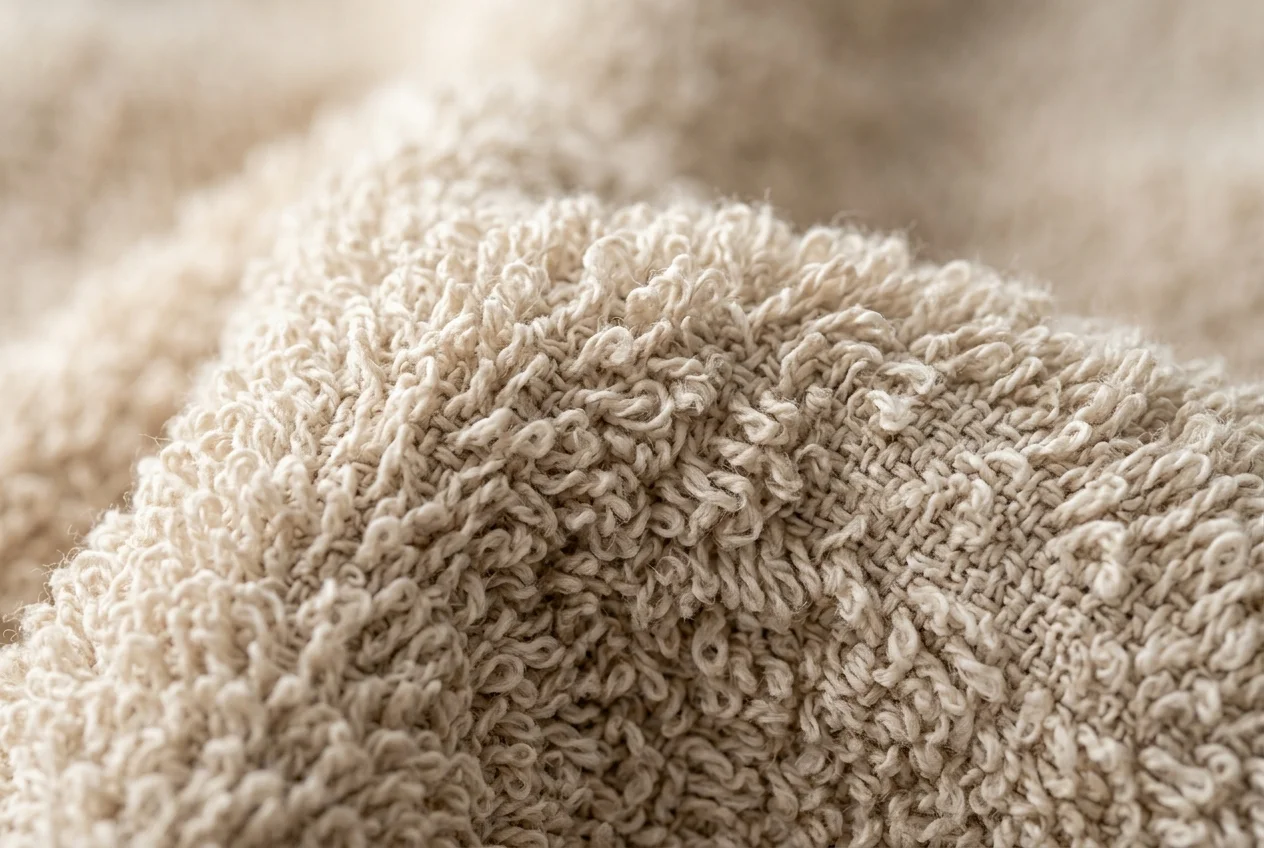
Combed and ring-spun cotton is the genuine, affordable step up. Combing removes the short, stray fibres before spinning, and ring-spinning twists the long fibres into a smoother, stronger yarn. The result is a towel that is smoother to the touch, more durable, and lints less: fewer little fibres on your skin and in the wash. This is the upgrade most worth paying for, and you will find it at very reasonable prices.
Egyptian cotton has genuinely long fibres, which makes for towels that are soft, very absorbent, and durable. It is a real premium material, but it is also a marketing word that gets stretched, and not every towel labelled "Egyptian cotton" is made entirely from the good stuff. When it is the real thing it is excellent; just do not assume the name alone guarantees quality.
Turkish cotton is another long-fibre cotton, and it has a couple of traits that make it a great all-rounder: it tends to dry faster than Egyptian cotton and it gets softer with each wash rather than wearing out. For Australian bathrooms (where drying time genuinely matters), Turkish cotton is often the smarter premium choice than Egyptian, and frequently cheaper too.
The honest takeaway: do not over-pay for a country name. The quality of the cotton and the right GSM matter far more than whether the label says Egyptian or Turkish. A well-made ring-spun cotton towel at the right weight beats a poorly made "Egyptian cotton" towel every time.
As an Amazon Associate, NestPath earns from qualifying purchases.
Absorbency, Drying Time and Plushness: The Real Trade-Off
This is the heart of buying towels well, and it is the part most people only learn after living with the wrong towel for a year. Absorbency, drying time, and plushness are not three separate features you can max out together. They pull against each other, and the trick is choosing the balance that suits your life.
A plusher, higher-GSM towel feels luxurious and holds more water, so it absorbs beautifully. But that same density means it takes longer to dry out after you use it, and a towel that does not dry fully between uses is exactly how towels develop that stale, musty smell. In humid and coastal Australian bathrooms, where the air is already damp and ventilation is often poor, a heavy towel can sit half-damp on the rail all day and never fully recover before the next shower.
A lighter, lower-GSM towel is the opposite. It feels less plush and absorbs a little less in one pass, but it dries fast on the rail and shrugs off odour because the moisture leaves quickly. In a small ensuite with no window and a fan that barely runs, a lighter towel is genuinely the better towel, not because it is cheaper, but because it stays fresh.
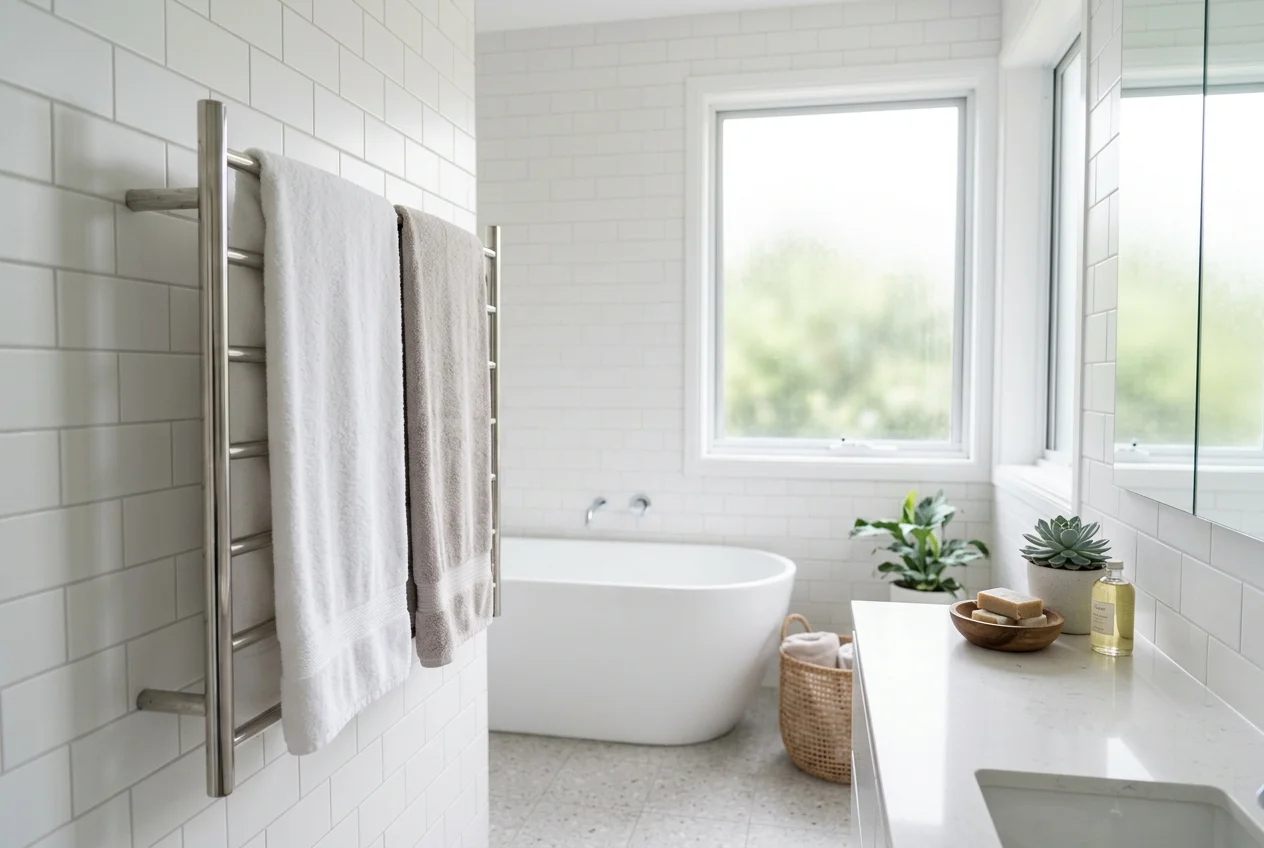
So the real question is not "which is the best towel" but "which is the best towel for my bathroom". If you have a big, well-ventilated bathroom with a window or a strong extractor fan, you can enjoy a plush high-GSM towel without the musty downside. If your bathroom is small, steamy, and slow to clear, prioritise drying time over plushness. Your towels will smell fresher and last longer for it. This is also why managing bathroom humidity in general pays off; a dehumidifier in a damp bathroom helps towels (and everything else) dry properly and keeps mould at bay.
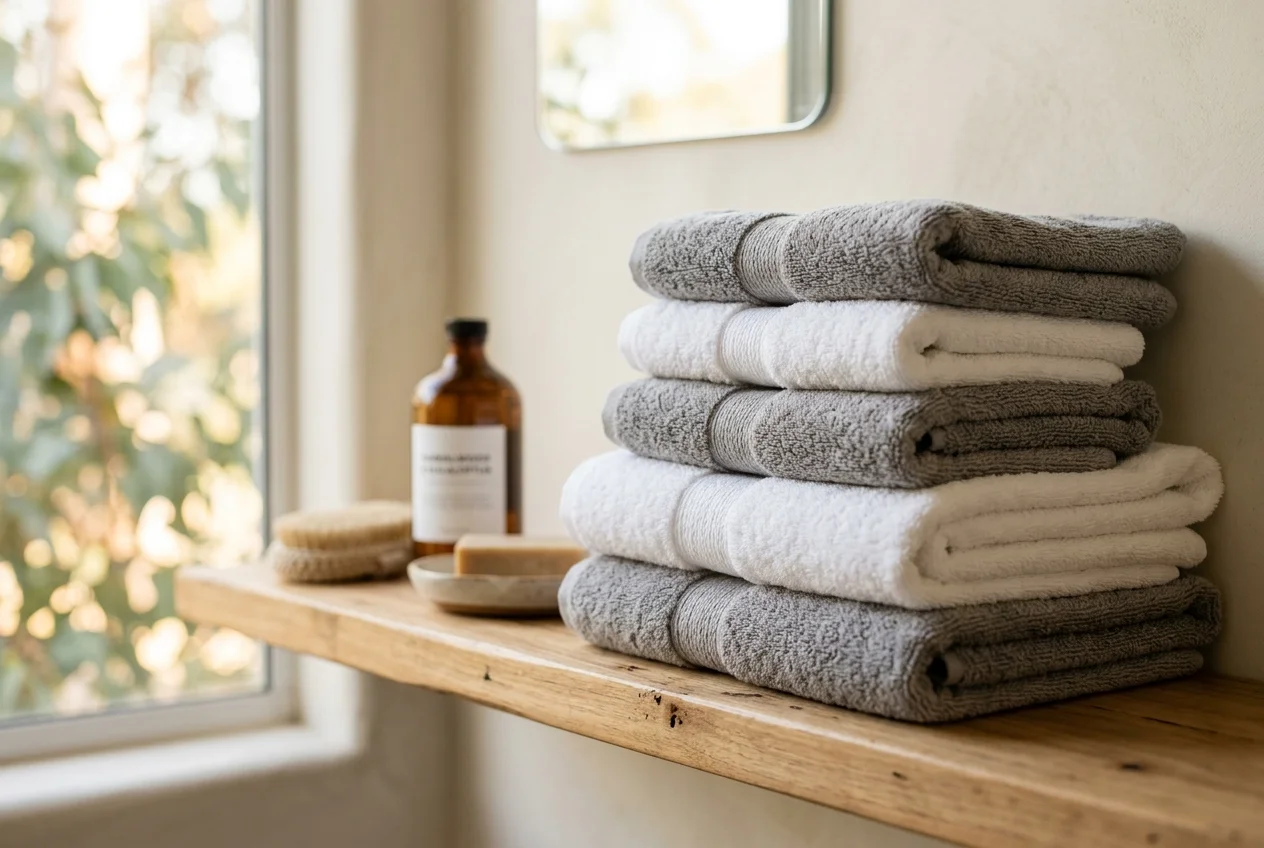
How Many Towels Do You Need: Bath Towel or Bath Sheet
Once you have picked the right towel, the next question is how many. A sensible rule of thumb is two bath towels per person (one in use and one in the wash or on a fresh rotation), plus a few spares for guests. For a couple that is four to six towels in regular rotation; for a family of four, eight or so. Buying a 4-pack in one go, rather than a towel at a time, is the easy way to get a matched set and cover the rotation properly. Count the rest of the set while you are at it: a bath mat per bathroom, plus hand towels and face washers, is what turns a pile of towels into a finished bathroom. If you are updating the vanity as well, an LED bathroom mirror adds lighting around the mirror.
You will also see "bath sheets" sold alongside bath towels, and the difference is simply size. A bath sheet is bigger than a bath towel: more surface area, more coverage, the kind you can wrap fully around yourself. The upsides are obvious: more drying surface and a more enveloping feel. The downsides follow directly from the size: a bath sheet uses more cotton, so it is heavier to wash and slower to dry, and at a high GSM it can be a real drying-time problem in a humid bathroom. If you love the wrapped-up feel and have the airflow to dry them, bath sheets are lovely. If drying time is already a concern, a standard bath towel is the more practical choice, and if it is the wrapped-up feeling you are really after, a towelling robe does that job without adding a slow-drying sheet to the rail.
What about Sheridan, Adairs, Canningvale and KOO?
Those are the names most Australians actually see when they shop for towels, and none of them is among our picks. Sheridan and Bambury sell through Myer, David Jones and Harris Scarfe, Adairs and Canningvale sell through their own stores and online, KOO is the Spotlight house brand and sits at the budget end, and Myer Heritage is the department store label. We rank from Amazon Australia listings where we can confirm a price, a star rating and a review count, so those ranges sit outside this guide rather than below it, and we earn nothing from those retailers. The good news is that the rules on this page transfer exactly: check the GSM on the swing tag, buy 400 to 600 unless your bathroom has real airflow, and wait for the department store sales, because the premium ranges are discounted often.
Care: How to Keep Towels Soft, Fluffy and Odour-Free
This is the most practical section in the guide, because how you wash your towels matters as much as which towels you buy. A great towel cared for badly turns rough and musty within a year; a modest towel cared for well stays soft and fresh for years. The rules are simple, and a couple of them are genuinely counter-intuitive.
Wash them before the first use. New towels carry finishing residues from manufacturing that sit on the cotton and stop it absorbing properly: that "why isn't my new towel soaking up water" feeling. One wash before first use strips the residue and switches the absorbency on.
Do not use fabric softener. This is the big one, and it surprises people. Fabric softener works by coating fibres in a waxy film, and on a towel that film progressively kills the cotton's ability to absorb water, the exact job a towel exists to do. It feels soft in the short term and ruins the towel over time. Skip it entirely on towels, and use a detergent without a built-in softener or optical brightener while you are at it. In winter, when nothing dries on the line, a clothes airer in a room with the door open beats draping towels over a radiator, because it is airflow rather than heat that stops the musty smell.
Use a little white vinegar instead. A small splash of plain white vinegar in the wash strips out detergent and softener residue and neutralises the stale, musty odour that builds up in towels. It rinses away completely and leaves no smell. Do it every few washes, or whenever towels start to feel stiff or smell off.
Do not over-dry them. Blasting towels in a hot dryer until they are bone dry makes the fibres rough and brittle. Take them out while there is still the faintest trace of moisture, or line-dry them and finish briefly in the dryer. A gentler dry keeps the loops soft.
Shake them out before drying. Giving a damp towel a firm shake before it goes on the line or into the dryer fluffs the loops back up and stops them drying flat and matted. It is a two-second habit that visibly improves how plush the towel feels.
Wash towels separately on a warm wash. Towels lint, and that lint clings to clothing, and they need a warmer wash than delicates to clean properly and stay hygienic. Washing them as their own load on a warm cycle keeps them fresh and keeps fluff off your everyday clothes.
Towels and everyday clothes run best as separate loads, so drum size matters: our guide to front load and top load washing machines compares capacity and running costs.
Replace them when they stop doing the job. When a towel no longer absorbs the way it used to, or has a musty smell that no amount of washing or vinegar will shift, it has reached the end of its useful life. No care routine lasts forever, but good towels treated this way will give you many years before that point.
Also great
Tens Towels
Tens Towels Large Bath Towels
4.3(15,064)
$88.94
Amazon.com.au price as of 05:01 am AEDT, subject to change
As an Amazon Associate, NestPath earns from qualifying purchases.
More sets worth a look: bath sheets and full bathroom sets
Four more sets cover what the three above do not: bath sheets for the wrapped-up feel, and matching sets with hand and face towels. All four listings sell other sizes or colours, and Amazon shows one rating across each listing, so read the stars as the range's rather than this exact set's.
Bath sheets: LINENOVA 90 by 180 cm, 2 pack
The LINENOVA set is two 90 by 180 cm bath sheets in 100% combed cotton at 550 GSM, OEKO-TEX certified, per its listing. That is the bath sheet size the section on bath sheets above describes: more coverage, but more cotton to dry, so it suits a bathroom with a window or a fan that runs. It was in stock and sold by NOVOBAY on Amazon AU.
LINENOVA
LINENOVA 100% Cotton Bath Sheets 90x180cm, 2 Pack
The LINENOVA set is two 90 by 180 cm bath sheets in 100% combed cotton at 550 GSM, OEKO-TEX certified, per its listing: the size for the wrapped-up feel, best with a bathroom that has airflow. Its Amazon rating covers the listing's other sizes or colours too. In stock and sold by NOVOBAY on Amazon AU.
$55.99
Amazon.com.au price as of 11:01 pm AEDT, subject to change
As an Amazon Associate, NestPath earns from qualifying purchases.
Plush bath sheets: Trends Alley Bourgeois, 2 pack
The Trends Alley Bourgeois sheets are 90 by 165 cm in 100% combed cotton at 600 GSM, per their listing, with double-stitched seams. At 600 GSM they sit at the plush top of the 400 to 600 band, so give them airflow to dry. They were in stock and sold by Trends Alley on Amazon AU.
Trends Alley
Trends Alley Bourgeois Bath Sheets, 2 Pack
The Trends Alley Bourgeois set is two 90 by 165 cm bath sheets in 100% combed cotton at 600 GSM, per its listing, at the plush top of the sweet-spot band. Its Amazon rating covers the listing's other sizes or colours too. In stock and sold by Trends Alley on Amazon AU.
$64.25
Amazon.com.au price as of 11:01 pm AEDT, subject to change
As an Amazon Associate, NestPath earns from qualifying purchases.
A matching set: Trends Alley Panache, 6 pieces
The Panache set is two 70 by 140 cm bath towels, two hand towels and two face towels in combed cotton at 550 GSM, per its listing, which says to machine wash up to 40 degrees and tumble dry low. It suits a guest bathroom or a first home that needs the smaller towels too. It was in stock and sold by Trends Alley on Amazon AU.
Trends Alley
Trends Alley Panache 6 Piece Towel Set
The Trends Alley Panache set is six pieces in combed cotton at 550 GSM, per its listing: two 70 by 140 cm bath towels, two hand towels and two face towels. Its Amazon rating covers the listing's other sizes or colours too. In stock and sold by Trends Alley on Amazon AU.
$59.95
Amazon.com.au price as of 11:01 pm AEDT, subject to change
As an Amazon Associate, NestPath earns from qualifying purchases.
A full set with a bath mat: Royal Comfort, 8 pieces
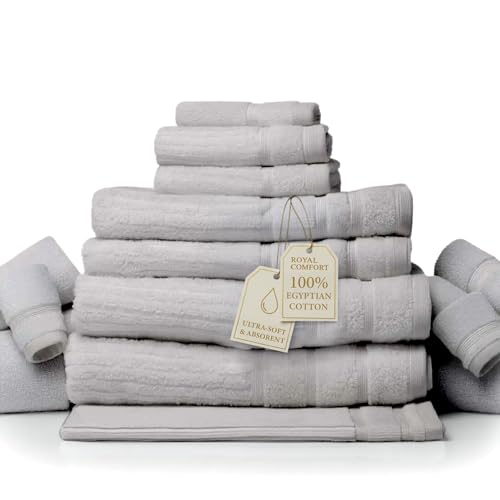
The Royal Comfort set adds a bath mat and a hand glove to two 69 by 137 cm bath towels, two hand towels and two face towels, at 600 GSM per its listing. Its title says Egyptian cotton while its bullets say 100% cotton; as the cotton section above explains, that label is often stretched, so buy this set for the pieces and the weight, not the name. Amazon AU listed it as usually dispatched within 2 to 3 days, sold by Good Buyz AU, at our 8 October 2026 check.
Royal Comfort
Royal Comfort 8 Piece Bath Towel Set, 600 GSM
The Royal Comfort set is eight pieces at 600 GSM, per its listing: two 69 by 137 cm bath towels, two hand towels, two face towels, a bath mat and a hand glove. Its title says Egyptian cotton and its bullets say 100% cotton, so buy it for the set. Its Amazon rating covers the listing's other sizes or colours too. Amazon AU listed it as usually dispatched within 2 to 3 days, sold by Good Buyz AU, at our 8 October 2026 check.
$39.95
Amazon.com.au price as of 11:01 pm AEDT, subject to change
Available to order at Amazon AU, ships after a lead time, last verified on 17 October
As an Amazon Associate, NestPath earns from qualifying purchases.
Frequently Asked Questions
What GSM is best for bath towels?
For most bathrooms, 400 to 600 GSM is the sweet spot, plush enough to feel like a proper soft towel, but still light enough to dry between showers. Below that, 300 to 400 GSM towels are thinner and faster-drying, which makes them ideal for the gym, the beach, or a humid bathroom with poor ventilation. Above that, 600 to 900 GSM towels are thick and hotel-luxurious but heavier to wash and the slowest to dry, so they only make sense in a well-ventilated bathroom. Higher GSM is not automatically better, it is a plushness-versus-drying-time trade-off, so choose the band that suits your bathroom rather than simply buying the heaviest towel you can.
Egyptian vs Turkish vs regular cotton: which is best?
Regular cotton is fine and cheap, and perfectly adequate for a spare bathroom or rental. Combed or ring-spun cotton is the genuine affordable upgrade, smoother, more durable, and it lints less. Egyptian cotton has long fibres that make it soft, absorbent, and durable, though the name is also used loosely as a marketing term, so it does not guarantee quality on its own. Turkish cotton is another long-fibre cotton that dries faster than Egyptian and gets softer with each wash, which makes it a great all-rounder for Australian bathrooms where drying time matters. The honest answer is that the quality of the cotton and the right GSM matter far more than the country named on the label, do not over-pay for a name.
Why do my towels smell or go scratchy?
The musty smell almost always comes from towels not drying fully between uses, moisture trapped in dense towelling, especially in a humid or poorly ventilated bathroom, lets odour build up. Scratchiness usually comes from fabric softener and over-drying: softener coats the cotton in a waxy film that stiffens the fibres and kills absorbency, and a too-hot dryer makes the loops rough and brittle. The fix is to stop using fabric softener, add a small splash of plain white vinegar to the wash every few cycles to strip residue and neutralise odour, take towels out of the dryer while they are still very slightly damp, and make sure they can dry fully on the rail between uses.
How many bath towels do I need?
A good rule of thumb is two bath towels per person, one in use and one in the wash or on a fresh rotation, plus a few spares for guests. For a couple that means roughly four to six towels in regular rotation, and for a family of four, around eight. Buying a 4-pack in one purchase, rather than a towel at a time, is the easiest way to get a matched set and cover the rotation properly so you always have a clean, dry towel ready while another is being washed.
What is the difference between a bath towel and a bath sheet?
The difference is simply size. A bath sheet is larger than a standard bath towel, more surface area and more coverage, the kind you can wrap fully around yourself. The upside is a more enveloping feel and more drying surface. The downsides follow from the extra size: a bath sheet uses more cotton, so it is heavier to wash and slower to dry, and at a high GSM it can be a real drying-time problem in a humid bathroom. If you love the wrapped-up feel and have good airflow to dry them, bath sheets are lovely; if drying time is already a concern, a standard bath towel is the more practical choice.
How do you keep towels soft and fluffy?
Wash new towels before first use to strip the manufacturing residues that stop them absorbing. Skip fabric softener entirely, it coats the cotton in a film that progressively kills absorbency, and use a small splash of white vinegar in the wash every few cycles instead to keep them soft and odour-free. Do not over-dry them, as a too-hot dryer makes the fibres rough; take them out while there is still the faintest trace of moisture. Finally, give each damp towel a firm shake before drying to fluff the loops back up so they do not dry flat and matted. Those few habits keep towels soft and plush for years.
How often should you replace bath towels?
There is no fixed calendar date, replace a towel when it stops doing its job. The two clear signs are that it no longer absorbs the way it used to (often a result of years of softener build-up or general fibre wear) or that it has a musty smell that no amount of washing or white vinegar will shift. Well-made cotton towels that are washed properly, no fabric softener, not over-dried, dried fully between uses, will commonly last many years before reaching that point. Budget or heavily used towels, or any towel cared for badly, will reach it sooner.
What towels do hotels use?
Hotels buy plain white cotton at a fairly high GSM, usually somewhere in the 500 to 700 band, in a simple loop pile with a dobby border and no dye. White is the point: it can be washed hot and bleached, so it survives hundreds of cycles and always looks clean. The plushness comes from the GSM and the long-fibre cotton rather than any secret. Buy 600 GSM white cotton and dry it properly and you have the same towel at home.
How often should you wash bath towels?
After about three or four uses for a towel that dries fully between showers, and after every use for anything that stays damp, such as a gym towel or a towel in a bathroom with no window. The rule is really about drying rather than counting: a towel that never dries breeds the bacteria behind the musty smell no matter how recently it was washed. Spread it out on a rail rather than folding it over a hook, and wash the lot weekly.
How do you fold bath towels?
For a rail or a hook, fold the towel in half lengthways, then in half lengthways again, then in thirds. For a shelf or a linen cupboard, the same fold stacked with the folded edge facing out looks tidier and stops the pile collapsing. For the hotel look, fold in thirds lengthways and then roll from the short end, which keeps the pile fluffy and stores well in a basket. Whichever you use, only fold a towel that is completely dry.
What are the best bath towels to buy in Australia?
For most households our pick is the Utopia Towels 4-pack: four 600 GSM ring spun cotton bath towels, each 27 by 54 inches by its listing, rated 4.4 stars from 571 ratings. For bigger, lighter towels, the Tens Towels set is 30 by 60 inches and quick drying, and the LINENOVA set gives two 90 by 180 cm bath sheets.
Which bath towels are the best quality?
Quality comes down to the cotton, the GSM and the weave, not the brand, the price or a hotel or luxury label. Combed or ring spun cotton is smoother, more durable and lints less than regular cotton, and long fibre Egyptian or Turkish cotton is soft and absorbent. For most bathrooms, 400 to 600 GSM gives plushness that still dries between showers.
What is the best towel brand in Australia?
Utopia Towels makes our best overall set, the 4 pack, though the cotton, the GSM and the weave matter more than the name on the label. Among the other sets compared, Tens Towels is the extra large and light option, and Trends Alley, LINENOVA and Royal Comfort cover bath sheets and full matching sets.
Where can I buy luxury bath towels in Australia?
This guide compares towel sets listed on Amazon AU, and the product cards link to them. A luxury label matters less than the cotton and the GSM: for a hotel plush feel, look for long fibre cotton at 600 GSM or more, such as the Trends Alley Bourgeois bath sheets at 600 GSM, and make sure your bathroom has the airflow to dry them.
DETAILED REVIEWS
Top pick
Utopia Towels
Utopia Towels 4-Pack Premium Bath Towels
4.4(571)
$73.42
Amazon.com.au price as of 05:01 am AEDT, subject to change
As an Amazon Associate, NestPath earns from qualifying purchases.
LINENOVA
LINENOVA 100% Cotton Bath Sheets 90x180cm, 2 Pack
The LINENOVA set is two 90 by 180 cm bath sheets in 100% combed cotton at 550 GSM, OEKO-TEX certified, per its listing: the size for the wrapped-up feel, best with a bathroom that has airflow. Its Amazon rating covers the listing's other sizes or colours too. In stock and sold by NOVOBAY on Amazon AU.
$55.99
Amazon.com.au price as of 11:01 pm AEDT, subject to change
As an Amazon Associate, NestPath earns from qualifying purchases.
Trends Alley
Trends Alley Bourgeois Bath Sheets, 2 Pack
The Trends Alley Bourgeois set is two 90 by 165 cm bath sheets in 100% combed cotton at 600 GSM, per its listing, at the plush top of the sweet-spot band. Its Amazon rating covers the listing's other sizes or colours too. In stock and sold by Trends Alley on Amazon AU.
$64.25
Amazon.com.au price as of 11:01 pm AEDT, subject to change
As an Amazon Associate, NestPath earns from qualifying purchases.
Trends Alley
Trends Alley Panache 6 Piece Towel Set
The Trends Alley Panache set is six pieces in combed cotton at 550 GSM, per its listing: two 70 by 140 cm bath towels, two hand towels and two face towels. Its Amazon rating covers the listing's other sizes or colours too. In stock and sold by Trends Alley on Amazon AU.
$59.95
Amazon.com.au price as of 11:01 pm AEDT, subject to change
As an Amazon Associate, NestPath earns from qualifying purchases.
Royal Comfort
Royal Comfort 8 Piece Bath Towel Set, 600 GSM
The Royal Comfort set is eight pieces at 600 GSM, per its listing: two 69 by 137 cm bath towels, two hand towels, two face towels, a bath mat and a hand glove. Its title says Egyptian cotton and its bullets say 100% cotton, so buy it for the set. Its Amazon rating covers the listing's other sizes or colours too. Amazon AU listed it as usually dispatched within 2 to 3 days, sold by Good Buyz AU, at our 8 October 2026 check.
$39.95
Amazon.com.au price as of 11:01 pm AEDT, subject to change
Available to order at Amazon AU, ships after a lead time, last verified on 17 October
Affiliate Disclosure: As an Amazon Associate, NestPath earns from qualifying purchases. This means if you click a product link and buy something, we may receive a small commission at no extra cost to you. We only recommend products we genuinely believe will help new homeowners. This does not influence our recommendations.
CERTAIN CONTENT THAT APPEARS ON THIS SITE COMES FROM AMAZON. THIS CONTENT IS PROVIDED ‘AS IS’ AND IS SUBJECT TO CHANGE OR REMOVAL AT ANY TIME.