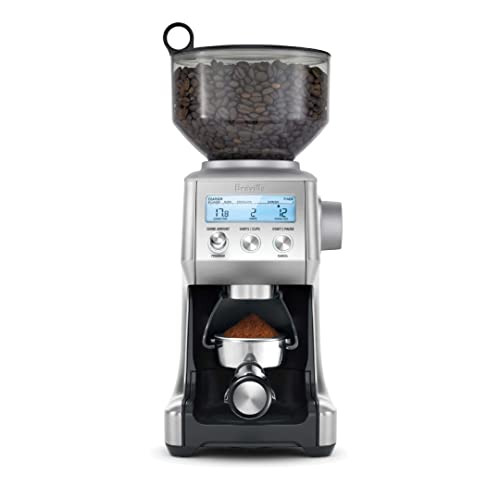
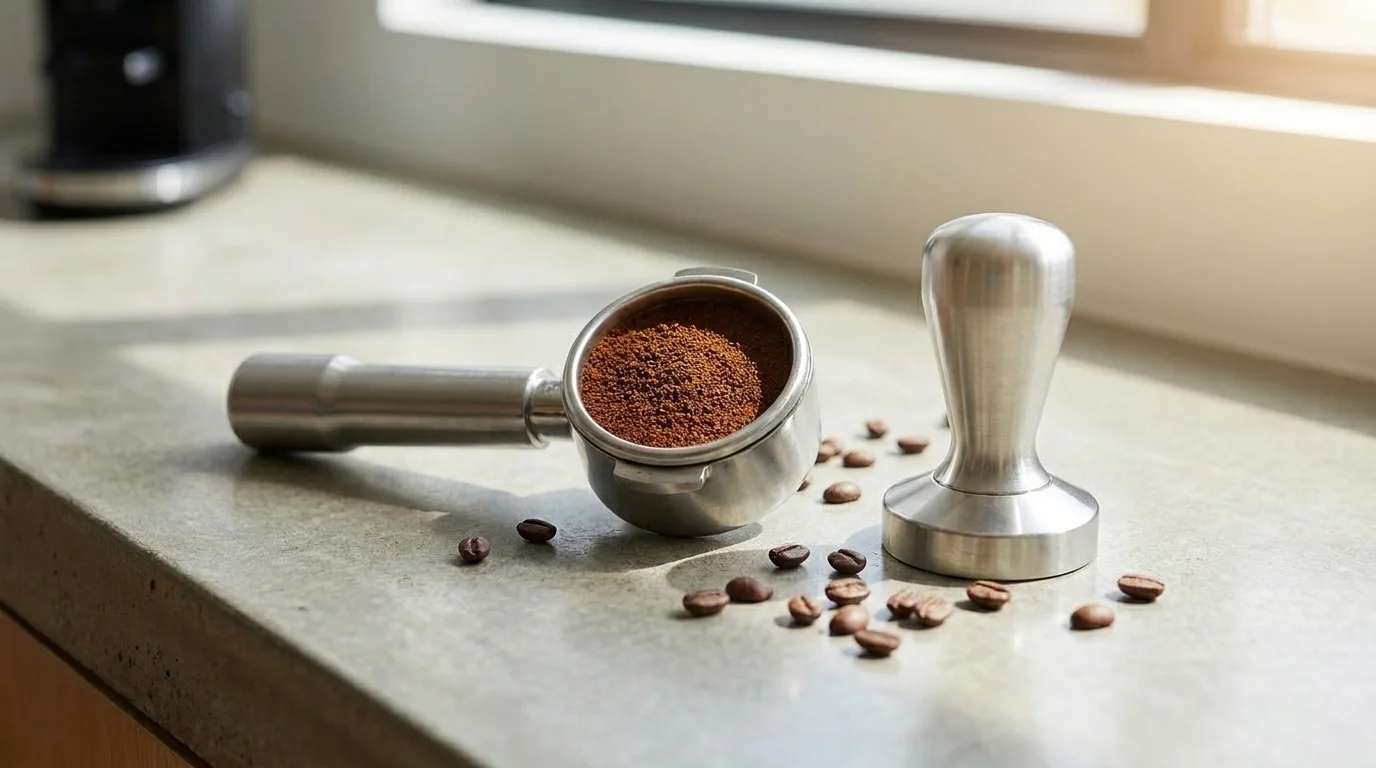
The Breville Smart Grinder Pro is the do-everything flagship and our best-overall pick. A 165W motor drives a stainless conical burr through 60 grind settings that span the full range from espresso to cold brew, and Dosing IQ lets you set the grind time in 0.2-second steps and adjust it automatically when you change grind size, so once you have dialled in a dose, the Breville reproduces it cup after cup. The coarse end of that range is there for brewing cold brew at home, which needs a much coarser grind than espresso to avoid turning bitter over a long steep. It grinds straight into a portafilter, a grinds container or a paper filter basket, the 450g hopper holds plenty of beans, and an LCD walks you through it all.
This is the grinder for the household that does a bit of everything (espresso on the weekend, filter through the week, plunger when guests are over) and wants one capable machine to cover all of it. Sixty settings is more range than the Baratza, and while the Baratza's dedicated 20-step espresso sub-range edges it for pure espresso micro-adjustment, the Breville is the more versatile all-rounder and the easier one to live with day to day. As Australia's dominant coffee brand, Breville also has by far the biggest local service and warranty network (this one ships with a 2-year AU warranty), which is reassuring on a $300-plus purchase. If you want a single grinder that does the lot and you are buying in Australia, this is the safe, strong default.
Burr vs blade: why it is the only spec that really matters
If you take one thing from this guide, take this: never buy a blade grinder. A blade grinder is just a spinning propeller in a cup. It does not grind to a size. It chops the beans for as long as you hold the button, producing a chaotic mix of fine powder and coarse chunks every single time. Because coffee extracts based on particle surface area, that powder over-extracts into bitterness while the chunks under-extract into sourness, and you taste both at once. No amount of pulsing or shaking fixes it, because the problem is built into how a blade works.
A burr grinder crushes beans between two abrasive surfaces set a fixed distance apart. Set the gap and every particle is crushed to that gap and no further, so the grounds come out uniform, and uniform grounds extract evenly, which is the whole point. This is why a $100 burr grinder will make better coffee than a $400 espresso machine fed by a blade grinder. The burr-versus-blade question is not one spec among many; for taste, it is the only one that really matters, and it is why every pick in this guide is a burr.
Conical vs flat burr, and manual vs electric
Among burrs, the next choice is conical versus flat. A conical burr is a cone spinning inside a ring, and a flat burr is two flat rings facing each other. Flat burrs can produce a marginally more uniform espresso grind and are common in high-end commercial grinders, but they are pricier, noisier and run hotter. Conical burrs are quieter, cooler, more efficient and more than good enough for home use, which is why every grinder on this list, manual and electric, uses a conical burr. For a home kitchen, do not lose sleep over flat versus conical; both are burrs, and that is the part that matters.
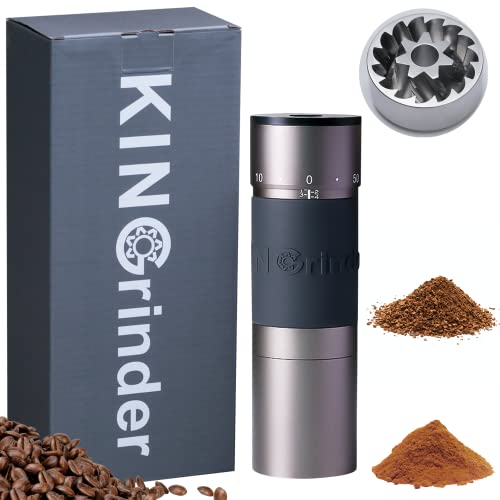
The bigger practical decision is manual versus electric. A manual hand grinder like the Timemore C3S or KINGrinder K6 is cheaper, silent, needs no power, never breaks down and gives you cafe-grade consistency, and the catch is a minute or so of arm work per dose, which adds up if you make several coffees back to back. An electric grinder like the Healthy Choice, De'Longhi, Baratza or Breville costs more and takes bench space, but you press a button and walk away, which matters for a busy household or anyone grinding multiple cups every morning. If you make one or two coffees a day and do not mind the ritual, manual saves real money; if you make several and value the convenience, electric is worth it. Bench space is the other constraint worth thinking about before you buy, because a grinder, a machine and a milk frother together take more room than most first kitchens plan for.
Grind size by brew method: espresso, filter, French press, moka and Turkish
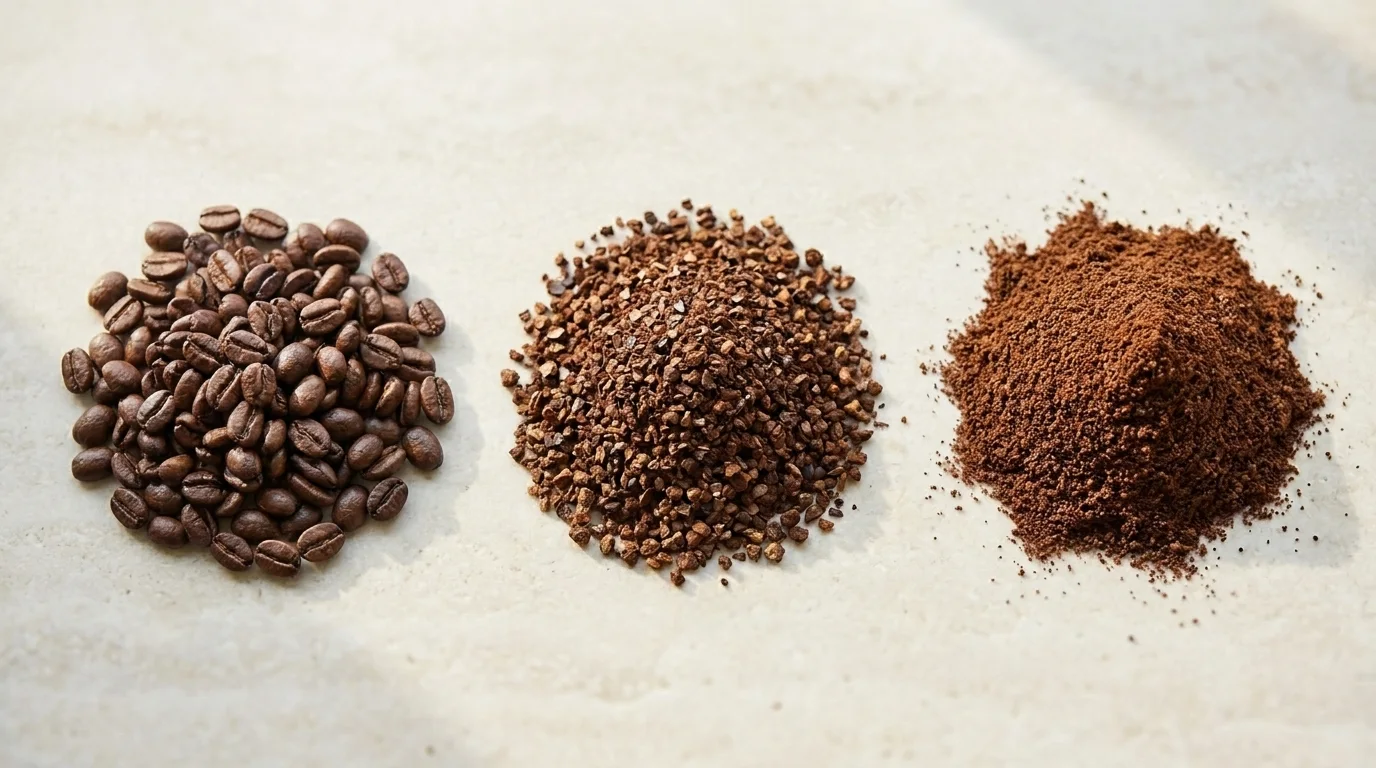
Grind size is not about your budget. It is about how your brew method extracts coffee, and getting it right is most of the battle. The rule is simple: the longer water touches the grounds, the coarser the grind needs to be.
Espresso (fine): water is forced through the puck under pressure in 25 to 30 seconds, so the grind must be very fine (like caster sugar) to create enough resistance. Espresso is also the most sensitive method to small grind changes, which is why it needs micro-adjustment. Filter and pour-over (medium): water passes through in two to four minutes, so a medium grind, roughly the texture of table salt, is the target. This is the most forgiving and where a budget burr shines. French press / plunger (coarse): the grounds steep in water for around four minutes then get filtered by a metal mesh, so you want a coarse grind like sea salt; too fine and you get muddy, silty coffee and a hard-to-press plunger. Moka pot: a fine-to-medium grind, a touch coarser than espresso. Turkish: the finest of all (a powder finer than espresso), which only some grinders (the Healthy Choice's Turkish setting, the hand grinders wound right in) can reach. Match the grind to the method first; the grinder you buy just needs to reach the settings your method needs.
| Brew method | Grind | Texture | Contact time | Picks that reach it |
|---|
| Turkish | The finest of all | Flour | Boiled with the water | Healthy Choice CG112 at its finest setting |
| Espresso | Very fine | Caster sugar | 25 to 30 seconds under pressure | Breville Smart Grinder Pro, Baratza Encore ESP, KINGrinder K6, Timemore C3S |
| Moka pot | Fine to medium | A touch coarser than caster sugar | Minutes on the stove | Any pick here |
| Filter and pour over | Medium | Table salt | 2 to 4 minutes | Any pick here |
| French press or plunger | Coarse | Sea salt | About 4 minutes | Any pick here |
| Cold brew | Coarsest | Coarser than sea salt | 12 hours or more | Any pick here |
The pattern is the only rule you need: the longer the water sits with the grounds, the coarser the grind. Espresso is the exception that drives the whole buying decision, because it is the one method where a change too small to see moves the shot, which is why the moka pot and French press owners in this guide can happily spend a third of what an espresso drinker does.
Stepped vs stepless adjustment, and why espresso needs micro-adjust
How a grinder changes its grind size matters, especially for espresso. A stepped grinder has fixed clicks (setting 1, 2, 3 and so on), which makes it easy to find and repeat a setting, but only if the steps are fine enough. The Breville's 60 steps and the Baratza's dedicated 20-step espresso range are fine enough for espresso; the De'Longhi's 18 levels and the Healthy Choice's 31 are spaced for filter and drip, which is why both are slightly coarse at their finest for true espresso. A stepless grinder, like the Timemore C3S, has no clicks at all. You can dial in any grind on a continuous scale, which is brilliant for precision but harder to return to exactly. The KINGrinder K6 splits the difference with a 200-position external dial: stepped enough to repeat by number, fine enough (16 microns per click) for espresso.
Why does espresso specifically need micro-adjustment? Because espresso is brutally sensitive to grind size. A change too small to see can take a shot from sour and gushing to bitter and choked. You need to nudge the grind in tiny increments to dial a shot in, then return to that exact point tomorrow. Filter and plunger coffee are far more forgiving and do not need this precision at all. So the rule for adjustment is the same as everything else in this guide: if you pull espresso, prioritise fine, repeatable micro-adjustment (Baratza Encore ESP, Breville Smart Grinder Pro, KINGrinder K6); if you brew filter or plunger, any decent burr with sensible settings will do the job.
Do you really need a $300 grinder?
Honestly? For most people, no. If you drink plunger, filter, pour-over or drip coffee, a $300 grinder buys you nothing your tastebuds can detect over a good $100 burr. Those methods use coarse and medium grinds that are forgiving and easy to hit, so a Healthy Choice electric burr at about $100, or one of the $96 to $118 hand grinders, is genuinely all you need, and the hand grinders will outlast anything with a motor. Spending more on a grinder for plunger coffee is like buying a sports car to drive to the letterbox.
The one exception is repeatable espresso. There, the answer flips to a qualified yes. Espresso needs a very fine grind with micro-stepped adjustment so you can dial a shot in and return to it precisely, and that capability is what the more expensive grinders are actually selling. If espresso is your daily ritual, the Baratza Encore ESP, the Breville Smart Grinder Pro or the manual KINGrinder K6 are worth the money, because they make espresso you can reliably reproduce rather than a lucky shot now and then. So the honest answer to do-you-need-a-$300-grinder is: not for plunger and filter, where about $100 is plenty; but for repeatable espresso, the extra spend buys a real, tasteable improvement.
How do you clean a coffee grinder?
Answer first: brush the burrs dry every week or two, deep clean every few months, and never put water anywhere near a burr set.
- Unplug it and empty the hopper. Tip the beans out and run the grinder empty for a couple of seconds so nothing is sitting in the chamber.
- Take the top burr out. On the Breville Smart Grinder Pro, the De'Longhi Dedica and the Baratza Encore ESP the upper burr lifts out by hand or with a quarter turn. On a manual grinder like the Timemore C3S or the KINGrinder K6 the whole body unscrews.
- Brush, do not wash. A stiff dry brush and a vacuum nozzle take out the grounds packed into the burr teeth and the chute. Water rusts steel burrs and turns old grounds into a paste, so the burrs stay dry.
- Wipe the hopper and lid. These are the only parts that see the oils from whole beans, and they are usually the only parts that can be washed. Dry them completely before they go back on.
- Reassemble and reset your grind. Taking a burr out often shifts the setting, so run a throwaway dose and check before you brew properly.
Every few months, or sooner if you drink dark oily roasts, run grinder cleaning tablets through the burrs and then a small dose of beans to clear the residue. The signs you have left it too long are a grinder that sounds like it is working harder than it used to, a grind that has quietly drifted coarser, and a stale smell in the hopper.
How do you clean a Breville coffee grinder?
Same method, with two Breville specifics. On the Smart Grinder Pro the hopper twists off with beans still in it, because the base seals as it lifts, so you do not have to empty it first. The upper burr then lifts straight out with the wire handle. Brush the lower burr and the chute dry, put the burr back so it seats flat, and lock the hopper on before you set the grind again. Breville sells a cleaning brush in the box, and the grind setting can shift when the burr comes out, so check a dose before you pull a shot.
How do you grind coffee beans without a grinder?
You can, and the results range from usable to poor depending on the brew method. None of these gives you an even grind, so use them for plunger or filter, where the coarse end of the scale is forgiving, and forget about espresso entirely.
- Mortar and pestle. The best of the improvised options, because you are crushing rather than chopping, which is what a burr does. Work in small batches, press and roll rather than pound, and you get a passable coarse to medium grind for a plunger. It is slow and it is a workout.
- Blender or food processor. Pulse in short bursts rather than running it, and shake the jug between bursts. You get the same problem as a blade grinder, a mix of dust and boulders, but for a plunger it is drinkable. Heat is the other issue: a long run warms the grounds and drives off aroma.
- Rolling pin. Put the beans in a sealed freezer bag on a chopping board, press with the pin to crack them, then roll. Cracking first and rolling second gives a far more even result than rolling from the start. Coarse only.
- Hammer or meat mallet. Same bag method, short taps. Fast, loud, and the least even of the lot.
All four are a stopgap. A $96 hand grinder produces a better cup than any of them, which is the honest reason this section exists: it is what to do this morning, not what to do this year.
Where do you buy a coffee grinder in Australia?
All six picks here are Amazon Australia listings, which is where the prices and ratings in this guide come from. Beyond it, Breville and De'Longhi sell through the big chains, Harvey Norman, The Good Guys, JB Hi-Fi, Myer and Bing Lee, and Breville also sells direct. Baratza, Timemore, KINGrinder, Varia and the other specialist names sell through Australian coffee retailers such as Coffee Parts, The Beanery, Dipacci and Artisti, which is also where you go for burr replacements and servicing on a grinder you intend to keep for a decade. We do not publish prices for those retailers, because we only quote figures we can pull from a live listing we check.
Two buying notes worth more than the shop you pick. Warranty and parts matter more on a grinder than on most kitchen appliances, because burrs wear and motors are the part that fails, so an Australian warranty and a local parts channel are worth real money over five years. And if you are buying a grinder and a machine together, decide the split first: the grinder deserves the larger share of a tight budget, which is the argument our coffee machine guide makes from the other side.
Frequently Asked Questions
Why is a burr grinder better than a blade grinder?
A burr grinder crushes beans between two abrasive surfaces set a fixed distance apart, so every particle comes out a uniform size, and uniform grounds extract evenly into balanced coffee. A blade grinder just chops the beans with a spinning propeller for as long as you hold the button, producing a chaotic mix of fine powder and coarse chunks. The powder over-extracts into bitterness while the chunks under-extract into sourness, so you taste both in the same cup. This is why every pick in our guide is a burr grinder and why we never recommend a blade unit at any price.
Can a hand grinder make espresso?
Yes, a good manual grinder can absolutely grind fine enough for espresso, and many home baristas use one happily. The KINGrinder K6 is the standout here because its 200-position external dial lets you find an espresso setting and return to it precisely, which is exactly what espresso needs. The Timemore C3S can also reach espresso-fine, though its stepless collar makes repeating an exact setting fiddlier. The honest catch is effort: espresso-fine is the hardest, slowest grind to crank by hand, so if you pull several shots back to back every morning, an electric grinder will save your arm. For one or two shots a day, a hand grinder is a genuinely good espresso option.
What grind size do I need for espresso, filter and plunger?
Match the grind to how long water touches the coffee. Espresso forces water through under pressure in seconds, so it needs a very fine grind like caster sugar. Filter and pour-over take a few minutes, so they want a medium grind about the texture of table salt. French press or plunger steeps for around four minutes then filters through metal mesh, so it needs a coarse grind like sea salt: too fine and you get muddy, silty coffee. Moka pot sits between espresso and filter, a touch coarser than espresso, and Turkish coffee is the finest of all, a powder finer than espresso. The rule of thumb: the longer the contact time, the coarser the grind.
Do I really need a $300 grinder?
For plunger, filter and pour-over coffee, no, a $300 grinder gives you nothing you can taste over a good $100 burr, because those methods use forgiving coarse and medium grinds. A Healthy Choice electric burr at about $100 or a $96 to $118 hand grinder is genuinely enough. The exception is repeatable espresso, where the answer becomes a qualified yes: espresso needs fine, micro-stepped adjustment to dial in a shot and return to it, which is what grinders like the Baratza Encore ESP, Breville Smart Grinder Pro and KINGrinder K6 are built to deliver. So buy to your brew method, not to a price tag.
What is the difference between conical and flat burrs?
A conical burr is a cone that spins inside a matching ring, while a flat burr is two flat rings facing each other. Flat burrs can give a marginally more uniform espresso grind and show up in high-end commercial grinders, but they cost more, run hotter and are noisier. Conical burrs are quieter, cooler, more efficient and more than good enough for home use, which is why every grinder in our guide, manual and electric, uses a conical burr. For a home kitchen the conical-versus-flat question barely matters: both are burrs, and that is the part that makes the difference to your cup.
How do I keep my grinder consistent and clean?
Two habits keep a grinder grinding well. First, brush it out regularly: coffee oils and old grounds build up around the burrs and go stale, dulling flavour and clogging the adjustment, so a soft brush every week or two and an occasional deeper clean keeps it fresh. Grinders with a quick-release burr, like the Baratza Encore ESP, make this easy. Second, keep your grind setting noted so you can return to it: stepped grinders let you record a number, which is why repeatable espresso favours them. Also grind only what you need fresh, since ground coffee goes stale within minutes, and avoid forcing beans through, which stresses the motor and burr holder over time.
Breville, De'Longhi or Baratza: which brand should I buy?
It comes down to what you brew and what you value. Breville is the best all-rounder and our overall pick. The Smart Grinder Pro does espresso through to cold brew across 60 settings, and as Australia's dominant coffee brand it has the biggest local service and warranty network. Baratza is the espresso specialist: the Encore ESP has a dedicated micro-fine espresso range and is famously rebuildable with AU parts support, so it is the pick if espresso is your focus and you want a grinder you can maintain for years. De'Longhi is the familiar, nationally-serviced all-rounder with the deepest AU rating count, ideal for moka, filter and plunger, though its finest setting is slightly coarse for true espresso. Choose Breville for versatility, Baratza for espresso, De'Longhi for a recognisable do-most brand.