It all comes down to aperture
Before you compare a single other spec, look at aperture - the width of the telescope's main lens or mirror. It is the number that decides how much light the scope gathers and, therefore, how much you can actually see, which is why it matters far more than any flashy magnification claim on the box. For beginners, kids and adults wanting to explore the Moon, the planets and bright objects, a 90mm aperture is the recognised sweet spot: wide enough to show real detail, but still affordable, light and easy to live with. Most of the picks here are 90mm refractors for exactly that reason, paired with a simple altazimuth mount you just point and look through.
The six telescopes below run from the EACONN up to the DWARFLAB Dwarf 3, and there is one important fork in the road. Five are traditional refractors you look through with your eye, sorted by mount, tripod quality and accessories. The Dwarf 3 is a different beast - a smart, phone-controlled astrophotography scope built for capturing images rather than eyepiece viewing - so we frame it honestly as a premium for a different use-case. Decide first whether you want to see the night sky with your own eye or photograph it, and the right pick gets much clearer. If the curiosity points down rather than up, our kids microscope guide covers the other end of the same interest, and Kmart and Bresser both sell the two as a set.
EACONN 90mm Refractor Telescope
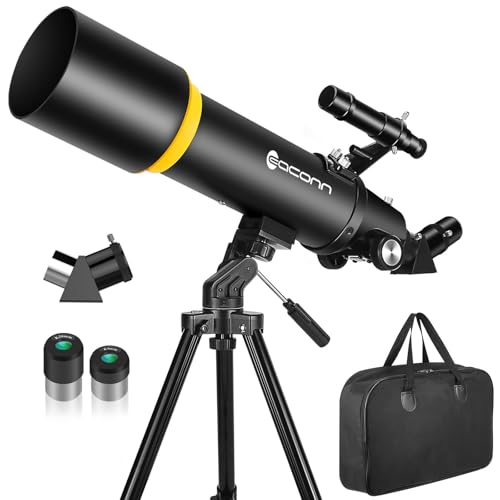
If you just want to start exploring the night sky without overspending, the EACONN is the entry point and it lands squarely on the 90mm beginner sweet spot. That aperture is wide enough to pull in genuine detail on the Moon and the brighter planets, and it is the cheapest pick here while still coming with everything you need to start the same night.
It includes two eyepieces giving 30x to 66x, a 5x24 finder to help you aim, a phone adapter for snapping the Moon and an altazimuth gimbal so you simply nudge it up, down and across to follow your target. Everything packs into the supplied handbag for trips to a dark backyard or campsite. The honest trade-off is that, like all entry-level beginner refractors, the optics and the bundled eyepieces and phone adapter are modest - expect crisp Moon craters and bright planets rather than faint deep-sky objects, and treat the phone shots as fun snapshots rather than serious astrophotography.
MEEZAA 90mm AZ Mount Refractor
The MEEZAA is the natural step up from the budget pick, keeping the friendly 90mm aperture but pairing it with a longer 800mm focal length and a proper altazimuth mount sitting on a thick stainless steel tripod. The longer focal length and the included 3x Barlow lens push usable magnification higher for the Moon and planets, while the sturdier tripod resists the shakes that ruin the view on flimsier beginner stands.
You also get two eyepieces, a finder scope, a zenith mirror that flips the image upright for comfortable daytime land viewing, a carry bag and a phone adapter, so it is a complete kit out of the box. The honest note is that the headline 240x magnification is the theoretical maximum rather than an everyday setting - on a 90mm scope the very highest powers look dimmer and softer, so the mid-range magnifications are where this telescope really shines.
Celticbird 90mm Refractor Telescope
The Celticbird earns its spot on sheer track record: with well over 1,300 ratings it has by far the largest review base in this guide, which is genuinely reassuring when you are buying your first telescope and not sure what to trust. It keeps the beginner-friendly 90mm aperture and a fully coated multi-layer lens for sharper, brighter images.
Its two upgraded wide-angle eyepieces make finding and framing the Moon, Saturn and Jupiter a little more forgiving, and it adds a 5x24 finder, a phone adapter and a tripod that adjusts from 50cm to 115cm to suit both adults and kids. It assembles with no tools from a clear manual and video. The honest trade-off is that it is still an entry-level refractor at heart, so the optics are good-for-the-price rather than premium, and part of what you pay covers the proven popularity and the generous accessory bundle.
SVBONY SV48P 90mm Refractor OTA
The SVBONY SV48P is the pick for someone already looking past casual viewing toward deep-sky observing and astrophotography, because it is a more serious optic than the all-in-one beginner kits. Its 90mm aperture pairs with a short 500mm F5.5 focal length to give a wide, fast field that suits imaging, and a fully multi-coated achromatic lens keeps views clean from edge to edge.
It also has a proper 2-inch dual-speed 1:10 focuser that nails fine focus where the basic focusers on cheaper scopes struggle, plus 360-degree rotation for composing shots. The big honest caveat is that this is an OTA - an optical tube on its own - so it does not include a mount or tripod, and you must supply your own to use it at all. That makes it a poor first telescope but a strong upgrade for people who already own a mount, and with just 87 ratings its review base is small, so there is less long-term feedback than the more popular picks carry.
Celestron PowerSeeker Refractor
If brand reassurance matters most to you, the Celestron PowerSeeker is the pick, because Celestron is one of the longest-standing and most recognised names in telescopes - a real comfort when you are spending a few hundred dollars on a first scope. It is a refractor with erect image optics, so the view comes through the right way up for both stargazing and daytime land viewing.
The fully coated glass optics with high transmission coatings keep images bright and clear, and as a long-established product it is well documented and easy to find help for. Two honest notes temper the appeal: stock on this model runs low and it is not always available the moment you want it, and at this price you are partly paying for the trusted badge, so a popular generic 90mm scope can deliver similar beginner performance for less.
DWARFLAB Dwarf 3 Smart Telescope
The Dwarf 3 is a completely different beast from the refractors above, and it is the premium pick deliberately - it is a smart, computerised astrophotography scope you aim and operate entirely through the DWARFLAB phone app rather than by squinting through an eyepiece. A dual lens system covers deep-space targets and wide Milky Way panoramas, and smart auto tracking follows celestial objects and even wildlife in 4K.
Cloud-powered processing stacks your frames into a finished image in minutes with no PC needed, and at just 3 lbs it drops into a backpack for spontaneous trips. It carries the highest rating in this guide at 4.7 stars. The crucial honest framing is that this is built for capturing images, not for traditional visual viewing - if your dream is putting your eye to a lens and seeing Saturn live, a 90mm refractor is the right buy. The Dwarf 3 is for people who specifically want to photograph the night sky.
How to choose a beginner telescope
Start with the most honest question: do you want to look at the night sky with your own eye, or photograph it? That single answer splits this whole guide. For visual stargazing - the Moon, planets and bright objects - a 90mm refractor on a simple altazimuth mount is the sweet spot, and the EACONN, MEEZAA, Celticbird and Celestron all fit that brief. If your real interest is imaging, the SVBONY OTA is a step toward traditional astrophotography (with your own mount), while the DWARFLAB Dwarf 3 is a fully automated smart scope that does the capturing and processing for you.
After that, weigh aperture first, then the mount and tripod, then accessories. Aperture decides how much you can see, so 90mm is a sensible floor for a beginner. A steady mount and a sturdy tripod matter more than people expect, because a wobbly stand makes even good optics frustrating at higher magnifications - the MEEZAA's thick stainless tripod is a genuine advantage here. Treat eyepieces, finders and phone adapters as useful bonuses rather than the headline, and be wary of huge magnification numbers on the box: usable magnification is limited by aperture, not by whatever the marketing claims.
What the key specs mean
A handful of terms do most of the work. Aperture is the width of the main lens or mirror, and it is the single most important spec because it sets how much light the scope gathers and how much detail you can resolve - bigger generally means more to see. Focal length, measured in millimetres, combines with your eyepiece to set the magnification, and a longer focal length favours high-power views of the Moon and planets while a shorter one gives a wider field that suits imaging. Magnification itself is just focal length divided by the eyepiece, which is why one scope can offer many magnifications by swapping eyepieces or adding a Barlow lens.
The mount and tripod are the unsung heroes. An altazimuth, or AZ, mount is the beginner-friendly kind - you simply move it up, down and side to side to point at and follow an object, with nothing to align. An OTA, by contrast, is the optical tube on its own with no mount included, which is why a scope like the SVBONY SV48P needs you to already own a tripod and mount. Read aperture, focal length, mount type and tripod sturdiness together, and any telescope listing starts to make sense rather than reading as a wall of numbers.
Frequently Asked Questions
What does aperture mean on a telescope, and why does it matter?
Aperture is the width of the telescope's main lens or mirror, usually given in millimetres, and it is the single most important spec. It decides how much light the scope gathers, which sets both how bright the image is and how much fine detail you can resolve - so a 90mm scope shows noticeably more than a 60mm or 70mm one. It matters far more than the magnification numbers printed on the box, because no amount of magnification can show detail the aperture did not collect in the first place. For a beginner, 90mm is a sensible sweet spot: enough to see real detail without the cost and bulk of a larger scope.
What can a beginner 90mm telescope actually see?
Quite a lot, as long as your expectations are realistic. A 90mm refractor will show the Moon in beautiful detail - craters, mountains and shadows along the terminator - and reveal the brighter planets, including the rings of Saturn, the cloud belts and four big moons of Jupiter, and the phases of Venus. You can also pick out bright star clusters and the brightest galaxies and nebulae as faint smudges. What it will not do is show colourful, Hubble-style deep-sky images; faint objects look like soft grey patches to the eye through any beginner scope, so the Moon and planets are where these telescopes genuinely shine.
What is the difference between a refractor and a smart telescope?
A refractor is a traditional telescope: a tube with a lens at the front that you point at the sky and look through with an eyepiece, with your own eye doing the viewing. Most picks here, like the EACONN and MEEZAA, are 90mm refractors. A smart telescope such as the DWARFLAB Dwarf 3 has no eyepiece at all - it is a computerised camera you aim and control from a phone app, and it automatically tracks objects, captures images and stacks them into a finished photo. The simple way to choose: a refractor is for seeing the sky live with your eye, while a smart scope is for photographing it.
Can I photograph the Moon and planets with these telescopes?
Yes, to different degrees. The beginner refractors here include a phone adapter that clamps your phone over the eyepiece, which works well for snapshots of the Moon and is a fun way to share what you see, though planets come out small. For more serious imaging, the SVBONY SV48P is an optical tube designed with astrophotography in mind, but it needs a suitable mount you supply yourself. The DWARFLAB Dwarf 3 is the dedicated imaging choice - it captures and processes deep-sky and planetary photos automatically through its app. So casual Moon photos are easy on any of them, while real astrophotography points you toward the SVBONY or the Dwarf 3.
Which telescope is best for kids?
For kids, the priorities are an easy point-and-look mount, quick no-tools assembly and a forgiving design, which is exactly what the budget and value refractors here offer. The EACONN and Celticbird are both strong choices: they use a simple altazimuth mount that children can aim by hand, assemble without tools from a clear manual, and adjust to suit shorter heights - the Celticbird's tripod drops to 50cm. The Moon is the perfect first target because it is bright, easy to find and genuinely impressive at this aperture. Just set realistic expectations, and start with the Moon before chasing fainter planets so the first session is a win rather than a frustration.
Do I need a sturdy tripod and mount?
More than most beginners expect. A wobbly tripod is the quickest way to ruin an otherwise good telescope, because every small touch sends the view shaking, and the higher the magnification the worse it gets. A steady stand lets you focus carefully and actually enjoy what you are looking at, which is why the MEEZAA's thick stainless steel tripod is a real advantage over flimsier stands. It also explains why an OTA like the SVBONY SV48P, which is just the optical tube with no mount, needs a solid mount and tripod of your own to be usable at all. When you compare scopes, give the mount and tripod as much weight as the optics.
Is a more expensive telescope always better for a beginner?
Not necessarily. For a beginner who wants to view the Moon, planets and bright objects, a well chosen 90mm refractor delivers most of the experience, and spending more often buys a heritage brand badge, a bigger accessory bundle or imaging features you may not use yet. The Celestron PowerSeeker, for instance, is reassuringly branded but a popular generic 90mm scope can match it for visual use for less. The exception is if your real goal is astrophotography rather than eyepiece viewing - then a purpose-built option like the DWARFLAB Dwarf 3 justifies its higher price by doing something the cheaper scopes simply cannot.