A simple steep jug or a dedicated system? That is the real question
Before you compare a single spec, answer this: do you want the simplest possible routine, or do you want a concentrate you can stockpile and dilute? It is the question that splits this whole category in two. A steep-in-the-fridge immersion jug like the Hario Mizudashi needs no power at all - you add coarse grounds to a mesh basket, fill with cold water, leave it 12 to 24 hours and pour ready-to-drink cold brew straight from the carafe, which makes it almost impossible to get wrong. A dedicated system like the Toddy makes a thick, low-acid concentrate instead, which you dilute to taste and keep in the fridge for up to two weeks. Get that one decision right and the rest is easy.
The six picks below map onto that split plus one shortcut: the immersion jugs are for the simplest, ready to drink routine, the concentrate makers are for people who want a long keeping base, and the OXO Rapid Brewer and the AeroPress are faster presses for anyone who will not wait overnight. The other things worth weighing as you read are capacity - a single mug versus a family jug - filter type, and whether the body is glass or plastic, so match the maker to how you will actually drink it and you will not overspend.
Hario Mizudashi Cold Brew Coffee Pot 1000mL
If you just want to start making cold brew without any fuss, the Hario Mizudashi is the entry point and the cheapest pick here. It does the immersion job perfectly: you add coarse grounds to the fine mesh basket, fill the glass pot with water, drop it in the fridge and leave it to brew, then pour ready to drink cold brew straight from the slender spout. There is no power, no concentrate to dilute and almost nothing to get wrong.
The removable filter washes and reuses in seconds, and the heatproof Hario glass is made in Japan and serves as both brewer and carafe, so it sits neatly in the fridge door. With well over 13,000 ratings at 4.8 stars it is also the best-loved maker in this guide. The trade-offs at this price are honest ones: it makes ready-to-drink cold brew rather than a thick concentrate you keep for days, and at 1000mL it is sized for one or two people rather than a houseful.
Takeya Deluxe Cold Brew Coffee Maker 2 Quart
The Takeya is the pick if you love the steep-in-the-fridge simplicity of the Hario but want something tougher and family-sized. The pitcher is durable BPA-free Tritan with an airtight lid and a non-slip silicone handle, so it shrugs off knocks better than glass and seals tight for storage, and the two-quart body is shaped to slide into most fridge doors.
It produces four servings of smooth cold brew through a fine-mesh filter that keeps grounds out of the pot, and the result is less acidic than traditional brewing. With more than 58,000 ratings it is by a wide margin the most-reviewed maker in this guide, which is a lot of reassurance for the money. The honest caveat is that it brews ready-to-drink cold brew rather than a long-keeping concentrate, and being plastic rather than glass it asks for a thorough clean to stay free of coffee oils.
OXO Brew Rapid Brewer Hot and Cold
The OXO Rapid Brewer is the pick if the 12-to-24-hour wait is the dealbreaker, because it brews a concentrated cup in five minutes or less rather than steeping overnight. You can run it cold in about five minutes or hot in two, so it flexes with your taste and the weather, and the built-in stainless filter means there is no paper to buy or bin.
It is compact, lightweight and needs no plugs or charging, which makes it as happy in a hotel room or office as on the kitchen bench. The honest caveats are two: a rapid brew is a different process to a long cold steep, so purists who chase the ultra-smooth, low-acid character of an overnight immersion may still prefer a dedicated steeper, and it makes a small concentrated batch rather than a fridge jug for the whole household.
AeroPress Coffee Maker
The AeroPress is the pick if you want one tool that does far more than cold brew, and it is the cult favourite that travellers swear by. It presses cold brew, an espresso-style shot or a regular American coffee in about a minute, with a smoother, richer flavour and around one ninth the acidity of a French press, so it is genuinely versatile rather than a single-trick steeper.
It is durable, compact and light enough to throw in a bag for travel or camping, and at 4.8 stars across more than 20,000 ratings it is one of the best-loved makers on this list. The honest trade-off is that it is a versatile press you actively operate rather than a hands-off steeper, so it makes a single cup at a time and is not the way to fill a jug of cold brew to keep in the fridge - we include it because it does make cold brew, not because it is a dedicated immersion maker.
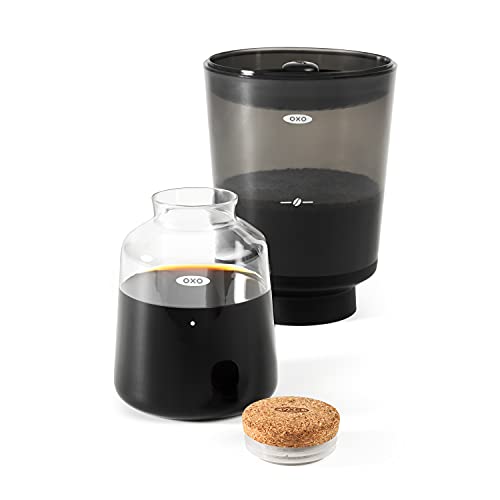
OXO Good Grips Compact Cold Brew Coffee Maker
The OXO Good Grips Compact is the pick if you want concentrate without the mess of straining a jug yourself, because draining starts automatically the moment you set the brewer on the carafe. Its Rainmaker lid evenly distributes water over the grounds for a more even extraction, and the result is a low-acid concentrate, up to 16oz, that you dilute for hot or cold coffee to taste.
The compact body takes up less room on the bench and in the fridge than a full system, which suits smaller kitchens. The honest caveats are that it is concentrate-first rather than a ready-to-drink jug, so you measure and dilute every cup, and at 4.4 stars it carries the lowest rating in this guide, with the multi-part build asking for a careful clean to keep it brewing cleanly. Note too that OXO appears twice in this list - this Compact is the dedicated steeper, while the Rapid Brewer above is the five-minute press, so pick by whether you want slow concentrate or speed.
Toddy Cold Brew System
The Toddy Cold Brew System is the standout in this guide and the recognised name when people talk about cold brew at home. It is the original cold-brew pioneer, a non-electrical system whose deceptively simple cold water filtration trades time for heat, extracting the bean's true flavour while leaving much of the acidity behind for a notably smooth result.
The concentrate it makes is the perfect base for iced, blended or steaming-hot drinks, and it stays fresh for up to two weeks with no change to the flavour, so a single brew lasts you well over a week of coffees. The set is properly equipped, with a brewing container, a glass decanter, two reusable filters and a silicone stopper. The honest caveat is that it makes a concentrate you dilute rather than a ready jug, and the multi-part system asks for a little more setup and cleaning than a single steep-in-the-fridge pot - you trade a touch of convenience for the original, best-regarded low-acid concentrate.
How to match the maker to how you will drink it
The single biggest mistake is buying for the cold brew habit you imagine rather than the one you will actually keep up. If the honest answer is that you just want fresh, ready to drink cold brew with the least possible effort, an immersion jug is the smart buy, and a concentrate system would mostly add a dilution step you never wanted. If you drink cold brew daily, or want to make a base once and pour from it all week, a concentrate maker like the Toddy or the OXO Compact earns its keep.
Capacity and build are the other deciding factors. A 1000mL Hario suits one or two people, while a two-quart Takeya feeds a household, and a concentrate system effectively stretches further again because you dilute it. Glass, as on the Hario and the Toddy decanter, looks the part and never holds odours, while BPA-free plastic like the Takeya survives being dropped and slots into a fridge door. Be realistic about how much you drink and how rough your kitchen is, because the best maker is the one whose brew gets finished rather than forgotten.
What the key specs mean
A few details do most of the work when you compare these makers. Brew style tells you the routine: an immersion jug steeps coarse grounds in cold water for 12 to 24 hours and pours ready to drink, while a rapid press like the OXO Rapid Brewer or the AeroPress makes a concentrated cup in minutes. Output is the next thing to read - ready-to-drink cold brew you pour as is, versus a concentrate you dilute and keep, like the Toddy and the OXO Compact produce.
Filter type matters for both taste and upkeep: a fine mesh or stainless filter, as on the Hario, Takeya and OXO makers, keeps grounds out and rinses clean with no paper to buy, while the Toddy uses reusable filters within its system. Capacity and material round it out - millilitres or quarts tell you how many cups, and glass versus BPA-free plastic decides between odour-free looks and drop-proof fridge-door fit. Read brew style, output, filter type and capacity together and any product page starts to make sense.
Frequently Asked Questions
What is the difference between an immersion cold brew maker and a system?
It comes down to what you pour at the end. An immersion jug like the Hario Mizudashi or the Takeya steeps coarse grounds in cold water for 12 to 24 hours and gives you ready-to-drink cold brew you pour straight from the carafe. A dedicated system like the Toddy makes a thick, low-acid concentrate instead, which you dilute with water or milk to taste and keep in the fridge for up to two weeks. If you want the simplest routine, buy an immersion jug; if you want to brew a base once and pour from it all week, a concentrate system suits you better.
How long does cold brew take to make?
Usually somewhere between 12 and 24 hours for an immersion steep, with longer giving a stronger, smoother result. Makers like the Hario, Takeya and Toddy are built around that overnight rest, often left in the fridge from one evening to the next. If that wait is a dealbreaker, the OXO Rapid Brewer makes a concentrated cup in about five minutes and the AeroPress in roughly a minute, though a fast press is a slightly different process to a long cold steep. As a rule, longer immersion means smoother, lower-acid coffee, so the exact time is partly a matter of taste you tune over a few brews.
Why is cold brew less acidic than hot coffee?
Because time replaces heat. Cold water steeped slowly over many hours extracts the coffee's flavour while pulling out far less of the bitter, acidic compounds that hot water draws out quickly. That is the whole idea behind the Toddy's cold water filtration and why immersion cold brew tastes so smooth and easy on the stomach. The AeroPress reaches a similar place a different way, with around one ninth the acidity of a French press. If a sensitive stomach is your reason for trying cold brew, a long immersion steep is the gentlest route.
What grind should I use for cold brew?
A coarse grind is the standard starting point, roughly like coarse sea salt. Coarse grounds steep cleanly in an immersion maker and strain out easily through a fine mesh filter without clogging it or leaving silt in your cup, which is why makers like the Hario specify them. You can grind a little finer for more body and strength if you prefer, as the Hario notes, but go too fine and you risk a muddy, over-extracted brew and grounds slipping through the filter. For concentrate systems and rapid presses, follow the maker's own guidance, but coarse remains the safe default.
How long does cold brew keep in the fridge?
Ready-to-drink cold brew is generally best within about a week, while a concentrate keeps longer. The Toddy concentrate, for example, stays fresh for up to two weeks with no change to flavour, because it is more concentrated and you dilute it as you go. Cold brew you have already poured and diluted, or the ready-to-drink kind from an immersion jug, is at its best in the first few days and fine for roughly a week if kept sealed and cold. Either way, an airtight lid like the Takeya's helps it last, so keep it covered in the fridge rather than open.
Can these makers make hot coffee too?
Several can, in different ways. Concentrate makers like the Toddy and the OXO Good Grips Compact produce a base you can dilute with hot water for a smooth hot cup as easily as a cold one. The OXO Rapid Brewer brews hot in about two minutes or cold in five, and the AeroPress makes hot coffee, espresso style or cold brew. A pure immersion jug like the Hario is designed for cold brew specifically, though you can warm the finished brew. If you want one maker for both hot and cold, a concentrate system or a versatile press is the smarter buy.
Glass or plastic - which cold brew maker is better?
It depends on whether you value looks and purity or durability and fit. Glass makers like the Hario and the Toddy's decanter never hold onto odours or coffee oils and look the part on the bench, but they can break if knocked. BPA-free plastic like the Takeya's Tritan survives drops, seals airtight and is shaped to slot into a fridge door, which suits busy or family kitchens. Neither is better outright - choose glass if you want the cleanest taste and a maker that doubles as serveware, and plastic if you want something tougher that tucks away easily.