Before you compare a single wattage, answer this: how do you actually want to grill? It is the question that splits this whole category into three. An open teppanyaki plate is a big flat surface you cook on at the table, brilliant for shared cooking where everyone grills their own, but it will not close to cook both sides or drain fat. A contact grill - the George Foreman idea - clamps angled plates over your food so it cooks from both sides at once and the fat runs off into a tray. A smart multi-cooker grill goes further again, adding sensors, air-frying or a temperature probe so the machine adjusts the cook for you. Get that one decision right and the rest is easy.
The six picks below run from a Healthy Choice teppanyaki plate up to the Tefal OptiGrill, and they map cleanly onto that split: the first two are open plates for cooking at the table, the next two are George Foreman contact grills, and the last two are smart cookers for people who want the grill to do the work. Match the machine to how you will actually cook and you will not overspend.
If you would rather cook outdoors over charcoal or gas, see our gas and charcoal BBQ guide.
Healthy Choice 70cm Electric Grill
If you just want a big plate to cook on at the table without spending much, the Healthy Choice is the entry point. It is the cheapest pick here, and it nails the basics of an open teppanyaki plate: a generous 70cm by 23cm nonstick surface with room for the whole family to cook at once, and a five setting thermostat that handles everything from pancakes to steaks.
The tough non-stick coating releases food cleanly and the removable drip tray makes cleanup quick. The trade-offs at this price are an honest small review base of 36 ratings and the nature of an open plate - it does not close to cook both sides or drain fat the way a contact grill does, so treat it as a shared table cooker rather than a fast two-sided grill.
GreenLife Teppanyaki Electric Grill
The GreenLife is the open plate to pick if the coating matters as much as the cooking. Its headline feature is a ceramic non-stick surface made without PFAS, PFOA, lead or cadmium, which is the reason most people choose it over a cheaper PTFE plate. It still releases food cleanly and wipes down easily, and the Healthy Power heating warms quickly between batches.
The large surface serves a group of up to eight and the five-setting thermostat gives proper temperature control for shared cooking. The catch is the review base: at 14 ratings it is the smallest in this guide, and like any open plate it is built for table cooking rather than the fast, fat-draining grilling of a contact design.
George Foreman Medium Fit Grill
The George Foreman Medium Fit Grill is the best overall pick for most people, because it does everything a contact grill should and has the reviews to prove it works. The angled plates close over your food so it cooks from both sides at once - roughly halving the time versus a flat plate - and the sloped design drains excess fat into a clip-in tray rather than leaving it under your steak.
It heats from cold in under six minutes and wipes clean in one pass with a paper towel while the plates are still hot. With more than 23,600 ratings it is by a wide margin the most-reviewed grill in this guide, which is hugely reassuring at this price. The honest limit is size: the cooking area is medium, so it is best for one or two people rather than feeding a crowd.
George Foreman Medium Smokeless Grill
The Smokeless is where the George Foreman range steps up for people who cook indoors and hate the smoke. Its smokeless technology and integrated venting system cut up to 87 percent of the smoke a classic grill produces when searing fatty burgers, so you can grill in an apartment without setting off the alarm or filling the room with greasy smells.
It keeps every contact-grill benefit - both sides cooked at once, three times faster than an oven - and adds removable plates and a drip tray that are dishwasher safe, which the cheaper Fit grill is not. The honest note is the price: it costs roughly double the standard Fit grill, so the smoke reduction and dishwasher safe plates are what you are paying the premium for.
Ninja Foodi Smart XL Grill and Air Fryer
The Ninja Foodi is the pick if you want one appliance that earns its bench space several times over. It is a grill and an air fryer in the same XL body, with six functions in all, grill, air fry, roast, bake, dehydrate and broil, so it can sear steaks one night and crisp a basket of chips the next. The smart cooking probe is the clever part, reading the internal temperature and taking meat from rare to well done at the touch of a button.
The extra-large grate fits up to six steaks, and the cyclonic air circulates up to 260 degrees so food cooks evenly with no need to flip. The honest caveat is the obvious one for any multicooker: with a chunky 5.7L footprint, it is a real commitment of money and counter space compared with a simple contact grill.
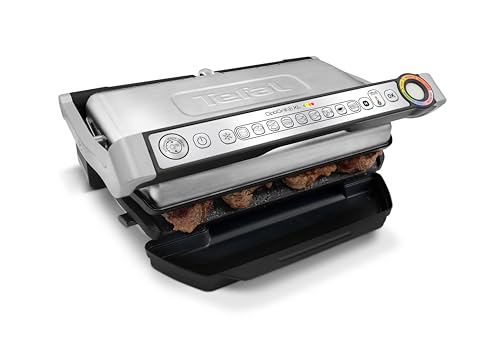
Tefal OptiGrill Plus Sensor Grill
The OptiGrill Plus is the most hands-off grill in this guide and the pick if you want the machine to do the thinking. Its sensor measures the thickness of whatever you put on it and adjusts the cooking time automatically across nine programs, while colour-coded indicators tell you exactly when the food has reached rare, medium or well done - so you stop cutting into a steak to check.
That sensor cooking is what sets it above a normal contact grill: you can trust it to flag a thick fillet and a thin one separately rather than overcooking both to be safe. The removable plates are non-stick and dishwasher safe for easy cleaning. The honest caveat is the price: it sits well above a simple contact grill, so you are paying for the sensor smarts rather than extra raw grilling power.
How to match the grill to how you will cook
The single biggest mistake is buying for the cooking you imagine rather than the cooking you will actually do. If the honest answer is that you mostly want a sociable plate everyone gathers around, the family cooking their own at the table, an open teppanyaki plate is the smart buy, and a sensor grill would mostly sit idle. If you mainly grill steaks, burgers and toasties for one or two and want less fat in the result, a George Foreman contact grill is the right call. And if you want one machine that grills, air-fries and cooks meat to a probe temperature, the Ninja or Tefal earn their higher price.
Fat and smoke are the other deciding factors. A contact grill drains fat away as it cooks, which an open flat plate cannot do, so it gives a leaner result. If you cook indoors in a small home, the smoke matters too - the Smokeless grill exists precisely because searing fatty meat on a normal grill clouds the kitchen. Be realistic about where and what you will cook, because the best grill is the one you will actually pull out and use rather than leave in the cupboard.
What the key features actually mean
A few details do most of the work when you compare these grills. Plate style tells you the whole story - an open teppanyaki plate is flat and shared, a contact grill closes to cook both sides and drain fat, and a smart cooker layers sensors or air-frying on top. Removable, dishwasher-safe plates make a real difference to whether you keep using a grill, which is why the Smokeless, Ninja and Tefal all call them out while the cheapest open plates are wipe-clean only.
Smokeless designs and sensor cooking are the two features worth paying for if they match your needs. A smokeless grill with integrated venting cuts the smoke that comes off fatty meat, which is the difference between grilling indoors comfortably or not. Sensor cooking, as on the Tefal, measures food thickness and adjusts the time so you do not overcook, and a temperature probe like the Ninja's does a similar job for larger cuts. Read those features against how you cook and any product page starts to make sense.
Frequently Asked Questions
What is the difference between a teppanyaki plate and a contact grill?
It comes down to whether the grill closes. An open teppanyaki plate, like the Healthy Choice and GreenLife here, is a large flat surface you cook on at the table, which is ideal for shared cooking where everyone grills their own but cannot cook both sides at once or drain fat. A contact grill, the George Foreman style, clamps angled plates over your food so it cooks from both sides simultaneously and the fat runs off into a tray. Choose an open plate for sociable cooking and a contact grill for fast, leaner single-serve grilling.
Do George Foreman contact grills really drain fat?
Yes, and that is the core of the design. The cooking plates are tilted, so as fat melts out of meat it runs down the slope and collects in a clip-in drip tray rather than pooling under your food. That is why a contact grill gives a leaner result than a flat plate, where the fat just sits there. The George Foreman Fit and Smokeless grills in this guide both work this way; the open teppanyaki plates do not, since they are flat by design and keep the juices on the surface.
Are smokeless electric grills actually smokeless?
They cut smoke heavily rather than eliminate it entirely. The George Foreman Smokeless grill uses smokeless technology and an integrated venting system to remove up to 87 percent of the smoke a classic grill makes when searing fatty burgers, which in a small kitchen is the difference between grilling comfortably and setting off the alarm. You may still see a little wisp from very fatty meat, but it is dramatically reduced. If grilling indoors usually clouds your kitchen, a smokeless design is worth the extra cost over a standard grill.
Is the Tefal OptiGrill worth the premium price?
It depends on how much you value not overcooking. The OptiGrill Plus uses a sensor that measures food thickness and adjusts the cooking time automatically across nine programs, with colour-coded lights showing rare, medium and well done, so you stop cutting into steaks to check. That hands-off precision is genuinely useful if you grill meat often and want consistent results. The honest caveat is the price: it costs roughly four times a simple George Foreman Fit grill, so you are paying for the sensor smarts rather than extra raw grilling power.
Can one grill replace an air fryer?
A smart multi-cooker like the Ninja Foodi can, which is part of its appeal. It is a grill and an air fryer in one XL body, with six functions covering grill, air fry, roast, bake, dehydrate and broil, plus a crisper basket and cooking pot, so it can sear steaks and crisp chips in the same machine. A dedicated contact grill or open plate cannot air fry. If bench space is tight and you want one appliance to do both jobs, a grill and air fryer combo makes sense, though it costs and takes up more room than a single-purpose grill. If drying food is a bigger job than grilling, read our Devanti and Sunbeam dehydrator comparison.
Are removable dishwasher-safe plates worth looking for?
They make a real difference to whether you keep using the grill. Removable plates lift out so you can wash them properly, and dishwasher-safe ones save you scrubbing baked-on grease by hand, which is often the reason a grill ends up unused in a cupboard. In this guide the Smokeless, Ninja and Tefal all offer removable, dishwasher-safe plates, while the cheapest open plates are wipe-clean only. If easy cleanup matters to you, it is a feature worth paying a little more for.
How many people can these electric grills cook for?
It varies a lot by style. The open teppanyaki plates are the most generous - the Healthy Choice is 70cm wide and the GreenLife serves up to eight, so both suit cooking for a group at the table. The George Foreman contact grills are medium-sized and best for one or two people at a time. The Ninja Foodi XL sits in between, with a grate that fits up to six steaks. As a rule, pick an open plate for crowds and a contact grill for couples or solo cooking, and check the stated capacity before you buy.