Corded or cordless? That is the real question
Before you compare a single spec, answer this: do you want unlimited runtime for the least money, or do you want to be free of the cord? It is the question that splits this whole category in two. A corded random-orbital sander like the Black and Decker or the Bosch plugs into the wall and runs forever for very little outlay, which is exactly what most occasional DIYers want. A cordless sander frees you from the lead so you can sand a deck rail or a door off its hinges, but it only makes sense if you already own the matching 18V or 20V battery platform - because nearly every cordless model here is sold as a skin, meaning the tool only, no battery.
The other thing worth knowing up front is why we have stuck to random-orbital sanders. A random-orbital pad spins and oscillates at the same time, so it removes material quickly yet leaves a swirl-free finish that is ready for paint or oil - the result most people actually want. The six picks below run from the corded Black and Decker up to the cordless DeWalt, and they map cleanly onto that corded versus cordless split. Match the sander to how you will actually use it, and which batteries you already own, and you will not overspend.
| Pick | Best for | Standout feature |
|---|
| Black and Decker 230W Random Orbit Sander | Budget corded | 230W, corded |
| Bosch PEX 220 A Random Orbit Sander | Most-reviewed corded | 220W corded, 125mm pad |
| Ryobi ONE+ 18V Random Orbit Sander | Ryobi ONE+ owners | 18V cordless (ONE+) |
| Einhell Power X-Change Cordless Sander | Einhell battery owners | 18V cordless, variable speed |
| Milwaukee M18 BOS125 Random Orbital Sander | Milwaukee M18 owners | 18V cordless (M18) |
| DeWalt 20V MAX Orbital Sander | DeWalt 20V owners | 20V cordless, brushless |
Best budget corded: Black and Decker 230W Random Orbit Sander
If you just want to get a job done without spending much, the Black and Decker is the entry point. It is the cheapest pick here and the only one that needs nothing else to run, no battery, no platform, just a plug. The 230W motor spins the pad from 0 up to 13,000 rpm, so you can ease into careful finishing or lean on it to strip old paint and varnish from flat or curved surfaces.
Because it is random-orbital, it sands across the grain without leaving the swirl marks a cheap sheet sander would, and the multiple grip areas keep it comfortable as the job drags on. The trade-off at this price is honest: dust collection is basic rather than the proper extraction the Bosch offers, so this is a weekend-project tool rather than something to run all day.
Most-reviewed corded pick: Bosch PEX 220 A Random Orbit Sander
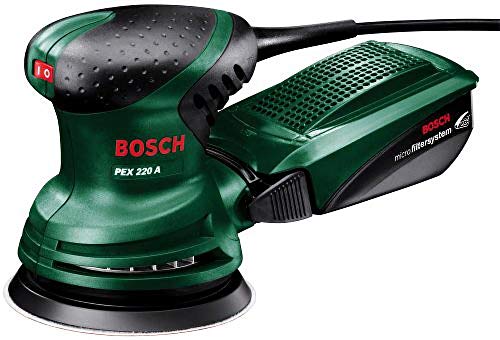
The Bosch PEX 220 A is our pick for most people, because it nails the two things that matter most on a random-orbital sander - the finish and the dust. The 220W corded motor drives a 125mm hook-and-loop pad to a smooth, swirl-free result on wood, filler and paintwork, and the Bosch micro filter system genuinely captures the fine dust that a cheaper sander lets drift into the air.
The softgrip body keeps a lightweight, compact tool comfortable through a long sanding session, and with more than 4,100 ratings it is comfortably the most-reviewed pick in this guide, which is reassuring at this price. The honest limit is the onboard dust box, which fills fast on bigger jobs, so for heavy work you will get the cleanest result by connecting it to a vacuum.
Best for Ryobi ONE+ owners: Ryobi ONE+ 18V Random Orbit Sander
The Ryobi ONE+ is the cordless pick to reach for if you already own Ryobi ONE+ tools, because the same 18V battery that powers your drill or driver runs this sander too - no new charger, no second platform. The 125mm orbital pad gives a clean, swirl-free finish on wood and composites, and cutting the cord lets you reach a deck rail, a door off its hinges or a corner a lead would never stretch to.
It is sold as a skin, which is exactly what you want if you are already in the ONE+ family, since you are not paying again for a battery you own. Two honest caveats apply: with no battery in the box it is poor value for anyone not already on ONE+, and stock on this particular skin can run low at times, so grab it when you see it.
Best for Einhell battery owners: Einhell Power X-Change Cordless Sander
The Einhell Power X-Change is the cordless value pick for anyone already on the Einhell battery system, and with more than 3,100 ratings it carries a reassuringly deep review base for a platform skin. The 18V motor has speed electronics, so you can ease off for fine finishing or open it up for faster stock removal, and the onboard dust box keeps the bulk of the mess off your bench.
The hook-and-loop plate swaps abrasive paper with a single twist of the wrist, and like every battery-platform tool the point is that it shares its 18V pack with the rest of the Einhell range. The honest caveat is the familiar skin trap: the battery is not included, so if you are not already a Power X-Change owner you need to add a pack to the price before this makes sense.
Best for Milwaukee M18 owners: Milwaukee M18 BOS125 Random Orbital Sander
The Milwaukee M18 is the cordless pick for tradespeople already invested in the M18 platform, where buying the bare skin and dropping in a battery you already own is the obvious move. It is built to a tougher standard than the budget sanders here, with strong dust capture that keeps the surface clear so you can actually see your work as you go.
At just 1.41kg it is light enough to use overhead or for long stretches without your arm tiring, and sharing M18 batteries with the rest of the Milwaukee range is the whole reason to be in this system. The honest caveat is price and packaging together: for a bare unit, it only stacks up financially if you already own M18 batteries, otherwise a corded Bosch does the finishing job for far less.
Best for DeWalt 20V owners: DeWalt 20V MAX Orbital Sander
The DeWalt 20V MAX is the top cordless sander in this guide and the pick if you want the smoothest, lowest-vibration finish on the DeWalt platform. The brushless motor wrings strong runtime out of a 20V battery, variable speed from 8,000 to 12,000 OPM lets you slow right down for delicate finishing or speed up for stock removal, and the low-profile body keeps the pad close to the surface for precise control.
With more than 13,200 ratings it is the most proven tool in this entire guide by a wide margin, and the replaceable 8-hole hook-and-loop pad swaps abrasive in seconds. The honest caveat is the one that applies to every premium cordless tool: it is sold as a skin with no battery, so unless you already own a DeWalt 20V pack you need to budget for one on top of the price of the sander itself.
How to match the sander to how you will use it
The single biggest mistake is buying cordless for the freedom and then realising the battery costs as much as the tool. Be honest about which platform you already own. If you have no cordless tools, or only ever sand at a bench near a power point, a corded sander is the smart buy, the Black and Decker or the Bosch gives you unlimited runtime and a better finish per dollar than any skin. If you already own Ryobi ONE+, Einhell Power X-Change, Milwaukee M18 or DeWalt 20V batteries, then the matching skin is genuinely good value, because you are only paying for the tool.
The other deciding factor is how much sanding you do and how much dust you can tolerate. For the odd weekend project, basic onboard dust collection is fine. For frequent work, or sanding indoors where fine dust lingers, prioritise extraction - the Bosch micro filter system and the strong capture on the Milwaukee are the standouts here, and connecting any of these sanders to a workshop vacuum will beat the onboard box every time.
What the key specs actually mean
A few numbers do most of the work when you compare these sanders. Pad size is the first: 125mm is the common standard here, and it sets which abrasive discs fit, so sticking to 125mm keeps replacement paper cheap and easy to find. That pad is also the limit of what these tools can reach, so for spindles, mouldings and other fiddly detail work a rotary tool with small sanding drums is the better fit. Speed, quoted in rpm or OPM (orbits per minute), tells you how aggressive the sander is - variable speed like the DeWalt's 8,000 to 12,000 OPM matters because you want it low for fine finishing and high for stock removal.
Power source is the spec that decides the rest. Corded sanders quote watts - 220 to 230W here - and never run flat. Cordless models quote voltage, 18V or 20V, and almost always arrive as a skin, so always check whether a battery is included before you compare prices. Finally, look for the words random-orbital: that oscillating-plus-spinning action is what leaves a swirl-free surface, and every pick in this guide has it. A dual-action car polisher works on the same principle, but it runs slower and drives a foam pad, so keep a sander well away from paintwork. Read those few details together and any spec sheet starts to make sense.
Frequently Asked Questions
Corded or cordless orbital sander - which should I buy?
It depends on whether you value unlimited runtime or freedom from the lead. A corded random orbital sander like the Black and Decker or the Bosch plugs in and runs forever for very little money, which suits most bench based DIY. A cordless sander lets you reach a deck rail or a door off its hinges, but it almost always comes as a skin - the tool only, no battery - so it makes sense mainly if you already own an 18V or 20V platform. If you have no cordless tools, buy corded; if you already own the batteries, buy the matching skin.
What is a random-orbital sander and why does it matter?
A random-orbital sander spins its pad and oscillates it in small circles at the same time, so no single grit point ever follows the same path twice. That combination removes material quickly while leaving a swirl-free finish that is ready for paint or oil, which is the result most people actually want. A plain sheet or orbital sander can leave visible swirl marks, so for general furniture, doors and DIY a random-orbital is the type to choose - and every pick in this guide is one.
What does it mean that a sander is sold as a skin?
A skin, also called a bare unit or tool only, means you get the sander itself but no battery and no charger. The Ryobi, Einhell, Milwaukee and DeWalt cordless picks here are all sold this way. The idea is that you already own batteries from the same brand, so you slot one in and save money by not buying another. If you do not own that platform yet, you must add the cost of a battery and charger before comparing the price against a corded sander, which never needs either.
What pad size should an orbital sander have?
For general DIY and finishing, 125mm is the common standard and the size most picks in this guide use. It is a good balance: large enough to cover a surface quickly, small enough to stay controllable and to fit hook-and-loop discs that are cheap and easy to buy anywhere. Sticking to a 125mm pad means you will never struggle to find replacement abrasive paper, whereas less common sizes can be pricier and harder to source.
How important is dust collection on a sander?
More important than people expect, both for the finish and for your health. Sanding throws up very fine dust that settles back on the surface and lingers in the air indoors. A good system like the Bosch micro filter, or the strong capture on the Milwaukee, keeps the surface clear so you can see your work and keeps the air cleaner to breathe. Onboard dust boxes fill fast, so for bigger or indoor jobs the cleanest result comes from connecting the sander to a workshop vacuum.
Do I need variable speed on an orbital sander?
It is genuinely useful rather than essential. Variable speed, like the DeWalt's 8,000 to 12,000 OPM, lets you run slow for delicate finishing on veneer or paint and fast for removing a lot of material, so one tool handles both ends of the job well. The cheaper corded sanders here have a fixed or single-trigger speed, which is fine for most everyday sanding. If you work with a wide range of materials and finishes, variable speed earns its place; for simple jobs you will rarely miss it.
Can one orbital sander handle wood, metal and paint stripping?
Yes, a random-orbital sander is a genuine all-rounder. The picks here are rated for wood, metal and PVC and for stripping paint or varnish from flat or curved surfaces - the difference between tasks is mostly the abrasive grit you fit, not the tool. Use a coarse grit to strip old finish and remove stock, then move to finer grits to smooth and prepare for paint or oil. The same 125mm sander, with a few discs of different grit, covers nearly every household sanding job.
What is the best brand of orbital sander?
There is no single best brand; it depends on how often you sand and whether you already own cordless batteries. The two corded picks, Bosch and Black and Decker, plug in and run for the least outlay. The four cordless picks are each sold as a skin, meaning the tool only, so buy the one that matches batteries you already own and check the exact model against your charger before you buy.
How do you use an orbital sander?
Let the weight of the tool do the work: rest it flat and keep it moving in overlapping passes rather than pressing down, which can leave swirl marks. Work up through the grits, a coarser one first to take material off and a finer one to smooth the surface. Fine timber dust gets everywhere, so a dust bag or vacuum plus the eye and dust protection listed in the tool's manual are worth using.