Why is a plyo box one of the best-value buys in a home gym?
Because almost nothing else gives you so much training for so little money or floor space. A single plyo box turns into box jumps, step-ups, box squats, incline push-ups, tricep dips, Bulgarian split squats and a seat for your rest periods. Most of the boxes in this guide cost less than a pair of decent runners, store flat against a wall, and last for years. For a first-home buyer kitting out a garage or spare room, it is the kind of purchase that quietly earns its keep.
The plyo box market in Australia splits three ways. Wooden boxes are cheap, rock solid and the CrossFit standard, but they punish a missed jump with a grazed shin. Soft foam boxes cushion that mistake, which makes them the safer pick for beginners and for anyone training alone with no spotter. Steel boxes are the gym-grade option, near indestructible and stackable, but heavier and dearer. The good news is that the most popular boxes are now 3-in-1 designs, so one box flips to give you three jump heights as your confidence grows.
We looked hard at what actually sells and reviews well on Amazon Australia, because that is where the price and availability are honest. The result is seven boxes that cover every budget and every comfort level, plus a clear steer on what to look for so you do not overpay for height you will never use.
The quick answer: which plyo box should you buy?
If you want one recommendation, buy the VEVOR 3-in-1 Wooden Plyo Box. It is the best balance of price, stability and capacity we found, with three heights and a 204kg rating for under $90 at its entry price. If a missed jump scares you, the Goplus 3-in-1 Soft Foam Box is the best value soft option, and the CAP Barbell 3-in-1 is the cheapest box we trust, at around $63 with hundreds of reviews behind it.
- Best overall: VEVOR 3-in-1 Wooden Plyo Box, three heights and 204kg capacity for a low price.
- Best value: Goplus 3-in-1 Soft Foam Box, forgiving foam landing with no assembly.
- Best budget: CAP Barbell 3-in-1, the cheapest pick here and an Amazon's Choice box.
- Most reviewed: Yes4All Soft Plyo Box, with more than 1,800 ratings.
- Highest rated: MEMAX Anti-Slip Wood box, built from 18mm birch plywood.
Last updated June 2026. Prices and availability change often on Amazon Australia, so check the live listing before you buy.
How do the best plyo boxes compare at a glance?
The table below is the short version. Wooden boxes give you the highest weight capacities and the firmest platform, which is why most CrossFit gyms run them. Soft foam boxes trade a little capacity for a kinder landing, and they need no assembly. Use the heights to match your room and your starting fitness, then read the full write-up for the box that fits your situation. Every box here is a 3-in-1, so the listed heights are all in a single unit.
How did we choose the plyo boxes in this guide?
NestPath is run by Australian first-home buyers, and we research products the way a careful shopper would, not by claiming to have jumped on every box ourselves. Our job is to read the evidence honestly and surface the boxes that hold up. Here is how we narrowed a crowded market down to seven.
- Real Australian availability and pricing. Each product card shows its current stock status, so check it before you order.
- Verified ratings and review counts. We only included boxes with a genuine star rating and a meaningful number of customer reviews, then cross-checked the rating and count for each one before making any claim about it.
- Safety and stability signals. We weighted anti-slip surfaces, rounded or smooth edges, internal bracing and honest weight-capacity figures, because a box that slides or tips is the fastest way to a shin injury.
- Material and use case. We deliberately mixed wood, soft foam and steel, and a spread of heights, so beginners, taller athletes and small rooms are all covered.
- What owners actually say. We read through the review text for recurring complaints, like a slick top surface or a fiddly internal brace, and folded those into the flaws sections so you know the trade-offs before you spend.
Best plyo box overall: VEVOR 3-in-1 Wooden Plyo Box
The VEVOR 3-in-1 Wooden Plyo Box is the box we would put in most home gyms. It nails the three things that matter, stability, capacity and price, and it does not ask you to compromise on any of them. One box flips to give you 16, 20 and 24 inch jump heights, the multi-layer plywood is rated to 204kg, and the honeycomb-textured top keeps your shoes planted on landing. At an entry price under $90 it undercuts most timber boxes from specialist gym retailers while matching them on build.
It arrives flat packed, pre cut and pre drilled, and most owners have it together in about five minutes with a drill or electric screwdriver. The internal support board is the one step worth slowing down for, since it is what gives the box its rigidity, so read the instructions for that part rather than guessing. Once built, the edges are sanded and slightly rounded to spare your hands, and the cut-out handles make it easy to drag across a garage floor or stack out of the way.
Australian reviewers single out the value and the practical heights. One verified buyer needed a precise 40cm (16 inch) step for a work fitness test and found this box hit it exactly when other step boxes did not, then praised the textured grip and the look of it. Another called it as good as the commercial boxes at their gym. The 204kg capacity is the joint highest in this guide, alongside the Yes4All wood box, which means it suits heavier athletes and weighted step-ups without any wobble. For a single box that covers beginners through to serious training, this is the one to beat.
Flaws but not dealbreakers
The top surface is grippy but firm, and a couple of overseas reviewers wished it were a touch softer underfoot, which is simply the nature of a timber box rather than a fault. As with any wooden plyo box, a missed jump will graze a shin, so if you are brand new to box jumps a soft box may suit you better. Finally, you do need a drill to assemble it properly, since hand-tightening the screws is slow going.
Best value soft plyo box: Goplus 3-in-1 Soft Foam Box
The Goplus 3-in-1 Soft Foam Plyo Box is the box we steer nervous first-timers toward. Box jumps are intimidating when you are learning, and the single biggest fear is clipping the edge and barking your shin. A soft box removes that fear, and the Goplus does it for a sensible price without feeling cheap. It flips for 16, 20 and 24 inch heights, the dense EPE foam core gives a forgiving landing while still feeling stable, and there is zero assembly, you lift it out of the carton and start training.
The outer is a tear-resistant PU cover that wipes clean in seconds after a sweaty HIIT session, with a hidden zip so nothing snags mid-workout and clear height markings so you can pick the right side at a glance. It weighs only around 3kg, so it is genuinely easy to carry between rooms or out to a class, yet it supports up to 160kg for confident jumps, step-ups, dips and split squats. For a beginner, a parent fitting workouts around the kids, or anyone who trains solo with no spotter, the soft landing is worth more than a few extra kilos of capacity.
It is a newer listing than some of the timber heavyweights here, but the early rating is solid and the formula is well proven, since soft wooden-core and foam boxes have been a staple of CrossFit boxes for years. If you value confidence and a clean, low-maintenance box over raw capacity, this is the smart value buy.
Flaws but not dealbreakers
A soft box is lighter than timber, so at the tallest 24 inch setting it can feel a fraction less planted than a heavy wooden box, which is true of every foam box and a reason to keep your jumps controlled at height. The review count is still building compared with the Yes4All soft box, so there is less long-term feedback to lean on. And while the 160kg capacity covers the vast majority of users, very heavy athletes doing weighted work may prefer the 204kg timber boxes.
Best budget plyo box: CAP Barbell 3-in-1 Plyometric Box
The CAP Barbell 3-in-1 is the cheapest box we are happy to recommend, and it is far from a token budget option. At around $63 it is the lowest price of our headline three, it carries an Amazon's Choice badge, and it is backed by hundreds of reviews, which is rare at this price. You get three heights of 12, 14 and 16 inches in one wooden box, interlocking panels held with countersunk screws, a non-slip textured surface on every side and wide ergonomic handles for carrying.
The lower height range is a feature, not a limitation. A 12 inch start is the right place for most beginners to learn the landing mechanics safely, and a 16 inch top end is plenty for step-ups, box squats and dips. It also means the box fits neatly into rooms with lower ceilings or limited space. The CARB-compliant wood is heavier and more solid than the flimsy foam blocks you sometimes see at this price, and verified buyers describe it as sturdy, well made and stable once the panels interlock correctly.
Assembly is the one thing to get right, since the panels slot together in a specific order before you drive the screws home, but reviewers say it is straightforward once you see how the sides lock. For a first box, a beginner, a teenager, or a second box to add lower heights to a taller one, the CAP Barbell is hard to beat on value. With 578 ratings it is also the most reviewed of our three headline picks, so you are buying a known quantity.
Flaws but not dealbreakers
The top height tops out at 16 inches, so taller or more advanced athletes chasing big jumps will outgrow it and should look at the VEVOR or a wood box with 24 or 30 inch options. Despite the brand wording, this is a firm wooden box with no rubber padding, so the same shin-graze caution applies as any timber box. And a few owners found the interlocking assembly puzzling at first, so take a minute with the panels before reaching for the drill.
Best for sheer track record: Yes4All Soft Plyo Box 3-in-1
If you want the box that the most people have already bought and rated, it is the Yes4All Soft Plyo Box. With more than 1,800 ratings it is by far the most reviewed box in this guide, and it has held a strong score across all of them. The clever part is the construction, a strong wooden core wrapped in EVA foam and a grippy vinyl cover, so you get the stability of timber with the softer, shin-friendly landing of foam.
That hybrid build is why it suits such a wide range of users. The vinyl surface grips your feet better than bare wood, the foam underneath absorbs the impact and protects the box, and the high weight capacity means heavier athletes and a workout partner can both use it without complaint. Owners regularly mention that it feels just as good as commercial gym boxes and that the three heights cover everything from learning step-ups to serious box jumps. If you want maximum reassurance from the crowd, this is the safest bet on the list.
It usually sits a little above the budget timber boxes on price, but you are paying for the soft-landing build and the enormous body of positive feedback. For a household where more than one person will use the box, or where someone is easing back into training after a break, the comfort is worth it.
Flaws but not dealbreakers
A couple of reviewers note the top surface is a touch small, so very tall jumpers should size up their height setting carefully. At the tallest setting some users found it best for controlled step work rather than maximal jumps, as with most soft boxes. It is also heavier than the lightweight foam-only boxes, which is the trade-off for that stable wooden core.
Best premium wooden box: Yes4All 3-in-1 Wood Plyo Box
For buyers who want a classic timber box with a deep review history, the Yes4All 3-in-1 Wood Plyo Box is the pick. It is the firm, no-nonsense CrossFit-style box, with internal bracing on the larger sizes for rigidity and a 450lb (about 204kg) weight capacity that ties for the highest here. With more than 700 ratings it is one of the most proven wooden boxes you can buy on Amazon Australia.
It ships flat with pre-drilled holes, and reviewers consistently report a clean, well-organised build that takes around 15 minutes with a drill, with spare screws included. The poly-coated outer protects the timber, the corners are rounded to reduce knocks, and the non-slip top keeps you stable through explosive reps. Several owners weighing 90kg and up confirm it handles their training with no flex or creak, which is exactly what you want from a wood box.
It is the dearest of the timber options here, but you are buying into a long, reliable track record and a higher capacity than the budget boxes. If you prefer the firm, predictable feel of a traditional wooden box and you want the reassurance of hundreds of happy owners, this is a safe, serious choice.
Flaws but not dealbreakers
It is a firm wooden box, so the usual shin-graze caution applies and beginners may prefer a soft option. Assembly really does want a drill rather than a hand screwdriver, and the internal support boards need to go in before you fully tighten everything. The price sits at the top of the timber range, so bargain hunters will be happier with the CAP Barbell or VEVOR.
Best premium build quality: MEMAX Anti-Slip Wood 3-in-1 Plyo Box
The MEMAX Anti-Slip Wood box earns the highest star rating in this guide, and the construction explains why. It is built from 18mm birch plywood, a thicker, higher grade than many budget boxes, with a honeycomb anti-slip texture on the surface. It comes in three sizes, small, medium and large, so you can match the box to your height and your room, and the largest size includes an internal reinforcement structure for extra rigidity.
Australian reviewers describe it as a good, solid jump box that is sturdy and as advertised, with one noting it doubles neatly as an ad-hoc seat. Each box gives three jump heights by simply rotating it, the handle cut-outs make it easy to move, and it arrives flat-packed for straightforward assembly. The maximum user weight is 150kg, and MEMAX recommends adding wood glue along the joins before screwing it together for commercial use or heavier users, a sensible tip that adds a lot of strength.
The review count is smaller than the big Yes4All boxes, so there is less long-term feedback, but the ratings that exist are excellent and the birch plywood spec is genuinely a step up. If build quality and a premium timber feel matter most to you, this is the box to consider.
Flaws but not dealbreakers
It ships without printed instructions in some cases, and one owner had to find an assembly video for a similar box to work out the internal bracing, so be prepared to improvise slightly. It is a firm wooden box, with the usual shin caution. And because the review base is still modest, you are leaning more on the spec sheet and a handful of strong reviews than on a huge crowd of feedback.
Best Australian-brand soft box: LSG Soft Plyo Box 3-in-1
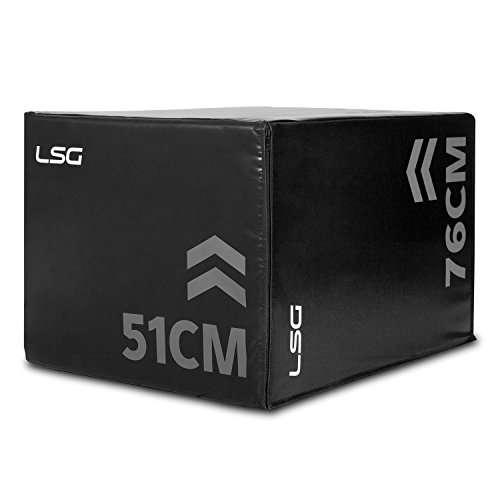
The LSG Soft Plyo Box is the pick for buyers who want an Australian brand and the soft-landing safety of foam. LSG is a familiar local fitness name, and this box wraps its foam in a heavy-duty PVC and polyester cover built to take a beating. It flips for three heights of 51cm, 61cm and 76cm, with colour-coded and clearly labelled sides so you always know which height you are on, plus a 160kg weight capacity and a 12-month local warranty.
The clear labelling is a genuinely nice touch in a group HIIT setting, where you want to set the right height fast, and the PVC surface grips better than bare timber while staying easy to wipe down. Local reviewers who chose foam over wood say they are glad they did, citing how easy it is to move and how durable it has proven over weekly WOD use. At around 7.5kg it is light enough to flip mid-session yet stable enough to jump on with confidence.
It is the most expensive soft box here, and that is the main thing to weigh up, since the Goplus offers a similar soft landing for less. But if buying from an established Australian brand with local warranty support matters to you, and you like the clear height labels, the LSG is a tidy, well-finished option.
Flaws but not dealbreakers
The biggest catch is a listing detail, not the box itself, one reviewer noted the item weight is shown incorrectly as around 50kg when the box actually weighs about 7.5kg, so do not buy it expecting a heavy, anchored box. It is also the priciest soft option in this guide. And as with all soft boxes, keep your jumps controlled at the tallest 76cm setting.
What should you look for in a plyo box?
Answer four questions before you buy and you will not put a foot wrong. First, wood, foam or steel? Wood is cheapest, firmest and the CrossFit standard, but unforgiving on a missed jump. Soft foam cushions mistakes and is the safer beginner choice. Steel is the most durable and stackable, but heavier and dearer. For most home gyms, a 3-in-1 wood box or a soft box is the sweet spot.
Second, what height do you actually need? Beginners should start around 12 to 20 inches and progress. A 24 inch box is a common all-round top end, and 30 inches is for confident athletes. Because every box here is a 3-in-1, you get a range in one unit, so buy for where you will be in six months, not where you are on day one. Also sanity-check the box against your ceiling height, since a tall box plus a jump plus your own height adds up fast.
Third, how much weight must it hold? Look at the capacity and add a margin, especially if you do weighted step-ups or you are a heavier athlete. The wood boxes here run to about 204kg, the soft boxes to around 160kg. Fourth, how safe is the surface? Prioritise an anti-slip or textured top, rounded or smooth edges, and internal bracing or a solid core for stability. A box that slides on a hard floor is dangerous, so check that the base grips or plan to put it on rubber gym flooring.
How do you care for a plyo box so it lasts?
Plyo boxes are low maintenance, but a few habits keep them safe and looking good. For wooden boxes, the single most useful tip comes straight from owners and manufacturers, run a bead of wood glue (PVA) along the joins before you screw the box together, then tighten the screws fully only after every panel and the internal brace are in place. That turns a good box into a rock-solid one and is strongly advised for heavier users.
After assembly, re-check the screws after your first week of use and then every month or so, since explosive landings can loosen fixings over time. For soft and foam boxes, wipe the PU or PVC cover down with a damp cloth after sweaty sessions to stop odour building up, and use the hidden zip to air the cover if your box has one. Store any box out of direct sun and away from damp, as constant moisture can swell plywood and degrade foam.
Finally, give the box a quick once-over before each session, look for a cracked panel, a torn cover or a wobbly side, and stand it on a non-slip surface such as rubber flooring or a gym mat. A stable base does more for your safety than any single feature on the box.
What else will you want for plyo and jump training?
A plyo box rarely trains alone. A few inexpensive extras turn it into a complete conditioning setup, and most pair naturally with the boxes above. Here are the accessories worth adding.
How does our pick compare with boxes from specialist gym retailers?
If you have searched plyo boxes in Australia, you will have seen brands like SMAI, CORTEX, Rogue, Iron Edge, HART, Force USA and Nike Strength on dedicated fitness sites. Those boxes are good, and some are genuinely premium, but they often cost more once you account for delivery, and availability moves around. Our picks focus on Amazon Australia because the pricing and stock are transparent and delivery is usually included with Prime.
A couple of those alternatives are worth knowing about. CORTEX sells a popular 3-in-1 wooden box widely across The Good Guys, Harvey Norman and Amazon, and a steel triple-box set if you want gym-grade durability, though its Amazon review count is still thin. SMAI makes a competition-grade foam WOD box that CrossFitters rate, sold through SMAI direct and a handful of stockists. Rogue's foam and flat-pack games boxes are the gold standard if budget is no object. For most first-home buyers, though, the boxes in this guide deliver the same training at a friendlier price, which is why they earned the spots.
Frequently asked questions about plyo boxes
Are plyo boxes worth it?
For most people, yes. A plyo box is one of the cheapest ways to add explosive jump training, step-ups, box squats and dips to a home gym, and a single 3-in-1 box replaces several pieces of kit. It stores flat, costs less than many pairs of shoes, and lasts for years, which makes it excellent value for a beginner building a garage or spare-room setup.
What size plyo box should I buy?
Match the height to your fitness, not your ambition. Beginners are best starting around 12 to 20 inches to learn safe landings, then progressing. A 24 inch box is a common all-round top end for general fitness, and 30 inches suits confident athletes. Because the boxes in this guide are all 3-in-1, you get a range of heights in one unit, so you can grow into it.
Are soft or wooden plyo boxes better?
It depends on your priority. Wooden boxes are firmer, cheaper and the CrossFit standard, but a missed jump can graze your shin. Soft foam boxes give a more forgiving, cushioned landing, which makes them safer and more confidence-building for beginners and for anyone training alone. If you are nervous about box jumps, choose soft, if you want maximum stability and value, choose wood.
What weight capacity do I need in a plyo box?
Take your bodyweight, add a generous margin, and account for any weighted work like loaded step-ups. The wooden boxes in this guide are rated to around 204kg and the soft boxes to about 160kg, which covers the vast majority of users comfortably. Always treat the stated capacity as a maximum rather than a target.
How do I stop my plyo box from slipping?
Choose a box with an anti-slip or textured top and a base that grips, then stand it on rubber gym flooring or a mat rather than a slick tiled or polished floor. For wooden boxes, gluing the joins during assembly and keeping the screws tight also reduces any movement and creak that can make a box feel unstable.
Can I leave a plyo box outside?
It is not ideal. Constant sun, rain and damp will swell and warp plywood over time and can degrade foam and covers. If you train on a patio or in a carport, store the box undercover between sessions and wipe down any moisture. The boxes here are built for indoor or garage use, not permanent outdoor exposure.
Build the rest of your home gym
A plyo box is the perfect anchor for a low-cost, high-output home gym. Pair it with these NestPath guides to round out your strength and conditioning setup without overspending.
About the author
Anish Puri founded NestPath in 2026 after going through the Australian first-home-buyer process himself. NestPath focuses on Australian first-home buyers because the existing review sites are American, generic, or both. Anish handles editorial selection across the homeowner hub. Reach out: hello@nestpath.com.au