How to choose a baby gate in Australia
A baby gate does one job - it puts a barrier between a mobile baby and the part of the house that can hurt them, the stairs above all. One rule outranks everything: a pressure-mounted gate must never be used at the top of stairs - we will repeat it through this guide. Beyond it, the choice comes down to the opening. Walk-through pressure gates like the Regalo Easy Step and Dreambaby Chelsea suit the doorways and hallways you pass through all day. A hardware-mounted retractable like the Perma Child Safety is the top-of-stairs answer. An extra-wide frame like the BABELIO spans open-plan gaps up to 122cm, an extra-tall gate slows a climber, and a built-in cat door keeps a pet household moving. This guide covers six gates from $55.93 to $109.99, each matched to a different opening, plus the certification fine print most listings skip.
Pressure-mounted vs hardware-mounted - the rule that decides everything
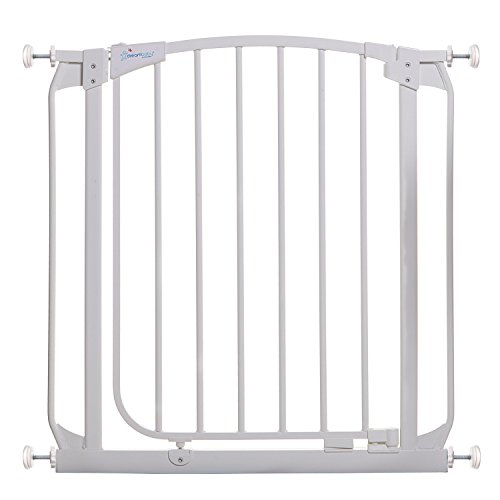
Every gate here mounts one of two ways, and the difference is the most important thing on this page. A pressure-mounted gate clamps between two surfaces by tension - no drilling, up in minutes, down without a trace and easy to move between rooms. That makes it the renter-friendly option and the right tool for doorways, hallways and the bottom of stairs. But a determined toddler leaning, rattling or pushing can work a pressure gate loose, and almost every framed pressure gate runs a bar across the floor. At the top of stairs those two flaws turn dangerous - a dislodged gate or a tripped adult falls down the whole flight. So the rule, with no exceptions: never use a pressure-mounted gate at the top of stairs. A hardware-mounted gate screws into studs or a post, cannot be pushed over and is the only type that belongs up there - the trade-off is drilling, which renters need permission for. Of the six picks, only the Perma Child Safety retractable is hardware-mounted by design. The Regalo Easy Fit below is the simplest of them - a plain, cheap barrier you step over.
Stair gates - what actually belongs at the top of the stairs
A search for a stair gate usually means one of two jobs, and they need different gates. The bottom of the stairs is the easy job - any well-fitted pressure gate works there, because a gate that fails at the bottom drops onto flat floor, not down a flight. The top of the stairs is the hard job. Up there the gate must be hardware-mounted, and the floor bar that most framed gates put across the opening becomes a trip hazard right at the edge of the drop. This is where a retractable gate earns its place: the Perma Child Safety screws into the wall or post on both sides, and the mesh rolls completely away when open, so there is no bar underfoot at all. It is the top-of-stairs pick in this guide. Every pressure-fit pick in this guide, the Chelsea included, stays away from the top of stairs - no exceptions.
Walk-through doors, auto-close and one-hand operation
How the gate opens decides how annoying it is to live with, and you will open it thousands of times. A walk-through door with a one-hand latch is the feature to prioritise on a busy doorway, because you will usually be holding a baby, a basket or both. The Regalo Easy Step is the benchmark - thumb the latch, swing through, done - with 81,891 global ratings behind it. The Dreambaby Chelsea and both BABELIO gates go a step further with auto-close doors that swing themselves shut and latch, so a gate left ajar closes itself. At the other end, the Regalo Easy Fit has no door at all: it is a fixed barrier you step over, which is fine across an opening you rarely cross and tiresome anywhere else. One repeat of the rule: every pressure gate in this guide - the two Regalos, the Dreambaby and both BABELIOs - is for doorways, hallways and the bottom of stairs, never the top.
The certification question - and the Australian brands
Here is the part most listings will not tell you: there is no mandatory Australian standard for baby gates. There is no AU mark to look for, and nothing requires a gate sold here to pass a local rule. Regalo, BABELIO and most imported gates certify to the US ASTM standard - and often carry JPMA certification, the American juvenile-products body - a genuine third-party bar, but an American one. The Australian brands in this guide are Dreambaby, the Sydney-based Tee-Zed company that has made child-safety gear for decades, and Perma Child Safety, the Australian retractable-gate specialist. What this means in practice: treat any certification as a starting point, not a guarantee. The standard never saw your doorway, your skirting boards or your staircase. Install exactly per the manual, then push the gate hard, shake the frame and lean on it the way a toddler will. If it shifts, refit it.
Measuring your opening - skirting boards, banisters and wide gaps
More gates fail on fit than on quality, so measure before you buy. Measure the width of the opening at the height where the gate frame will actually sit and press - not at floor level - skirting boards make the bottom of most Australian openings narrower than the wall above. Measure at both the top and bottom of the frame zone and use the smaller figure - older openings are rarely perfectly square. Pressure gates also need two flat, parallel surfaces to grip - a round banister or newel post will not take a tension cup or a screw plate properly without a banister adapter kit, so check what each side of your opening actually is. Then match the range: the Regalo Easy Step fits 74-99cm, and the Dreambaby Chelsea fits 71-82cm with extension panels available to grow it. For genuinely wide spans - open-plan rooms, the gap between a kitchen bench and a wall - the BABELIO extra-wide covers 73.7 to 122cm out of the box.
Climbers, cats and when to take the gate down
Two situations break standard gates. The first is a climber - some toddlers treat a standard-height gate as a ladder, and a gate a child can climb is more dangerous than no gate, because now they fall from height. An extra-tall gate like the 91.4cm BABELIO buys real time by keeping the top rail out of reach. The second is a pet household: shut a normal gate and the cat is cut off from the litter tray, and a gate propped open for the cat protects nobody. The extra-tall BABELIO solves both at once with a built-in small pet door that lets a cat slip through while the child-proof main door stays latched. And know when to stop: most manufacturers and safety guidance suggest removing gates around the time your child turns two, or once they are roughly 1m tall, can work the latch or start climbing - whichever comes first. Treat those as rough markers, and once climbing starts in earnest, take the gate down and teach stair skills under supervision instead.
Our verdict
For most people the Regalo Easy Step Walk Thru at $69.49 is the one to buy - the most-reviewed walk-through pressure gate in the world at 81,891 ratings on its global listing, with a one-hand door and a 74-99cm range that covers most Australian doorways, which is why it is our pick. For the top of stairs, ignore every pressure gate including ours and buy the hardware-mounted Perma Child Safety retractable at $56.44 - it screws in, rolls away and leaves no trip bar. The cheapest way in is the Regalo Easy Fit at $55.93, a step-over pressure barrier. The Dreambaby Chelsea at $69.95 is the Australian heritage pick with an auto-close door and the highest rating here at 4.6 stars. The runner-up BABELIO extra-wide at $95.99 spans openings up to 122cm without extensions, and for climbers and cat households the 91.4cm extra-tall BABELIO at $109.99 adds a built-in pet door.
Frequently Asked Questions
Can I use a pressure-mounted baby gate at the top of stairs?
No - never. A pressure gate grips by tension and can dislodge if a child leans on it, pushes it or rattles it, and at the top of stairs that failure means a fall down the whole flight. Most pressure gates also run a trip bar across the floor - at the worst possible spot in the house. At the top of stairs use only a hardware-mounted gate screwed into the wall or post, like the Perma Child Safety retractable ($56.44). The Regalo, Dreambaby and BABELIO pressure picks belong in doorways, hallways and at the bottom of stairs.
What is the difference between a pressure-mounted and a hardware-mounted baby gate?
A pressure-mounted gate clamps between two flat surfaces by tension - no drilling, up in minutes and down without a trace, which makes it ideal for renters and doorways. A hardware-mounted gate screws into wall studs or a post, so it cannot be pushed over, and that is why it is the only type safe for the top of stairs. In this guide only the Perma Child Safety retractable ($56.44) is hardware-mounted - every other pick is pressure-fit.
Do baby gates sold in Australia meet an Australian safety standard?
There is no mandatory Australian standard for baby gates, so no gate here carries an AU-specific certification. Regalo and most imported gates certify to the US ASTM standard used in their home market, a genuine third-party bar but an American one. Dreambaby, the Sydney-based Tee-Zed brand, and Perma Child Safety are the Australian-brand picks in this guide. Whichever you buy, the certificate never saw your doorway - install per the manual, then push, shake and lean on the gate the way a toddler will before trusting it.
How do I measure my opening for a baby gate?
Measure the width at the height where the gate frame will press, not at floor level - skirting boards make the bottom of most openings narrower than the wall above. Measure at the top and bottom of the frame zone and use the smaller figure - older openings are rarely square. Check both sides are flat and parallel: a round banister or newel post needs an adapter kit before a gate can grip it. Then match the range - the Regalo Easy Step fits 74-99cm, the Dreambaby Chelsea fits 71-82cm with extensions available, and the BABELIO extra-wide spans 73.7-122cm.
Are retractable baby gates worth it?
For the right opening, yes. A retractable gate like the Perma Child Safety ($56.44) is a mesh barrier that rolls completely away into its housing, so when open there is no frame to step over and no bar on the floor - which is exactly why it suits the top of stairs, where a framed gate leaves a trip hazard at the edge of the drop. It is hardware-mounted and covers openings up to 180cm. The trade-offs: mesh feels less solid than steel, opening it is a two-step roll-and-hook action rather than a one-hand swing, and it must be screwed in.
What is the best baby gate for renters?
A pressure-mounted gate, because it holds by tension and needs no drilling - the Regalo Easy Step ($69.49) and Dreambaby Chelsea ($69.95) both go up in a doorway without a screw and come down without leaving a mark. The catch is the stairs rule: a top-of-stairs gate must be hardware-mounted, which means drilling and therefore landlord permission. If you cannot drill, do not compromise by tension-fitting a gate at the top of stairs - gate the doorways and the bottom of the stairs instead, and manage the top with supervision and closed doors.
When should I take the baby gate down?
Most manufacturers and safety guidance suggest removing gates around the time your child turns two, or once they are roughly 1m tall, can open the latch or start climbing over - whichever comes first. A gate a child can climb becomes its own falling hazard. Children vary, so treat these as rough markers rather than a fixed date. If you have an early climber, an extra-tall gate like the 91.4cm BABELIO ($109.99) buys time, but once climbing starts in earnest the safer path is removing the gate and teaching stair skills under supervision.
Found this helpful?
Check out more guides for new homeowners.