Maintainer or fast charger? That is the real question
Decide first whether you want to keep a healthy battery topped up or bring a flat one back quickly. The NOCO GENIUS1 is a 1A unit that its listing says you can leave connected safely, indefinitely, while the Husgw and NOCO GENIUS10 are 10A chargers.
The listings here run from 0.8A to 10A. Get that one decision right and the rest is easy. If your battery goes flat away from home, a jump starter is the roadside tool and a charger is the home fix.
Availability: Could not be bought on 17 October 2026: CTEK XS0.8 Battery Maintainer, which Amazon AU showed as temporarily out of stock. Product details below retain it for comparison; check the live listing before ordering.
The second thing to check is battery type. The listings name the battery types each charger supports: the NOCO GENIUS1 and GENIUS10 name 6V and 12V lead acid, including AGM, EFB and gel, plus lithium LiFePO4, and the CTEK MXS5.0 title names a dedicated AGM mode. Choose a charger whose listing names your battery type. The six chargers below cover that maintainer versus fast charger split.
What is the best car battery charger in Australia?
The NOCO GENIUS1, rated 4.6 stars from 197 ratings, is the charger we recommend for most drivers. It is a 1A smart charger and maintainer for 6V and 12V lead acid and lithium LiFePO4 batteries, and its listing says you can leave it connected safely, indefinitely. For a higher amp charger, see the 10A NOCO GENIUS10.
How the six chargers compare
| Charger | Output | Battery types named in the listing | Rating on Amazon AU | Mains input in the listing |
|---|
| NOCO GENIUS1 1A Smart Charger | 1A | 6V and 12V lead acid (AGM, EFB, Gel, SLA, VRLA, Start Stop) and lithium LiFePO4 | 4.6 stars from 197 ratings | Input voltage 240 Volts in the product information; plug type not named |
| COREBOX 6A Smart Battery Charger | 6A | 12V lead acid, including AGM, GEL, SLA and flooded types | 5.0 stars from 1 rating | Product information lists Input Voltage 12 Volts, which is not a mains figure |
| Husgw 10A 12V/24V Smart Charger | 10A on 12V, 5A on 24V | 12V and 24V lead acid, including AGM, GEL, SLA and flooded types; lithium wording is mixed | 4.5 stars from 4,812 ratings | Input voltage 100 to 240 VAC, 50/60 Hz, in the description; Input Voltage 240 Volts in the product information; plug type not named |
| CTEK XS0.8 Battery Maintainer (could not be bought on 17 October 2026) | 0.8A | Smaller 12V batteries such as motorcycle, jet ski, ATV and lawnmower batteries | 4.7 stars from 55 ratings | Product information lists Input Voltage 12 Volts, which is not a mains figure |
| CTEK MXS5.0 Smart Charger | 5A | 12V lead acid with a dedicated AGM mode | 4.8 stars from 284 ratings | No mains voltage figure in the listing |
| NOCO GENIUS10 10A Smart Charger | 10A | 6V and 12V lead acid (AGM, EFB, Gel, SLA, VRLA, Start Stop) and lithium LiFePO4 | 4.5 stars from 229 ratings | Input voltage 240 Volts in the product information; plug type not named |
Ratings and counts come from the Amazon AU listings. The CTEK MXS5.0 listing's merchant line reads Sold by Amazon Resale and Fulfilled by Amazon.
COREBOX 6A Smart Battery Charger
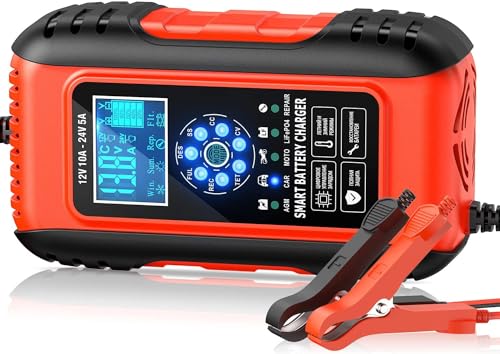
The COREBOX is a 12V 6A automatic charger with a seven stage program that runs from desulfation and soft start through bulk charge, analysis, recondition and float to pulse maintenance, and its listing calls it a charger, maintainer, trickle charger and desulfator in one. It is sold by a third party, and Amazon AU shows one rating, a 5.0, so there is almost no review history to lean on.
The listing says it suits all 12V lead acid batteries, including AGM, GEL, SLA and flooded types, includes a pulse repair mode, and has eight charging protections, including reverse protection, overcurrent, overcharge and short circuit. It also warns that it cannot repair a totally dead battery, and it does not name lithium. On 17 October 2026 the Amazon AU listing showed a third party seller rather than Amazon AU and did not state where the unit ships from, so treat it as an overseas seller.
Husgw 10A 12V/24V Smart Charger
The Husgw is a 10A charger for 12V and 24V batteries, and Amazon AU showed it as in stock. Its listing says the charging speed is about 30% faster than an 8A automatic charger and about 50% faster than a 5A charger, and it names 12V at 10A and 24V at 5A. It is sold by a third party, XingOuji, and ships from Amazon.
The listing describes a seven stage program with a pulse repair mode and up to 11 protections, and says it suits 12V and 24V lead acid batteries including AGM, GEL, SLA and flooded types. It has the largest review base on this page, 4.5 stars from 4,812 ratings on Amazon AU. The honest caveats are that the listing wording on lithium is mixed, so confirm before using it on a lithium battery, that it says it cannot activate a completely dead battery, and that 10A is more than you need if you only want to keep a healthy battery topped up.
Best overall: NOCO GENIUS1 1A Smart Charger
The NOCO GENIUS1 is the charger we recommend for most drivers: Amazon AU shows it at 4.6 stars from 197 ratings, and the listing describes a 1A charger, maintainer, trickle charger and desulfator in one. Its listing says the charger constantly monitors the battery, allowing you to leave it connected safely, indefinitely, and it names both lead acid and lithium batteries, which is why it suits a stored, weekend or seldom driven battery.
It is designed for 6V and 12V lead acid (AGM, EFB, Gel, SLA, VRLA, Start Stop) and lithium LiFePO4 batteries, and an integrated thermal sensor dynamically adjusts the charge based on ambient temperature. The listing says you can charge batteries from as low as 1 volt, or use Force Mode to manually charge completely dead batteries down to zero volts, and it includes a 3 year warranty. The honest caveat is the 1A output: it will take longer to recharge a flat battery than the 5A and 10A chargers here, so choose a higher amp charger if that matters. The product information lists input voltage 240 Volts, and the listing does not name the plug type.
CTEK XS0.8 Battery Maintainer
The CTEK XS0.8 is a 0.8A maintainer for charging smaller 12V batteries like motorcycle, jet ski, ATV and lawnmower batteries, and its listing says it is also suitable for maintenance charging of classic car batteries. The listing says its patented float and pulse maintenance makes it ideal for long term battery maintenance.
The listing describes fully automatic charging programs that you select with the mode button, a patented desulphation function that analyses the state of the battery and, if possible, recovers it, and a 5 year warranty. Amazon AU showed 4.7 stars from 55 ratings. Because it could not be bought on 17 October 2026, treat this card as a reference until it is back in stock.
CTEK MXS5.0 Smart Charger
The CTEK MXS5.0 is a 5A, eight step charger for 12V lead acid batteries that both charges and maintains. Its listing highlights RECOND mode, which restores batteries that are out of condition or deeply discharged, and a dedicated charge program for AGM batteries for a faster charge time.
The listing also names built in temperature compensation and a patented desulphation function, and Amazon AU shows 4.8 stars from 284 ratings. The honest caveats are that it costs more than the COREBOX, Husgw and NOCO GENIUS1, and that its listing names lead acid and AGM batteries, not lithium.
NOCO GENIUS10 10A Smart Charger
The NOCO GENIUS10 is a 10A smart charger with the same 6V and 12V lead acid and lithium LiFePO4 support as the GENIUS1. The listing says Force Mode can charge completely dead batteries down to zero volts and a thermal sensor adjusts the charge based on ambient temperature.
The box includes a 10A charger, a 72 inch AC cable, an 80 inch DC cable with battery clamps and a mounting bracket, and the listing gives a 3 year warranty. Amazon AU shows 4.5 stars from 229 ratings, and the product information lists input voltage 240 Volts. The honest caveat is that 10A is a lot of output if you only want to keep a healthy battery topped up; the 1A NOCO GENIUS1 is a maintainer built for that.
How to match the charger to your situation
The biggest mistake is buying for the dramatic rescue rather than the everyday reality. If your situation is a healthy battery in a car, motorcycle, boat or classic that sits in the shed, a maintainer such as the 1A NOCO GENIUS1 is the match, and a 10A charger would mostly sit idle. If you regularly face a flat battery, look at a higher amp charger such as the 5A CTEK MXS5.0 or a 10A charger like the NOCO GENIUS10 or Husgw. A car that sits outside between drives also needs weather protection, which is what a fitted car cover for outdoor parking is for.
Battery chemistry is the other deciding factor. Choose a charger whose listing names your battery type. The NOCO GENIUS1 and GENIUS10 listings name lead acid (AGM, EFB, Gel, SLA, VRLA, Start Stop) and lithium LiFePO4, the CTEK MXS5.0 title names a dedicated AGM mode, and the COREBOX and Husgw listings name AGM, GEL, SLA and flooded lead acid types. Check which battery is actually under your bonnet before you buy. For the fuel system side of a driveway service, see the fuel injector cleaner guide.
What the key specs actually mean
Three things do most of the work when you compare these chargers. Output in amps tells you how much current the charger can deliver: the listings here run from 0.8A to 10A. The number of charging stages or steps shows how much the charger does between bulk charge and maintenance; the COREBOX and Husgw listings describe seven stages and the CTEK MXS5.0 lists eight steps.
Battery type support is the spec to read closely. A charger that names AGM, gel and lithium alongside flooded lead acid, as the NOCO GENIUS1 and GENIUS10 listings do, tells you what it was designed for. Read those three together: amps, stages and supported battery types. If you are also sorting out other boot essentials, our guide to the best tyre inflators in Australia covers the other tool worth keeping in the car. If your next vehicle accessory is an LED light bar, compare its wiring requirements too.
Which charger suits your battery or vehicle?
Choose by battery type first, then amps, then vehicle. Each listing names the battery types its charger supports, so match yours to the list below before you look at brand or size. The vehicle lists in the listings, such as caravans, boats and ATVs, are a second check.
- 6V or 12V lead acid, or lithium LiFePO4: NOCO GENIUS1 1A Smart Charger or NOCO GENIUS10 10A Smart Charger.
- 12V and 24V lead acid: Husgw 10A 12V/24V Smart Charger.
- 12V lead acid with a dedicated AGM mode: CTEK MXS5.0 Smart Charger.
- 12V lead acid with a seven stage program: COREBOX 6A Smart Battery Charger.
How do I connect a car battery charger?
Switch off the vehicle ignition and all electrical accessories before starting, then identify the terminals clearly marked positive in red and negative in black. Follow your charger's instructions for the order of connection and the charge mode, because the listings here describe different modes for different batteries.
Those two steps are the first ones in Google's AI Overview for this search.
Charger terms in plain words
Four terms matter when you read these listings: maintainer and trickle charger, sulphation, temperature compensation and Force Mode. Each definition below repeats the wording on the NOCO GENIUS1 or CTEK listing, so you can check it against the page before you buy.
- Maintainer, trickle charger and desulfator: the NOCO GENIUS1 listing calls itself the all in one charging solution: battery charger, battery maintainer, trickle charger, plus desulfator.
- Sulphation: the CTEK MXS5.0 listing says unused batteries lose their power and their life is shortened through sulphation, and that pulsing current and voltage safely removes sulphate from the lead plates.
- Temperature compensation: the NOCO GENIUS1 listing says an integrated thermal sensor dynamically adjusts the charge based on ambient temperature, preventing overcharging in hot weather and undercharging in cold.
- Force Mode: the NOCO GENIUS1 listing says you can use Force Mode to manually charge completely dead batteries down to zero volts.
How we chose these car battery chargers
We read each charger's Amazon AU listing, including the maker's bullet points and the product information table, and took ratings and review counts from the Amazon AU page. We have not bench tested these chargers. Where a listing does not state a figure, such as a plug type, we say so.
Last checked: 17 October 2026.
Frequently Asked Questions
Do I need a smart maintainer or a fast charger?
A maintainer, such as the 1A NOCO GENIUS1, is for keeping a healthy battery topped up, and its listing says it can stay connected safely, indefinitely. A higher amp charger, such as the 10A NOCO GENIUS10 or the 5A CTEK MXS5.0, suits a battery that regularly goes flat.
Are cheap car battery chargers any good?
The COREBOX listing describes a 6A, seven stage automatic charger with pulse repair and eight protections for AGM, gel, SLA and flooded 12V batteries. It has one rating on Amazon AU, a 5.0, so there is almost no review history to lean on. The Husgw 10A has 4,812 ratings at 4.5 and suits 12V and 24V lead acid batteries.
Can I charge an AGM or lithium battery with these?
Only with a charger whose listing names your battery type. The NOCO GENIUS1 and GENIUS10 list 6V and 12V lead acid, including AGM, EFB and gel, plus lithium LiFePO4. The CTEK MXS5.0 has a dedicated AGM mode. The Husgw listing mixes lead acid and LiFePO4 wording, so confirm before using it on lithium.
What does desulfation or pulse repair actually do?
Desulfation and pulse repair modes target sulphation: the CTEK MXS5.0 listing says unused batteries lose their power through it and that pulsing current and voltage removes sulphate from the lead plates. The COREBOX and Husgw listings both say they cannot repair or activate a totally dead battery.
Can I leave a battery charger connected all the time?
The NOCO GENIUS1 and GENIUS10 listings say the charger constantly monitors the battery and lets you leave it connected safely, indefinitely. CTEK describes its float and pulse maintenance as ideal for long term battery maintenance. Follow your maker's instructions for any unit you leave connected.
How many amps do I need to charge a car battery?
Pick the lowest amp rating that fits the job, such as 1A to keep a healthy battery topped up. The listings here run from 0.8A to 10A: the CTEK XS0.8 is 0.8A, the NOCO GENIUS1 is 1A, the CTEK MXS5.0 is 5A, the COREBOX is 6A, and the Husgw and NOCO GENIUS10 are 10A.
Is CTEK or NOCO better?
We recommend the NOCO GENIUS1, rated 4.6 from 197 ratings, for most people because its listing names lead acid and lithium and says it can stay connected safely, indefinitely. The CTEK MXS5.0 is rated 4.8 from 284 ratings and its listing names lead acid and AGM, not lithium. Choose by amps and battery type.
Can a dead car battery be recharged?
Sometimes. The NOCO GENIUS1 and GENIUS10 listings say they charge batteries from as low as 1 volt, and Force Mode can charge completely dead batteries down to zero volts. The COREBOX and Husgw listings say their repair modes have limits: the COREBOX cannot repair a totally dead battery and the Husgw cannot activate a completely dead one.
Which charger suits a caravan, motorhome or boat?
The NOCO GENIUS1 and GENIUS10 listings name caravans, campervans, motorhomes, vans and boats among compatible vehicles, and the Husgw lists RV, ATV, golf cart and marine batteries with 12V and 24V support. Check your battery type and amp needs before choosing.
Will these chargers run on Australian mains power?
The NOCO GENIUS1, GENIUS10 and Husgw listings list 240 volt input; the COREBOX and both CTEK listings give no mains figure. The GENIUS1 listing describes a direct wall plug in but does not name the plug type. The COREBOX and CTEK XS0.8 product information lists Input Voltage 12 Volts, which is not a mains figure.