Best overall: STANLEY FATMAX V20 18V 18 Gauge Finishing Nailer, Nailer Only, No Battery or Charger
The STANLEY FATMAX V20 18V 18 gauge Finishing Nailer is the nailer we choose, and it is a nailer only, with no battery or charger. The listing says "Battery and Charger sold separately", so the battery and charger are bought on top. It is rated 5.0 from 6 ratings on Amazon AU, a small base, so treat the score as promising rather than proven.
It is an 18 gauge brad nailer, not a framing nailer. The title lists up to 425 18Ga brad nails, a magazine that stores 100 nails, tool free depth adjustment and an LED work light. The bullet points add a non marring nose that avoids marks on surfaces, and say the battery powered design eliminates the need for compressors, hoses or costly gas cartridges. Its description calls it ideal for finer finishing such as tongue and groove panelling, door and window casing and cabinetry trimming.
The 425 figure is the listing's claim when the nailer is used with a STANLEY FATMAX V20 2.0Ah battery. Amazon AU is the seller shown on its listing.
How we chose these nail guns
We read the Amazon AU listing for each nailer: the title, the bullet points, the product information table and the maker's description shown on the listing. Specs come from the maker's bullet points and the product information on each listing. We did not test these nailers. Where a listing does not state a power source or a use, we say so and point you to the maker's manual. The STANLEY FATMAX V20 18V 18 gauge Finishing Nailer, nailer only with no battery or charger, is the nailer we choose because its Amazon AU listing has the highest star rating of the six, 5.0 from 6 ratings, though that is a small base.
Last checked: 21 October 2026.
Nail guns compared at a glance
The table sorts the six nailers by gauge, power and what each listing says comes with the nailer. The STANLEY FATMAX V20 (nailer only, no battery or charger) and the Milwaukee M18 FUEL are tool only listings, so the battery and charger are not part of what they sell.
| Nailer | Type and gauge | Power | In the listing | Amazon AU rating |
|---|
| STANLEY FATMAX V20 18V 18 Gauge Finishing Nailer, nailer only, no battery or charger | Brad nailer, 18 gauge | Battery powered, 18 Volts | Nailer only, battery and charger sold separately | 5.0 from 6 ratings |
| Craftsman 18GA Pneumatic Brad Nailer | Brad nailer, 18 gauge | Air powered | Nailer, 1/4 inch air fitting and carrying case | 4.8 from 206 ratings |
| Metabo HPT 16GA Finish Nailer | Finish nailer, 16 gauge | Air fitting for a compressor hose | Nailer, safety glasses, plug, no mar tip and carrying case | 4.7 from 1,899 ratings |
| Ryobi 18V ONE+ Cordless Brad Nailer | Brad nailer, 18 gauge | Cordless, 18 Volt ONE+ | Tool only in the title. Could not be bought on 21 October 2026 | 4.7 from 1,138 ratings |
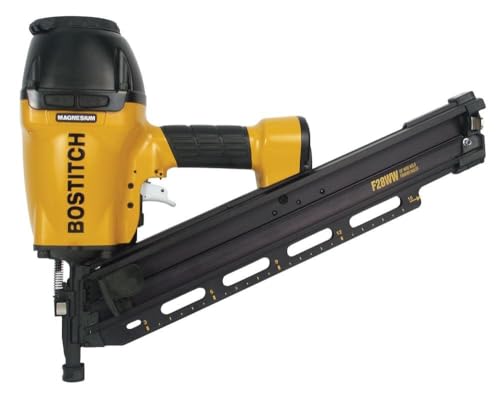
| Bostitch F28WW Framing Nailer | Framing nailer, clipped head nails 2 to 3.5 inch | Not stated in the listing | The nailer | 4.8 from 562 ratings |
| Milwaukee M18 FUEL Cordless Brad Nailer | Brad nailer, 18 gauge | Cordless, 18 Volts lithium ion | TOOL ONLY, no battery or charger | 4.7 from 169 ratings |
Read the table by power source first, then by gauge. The sections below give the listing facts for each nailer, and the gauge section explains which job each gauge suits. For most home jobs an 18 gauge brad nailer is the usual starting point, a 16 gauge finish nailer covers heavier trim, and a framing nailer is only worth buying if you do structural work.
Craftsman 18GA Pneumatic Brad Nailer
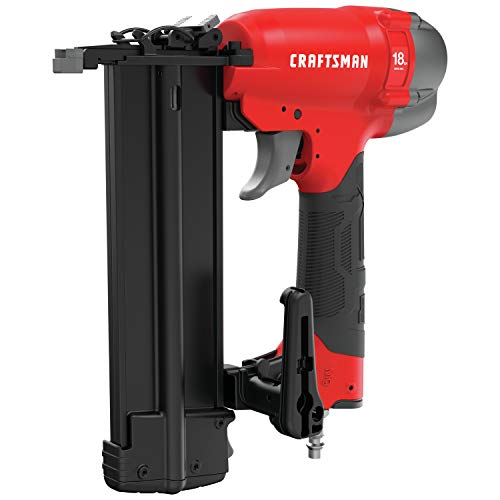
The Craftsman CMPBN18K is an 18 gauge air powered brad nailer: the listing says Power Source Air Powered, and its title calls it a pneumatic nail gun. Brad nailers are the usual choice for trim and light finishing, as the gauge section below explains. The listing description says the 18GA Brad Nailer drives 18 GA nails from 5/8 inch to 2 inch in length and is perfect for small trim, shoe molding, and baseboards.
The bullet points list an oil free motor for maintenance free operation, a tool free jam release mechanism and tool free depth of drive adjustment for proper setting of nail heads, and say it includes a carrying case. The included components are the nailer, a 1/4 inch air fitting and a carrying case. The listing lists no air compressor or hose, so an air supply is a separate purchase. The product information gives an item weight of 2 kg.
Air powered, with no compressor in the listing. Amazon US was the seller shown on 21 October 2026, a US import, and the listing carries the notice "US imports may differ from local products. Additional terms apply." It also says "Manufacturer warranty may not apply but you may have other rights under law."
The Metabo HPT NT65M2S is a 16 gauge finish nailer. Its listed applications are molding, chair rail, cabinetry and other fine finish applications; skirting boards and architrave are the usual 16 gauge jobs, as the gauge section below explains. The step from 18 gauge to 16 gauge means a slightly thicker nail and a firmer hold, while the hole stays small enough to fill and paint over.
The listing gives 16 gauge finish nails in lengths from 1 inch up to 2.5 inches, a selective actuation switch to choose bump fire or sequential fire, tool free depth of drive adjustment and a weight of only 3.7 lbs. An integrated air duster button blows dust off the work surface. The listing also describes a factory installed air fitting angled to keep the compressor hose out of the way and a 360 degree adjustable exhaust port, but it does not use the word pneumatic, so confirm the air supply in the maker's manual. A 16 gauge nail is thicker than an 18 gauge brad, so for the most delicate beading an 18 gauge nailer leaves the smaller hole.
Imported listing. Amazon US was the seller shown on 21 October 2026, and the listing carries the notice "US imports may differ from local products. Additional terms apply." Its product information gives a warranty description of 5 years, and the listing also says "Manufacturer warranty may not apply but you may have other rights under law." The included components are the finish nailer, safety glasses, a 1/4 inch NPT male plug, a no mar tip and a carrying case.
Ryobi 18V ONE+ Cordless Brad Nailer
Could not be bought on 21 October 2026: the listing showed "Currently unavailable. We don't know when or if this item will be back in stock." We are not recommending it while it is unavailable. The title describes an 18 Volt ONE+ AirStrike 18 Gauge Cordless Brad Nailer sold as tool only.
For reference, the listing's bullet points describe a selectable drive shift with single sequential or contact actuation, a contact actuated mode for production speed up to 60 nails per minute, tool free depth of drive adjustment and a single sequential mode for precision placement. The 60 nails per minute figure is the maker's claim. Because the title says tool only, the battery and charger are not part of what the listing sells.
Bostitch F28WW Framing Nailer
The Bostitch F28WW is a framing nailer, a different class of work from the brad and finish nailers above. Its title gives clipped head nails from 2 inch to 3.5 inch, and its bullet points call it a stick framing nailer. The description names framing, sheathing, siding, trusses, bridging, wood to masonry, engineered lumber, fencing and exterior decks, and says the 28 degree wire weld framing nailer is designed to drive nails into engineered lumber.
The title lists a magnesium housing, the bullet points say the product is manufactured in the United States, and the description says it is lightweight with depth set by a push button. The product information gives an item weight of 9.8 Pounds. The saved listing text does not state the power source, so confirm the air supply and the nail type in the maker's manual before you buy. It is far more nailer than trim work needs, so only buy it if some of your project is structural.
Imported listing. Amazon US was the seller shown on 21 October 2026, and the listing carries the notice "US imports may differ from local products. Additional terms apply." It also says "Manufacturer warranty may not apply but you may have other rights under law."
Milwaukee M18 FUEL Cordless Brad Nailer
The Milwaukee M18 FUEL is a cordless 18 gauge brad nailer. Its title reads M18 FUEL 18 Volt Lithium Ion Brushless Cordless Gen II 18 Gauge Brad Nailer, and the product information gives a voltage of 18 Volts and a lithium ion battery cell composition. Whether your existing batteries fit is a check for the maker's manual.
The product information lists the included components as TOOL ONLY, so the battery and charger are not included. The listing's bullet point is a general statement about the maker rather than a feature of this nailer.
Tool only, no battery or charger included. Amazon US was the seller shown on 21 October 2026, and the listing carries the notice "US imports may differ from local products. Additional terms apply." It also says "Manufacturer warranty may not apply but you may have other rights under law."
Gauge first, then power: the two questions that decide the choice
Gauge decides the job. Gauge measures the nail, and a higher gauge number means a thinner nail, so an 18 gauge brad leaves a smaller hole than a 16 gauge finish nail. A brad nailer drives thin 18 gauge nails to fasten delicate trim, moulding and cabinetry without splitting the material. A 16 gauge finish nailer suits skirting boards and architrave, where a firmer hold matters, and a framing nailer drives long, thick nails into structural timber. One gun rarely covers all three jobs well, so be honest about what you are building. If your project calls for staples, compare staple guns before buying a nailer.
The second decision is the power source. A pneumatic nailer connects to an air compressor, and none of the air powered listings here lists a compressor among the included components. A cordless nailer runs on a battery platform without hoses, and a nailer only or tool only listing leaves the battery and charger out. If you already own a compressor, an air powered nailer can use it; if you value convenience or already own a battery platform, cordless is worth considering. If you also need a cordless drill, check whether both tools use the same battery platform.
Nail guns for skirting boards and architrave
A 16 gauge finish nailer is the usual choice for skirting boards and architrave, because these boards are bigger and need a firmer hold than fine beading. Of the six nailers here, the Metabo HPT 16GA Finish Nailer is the 16 gauge one: its listing gives 16 gauge finish nails from 1 inch up to 2.5 inches. An 18 gauge brad nailer can fasten light architrave and leaves a smaller hole to fill, but the thicker 16 gauge nail grips better on heavier trim.
Pneumatic or cordless nail guns
Pneumatic and cordless nail guns differ in what they need besides the nailer. The Craftsman listing says Power Source Air Powered, and its included components are the nailer, a 1/4 inch air fitting and a carrying case. The STANLEY FATMAX V20 (nailer only, no battery or charger, rated 5.0 from 6 ratings on Amazon AU) says its battery powered design eliminates the need for compressors, hoses or costly gas cartridges. The Milwaukee M18 FUEL is also a tool only listing.
What nailer only means
Nailer only means the nailer comes without a battery or charger. The STANLEY FATMAX V20 18V 18 gauge Finishing Nailer, rated 5.0 from 6 ratings on Amazon AU, is listed that way: its title ends with Nailer Only and its product information says "Battery and Charger sold separately". The Milwaukee M18 FUEL lists its included components as TOOL ONLY. Check which battery platform a nailer uses before you buy, because a nailer only purchase is not complete without a compatible battery and charger.
Framing nailers or finish nailers
A framing nailer and a finish nailer do different jobs and are not interchangeable. A framing nailer drives long, thick nails into structural timber: the Bostitch F28WW title gives clipped head nails from 2 inch to 3.5 inch, and its description lists framing, sheathing, siding, trusses and exterior decks. A finish nailer, whether 16 gauge or 18 gauge, drives much smaller nails for trim, skirting, architrave and cabinetry. Choose by whether you are building a frame or finishing a surface.
What the key specs mean
A handful of numbers do most of the work when you compare nailers. Gauge is the thickness of the nail, and a higher gauge number means a thinner nail, so 18 gauge is finer than 16 gauge, which is why 18 gauge brads suit delicate trim and 16 gauge finish nails suit heavier skirting and architrave. Nail length tells you how deep the gun can fasten, which matters as you move from thin mouldings to thicker timber. The Metabo HPT listing gives 16 gauge finish nails from 1 inch up to 2.5 inches, and the Bostitch F28WW title gives clipped head nails from 2 inch to 3.5 inch for structural work.
Firing mode is the other detail worth understanding. The Metabo HPT listing offers bump fire or sequential fire through a selective actuation switch, and the maker's manual explains how each mode works. Depth of drive adjustment sets how far the nail sinks, and the Craftsman and Metabo HPT listings both describe a tool free version. Read gauge, nail length, power source and firing mode together and any nailer listing starts to make sense. Include safety glasses when planning the rest of your kit.
Staying safe with a nail gun
Follow the maker's manual for loading, clearing jams, firing mode and safety gear, and wear eye protection. The Metabo HPT listing lists safety glasses among its included components, and its adjustable exhaust port directs air exhaust away from the user. None of this replaces the instructions that come with your nailer.
Frequently Asked Questions
Should I buy a 16 or 18 gauge brad nailer?
Choose 18 gauge for trim and light finishing, and 16 gauge for skirting boards and architrave. A higher gauge number means a thinner nail, so 18 gauge leaves a smaller hole and 16 gauge holds more firmly. The Metabo HPT here is a 16 gauge finish nailer, and the brad nailers are 18 gauge.
What is the best nail gun for DIY?
For most home projects an 18 gauge brad nailer is the usual starting point. We choose the STANLEY FATMAX V20 18V 18 gauge Finishing Nailer, nailer only with no battery or charger, rated 5.0 from 6 ratings on Amazon AU. Its listing describes finer finishing such as door and window casing and cabinetry trimming.
What is the best cordless nail gun for home use?
For cordless, we choose the STANLEY FATMAX V20 18V 18 gauge Finishing Nailer, nailer only with no battery or charger, rated 5.0 from 6 ratings on Amazon AU, a small base. Its listing says the battery powered design eliminates the need for compressors, hoses or costly gas cartridges, so you add a V20 battery and charger.
What is the best nail gun for a beginner?
For a beginner, an 18 gauge brad nailer is the usual starting point. We choose the STANLEY FATMAX V20 18V 18 gauge Finishing Nailer, nailer only with no battery or charger, rated 5.0 from 6 ratings on Amazon AU, a thin base. Its listing says it has tool free depth adjustment and an LED work light.
What is the strongest nail gun?
There is no single strongest nail gun, because strength depends on the job. A framing nailer drives the longest, thickest nails: the Bostitch F28WW title gives clipped head nails from 2 inch to 3.5 inch. It is too much for trim, where a brad or finish nailer suits better.
Do finish nails work in a brad nailer?
Usually not. A brad nailer is built for 18 gauge brads, which are thinner than the 16 gauge finish nails a finish nailer drives, so the two nail types are not interchangeable by default. Check the nail gauge and length in the maker's manual for your gun before loading anything.
How do you use a brad nailer?
Check the maker's manual first, then match the nail to the job. A brad nailer drives 18 gauge nails for trim. Set the depth so heads sit just below the surface; the STANLEY FATMAX V20 nailer only (no battery or charger, rated 5.0 from 6 ratings) lists tool free depth adjustment. Follow the manual for loading and safety.
What nail gun nails to use for fencing?
The Bostitch F28WW listing names fencing among the uses for its 28 degree wire weld framing nailer, and its title gives clipped head nails from 2 inch to 3.5 inch. None of the other five listings names fencing. Check the nail type and length your gun accepts in the maker's manual before you buy nails.
Which nail gun is better, Hikoki or Milwaukee?
We do not rank Hikoki against Milwaukee, because this guide holds no side by side comparison of them. Choose by the job, the nail gauge and the battery platform you already own. The Milwaukee M18 FUEL here is a cordless 18 gauge brad nailer sold as a tool only listing, so the battery and charger are not included.