We link to Amazon Australia listings, and sellers vary. Please check the seller, plug, voltage and warranty on the listing before you buy.
How to choose a torque wrench in Australia
A torque wrench does one critical job, tightening a fastener to an exact spec so it neither works loose nor strips its thread, and the right one depends entirely on the job. For car wheel nuts our pick is the GEARWRENCH 85063M 1/2in Micrometer Torque Wrench, and the Park Tool TW-5.2 is the one for bicycles at 2 to 14 Nm. The single most important choice is drive size, because that decides what you can work on. A 1/2in drive wrench is the car staple for wheel nuts and suspension, and the GEARWRENCH 85063M, EPAuto, TOPEX, GOYOJO and LEXIVON all sit here. A 3/8in drive like the SUERCUP suits engine bays, spark plugs and motorbike fasteners where the torque is lower. A low range bike wrench like the Park Tool, working from just 2 to 14 Nm, is for delicate bicycle parts. After drive size it comes down to click versus digital, accuracy, and whether the wrench ships with a calibration certificate. This guide covers seven torque wrenches, one of which could not be bought at our 7 October 2026 check. The golden rule that ties them together: do not apply too much torque to small or carbon fasteners, and do not use a low range bike wrench on wheel nuts.
| Pick | Best for | Key spec |
|---|
| GEARWRENCH 85063M 1/2in Micrometer Torque Wrench | Best overall, car wheel nuts | 1/2in drive, micrometer click, 20 to 150 ft-lb, plus or minus 3 percent clockwise from 20 to 100 percent of full scale |
| EPAuto 1/2in Click Torque Wrench | Car wheel nuts and lower settings | 1/2in drive, click, 10 to 150 ft-lb or 13.6 to 203.5 Nm, plus or minus 4 percent |
| TOPEX 1/2in Click Torque Wrench | Reversible ratchet and a wider range | 1/2in drive, click, reversible ratchet, plus or minus 4 percent |
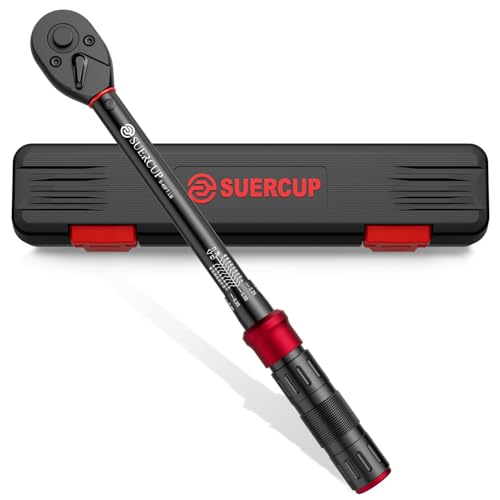
| SUERCUP 3/8in Click Torque Wrench | Engine bays and motorbikes | 3/8in drive, 6.8 to 61 Nm, 72 tooth reversible head, calibration report |
| GOYOJO 1/2in Digital Torque Wrench | Tightest accuracy and a live readout | 1/2in drive, digital to about 100 Nm, plus or minus 2 percent, backlit LCD |
| Park Tool TW-5.2 Ratcheting Torque Wrench | Bicycles and carbon parts | 2 to 14 Nm in fine steps, ratcheting head, the bike shop standard |
| LEXIVON LX-183 1/2in Click Torque Wrench | Unavailable at our 7 October 2026 check | 1/2in drive, 13.6 to 203.5 Nm, traceable calibration certificate |
How we picked
We compared torque wrenches sold on Amazon AU on drive size, torque range, stated accuracy, ratchet and whether calibration paperwork comes with the wrench. Each figure comes from the product's own Amazon AU listing or, for the GEARWRENCH 85063M, the GEARWRENCH product page, and we checked stock, sellers and listings on 7 October 2026. We did not test these wrenches ourselves, so every specification is attributed to the listing or maker that states it.
Best overall: GEARWRENCH 85063M 1/2in Micrometer Torque Wrench
For car wheel nuts and general work, the GEARWRENCH 85063M is our pick. It is a 1/2in drive micrometer click wrench covering 20 to 150 ft-lb, the range wheel nuts and suspension bolts need, and GEARWRENCH rates it at plus or minus 3 percent clockwise from 20 to 100 percent of full range, tighter than the plus or minus 4 percent the other 1/2in click wrenches here state. GEARWRENCH says it meets ASME B107.300, and at our 7 October 2026 check it was shipped and sold by Amazon AU, with only 3 left. Its top five reviews on the listing were of this model and size, from buyers in the United States, Canada and Mexico, none from Australia. The EPAuto starts lower at 10 ft-lb, but its star rating was shared with another size. GEARWRENCH lists a 90 day calibration warranty and marks this wrench as not certified, so plan a calibration check if you need paperwork.
Drive size decides the job
Before anything else, match the drive size to what you are working on, because it is the one thing you cannot work around. A 1/2in drive wrench is the car staple: it has the range for wheel nuts, hub bolts and suspension components, which is why five of the seven picks here are 1/2in. Step down to a 3/8in drive like the SUERCUP when you are in an engine bay tightening spark plugs, sensors and brackets, where a 1/2in wrench is too coarse to set a low figure accurately. And for bicycles you need a dedicated low-torque wrench like the Park Tool, which works from just 2 to 14 Nm in fine steps, far below where a car wrench even begins. That range is exactly what an electric bike asks for, since its stem, seatpost and disc bolts are usually marked in single-figure Nm. Get the drive size wrong and the wrench is either too coarse to be accurate or simply out of range for the fastener.
Click versus digital
Most torque wrenches are click type, and most of the picks here are too: the TOPEX, SUERCUP, LEXIVON and Park Tool. A click wrench is simple and accurate: you dial in the figure and it clicks once when you reach it. The catch is that you must wind it back to its lowest setting after use to relax the spring, and have it recalibrated periodically. A digital wrench like the GOYOJO instead shows the live torque on a backlit screen and sounds a buzzer at the target, which is great for a precise readout, but it depends on a battery. There is a third type worth knowing about. Beam type wrenches never lose calibration because they have no spring to drift, but they are harder to read and the good ones are not well stocked on Amazon AU, which is why none feature here. The GEARWRENCH 85063M and the EPAuto are click wrenches too.
The 3/8in mid-torque pick for engine bays
There is a real gap between a 1/2in wheel-nut wrench and a tiny bike wrench, and the SUERCUP 3/8in fills it. Its 5 to 45 ft-lb range, roughly 6.8 to 61 Nm, is sized for the medium fasteners you meet in an engine bay, such as spark plugs, oil drain plugs, sensors and brackets, and on motorbikes, where a 1/2in wrench is simply too coarse to set a low figure accurately. The 72-tooth reversible head is finer than the coarser ratchets on some 1/2in wrenches, which helps in tight engine spaces, and it ships with a calibration report. The key thing to understand is that this complements rather than replaces a wheel-nut wrench: its torque ceiling is well below the 1/2in tools, so you would own it alongside one of those, not instead of it.
A note on Australian and trade brands
If you have shopped for tools in Australia you will know names like ToolPRO from Supercheap Auto, Warren and Brown (the Australian made premium standard), Sidchrome, Kincrome, Teng and Tekton. It is worth being upfront that none of those are sold on Amazon AU; you will find them at Supercheap Auto, Repco, Bunnings or Total Tools instead. Warren and Brown is the one worth knowing in detail, because its deflecting beam wrenches bend a calibrated beam under load rather than compressing a spring, so there is no spring tension to fade and they hold their accuracy far longer than a click wrench. That is why professional workshops buy them, and why it is the name that comes up first whenever Australian mechanics are asked. If the wrench is going to be used daily, it is worth the trip to a trade retailer. The picks in this guide are the torque wrenches listed and well reviewed on Amazon AU. One more honesty note on the reviews: several listings here pool their ratings across different size variants of the same tool, so the count is not always for the exact wrench shown. The EPAuto's rating was shared with its 25 to 250 ft-lb size, and the TOPEX count was genuine but thin because it is a new listing.
Our verdict
For car wheel nuts the GEARWRENCH 85063M is our pick: a 1/2in micrometer click wrench that GEARWRENCH rates at plus or minus 3 percent clockwise from 20 to 100 percent of full range, shipped and sold by Amazon AU. The EPAuto is the 1/2in click alternative that starts lower at 10 ft-lb, and the TOPEX 1/2in adds a reversible ratchet and a wider range if you accept its thin reviews. Our earlier pick, the LEXIVON LX-183, was unavailable at the 7 October 2026 check. For engine bays, spark plugs and motorbikes the SUERCUP 3/8in is the mid torque pick, and for the tightest accuracy the GOYOJO 1/2in Digital reads to plus or minus 2 percent on a backlit screen. And for bicycles and delicate carbon parts the Park Tool TW-5.2 is the bike shop standard. Just remember it is far too low in range for car wheel nuts.
Frequently Asked Questions
What torque wrench do I need for car wheel nuts?
For car wheel nuts you want a 1/2in drive click wrench, because that drive size has the range and strength wheel nuts need, typically around 100 to 140 Nm depending on the car. Our pick is the GEARWRENCH 85063M (20 to 150 ft-lb), and the EPAuto (10 to 150 ft-lb, or 13.6 to 203.5 Nm) also covers that range; both were in stock. Avoid a low range bike wrench like the Park Tool for this job: its range tops out at 14 Nm, nowhere near enough for wheel nuts. Always check your car's handbook for the exact torque figure.
Is a click or digital torque wrench better?
Both are good; it depends on what you value. A click wrench like the GEARWRENCH 85063M or the EPAuto is simple, accurate and needs no battery; you dial in the figure and it clicks once when you reach it. A digital wrench like the GOYOJO shows the live torque on a backlit screen and sounds a buzzer at the target, with the tightest accuracy here at plus or minus 2 percent, but it depends on a battery. Most people are well served by a quality click wrench. Choose digital if you want a precise readout and do not mind charging or swapping a battery.
How accurate are torque wrenches and do they need recalibrating?
Good torque wrenches are accurate to plus or minus 3 to 4 percent, and the GOYOJO digital is the tightest here at plus or minus 2 percent. But every click wrench drifts over time as the spring ages, so yes, they need recalibrating periodically to stay true. The LEXIVON and SUERCUP listings both include calibration paperwork with the wrench. To slow the drift, wind a click wrench back to its lowest setting after every use and store it in its case, and have it checked or recalibrated down the track. A wrench you cannot trust the reading of is worse than no wrench at all.
Should you wind a torque wrench back to zero after use?
You should wind a click-type torque wrench back to its lowest setting after every use, though not quite to zero: down to the bottom of its scale. This relaxes the internal spring so it does not sit under tension between jobs, which is what causes a click wrench to drift out of calibration over time. It is one of the simplest habits that keeps a wrench accurate for years. This applies to the click wrenches here: the GEARWRENCH 85063M, EPAuto, TOPEX, SUERCUP, Park Tool and LEXIVON. A digital wrench like the GOYOJO has no spring to relax, but you should still store it carefully, as its case can press the power button and drain the battery.
What drive size torque wrench do I need?
Drive size decides the job. A 1/2in drive wrench (the GEARWRENCH 85063M, EPAuto, TOPEX, GOYOJO and LEXIVON here) is the car staple for wheel nuts and suspension, where the torque is high. A 3/8in drive like the SUERCUP suits engine bays, spark plugs and motorbike fasteners, where the torque is lower and a finer setting matters. For bicycles you need a dedicated low torque wrench like the Park Tool, which works from just 2 to 14 Nm for delicate carbon parts. If you mostly work on a car, start with a 1/2in; add a 3/8in for engine bay work, and a bike specific wrench only if you service bicycles.
Can you use a torque wrench to undo bolts?
No. Never use a torque wrench to crack loose a tight or rusted bolt. A torque wrench is a precision instrument for tightening to an exact spec, and shock-loading it to free a stubborn fastener ruins its calibration. Use a breaker bar or a standard ratchet to undo the bolt first, then bring in the torque wrench only to tighten it back to the correct figure. The same care applies when tightening: pull in smooth, steady strokes until it clicks once and then stop, rather than continuing to pull past the click, which over-torques the fastener. Treating the tool gently is what keeps it accurate.
Are ToolPRO or Warren and Brown torque wrenches on Amazon Australia?
No. The well known Australian and trade names, including ToolPRO from Supercheap Auto, Warren and Brown (the Australian made premium), Sidchrome, Kincrome, Teng and Tekton, are not sold on Amazon AU. You will find those at Supercheap Auto, Repco, Bunnings or Total Tools instead. The picks in this guide are the torque wrenches listed and well reviewed on Amazon AU. One caveat on the reviews: several listings pool ratings across size variants of the same tool, so the EPAuto's rating was shared with its 25 to 250 ft-lb size, and the TOPEX count was genuine but thin.
Do you actually need a torque wrench?
If you change your own wheels or work on brakes, suspension, an engine or a carbon bike, yes. Those fasteners have a tightening figure in the vehicle or bike maker's manual, and a torque wrench is the hand tool that sets it, rather than guessing by feel. If you only tighten flat pack furniture, garden gear or household fittings, you do not need one. For car wheel nuts, start with a 1/2in click wrench, as the drive size answer above explains.
What is a torque wrench?
A torque wrench is a spanner that measures how hard you are tightening. Instead of guessing, you dial in the figure the manufacturer specifies, usually in newton metres, and the tool tells you when you reach it, either by clicking or by reading out on a screen. That matters because an under-tightened wheel nut can work loose and an over-tightened one can stretch or strip the thread. Car wheel nuts are typically around 100 to 140 Nm, while a bicycle stem bolt can be as little as 5 Nm.
How do you use a torque wrench?
Look up the figure in the vehicle handbook first, then set the wrench to it and fit the right socket. Pull smoothly on the handle with one hand on the grip, not on the head, and stop the instant it clicks. Work in a star pattern on wheel nuts so the wheel seats evenly, and do a second pass at the same setting to confirm. Never use it to loosen a bolt, because the shock load ruins the calibration. Wind a click wrench back to its lowest setting before you put it away.
How do you set a torque wrench?
Unlock the collar at the base of the handle, usually by pulling it down or twisting it. The main scale on the shaft gives you the whole numbers and the ring on the handle gives you the fractions, so you turn the handle until the main scale reaches the figure below your target, then wind the handle ring around to add the remainder. Lock the collar again before you use it. The EPAuto covers 13.6 to 203.5 Nm this way, and setting it below its lowest mark makes the reading meaningless.
Where can you get a torque wrench calibrated in Australia?
A calibration laboratory, usually one accredited by NATA, which is what makes the certificate traceable to a recognised standard. Trade tool retailers and the larger Australian tool brands run or arrange the service, and it is not something Amazon Australia offers. A click wrench is generally due about every 5,000 clicks or every 12 months, whichever comes first. The LEXIVON LX-183 and SUERCUP listings both include calibration paperwork with the wrench.
How can I measure torque without a torque wrench?
Tightening by feel is a guess, not a measurement: wheel nuts, brakes, suspension, engines and carbon bike parts have a tightening figure in the vehicle or bike maker's manual, and a torque wrench is the hand tool that sets it. For those jobs, use a torque wrench set to that figure; for flat pack furniture or household fittings, you do not need one.
What is the best torque wrench for the price?
This guide picks on drive size, torque range, stated accuracy and calibration paperwork rather than price, so check current prices on the product cards. For car wheel nuts our pick is the GEARWRENCH 85063M, rated at plus or minus 3 percent clockwise from 20 to 100 percent of full range, and the EPAuto 1/2in click wrench starts lower at 10 ft-lb with a stated plus or minus 4 percent.
Is a cheap torque wrench worth it?
A cheap torque wrench is worth it only if you can trust its reading: look for a stated accuracy of plus or minus 3 to 4 percent, the normal good range for the wrenches here, and check the range that figure covers. Every click wrench drifts as its spring ages, so even a cheap wrench should be wound back after every use and rechecked or recalibrated down the track.