Corded or cordless? That is the real question
The best rotary tools in Australia depend on one choice: a corded mains tool or a cordless mini. Our best overall is the Hardell Mini Cordless Rotary Tool 3.7V, rated 4.6 stars from 147 ratings, while Dremel lists the corded 3000 at 130W with a 10,000 to 33,000 rpm dial for tougher grinding and cutting. If you only need a simple manual cut, our guide to manual hand saws for every cutting job covers the options.
Dremel lists the 3000 as a 130W corded tool with a 10,000 to 33,000 rpm variable speed dial, and lists the 4250 as holding speed under load with electronic feedback across a 5,000 to 35,000 rpm range. Before you compare a single accessory count, answer this: do you want a mains-powered workshop tool, or a light cordless mini? It is the decision that splits this whole category in two. A corded rotary tool like the Dremel 3000 plugs into the wall and delivers steady speed and stamina: it never runs flat, and its motor has the muscle for real grinding, cutting and sanding on harder materials. A cordless mini like the Hardell trades that power for freedom and weight: no cable, only a few hundred grams in the hand, and a pen-like grip that suits engraving, polishing and fine craft work. Get that one choice right and the rest is easy. If you already own a battery platform, the same argument runs through our cordless drill guide, and for the jobs a rotary tool is simply too small for, an angle grinder is the step up.
The picks below sort into corded tools and cordless minis, and our best overall is the Hardell Mini Cordless Rotary Tool 3.7V. If the job is gluing rather than grinding, a corded hot glue gun for craft and repairs is the simpler tool. The cordless minis (such as the Hardell and the premium Fanttik) are for light, detailed, cable free work, while the corded tools (the Topex, the Dremel 3000 and the Dremel 4250) are for stamina and tougher materials. The other things worth weighing as you read are the rpm range and variable speed, the keyless bit change, and how big and well-supported the accessory and collet ecosystem is, so match the tool to the jobs you will actually do rather than the longest spec sheet.
| Pick | Best for | Key spec | Rating |
|---|
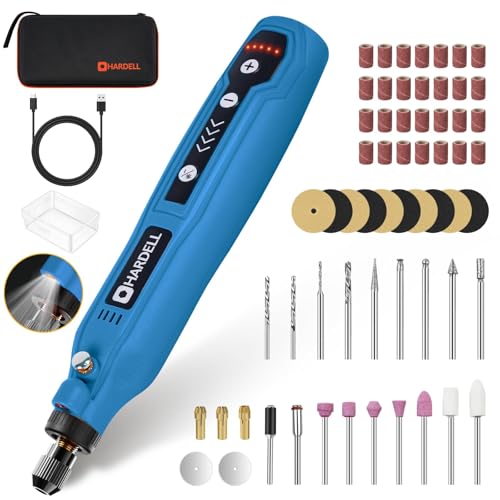
| Hardell Mini Cordless Rotary Tool 3.7V | Best overall: craft, engraving and polishing | Cordless 3.7V, 5 speeds from 5,000 to 18,000 rpm, 61 accessories, about 0.3 lb | 4.6 stars from 147 ratings |
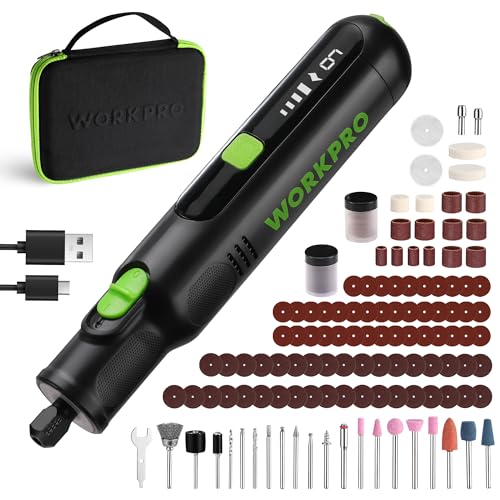
| Workpro 7.2V Cordless Rotary Tool | The largest accessory count here, but its card shows it could not be bought on Amazon Australia on 9 October 2026 | Cordless 7.2V, 6 speeds to 30,000 rpm, 117 accessories, about 45 minutes run time | 4.2 stars from 110 plus ratings |
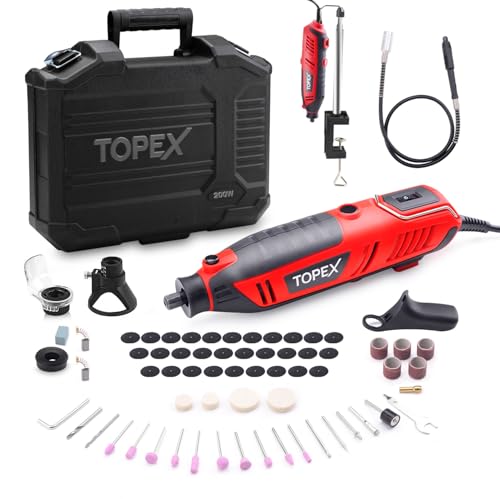
| Topex 200W Rotary Tool Kit | A corded tool on a budget | Corded 200W, 6 speeds from 10,000 to 40,000 rpm, flex shaft, 60 accessories | 4.3 stars from 170 plus ratings |
| Dremel 3000 Rotary Tool 130W | Corded standard | Corded 130W, 10,000 to 33,000 rpm, EZ-Twist nose cap, 2 year guarantee, 3 if registered | 4.6 stars from 7,200 plus ratings |
| Fanttik F2 Master Mini Rotary Tool 4V | Long, quiet detail sessions | Cordless 4V brushless, 5 speeds to 25,000 rpm, 35 accessories on a magnetic hub | 4.5 stars from 2,000 plus ratings |
| Dremel 4250 Rotary Tool 175W | Sustained or heavy work | Corded 175W with electronic feedback, 5,000 to 35,000 rpm, 35 accessories | 4.6 stars from 360 plus ratings |
| Bosch GRO 12V-35 (bare tool) | Bosch 12V battery owners | Cordless 12V system tool, batteries and charger not included, spindle lock, LED light | See card |
| Fanttik F2 PRO | Engraving and detail work | Cordless, engraving pen, 5 speeds from 5,000 to 25,000 rpm, 55 accessories on a magnetic hub | See card |
| Hardell 12V Cordless Rotary Tool | A stronger cordless Hardell | Cordless 12V, 6 speeds from 5,000 to 30,000 rpm, 94 accessories, about 1.1 lb | See card |
| Dremel Lite 7760 | A cordless Dremel | Cordless, USB charged, EZ Twist nose cap, variable speed up to 25,000 rpm, 15 accessories | See card |
| Ginelson 3.7V Mini Rotary Tool | Light craft work | Cordless 3.7V, 5 speeds from 5,000 to 18,000 rpm, 70 accessories | See card |
The Hardell mini is our best overall pick: it has a 4.6 star rating from 147 ratings and a light, cable free build that suits engraving, sanding and polishing, so it is the entry point for light work. For heavy grinding or long cutting jobs, step up to a corded Dremel. It does the light duty cordless job well: a 3.7V tool weighing only about 0.3 pounds, charged over Type C and held like a pen, with five speeds from 5,000 to 18,000 rpm and 61 accessories in the case.
A built-in LED light helps in dim corners, and the cable-free design makes it easy to manoeuvre around small, fiddly work. The trade-off at this price is honest: this is a hobby-grade mini, not a workshop tool. Its top speed and battery power sit well below a corded Dremel, so it shines on craft, engraving and detail work rather than heavy grinding or extended cutting.
What about Ozito, Ryobi, Milwaukee and Proxxon?
Every pick above is an Amazon Australia listing, and the Australian tool buyer often shops at Bunnings, Sydney Tools or Total Tools instead, where a different set of names sits on the shelf. Ozito sells a 170W corded kit through Bunnings and is a credible way into the category in person. Ryobi offers an 18V ONE+ HP brushless rotary tool, which is worth considering if you already own ONE+ batteries, and Milwaukee sells an M12 version on the same logic for anyone already in that platform. Proxxon is the precision brand modellers and jewellers argue for. All four are legitimate and none is linked here, because we only rank what we can price and rate on Amazon Australia. If you already own a battery platform, buying the rotary tool that shares it is usually the better call than anything in our table.
Two Dremel models are worth naming for the same reason. The Dremel 4250 above is the corded one most Australian retailers recommend, and the Dremel 8250 12V is its cordless equivalent, sold through Sydney Tools rather than Amazon Australia. If you want a cordless Dremel rather than a cordless mini, that is the model to look up.
The single biggest mistake is buying for the projects you imagine rather than the ones you will actually tackle. If the honest answer is craft, engraving, model making, cleaning up 3D printer prints and light polishing, a cordless mini is the smart buy, and a corded mains tool would mostly add weight and a cable you do not need. If you want to grind, cut and sand harder materials, or work for long stretches, a corded tool like the Dremel 3000 earns its keep because it holds speed and never runs flat.
The accessory and collet ecosystem is the other deciding factor. Dremel uses a widely supported standard, so bits and attachments are easy to find and a tool like the 3000 or 4250 grows with you. Budget tools often ship with more accessories in the box (the Workpro with 117, the Topex with 60), which is great value upfront, but the longer term supply and quality can be patchier. Be realistic about whether you want the cheapest complete kit today or a platform you will keep adding to for years.
Safety shield and accessory speed
Check for a safety shield before you buy. Bunnings' rotary tool guide says whichever model you choose should have one, because debris can come off the tool at 26,000 to 30,000 rpm and put your eyes at risk, and the Topex kit includes a shield. Match your accessories to the tool as well: Dremel's operating and safety instructions say wire and bristle brushes must never be operated at speeds greater than 15,000 rpm, so keep the speed dial low whenever you fit one, even on a tool that reaches 33,000 rpm.
What the key specs mean
This is bench work, so it is worth having a workbench to clamp to and a soldering iron nearby, since the same hobby bench usually ends up doing both jobs.
A few details do most of the work when you compare these tools. Power tells you the routine: a corded wattage figure like the Dremel 4250 at 175W signals mains stamina for tougher jobs, while a cordless voltage like the Hardell at 3.7V signals a light tool for short, detailed tasks. The rpm range and variable speed matter just as much: a wide range such as the Dremel 4250 at 5,000 to 35,000 rpm lets you go slow for delicate materials and fast for cutting, where a fixed or narrow range limits you.
Bit changing is the other thing you feel every session. A keyless system like Dremel EZ-Twist or the Workpro auto-lock means you swap accessories by hand in seconds, while basic tools need a collet and wrench. The accessory count and collet size decide what you can actually do and whether bits are easy to source: check the collet matches common 3.2mm or 2.3mm shanks. Read power, rpm range, bit changing and accessory ecosystem together and any product page starts to make sense.
How we picked
This guide is research, not a hands on test. We compared each tool's power source, speed range, accessory count and included extras from its Amazon AU listing, used Dremel's own product pages for the Dremel specifications, and checked every card's seller and stock on Amazon Australia. Star ratings and review counts come from the Amazon AU listings, and any card that could not be bought or that ships from overseas carries a dated warning.
For safety and buying advice we used Bunnings' rotary tool guide and the operating and safety instructions in Dremel's manual.
Last checked: 9 October 2026, covering the stock, seller and rating of every listing on Amazon Australia.
Frequently Asked Questions
Corded or cordless rotary tool: which should I buy?
It depends on the work. A corded tool like the Dremel 3000 plugs into the wall and holds steady speed and stamina, which is what you want for grinding, cutting and sanding harder materials or working for long stretches, and it never runs flat. A cordless mini like the Hardell or Fanttik trades that power for freedom and low weight, which suits engraving, polishing and fine craft where a cable and a heavier body get in the way. If you want a do-most-things workshop tool, buy corded; if you mostly do light, detailed, cable-free work, buy a cordless mini.
What can you actually do with a rotary tool?
A rotary tool is a multi-tool you fit with interchangeable bits, so one body covers grinding, cutting, sanding, polishing, engraving, carving, drilling small holes and sharpening. You change what it does by swapping accessories: a cut off wheel for cutting, a sanding drum for sanding, a felt wheel for polishing, an engraving bit for marking. That versatility is the whole point: instead of buying separate tools, you keep one rotary tool and a tray of bits, which is why the size and quality of the accessory range matter so much.
What does variable speed do on a rotary tool?
Variable speed lets you match the rpm to the material and the job rather than running flat out all the time. Lower speeds suit delicate materials, polishing and fine engraving where too much speed melts plastic or burns wood, while higher speeds cut metal and hard materials faster and cleaner. Dremel lists the 4250 at 5,000 to 35,000 rpm and the 3000 at 10,000 to 33,000 rpm, and the cordless minis offer a handful of preset steps. As a rule, more range and finer control mean you can take on a wider spread of tasks.
Are cheap mini rotary tools any good?
For the right jobs, yes, just be honest about which jobs. A budget mini like the Hardell is genuinely useful for engraving, sanding small parts, polishing and craft work, and being cordless it is easy to handle for fine detail. What it cannot do is sustained heavy grinding or cutting through hard material, because its 3.7V power and lower top speed sit well below a corded Dremel. So a cheap mini is a smart buy if your work is light and detailed, but it is a complement to a corded tool rather than a replacement for one.
What accessories and bits fit a rotary tool?
Most rotary tools use a collet that accepts common shank sizes, typically around 3.2mm or 2.3mm, so the key is matching new bits to your tool collet. Dremel uses a widely supported standard, which is why a Dremel 3000 or 4250 owner can find cut-off wheels, sanding drums, grinding stones, polishing wheels and engraving bits almost anywhere. Budget tools like the Workpro and Topex ship with large accessory sets in the box, 117 and 60 pieces respectively, which is great value upfront, though the long term supply and quality of replacements can be less consistent than the Dremel ecosystem.
Is a Dremel worth the extra money over a generic tool?
Often yes, for two reasons: the tool and the ecosystem. A Dremel 3000 or 4250 brings a refined motor, keyless EZ-Twist bit changes, a soft anti vibration grip and, on the 4250, electronic feedback that holds speed under load, features the budget tools either lack or do less well. Just as important, Dremel accessories and attachments are easy to find and reliable, so the tool keeps growing with you. A generic tool like the Topex can match the headline rpm, but you trade some build quality and ecosystem support, so the Dremel premium buys longevity rather than just a badge.
How do I change bits safely on a rotary tool?
Always unplug a corded tool or switch off a cordless one first, then lock the spindle so it cannot turn. Keyless systems make this easy: the Dremel EZ-Twist nose cap and the Workpro auto lock let you loosen the collet by hand and drop in a new accessory in seconds, while a basic tool needs you to hold the shaft lock and use the supplied wrench. Make sure the bit is seated fully and the collet is firmly tightened before you power back on, and wear eye protection, because accessories spin at tens of thousands of rpm and any that is loose can fly out.
Is a rotary tool the same as a Dremel?
Dremel is a brand, not a product type, in the same way Esky is a brand of cool box. It has been making rotary tools since 1932 and the name became the generic one in Australia. Every tool in this guide is a rotary tool; three of them happen to be Dremels. What the brand does buy you is the accessory ecosystem, because Dremel bits are stocked in every hardware shop in the country.
What is a collet on a rotary tool?
The collet is the split metal sleeve inside the nose that grips the shank of the bit. Rotary tool collets come in a small set of standard sizes, with 3.2mm and 2.4mm the two you will meet most, and the size has to match the shank on the accessory or it will slip or not seat at all. Most kits ship with several. It is the single fact that decides whether cheap generic bits will fit the tool you buy.
Is a Milwaukee M12 rotary tool better than a Dremel?
It depends on what is already in your shed. If you own M12 batteries, the Milwaukee shares them and that convenience is worth real money. If you do not, you are buying into a platform to get one tool, and the Dremel 3000 does the same jobs on mains power with a far bigger accessory range behind it. Dremel wins on ecosystem, Milwaukee wins on runtime and battery sharing.
How do you use an Ozito rotary tool?
The same way as any other. Fit the collet that matches the shank on your bit, seat the bit fully before you tighten, then pick a speed: low for plastics and polishing, high for cutting metal and engraving glass. Let the tool do the work rather than pressing, because pressure is what burns a bit out. Ozito kits are sold through Bunnings and take the same standard 3.2mm and 2.4mm accessories most other brands use.
Which Dremel is best for beginners?
The Dremel 3000 is the Dremel we point beginners to in this guide: it plugs into the wall so it never runs flat, has a variable speed dial from 10,000 to 33,000 rpm, and its EZ Twist nose cap changes accessories without a wrench. Dremel backs it with a two year guarantee that extends to three when you register the tool.
What are the key differences between the Dremel 8240 and 8250?
The 8250 is the brushless model: Dremel's Australian page says its brushless motor provides 20 percent more power and cutting speed, and it adds a reinforced digital display showing speed, battery status and warnings. Dremel lists its variable dial at 5,000 to 30,000 rpm. Neither model is one of our cards, so compare the exact kit before buying.
Which Dremel is the quietest?
Among the corded Dremels in this guide, the 4250 is the quieter one: Dremel lists its sound pressure at 72.5 dB(A) against 77.1 dB(A) for the 3000, and a lower figure means a quieter tool. Check the sound pressure row on each Dremel product page before you buy.
Which Dremel model is considered the best?
No single Dremel suits every job, but Dremel lists the 4250 at 175W, the strongest corded Dremel in this guide, and the 3000 at 130W, the one that covers most home jobs. Choose the 4250 for sustained or heavy work, the 3000 for general jobs, and the 12V cordless 8250 if you want a Dremel without a cord.
What is better than a Dremel?
It depends on the job: an angle grinder is the step up for heavy cutting and grinding that a rotary tool is too small for, and a tool from a battery platform you already own, such as the Bosch GRO 12V-35 on the Bosch Professional 12V system, saves buying new batteries. For light craft and engraving, a cordless mini like the Hardell does the job.