Most Australian homes have a smoke alarm and nothing else. The alarm tells you there is a fire. It does not put one out, and the gap between those two things is the three or four minutes when a bin fire, a forgotten frypan or an overheating charger is still small enough for one person to deal with.
A portable extinguisher is the cheapest tool that closes that gap, and one of the more confusing things to buy. The listings are full of letters and numbers (ABE, 1A:20B:E, AS/NZS 1841), and the Australian results are cluttered with car aerosol pads, warning stickers, replacement nozzles and novelty items shaped like extinguishers. The best fire extinguisher for an Australian home is a 2.5 kg ABE dry powder unit, which the FIREBOX 2.5KG here lists at $69.00, with a small water-based unit such as the FIOZABI at $94.62 kept in the kitchen and a 1 kg ABE such as the Firebox at $30.50 in the car.
NestPath went through the whole Australian catalogue and found only a handful of listings that are genuine home portable extinguishers with real customer feedback. Stock moves, so the picks are re-checked against Amazon AU stock regularly and each card carries the date it was last verified. Those six are below: five portable units and one automatic pad, with the fire ratings, capacities and standards their own listings state. This is product selection only. For how to actually fight a fire, and whether you should try at all, follow your state fire service guidance.
What is the best fire extinguisher for an Australian home?
Answer first. If you want one unit that covers the kitchen as well as the rest of the house, the FIOZABI Portable Fire Extinguisher is our top pick, because its water-based agent is listed for cooking fats and oils as well as the usual household classes, and it carries far more customer ratings than any other genuine extinguisher we verified in the Australian catalogue. If you would rather have the classic Australian answer, the FIREBOX 2.5KG High Pressure Dry Powder Fire Extinguisher is the ABE size Australian fire retailers point houses towards. On a tight budget, the Firebox 1kg ABE Professional Dry Powder is the cheapest of our six picks and the only one whose listing states both a fire rating and an AS/NZS 1841 approval.
What you should not buy is the bulk of what this search returns. Adhesive car aerosol pads, ID stickers, replacement nozzles, empty cylinders and party props all rank for the same words, and none will help you in a kitchen. If a listing does not name an agent and a capacity, it is not a portable extinguisher.
How do our fire extinguisher picks compare?
Six picks, three brands, one clear split: dry powder for whole-of-house cover, water-based for anything involving cooking oil. Prices move, so treat the last column as a guide.
Always follow the manufacturer's manual and the requirements of your state or territory regulator.
How did we choose these fire extinguishers?
- Genuine portable units only: an extinguisher you can pick up or that discharges on its own, never a bracket, sign, nozzle, empty cylinder or novelty item.
- In stock in Australia, with a live buy-box price and a verified brand, checked directly against Amazon Australia rather than a cached listing.
- Real customer feedback. Every pick carries a star rating and review count from its Australian listing, and our headline pick has the largest review base of any genuine extinguisher we verified.
- Listing-stated specifications only. Ratings, capacities, standards and dimensions come from the listing itself. NestPath researches and compares listings, it does not conduct fire trials.
Best fire extinguisher for the kitchen and the rest of the house
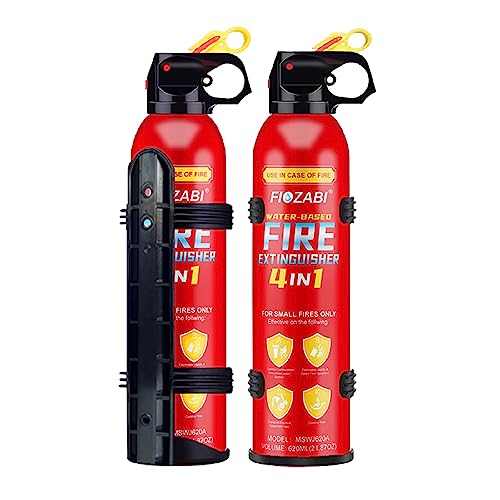
The FIOZABI Portable Fire Extinguisher is our top pick because it solves the one problem ABE dry powder cannot. Dry powder is the Australian all-rounder, but every fire retailer that sells it says the same thing in the fine print: it has limited use on cooking oils and fats. That is a real gap, because the kitchen is where most home fires begin. This unit is a 620 ml water-based extinguisher and its listing covers types A, B, C and K, with K being the cooking-media class.
It is a small unit at 1.64 kg and 29.72 cm tall, which matters more than it sounds: an extinguisher that fits in a pantry cupboard or under the sink is one you will actually mount, and one a smaller adult can hold steady with one hand. The listing includes a bracket, and the current option is sold as a pack of two, so you can put one in the kitchen and one near the laundry without buying twice.
The other reason it leads is evidence. With 659 ratings at 4.6 stars it is the most-reviewed pick here by a wide margin, and in a category where most listings have single-digit review counts, that depth of feedback is worth a lot. It is also the only water-based unit among our picks, so no fine powder residue coats the room after you use it. The listing further states it resists relighting, the practical failure mode with a small extinguisher: you knock the flame down, walk away, and the fuel reignites. Water-based agents cool the fuel as well as smothering it.
Flaws but not dealbreakers
It is not an ABE dry powder unit, so it is not the one to reach for if your main worry is a workshop full of petrol, solvents and paint. Its listing does not state an Australian fire rating in the 2A:10B:E format, or an AS/NZS 1841 approval, which the 1 kg Firebox does. And 620 ml is a small charge: it is sized for a small fire, not for a garage that is already going.
Best ABE dry powder extinguisher for a standard house
If you asked an Australian fire equipment shop what a house should have, the answer would be a 2.5 kg or 4.5 kg ABE dry chemical unit. The FIREBOX 2.5KG High Pressure Dry Powder Fire Extinguisher is the smaller half of that recommendation, and for a typical three or four bedroom house it is the sensible middle.
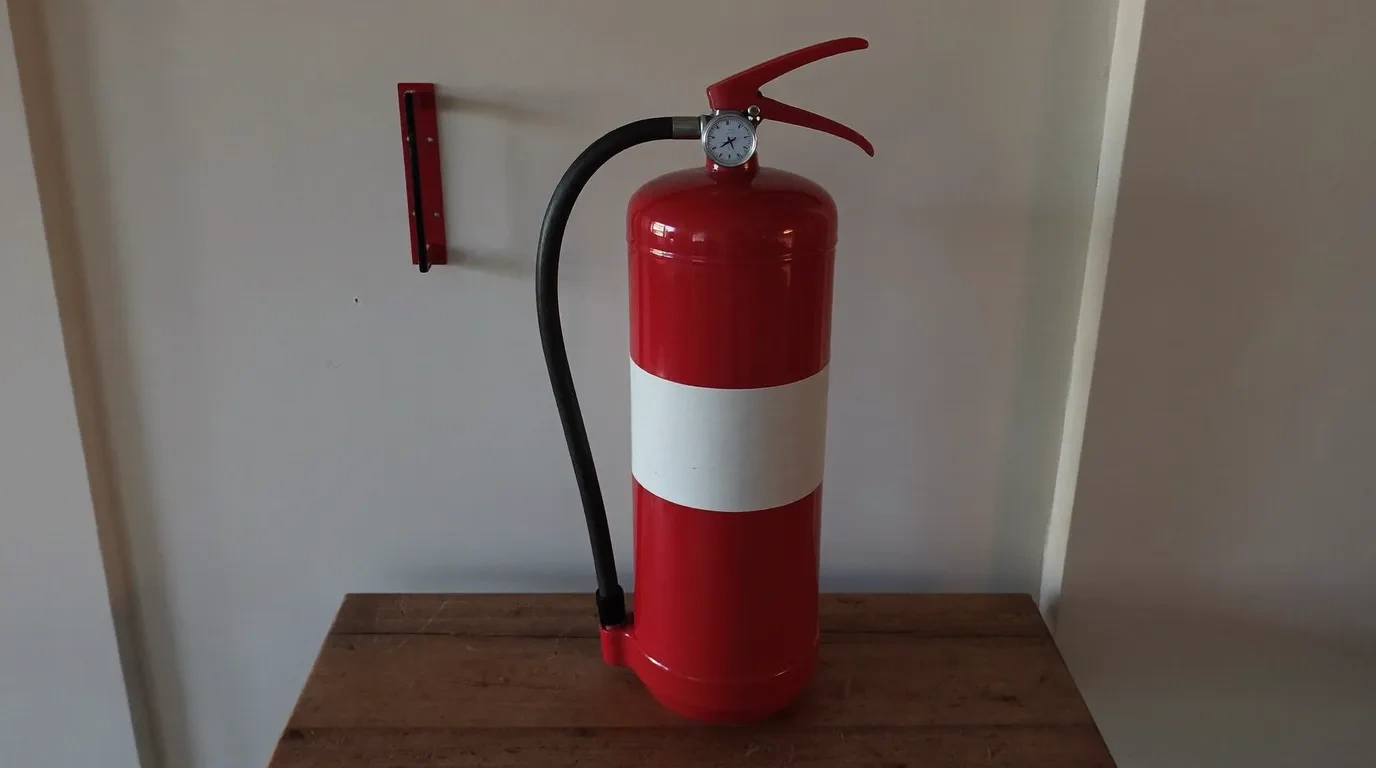
ABE is the Australian shorthand for the classes it covers: A for wood, paper, fabric and plastics, B for flammable liquids such as petrol, oils and paint, and E for electrical, meaning switchboards, motors and appliances still under power. One cylinder handles the lounge room, the shed and the powerboard.
Build quality is the reason to take the Firebox over a generic import at the same size. The listing describes a deep drawn steel cylinder with a welded base and a robust skirt, powder coated with a UV resistant finish. The skirt is the flared foot at the bottom, and it stops a cylinder rolling around a boot or tipping off a shelf. UV resistant paint matters in Australia specifically, because a lot of extinguishers end up in a carport, shed or caravan where they cook in summer. At 2.5 kg of powder and 41 cm tall it is a two-handed unit but not a heavy one, and it sits in the size band that still lets an average adult carry it up a hallway at a run. It is rated 4.8 stars on the Australian listing.
Flaws but not dealbreakers
Its review base is thin at 16 ratings, so you are leaning on brand reputation and the listing specification rather than a deep pool of Australian feedback. The listing does not print a fire rating in the 2A:10B:E format, so you cannot directly compare its output figure against a competitor. And like all dry powder units, it is poor on a cooking oil fire and it will leave a mess.
Best budget fire extinguisher for a unit or apartment
The Firebox 1kg ABE Professional Dry Powder is the cheapest of our six picks and, on paper, the most transparent. Its listing is the only one here that states both a fire rating and an approval standard: 1A:20B:E, approved to AS/NZS 1841.5. That is the single most useful thing a small extinguisher listing can tell you, and almost none of them do.
Reading that rating is simpler than it looks. The number before the A is the Class A output figure, so 1A is a modest wood-and-paper capability. The 20B is the Class B figure for flammable liquids, a strong number for a 1 kg unit. The E means it is safe on live electrical equipment. For a unit, townhouse or caravan, that is a sensible envelope.
Physically it is 90 mm across and 350 mm tall, with a total mass of about 2.5 kg once the cylinder is counted. It ships with a full-body metal mounting bracket and a quick release locking strap, so you can mount it inside a cupboard door, on a laundry wall or in a car. The valve is brass, the handle is stainless steel, and there is a pressure gauge on the head so you can check at a glance that it is still charged. It also has the strongest evidence here for its size, with 196 ratings at 4.7 stars, and it has been listed in Australia since 2019, a long run in a category full of listings that appear and vanish.
Flaws but not dealbreakers
One kilogram is genuinely small. It gives you a short discharge, so it suits a bin, a frypan on a benchtop or a powerboard, not a fire that has reached furniture. The 1A Class A figure is a modest one, well below the 4A and 6A units sold through specialist fire retailers. And because it is dry powder, the cooking oil caveat applies here too.
Best large extinguisher for a garage, shed or workshop
The FIREBOX 4.5KG High Pressure Dry Powder Fire Extinguisher is the biggest unit of our picks and the one to put where the fuel is. Garages, sheds and workshops hold the petrol, the mower, the two-stroke, the paint tins, the battery charger and the power tools, and that is a completely different risk profile from a lounge room.
At 4.5 kg of ABE powder it is the largest capacity of our picks, and the extra charge translates directly into discharge time. A 1 kg unit gives you seconds. This one gives you long enough to work around an object, come back to a flare-up, and still have something left. The listed shipped weight is 7.8 kg, so it is a wall-mounted unit rather than something you carry casually.
The listing states the same construction as its smaller sibling, a deep drawn steel cylinder with a welded base and robust skirt under a UV resistant powder coat, and it comes with both a vehicle bracket and a wall bracket. The wall bracket is the one that matters here: a 4.5 kg cylinder standing loose on a garage floor is a trip hazard and it will end up behind the mower within a month. The listing also gives a country of origin of Australia, unusual detail in this category. It shares the highest star rating in this guide at 4.9, tied with the 2.0 kg Firebox unit, across 19 Australian ratings.
Flaws but not dealbreakers
It is too big for most people to want indoors, and mounting it properly means drilling into a stud or masonry rather than trusting a plasterboard anchor. Its listing does not print a fire rating figure. And at 19 ratings the review base is shallow, so this is a specification and brand call rather than a crowd-verified one.
Best extinguisher for a car boot and a spare indoors
The FIREBOX 2.0KG ABE High Pressure Hose Dry Powder Fire Extinguisher is the one to buy if you want a single model that lives in the car most of the time and can come inside when you need it. Its listing includes a vehicle bracket, and it is the only one of our picks whose listing names a discharge hose.
The hose is the meaningful difference. On a small extinguisher the horn is fixed to the valve head, so aiming means pointing the whole cylinder and getting your hands close to the fire. A hose lets you hold the body at your hip and direct the discharge with your other hand, giving more distance and far more control on a low fire such as a puddle of fuel or a burning wheelie bin.
The listing describes exactly what it covers: Class A fires such as wood, paper and plastics, Class B fires such as flammable liquids, and Class E fires such as distribution boards and motors. At 2 kg and 41.5 cm it sits between the compact 1 kg unit and the house-sized 2.5 kg, a reasonable single answer for a household with one car and a small yard. It shares the highest star rating of our picks at 4.9, tied with the 4.5 kg unit, though only across 12 Australian ratings.
Flaws but not dealbreakers
Twelve ratings is the thinnest review base in this guide, so treat the star figure with caution. Its listing does not state a fire rating or a standards approval. And if you genuinely want an extinguisher in the car, remember that a boot in an Australian summer is a punishing environment: check the gauge far more often than you would for one sitting in a hallway cupboard.
Best automatic unit for a switchboard or charging spot
The FEROSTICKER Small Automatic Fire Extinguisher is the odd one out here, and it is on the list for a specific and increasingly common Australian problem: lithium battery and switchboard fires that start when nobody is in the room. This is not a hand-held extinguisher and it is not a replacement for one.
It is a small adhesive pad you stick inside an enclosed space. The listed F03 model is 8.7 by 8.7 by 2.0 cm, weighs 80 grams, and states a protected area of 0.3 cubic metres. When the temperature inside that enclosure passes its trigger point, it discharges an aerosol suppressant on its own. It is the only one of our picks that works with nobody present, which is the entire point of it.
The places that suits are narrow but real: a meter box or switchboard, a battery charging drawer, an e-bike charging cupboard, a caravan inverter compartment, or the enclosure around a solar isolator. These are sealed or semi-sealed volumes where a fault can smoulder for a long time before anything visible happens, and where a hand-held unit is useless because you cannot see the fire start. The listing states a 6 year service life and the current option ships as a two-pack. It carries 79 Australian ratings at 4.3 stars, and it is the dearest of our picks.
Flaws but not dealbreakers
The protected volume is tiny. At 0.3 cubic metres it will do nothing for a room, a car interior or an open garage, so buying this instead of a real extinguisher would be a serious mistake. The listing does not reference an Australian standard. And at 4.3 stars it is the lowest-rated pick here, with feedback noticeably more mixed than the dry powder units.
Which fire extinguisher should you buy?
Match the unit to where the fire is most likely to start, not to the biggest number you can afford.
What should you look for in a home fire extinguisher?
Five things decide whether an extinguisher is right for your house, and only one of them is price.
The letters. ABE is the Australian domestic default. A covers ordinary combustibles like wood, paper and fabric, B covers flammable liquids, and E means it is safe on live electrical equipment. What ABE does not properly cover is F, the class for cooking oils and fats, which is why a kitchen-focused household should consider a water-based or wet chemical unit alongside the powder one. Australia also uses colour bands on the cylinder: white for ABE dry powder, black for carbon dioxide, blue for foam, oatmeal for wet chemical and red for water.
The rating. A figure like 1A:20B:E or 4A:40B:E is a measured output, not marketing. The higher the number in front of each letter, the bigger the test fire that unit put out. Most consumer listings never print it, so when one does, that is a point in its favour. Bigger homes and workshops are where the higher B figures start to matter.
The size. A 1 kg unit is easy to store and easy for anyone to lift, but it discharges quickly. A 4.5 kg unit gives far more working time but is awkward to carry and needs proper wall mounting. For most houses 2.5 kg is the compromise, and two smaller units in different rooms often beats one large one at the far end of the house.
The bracket. An extinguisher on the floor of a cupboard is one you will not find in the dark. Most of the picks above list a bracket as an included component, and mounting one at roughly shoulder height near an exit, rather than next to the stove, is the standard advice.
The standard. AS/NZS 1841 is the Australian and New Zealand standard for portable fire extinguishers. Compliance is a strong signal, and it matters if you are in a strata building or renting, since body corporates and property managers often specify it. If you are still setting up a new place, our smoke alarm guide covers the detection half of the same job, and the two really should be bought together.
How do you look after a fire extinguisher?
Maintenance for a home unit is genuinely simple, and it is the part almost everyone skips.
Check the pressure gauge every few months. The needle should sit in the green band; if it has drifted into the red on either side, the unit is not reliable and needs servicing or replacing. A quick look when you change your smoke alarm batteries is enough of a routine.
Look at the physical condition at the same time. Rust at the base, a dented cylinder, a bent handle, a perished hose or a missing safety pin and tamper seal are all reasons to replace rather than keep. If the tamper seal is broken, treat the unit as discharged even if the gauge still reads green.
Turn dry powder units upside down and shake them once or twice a year. Powder compacts at the base of the cylinder over time, and inverting the unit loosens it. It is a ten second job and the single most useful thing you can do for a powder extinguisher that sits untouched for years.
AS 1851 is the Australian standard that sets the routine service requirements for fire protection equipment in workplaces and on common property. Domestic units in your own home are not policed the same way, but the same logic applies. Note the purchase date on the cylinder with a marker, and if you use it at all, replace or recharge it rather than putting it back on the bracket.
You'll also want
An extinguisher on its own is half a setup. These are the pieces that make it work, and a security camera that listens for a smoke alarm is what tells you about a fire when nobody is home.
The competition
Plenty of well-known names showed up in the Australian catalogue and did not make the list, almost always for availability or evidence reasons rather than quality.
Fire Sentry sells two units that look ideal on paper, a 4.5 kg 6A:60B:E and a 1.5 kg 3A:10B:E, both of which print a proper fire rating. Both are currently unavailable on Amazon Australia, so neither could be verified for price or stock. If they come back, that 6A:60B:E figure is the strongest rating we saw anywhere in this category.
Kidde Flame Out Fire Fighting Spray is a 500 ml aerosol from a genuine fire safety brand, listed for homes, kitchens and caravans. It is in stock, but the Australian listing carries no customer ratings at all, so there is nothing to judge it on beyond the brand name. A 2 kg carbon dioxide extinguisher with a frost-free swivel horn also appears, aimed at landlords and offices. CO2 is excellent on electrical equipment and leaves no residue, but it is weak on Class A materials, so it is a poor choice as a household's only unit, and it likewise has no Australian review history.
A Ford-branded 1 kg unit sits in the automotive listings at low stock with no ratings, and the enormous tail of this category is made up of things that are not extinguishers at all: adhesive car aerosol pads, replacement nozzles, O-ring kits, empty cylinders, warning stickers, wall cabinets and inflatable party props. If a listing does not state an agent and a capacity, skip it.
Fire extinguisher questions, answered
What size fire extinguisher does this guide recommend for a home?
For a standard Australian house, the ABE unit recommended in this guide is the FIREBOX 2.5KG Dry Powder, with 2.5 kg of ABE powder. The FIREBOX 2.0KG ABE High Pressure Hose is a separate pick for a car boot and a spare indoors.
What is the best rated fire extinguisher for home use?
Among our picks the highest star rating is a tie at 4.9 stars between the FIREBOX 2.0KG ABE High Pressure Hose and the FIREBOX 4.5KG Dry Powder, though both sit on small review bases. The most-reviewed pick by a wide margin is the FIOZABI Portable Fire Extinguisher at 4.6 stars across 659 Australian ratings, which is why it leads.
Which brand of fire extinguisher is considered the best?
There is no single best brand in the Australian consumer market, and the honest answer is that the catalogue is thin. Firebox is the most established name here, listed in Australia since 2019, and its 1 kg unit is the only listing among our picks that states an AS/NZS 1841 approval. Kidde and Fire Sentry are recognised fire safety brands, but their current Australian listings are either unavailable or carry no customer feedback.
What does ABE mean on an Australian fire extinguisher?
ABE describes the three fire classes a dry powder extinguisher is rated for. A covers ordinary combustibles such as wood, paper, fabric and plastics. B covers flammable liquids such as petrol, oils and paint. E means it is safe on live electrical equipment such as switchboards and motors. ABE is the standard Australian home recommendation because one cylinder covers all three, but it has limited use on cooking oils and fats.
What colour band identifies a dry chemical fire extinguisher?
A white band around the top of a red cylinder. Under the Australian standard AS/NZS 1841 every portable extinguisher has a red body, and a coloured band identifies the agent inside: white for ABE dry chemical powder, which is the type most Australian homes own, blue for foam, black for carbon dioxide, oatmeal for wet chemical and no band at all for plain water. If the band is white, it is dry chemical powder.
How do you use a fire extinguisher?
Remember PASS. Pull the pin, which breaks the tamper seal. Aim the hose at the base of the flames rather than at the smoke. Squeeze the handle steadily. Sweep side to side across the base until the fire is out. Stand back two to three metres and keep an exit behind you. If the fire is bigger than a bin, or you are not sure, leave it, get everyone out and call 000.
How do you dispose of a fire extinguisher?
Not in the kerbside bin, because it is a pressure vessel. A discharged or expired unit goes to a council waste transfer station or a household chemical drop-off, and most fire equipment suppliers will take one back, often when you buy the replacement. If it still holds pressure, do not try to vent it yourself. Some councils accept it as scrap metal once it is confirmed empty, so ring the transfer station first.
Does a fire extinguisher expire?
In practice yes. There is no printed use-by date on a home unit, but pressure falls slowly, the powder compacts and the seals perish, and the working rule is that a portable extinguisher is due for replacement or a full service somewhere around ten years. Check the gauge sits in the green every few months, write the purchase date on the cylinder with a marker, and replace it outright if the tamper seal is broken.
Where can you buy a fire extinguisher in Australia?
Bunnings and Supercheap Auto carry the small ABE units and car-sized cylinders, while Total Tools and the specialist fire equipment suppliers carry the larger ABE sizes and handle servicing. The marketplace listings this guide compares are the other route, and they are where the water-based kitchen units are easiest to find. Wherever you buy, check the listing names an agent, a capacity in kilograms or litres, and an AS/NZS 1841 approval.
Build the rest of your home safety kit
An extinguisher is one item on a shorter list than most people think. These cover the rest.
About the author
Anish Puri founded NestPath in 2026 after going through the Australian first-home-buyer process himself. NestPath focuses on Australian first-home buyers because the existing review sites are American, generic, or both. Anish handles editorial selection across the homeowner hub. Reach out: hello@nestpath.com.au