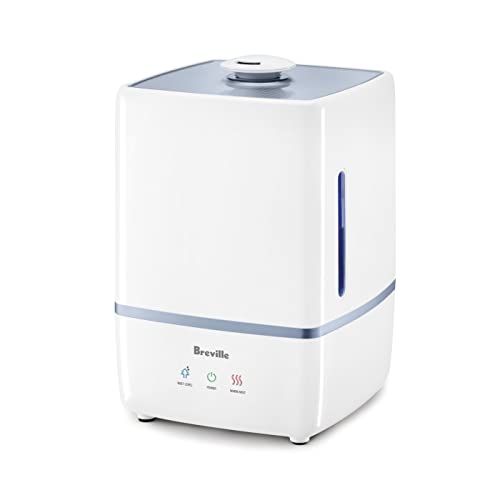
Best overall: Breville the Easy Mist LAH300. The LAH300 is our pick for a humidifier in rooms up to 30 m² because its Amazon AU listing combines a 5 litre tank, warm and cool mist, and three mist levels.
Checked 2 October 2026: Breville LAH300 appears on current Level 3 EESS registration E2022066356, certificate EESS-220068, held by Breville Pty Limited, rated 220 to 240 V, 50 Hz. Breville's Australian page lists 220 to 240 V; its ANZ manual specifies a 230 V or 240 V outlet.
The other three have weaker evidence: only STORM HERO's exact model is on a current registration (Level 1), and we found no register entry for the Philips unit or the MedeScan model. Check the RCM mark on the plug or adapter and the EESS public register.
Best humidifiers in Australia: the quick answer
- Breville the Easy Mist LAH300, best overall: A 5 litre ultrasonic humidifier with warm and cool mist, three mist levels and coverage up to 30 m².
- Philips Air Humidifier 5000 Series HU5710/00: NanoCloud evaporative humidification, a 4.5 litre tank, a humidity sensor and listed coverage up to 56 m².
- MedeScan Rainbow Mist RainbowMist II RMII0125: A 2.8 litre top-fill ultrasonic cool mist unit with a seven-colour night light and 3, 6 or 9 hour timers.
- STORM HERO SCK-2A30-61: A 4 litre top-fill ultrasonic cool mist unit with a sensor-based auto mode and a 1 to 8 hour timer.
What does a humidifier do, and do you need one?
A humidifier adds moisture to indoor air and raises relative humidity, according to the National Asthma Council Australia. The US EPA describes its use for discomfort from a dry nose, throat, lips or skin. Healthdirect also says using a humidifier in dry weather can help with itchy skin.
Start by measuring the room with a hygrometer, as the National Asthma Council advises. The Council recommends keeping indoor relative humidity between 30 and 50 per cent where possible. It says humidifiers are not usually recommended for everyday use unless you live in an extremely dry area or have been medically advised.
For very dry indoor air, the Council says a humidifier should not be set above 50 per cent. It also says the device should sterilise its mist and turn off automatically once the desired humidity is reached.
Asthma Australia does not recommend humidifiers for asthma, particularly in rooms with poor airflow, because they can encourage mould. ASCIA advises a dry, well-ventilated home to help reduce dust-mite exposure. Healthdirect lists humidifiers among cold and cough remedies without good scientific evidence.
What are signs I need a humidifier?
The National Asthma Council lists dry, flaky paint on the walls, frequent static electricity, and eye, nose or throat dryness as signs of low humidity in the home. Check the room with a hygrometer before adding moisture; the Council recommends keeping indoor relative humidity between 30 and 50 per cent where possible.
When should you stop using a humidifier?
The US EPA advises stopping use and contacting your doctor if you have respiratory symptoms you believe are associated with using your humidifier, even if you are following the maintenance directions. If condensation appears on windows or walls, the EPA says to relocate the unit, lower its humidity setting or reduce use.
Compare the humidifiers at a glance
Figures and seller names below come from the Amazon AU listings at our 2 October check. Coverage conversions are marked; a timer setting is separate from the listing's run time.
| humidifier | type | tank | coverage | run time | noise | timer or auto-off | sold by |
|---|
| Breville the Easy Mist LAH300 | Ultrasonic, warm and cool mist | 5 L | Up to 30 m² | Not stated | Not stated | Not stated | Amazon AU |
| Philips Air Humidifier 5000 Series HU5710/00 | NanoCloud evaporative | 4.5 L | Up to 56 m² | Up to 37 hours | 12 dB (listing highlight) | QuickDry stops when the filter is dry | Amazon AU |
| MedeScan Rainbow Mist RainbowMist II RMII0125 | Ultrasonic cool mist, top-fill | 2.8 L | About 23 m², converted from 250 ft² | 8 hours | Not stated | 3, 6 or 9 hour timer with automatic shut-off | Medescan |
| STORM HERO SCK-2A30-61 | Ultrasonic cool mist, top-fill | 4 L | About 47 m², converted from 505 ft² | Up to 32 hours | 30 dB or less | 1 to 8 hour timer; low-water shut-off | STORM HERO |
How we picked these humidifiers
This guide uses desk research. We compared the four models listed here on room coverage, tank capacity, mist type, listed noise and run time, filling arrangements, humidity controls, timers and maintenance requirements.
Our sources are the saved Amazon AU listings, the national EESS register, Breville's Australian LAH300 page and ANZ instruction book, the Philips HU5710 manual and the MedeScan Rainbow Mist manual. General health and care guidance comes from healthdirect, National Asthma Council Australia, Asthma Australia, ASCIA, Royal Children's Hospital Melbourne, Better Health Channel and the US EPA.
Electrical evidence: The exact Breville LAH300 code is on registered Level 3 record E2022066356, certificate EESS-220068, registered to Breville Pty Limited, with a 220 to 240 V, 50 Hz rating. Its Australian maker page also states 220 to 240 V, while the ANZ instruction book requires connection only to a 230 V or 240 V outlet.
STORM HERO's exact SCK-2A30-61 code appears on registered Level 1 humidifier record E2025005867 held by Heymix Pty Ltd, an Australian supplier. Its listing and register disagree about frequency. Searches did not find Philips HU5710/00 itself; the KA12H adapter family has registered record E2024179032, but the manual identifies EU variant KA12H-1201000EU, leaving the supplied Australian adapter unconfirmed. Searches also found no MedeScan RMII0125 equipment entry; the Rainbow Mist manual states AC 220 to 240 V, 50/60 Hz and is not confirmed for RMII0125.
Inspect the plug or adapter for the RCM mark, then search the EESS public register using the exact model code. Listings and register checked 2 October 2026.
We earn affiliate commission through our Amazon AU links. Read our methodology.
Best overall: Breville the Easy Mist LAH300
Breville the Easy Mist LAH300 is our best overall humidifier for its combination of manual mist controls, warm and cool output, and a 5 litre tank. The Amazon AU listing gives coverage up to 30 m² and three mist levels. That feature set suits someone seeking adjustable mist for a room within the stated coverage.
Breville's ANZ instruction book describes separate Power, Mist Level and Warm Mist buttons. The unit starts at low mist intensity; the Mist Level button cycles through medium and high before returning to low. The nozzle swivels to change the direction of the mist. Warm mist uses an internal heating element, according to the manual.
Refilling involves removing the top cover, lifting out the tank by its handle, turning it upside down and unscrewing the tank cap, per Breville. The instructions also call for the tank cap to be secured before the tank goes back onto the base.
Breville's manual lists product dimensions of 193 x 193 x 294 mm. Measure the surface you plan to use, and allow the manual's minimum 20 cm clearance from walls, curtains and other heat or steam sensitive materials.
The manual confirms that the LAH300 stops operating when water in the tank or basin becomes too low, with a three-beep warning and a red Power button. This stop responds to low water, not a selected room humidity.
For that reading, the National Asthma Council advises using a hygrometer and keeping indoor relative humidity within 30 to 50 per cent where possible. Use that reading when choosing a mist level.
Breville's manual gives a noise level of up to 43 dB. Its aromatherapy instructions specify two to three drops of essential oil on the aroma tray's felt pad, with oils kept out of the tank and water inlet basin. Aromatherapy is an optional feature, separate from the warm and cool mist controls.
The US EPA advises daily emptying, drying and fresh water, plus cleaning portable humidifiers every third day. It also advises low-mineral water, such as distilled water, to reduce mineral dispersal. These care requirements belong in the decision alongside tank size and mist settings.
At our 2 October check, Amazon AU sold and shipped this listing, which showed 4.1 out of 5 from 20 ratings and dispatch usually within 7 to 13 days. The listing gives a two-year warranty.
Evaporative humidifier with a humidity sensor: Philips Air Humidifier 5000 Series HU5710/00
STORM HERO SCK-2A30-61 is listed as a 4 litre top-fill ultrasonic cool mist humidifier. The Amazon AU listing describes an auto mode with sensors that adjust mist output, a night light and a timer from 1 to 8 hours. This feature set suits someone looking for top filling and automatic output adjustment.
The listing gives coverage of about 47 m², converted from 505 ft², and up to 32 hours of continuous use. Its noise claim is 30 dB or less.
Its advertised humidity range is 45 to 90 per cent. The National Asthma Council recommends indoor relative humidity of 30 to 50 per cent and says not to set a humidifier above 50 per cent. The overlap is therefore 45 to 50 per cent.
Automatic output adjustment and timer shut-off are different controls. The listing also describes shut-off when water levels are low. For room conditions, the US EPA advises keeping the surrounding area dry and relocating the unit, lowering the humidity setting or reducing use when condensation forms.
Top filling is described as pouring directly into the tank without flipping it. The listing gives a 365-day warranty. At our 2 October check, it shipped from Amazon, was sold by STORM HERO and showed 3.9 out of 5 from 46 ratings.
Smart humidifiers: what humidity sensors and app control add
Humidity sensing, a timer and low-water shut-off answer different questions. A humidity reading concerns the room, a timer concerns elapsed time, and low-water shut-off concerns the tank. The National Asthma Council says a humidifier should turn off automatically when the desired humidity is reached, so check specifically for that behaviour.
Among these cards, the Philips HU5710/00 listing identifies a humidity sensor. Its QuickDry description also mentions a sensor, but that sensor stops the device when its filter is dry. QuickDry responds to filter dryness, not a room humidity target.
The STORM HERO SCK-2A30-61 listing describes an auto mode that adjusts mist output using sensors. It advertises humidity adjustment from 45 to 90 per cent. Only 45 to 50 per cent of that range falls within the National Asthma Council's recommended 30 to 50 per cent indoor range and its limit on humidifier settings.
To choose a target, first take a room reading with a hygrometer, as the Council advises, then keep any selected humidity within its recommended range. The US EPA says to use a humidifier only when conditions require it. Its advice also covers what to do if condensation appears: relocate the appliance, lower the humidity setting or reduce use.
A MedeScan RMII0125 timer can end operation after 3, 6 or 9 hours, according to its listing. Breville's LAH300 manual describes stopping when water becomes too low.
Check app controls in the instructions for the model. Check which settings an app can change and whether humidity-based shut-off works as described. Do not infer app, scheduling or voice-assistant compatibility from an auto-mode label. For a bedroom, start with the documented humidity controls and the official moisture guidance.
Warm mist, cool mist and hybrid humidifiers
Warm vs cool mist: the practical differences
| Type | How it adds moisture | What the US EPA says |
|---|
| Ultrasonic cool mist | Ultrasonic sound vibrations create a cool mist | Minerals and microorganisms from the tank can be dispersed into the air |
| Steam vaporiser or warm mist | Water is heated; in warm mist units the steam is cooled before it leaves | Keep steam units out of children's reach: steam and boiling water can cause burns |
| Evaporative | A fan passes air through moistened absorbent material | Not expected to disperse substantial amounts of minerals |
The US EPA distinguishes ultrasonic, impeller cool mist, evaporative and steam-vaporiser humidifiers by how they put moisture into the air. Ultrasonic units create cool mist through sound vibrations. Evaporative units use a fan and moistened absorbent material, while steam vaporisers heat water. The EPA describes warm mist as steam that is cooled before leaving the appliance.
Breville the Easy Mist LAH300 offers warm and cool ultrasonic mist, per its listing and manual. MedeScan RainbowMist II RMII0125 and STORM HERO SCK-2A30-61 are listed as ultrasonic cool mist units. Philips HU5710/00 uses NanoCloud evaporative humidification.
Breville's ANZ manual says an internal heating element heats water to create warm vapour. The manual describes heating, not mist sterilisation. The National Asthma Council says humidifiers should include a mist-sterilisation feature.
For ultrasonic and impeller cool mist units, the EPA warns that minerals and microorganisms from the tank can enter indoor air. Minerals can also appear as white dust on surfaces or build up as scale. The EPA recommends low-mineral water, including distilled water, to reduce mineral dispersal and scale.
Evaporative and steam-vaporiser designs are not expected to disperse substantial mineral amounts, according to the EPA. The agency also says microorganisms can grow in these types if they have standing-water tanks. Its daily water-changing and every-third-day cleaning advice is therefore relevant when comparing designs.
Children's rooms need particular attention to steam appliances. The EPA says to keep steam vaporisers out of children's reach because steam and boiling water can cause burns.
Healthdirect, Royal Children's Hospital Melbourne and Better Health Channel do not recommend humidified air or steam for croup. Match a design to its documented controls and maintenance instructions rather than assuming warm or cool output treats respiratory symptoms.
Best humidifier for a bedroom
Our overall answer for a bedroom within the listed room coverage is Breville the Easy Mist LAH300. Its Amazon AU listing gives a 5 litre tank, warm and cool mist and three output levels for rooms up to 30 m². Breville's manual describes low-water shut-off and a noise level of up to 43 dB.
For the lowest listed numerical noise figure among these four Amazon AU listings, Philips HU5710/00 has the 12 dB highlight. Its other listed bedroom-relevant features include a 4.5 litre tank, humidity sensor, ambient light and up to 37 hours of use.
MedeScan RMII0125 lists a seven-colour light with adjustable brightness, a 2.8 litre tank and 3, 6 or 9 hour timer shut-off. STORM HERO SCK-2A30-61 lists a night light, 4 litre tank, 30 dB or less, sensor-based auto mode and a 1 to 8 hour timer.
For overnight use, follow room humidity rather than treating tank run time as an instruction. The National Asthma Council says not to set a humidifier above 50 per cent and calls for automatic shut-off at the desired humidity. The US EPA says to reduce use or adjust placement and settings if condensation develops.
Humidifier for baby: what to know
A humidifier is not a treatment for croup. Healthdirect says inhalations of humidified air or steam are not recommended, as there is no evidence they help and they can cause burns, and the Royal Children's Hospital Melbourne says steam is no longer recommended to treat croup. The US EPA warns that steam and boiling water can burn children and says to keep steam vaporisers out of their reach.
The National Asthma Council says everyday humidifier use is not usually recommended unless you live in an extremely dry area or have been medically advised. If you do use one in a nursery, the Council's guidance still applies: check the room with a hygrometer, keep humidity within 30 to 50 per cent and clean the unit as the EPA describes below. For nasal aspirators, see our baby nasal aspirator guide.
What to look for in a humidifier
Start with the room and the reason for adding moisture. The National Asthma Council advises checking humidity with a hygrometer and says everyday humidifier use is not usually recommended outside extremely dry areas or medical advice. Its indoor target of 30 to 50 per cent gives the comparison a purpose: choosing controls that address the measured conditions. The US EPA likewise says to use a humidifier only when conditions require it, with the correct moisture setting.
- Room size: Compare the room's floor area with the model's stated coverage. The Amazon AU listings give Breville LAH300 up to 30 m² and Philips HU5710/00 up to 56 m². MedeScan RMII0125 lists about 23 m², converted from 250 ft², while STORM HERO SCK-2A30-61 lists about 47 m², converted from 505 ft². These figures are the listings' coverage claims.
- Mist type: The EPA explains that ultrasonic sound vibrations create mist, whereas evaporative units pass air through moistened absorbent material. Breville lists warm and cool ultrasonic output; MedeScan and STORM HERO list ultrasonic cool mist; Philips uses NanoCloud evaporation. The EPA warns that ultrasonic and impeller units can disperse minerals and microorganisms, and that steam vaporisers present burn risks around children. A type label does not replace the care instructions.
- Tank and run time: The listed capacities are Breville 5 L, Philips 4.5 L, MedeScan 2.8 L and STORM HERO 4 L. Listed run times are up to 37 hours for Philips, 8 hours for MedeScan and up to 32 hours for STORM HERO. Capacity, run time and timer choices describe different specifications. The EPA's daily fresh-water routine still applies to a portable unit with a long advertised run time.
- Humidity sensing and shut-off: Philips lists a humidity sensor; STORM HERO lists sensors and automatic mist adjustment. MedeScan lists timed shut-off, and Breville's manual describes stopping when water is low. The National Asthma Council calls for shut-off when the desired humidity is reached. Check for shut-off at the selected room humidity. For STORM HERO, the advertised 45 to 90 per cent adjustment range overlaps the Council's guidance only from 45 to 50 per cent.
- Noise and light: Look at the source of each number. Philips' Amazon AU listing highlights 12 dB and STORM HERO claims 30 dB or less. Breville's manual gives up to 43 dB, while MedeScan's listing uses quiet-operation wording without a numerical sound level. MedeScan also describes seven light colours with adjustable brightness; Philips lists ambient light and STORM HERO a night light. Compare documented features without assuming a particular sound or light level at your bed.
- Cleaning and parts: The EPA advises daily emptying and drying, cleaning portable units every third day and following manufacturer directions for cleaning agents. MedeScan's listing describes a filter-free design, while Philips' manual identifies a humidification filter, FY5030. Check the supplied instructions for access to water-contact surfaces and the care of any replaceable parts. The EPA also advises drying components before storage and cleaning the humidifier again after storage.
- Water: The EPA recommends low-mineral water and identifies distilled water as an option to reduce scale and mineral dispersal. It cautions that bottled spring, artesian or mineral water has not been treated to remove minerals. Read the water instructions for your model alongside that guidance.
- Power and plug: Look for the RCM mark on the plug or adapter and check the exact model in the EESS public register.
How to clean a humidifier and what water to use
The US EPA's portable-humidifier guidance is to empty the tank, wipe surfaces dry and refill with fresh water daily. It says to unplug the unit first.
Every third day, the EPA advises cleaning the portable unit, removing scale, deposits and film from the tank and interior surfaces, then wiping them dry. The agency says to use a brush or other scrubber and to unplug before cleaning. Follow the appliance instructions for access to its water-contact parts.
For cleaning products, the EPA says to follow the manufacturer's directions and rinse thoroughly with several changes of water after using a cleaning or disinfecting agent. This avoids releasing cleaning chemicals during operation. A recipe for one model should not be assumed to suit another model's filter or components.
Breville's LAH300 ANZ manual gives an internal-cleaning solution of one part vinegar to one part water. It describes cleaning the basin with a soft cloth and using the supplied brush or a cotton swab for deposits, followed by rinsing and drying. Breville also cautions against sharp or solid tools on the transducer and heating element.
For Philips HU5710/00, the manual identifies the humidification filter as FY5030. QuickDry uses a fan to dry the filter and stops the device when the filter is dry, according to the listing. For cleaning and replacement, the EPA says to follow the manufacturer's instructions for the materials supplied.
The EPA recommends water with low mineral content to reduce scale and dispersal of minerals into the air. It identifies distilled water as a suitable option and explains that mineral dispersal from ultrasonic or impeller units can leave white dust on surfaces. It does not describe distilled water as a replacement for cleaning.
The EPA also says not to leave water standing in a tank for extended periods. Check the bottle label when choosing water. The EPA says spring, artesian and mineral water have not been treated to remove minerals. Its advice is to look for water labelled distilled when using that option.
Can I put essential oils in the water tank?
For the Breville LAH300, no. Its manual allows two to three drops of essential oil on the aroma tray's felt pad and says never to add essential oil to the water tank, the water inlet basin or any other part of the humidifier. Follow the supplied instructions for other models.
Before storage, the EPA advises cleaning the humidifier and making sure its parts are dry. It also advises cleaning again after storage. During use, keep the surrounding area dry; the EPA says to lower output, use the appliance intermittently or relocate it and reduce use if dampness or condensation develops.
What else helps with dry winter air
A hygrometer gives you the room reading the National Asthma Council advises checking before changing humidity; the Council notes they are sometimes built into thermometers or clocks, such as the indoor display on a home weather station. The Council says most forms of heating lower relative humidity and can sometimes make air too dry. Compare heating options in our best heater in Australia guide, then use the humidity reading to decide whether added moisture is needed.
If excess moisture is the issue, the Council describes a dehumidifier as a device that removes moisture from air. Our best dehumidifier in Australia guide covers that appliance category.
For airborne particles, see our best air purifier in Australia guide. The US EPA says filtration and air cleaning can reduce airborne contaminants and should supplement source control and ventilation. Air cleaning addresses airborne contaminants; humidification adjusts moisture.
Humidifiers we considered but left out
- LEVOIT Classic 300S 6L: At our 2 October 2026 check, the Amazon AU buy box was sold and shipped by Amazon Germany through the Amazon Global Store, with a notice that an adapter might be required. The maker's US page specifies 120 V. We left this listing out.
- Ionmax ION90: Our 2 October 2026 national EESS register check found an expired legacy entry for IONMAX ION90 and no current registration for that model. Its card has been removed from the guide.
Our verdict
Breville the Easy Mist LAH300 remains our best overall recommendation for its listed 5 litre tank, warm and cool mist, three mist levels and coverage up to 30 m². Philips HU5710/00 suits readers seeking NanoCloud evaporation and a humidity sensor. MedeScan RainbowMist II RMII0125 describes a top-fill unit with timer shut-off and a seven-colour light; STORM HERO SCK-2A30-61 describes a 4 litre top-fill unit with sensor-based mist adjustment.
The electrical evidence checked on 2 October 2026 is strongest for the exact Breville LAH300 code: current Level 3 registration E2022066356, certificate EESS-220068, registered to Breville Pty Limited and rated 220 to 240 V, 50 Hz. Breville's Australian specification gives the same voltage range, and its ANZ book says to use only a 230 V or 240 V outlet.
For STORM HERO SCK-2A30-61, current Level 1 record E2025005867 is held by Australian supplier Heymix Pty Ltd, with a frequency conflict in the Amazon listing. For Philips HU5710/00, no unit entry was found; registered adapter family E2024179032 does not confirm the supplied variant because its manual names EU adapter KA12H-1201000EU. For MedeScan RMII0125, no register entry was located, and the Rainbow Mist manual's AC 220 to 240 V, 50/60 Hz specification is not confirmed for that exact model.
Before purchasing, check the RCM marking on the actual plug or adapter and use the exact model code in the national EESS public register. For whether to use a humidifier, follow the National Asthma Council's guidance on very dry conditions and a setting no higher than 50 per cent.
Frequently Asked Questions
What is the best humidifier for a bedroom in Australia?
Our best overall recommendation for a bedroom within the listed coverage is Breville the Easy Mist LAH300. Its Amazon AU listing gives a 5 litre tank, warm and cool mist and coverage up to 30 m². The National Asthma Council says not to set a humidifier above 50 per cent relative humidity.
What does a humidifier do?
A humidifier adds moisture to the air and increases indoor humidity, according to the National Asthma Council. Its guidance is to keep indoor relative humidity within 30 to 50 per cent if possible.
Are humidifiers good for you?
A humidifier can help in specific dry conditions: healthdirect says using one in dry weather can help with itchy skin. The National Asthma Council says humidifiers are not usually recommended for everyday use unless you live in an extremely dry area or have been medically advised. Asthma Australia does not recommend them for asthma, particularly where airflow is poor.
How long should you run a humidifier at night?
Use it only while conditions require added moisture, as the US EPA advises. The National Asthma Council says a humidifier should turn off at the desired humidity and should not be set above 50 per cent. The EPA advises reducing use, lowering the setting or relocating the unit if condensation forms.
Can a humidifier make a room too humid?
Yes: the National Asthma Council says high humidity supports dust mites and mould. It advises a 30 to 50 per cent indoor range and a humidifier setting no higher than 50 per cent. The US EPA says to adjust placement, settings or use if water condenses on windows, walls or pictures.
How often should you clean a humidifier?
The US EPA advises cleaning portable humidifiers every third day. It also says to unplug, empty the tank, wipe surfaces dry and refill with fresh water daily. Follow manufacturer directions for cleaning agents and rinse thoroughly after using them, as the EPA advises.
Which brand of humidifier is best in Australia?
Breville, with the Easy Mist LAH300, is our best overall pick in this guide. Its Amazon AU listing specifies a 5 litre tank, warm and cool mist, three output levels and coverage up to 30 m².
What is the healthiest humidifier to use?
Choose by documented humidity controls and care requirements rather than a healthiest label. The National Asthma Council says a humidifier should sterilise its mist, turn off at the desired humidity and not be set above 50 per cent. The US EPA advises daily water changes and cleaning portable units every third day. It also warns that steam and boiling water can burn children.
Is a diffuser the same as a humidifier?
A scent feature alone is not enough to identify a room humidifier. The National Asthma Council defines humidifiers by adding moisture and increasing indoor humidity. Breville's LAH300 manual describes essential oils as an optional aroma-tray feature, separate from its mist controls.
Does a humidifier help with a cough?
Healthdirect lists humidifiers among cold and cough remedies without good scientific evidence supporting their use. The US EPA describes their use for dry nose, throat, lip and skin discomfort. Healthdirect advises seeing a doctor if a cough does not improve.
What are the downsides of using a humidifier?
The US EPA warns that excess moisture can encourage mould and dust mites, and ultrasonic or impeller units can disperse microorganisms and minerals from their tanks. Those minerals can leave white dust or scale. The EPA advises daily water changes, cleaning every third day and keeping indoor humidity no higher than 50 per cent.
Should you sleep with a humidifier every night?
Do not make nightly operation a default: the National Asthma Council says everyday use is not usually recommended unless you live in an extremely dry area or have been medically advised. The US EPA advises restricting use to conditions that need added moisture. The Council advises a setting no higher than 50 per cent and automatic shut-off at the desired humidity.
Where is the best place to put a humidifier?
Use a dry, stable, flat and horizontal surface, as the Philips HU5710 manual specifies, and follow your model's supplied placement instructions. Breville's LAH300 ANZ manual specifies at least 20 cm from walls, curtains and other heat-sensitive or steam-sensitive materials. The US EPA says to keep the surrounding area and absorbent materials dry. If condensation forms, the EPA advises relocating the unit, lowering its setting or reducing use.
Is it better to humidify or dehumidify?
Choose according to the measured room humidity: the National Asthma Council says humidifiers add moisture and dehumidifiers remove it. The Council recommends checking with a hygrometer and keeping indoor relative humidity between 30 and 50 per cent where possible. It says humidifiers may suit very dry air but should not be set above 50 per cent.
Do humidifiers help with asthma?
Asthma Australia does not recommend humidifiers for asthma, especially in rooms with poor airflow, because they can cause mould to grow. It also warns that a dirty humidifier can emit germs into the air. Asthma Australia says complementary or alternative therapies should be discussed with your doctor.
Is a humidifier good for a chesty cough?
Healthdirect lists humidifiers among cold and cough remedies that lack good scientific evidence. It describes a chesty cough as one that produces mucus and advises seeing a doctor if a cough is not getting better.
What's the difference between a regular humidifier and an ultrasonic humidifier?
The US EPA classifies ultrasonic humidifiers as one type of humidifier. Ultrasonic units create mist using sound vibrations, while evaporative units use a fan and moistened absorbent material. The EPA says ultrasonic and impeller units can disperse minerals and microorganisms from their tanks.
Is it better to have an air purifier or a humidifier?
They do different jobs. A humidifier adds moisture to the air, according to the National Asthma Council, while the US EPA describes filtration and air cleaning as ways to help remove biological pollutants from the air, alongside source control and ventilation. Check the room's humidity first: the Council recommends keeping it between 30 and 50 per cent where possible.
Do bedroom humidifiers really work?
A humidifier adds moisture and raises indoor humidity, according to the National Asthma Council, so it can lift the reading in a very dry bedroom. The Council advises checking with a hygrometer, keeping humidity between 30 and 50 per cent where possible and not setting a humidifier above 50 per cent. Healthdirect says using a humidifier in dry weather can help with itchy skin.
About the author
Anish Puri founded NestPath in 2026 after going through the Australian first-home-buyer process himself. NestPath focuses on Australian first-home buyers because the existing review sites are American, generic, or both. Anish handles editorial selection across the homeowner hub. Reach out: hello@nestpath.com.au