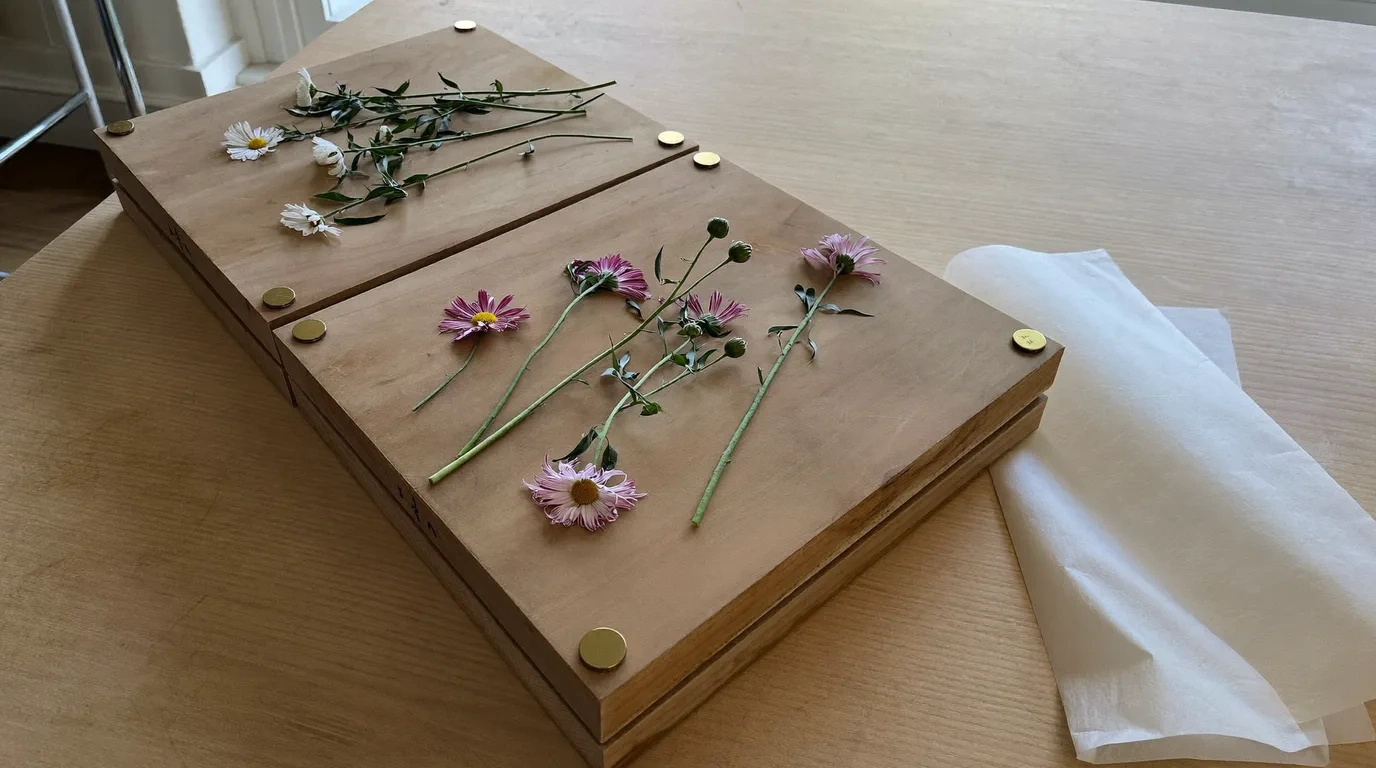
A flower press earns its shelf space when it matches the flowers you actually collect and the pace at which you make things. For a first home, that usually means choosing between a roomy wooden screw press that can sit in a craft cupboard and a microwave press that handles smaller batches quickly. The useful numbers are board area, layer count and what absorbent material arrives in the box, not decorative claims.
This guide stays tightly focused on real flower presses. It excludes flower-making kits, cutting dies, diamond-painting sets and paint pens. It also separates screw-press and microwave designs so you can compare like with like. Pressed petals remain natural material, so colour, texture and finish vary with the specimen, preparation and method.
What is the quick answer?
Choose the Rhykoka Extra Large 28 cm Flower Press for a generous all-round wooden press. Its 27.9 cm square boards, 10-layer stack and 24 blotting sheets are a practical match for leaves, flat flowers and several small arrangements at once. If you prefer a compact microwave design, the Microfleur Regular 13 cm Microwave Flower Press is our runner-up. For a simple, low-cost screw press with Australian flora artwork, the Kaper Kidz Koala Dream Australian Flora Flower Press is the budget pick.
The deciding question is not whether a press looks giftable. It is whether its usable area fits your blooms, its stack suits the batch size, and its closure matches your routine. Wooden screw presses trade speed for room and a familiar layered process. Microwave presses prioritise short sessions and reusable textile inserts, but their cavity fit and model instructions matter.
How do our flower press picks compare at a glance?
The table separates design, use case and listed price. The detailed notes below explain each product, while the design column tells you immediately whether each pick is a wooden screw press or a microwave press.
How did we evaluate flower presses?
Australian spring collecting can move from a few flat garden petals to broad leaves in one weekend, so we weighted usable pressing area and moisture-handling layers before decorative extras. That capacity-first lens matters in smaller homes because a press should finish a useful batch without turning the lounge table into permanent craft storage.
- Fit and format: We separated microwave presses from screw and strap presses, then compared listed dimensions, layers and included papers.
- Complete-kit value: We prioritised useful press components such as blotting sheets, drying boards, liners and storage, not unrelated craft filler.
- Buyer feedback: We recorded ratings and review counts from Amazon AU listings. Every pick had at least 3 reviews, and the top pick had 307.
- Shopping check: We checked that each product could be ordered from Amazon AU, along with its price, brand and category, on the day this guide was written.
Which flower press is best overall?
The Rhykoka Extra Large 28 cm Flower Press is the best overall choice for buyers who want a roomy, conventional screw press with a well-specified stack. Its 27.9 x 27.9 cm wooden plates create a useful square work area, while the 10-layer design gives you room to separate several flowers or leaves rather than crowding one sheet. The included storage bag also makes sense in a first home where the dining table may double as the craft bench.
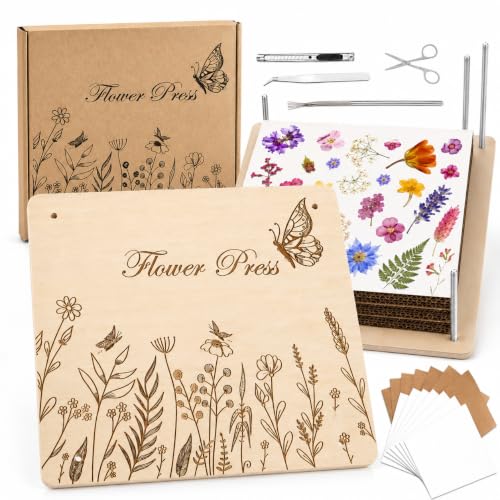
Rhykoka lists 24 blotting sheets, 10 cardboard layers, two wood pressing plates, scissors, tweezers, seven needles and a manual. That is a more coherent starting set than a bare press because you can sort delicate petals with tweezers and build the stack from matched materials. Four corner fasteners provide the familiar screw-down action. The process is visible and easy to understand: spread specimens, alternate the supplied layers, place the upper board and tighten gradually around the corners.
- Board dimensions: 27.9 x 27.9 x 5.1 cm
- Pressing capacity: 10 cardboard layers and 24 blotting sheets
- Listed weight: 1.81 kg
- Included tools: scissors, tweezers, seven needles, storage bag and manual
The adult age-range description keeps the positioning clear. Its 4.8-star rating from 307 reviews gives the selection a useful evidence base.
Flaws but not dealbreakers
At 1.81 kg, it is not our bushwalk-bag choice, and the square boards need flat storage. Frequent users should also keep dry replacement sheets in a labelled folder.
Which flower press is best for quick small batches?
The Microfleur Regular 13 cm Microwave Flower Press is the compact microwave choice for small, quick craft batches. Rather than using wooden plates, bolts and a long resting period, this 12.7 x 12.7 cm microwave design combines a patented moisture-release format with cotton and absorbent wool felt. It is a sensible fit for individual petals, small leaves, card embellishments and other pieces that fit comfortably inside its compact pressing area.
The 2.5 cm listed depth keeps the unit compact, and the product description says the 13 cm size fits most microwave ovens. Keep the instruction guide because cycle length and reset steps belong to the specific press and microwave combination.
- Press dimensions: 12.7 x 12.7 x 2.5 cm
- Design: microwave flower press
- Insert materials: washable cotton cloth and absorbent wool felt
- Included component: instruction guide
Its 4.6-star rating is backed by 1,251 reviews. Choose it for frequent small layouts when you want to move to arranging dried pieces in minutes rather than planning around a multi-week press cycle.
Flaws but not dealbreakers
The 12.7 cm square limits stem length and broad flowers, so larger material needs separating or a bigger press. You also need to keep its guide nearby and learn a repeatable cycle.
Which flower press is the best budget pick?
The Kaper Kidz Koala Dream Australian Flora Flower Press is the cheapest of our picks and a charming starter screw press. Its 21 x 17.8 cm footprint sits between pocket presses and the large square models, giving cards, small leaves and common garden flowers more room than its price suggests. The native-flora artwork feels at home on an Australian craft shelf without changing the practical basics underneath.
The set contains a wooden press, screws, 12 absorbent sheets and 7 cardboard spacers. Those are the pieces that do the real work, and the listing counts 19 pieces overall. It is designed in Australia and uses a classic screw-press layout. That makes it an accessible choice for a shared family activity or a first attempt before committing more cupboard room to a larger kit.
- Press dimensions: 21 x 17.8 x 5 cm
- Absorbent material: 12 sheets
- Spacing layers: 7 cardboard spacers
- Listed set count: 19 pieces
The product listing gives this warning verbatim: WARNING! Choking Hazard - Small Parts. Not suitable for children under 3 years. To be used under the direct supervision of an adult. Its 5.0-star score comes from 3 reviews, so we treat that early rating cautiously.
Flaws but not dealbreakers
The small review base gives us limited buyer history, and the listing does not enumerate scissors or tweezers. Treat it as a focused press set and add finishing tools as needed.
Which microwave flower press suits larger projects?
The Microfleur Max 23 cm Microwave Flower Press is the large-format microwave option for crafters who find a 13 cm square restrictive. Its 22.9 x 22.9 cm listed dimensions create much more layout room for longer foliage, multiple petals and broader compositions. It remains a microwave design, so the value lies in processing a larger arrangement without moving to a multi-week screw-press routine.
The complete kit contains two resin platens, four clips, two cotton liners, two wool felt pads, an instruction manual and video training. The clips close the textile-and-platen assembly without corner bolts.
- Press dimensions: 22.9 x 22.9 x 2.5 cm
- Press material: resin
- Press components: 2 platens and 4 clips
- Insert components: 2 cotton liners and 2 wool felt pads
This is the priciest and most-reviewed of our picks, with a 4.6-star rating from 1,390 reviews. The review depth supports confidence in the format, while your project size should decide whether the extra area is worthwhile.
Flaws but not dealbreakers
The larger square needs ample microwave and cupboard space. It is a specialist purchase if you usually press one or two small petals, so choose it for the 22.9 cm format and genuinely broader layouts.
Which wooden flower press gives you a broad square layout?
The Wakhow FP-202401 28 cm Flower Press is a strong alternative for wide leaves, grouped petals and flat bouquet sections. Its 28 x 28 cm basswood boards form the broadest listed square footprint among our screw-press picks. The pale-yellow wooden design uses a 10-tier arrangement and includes blotting sheets, so it covers the core needs of a traditional press without drifting into unrelated flower-making supplies.
Wakhow labels the age range as teen and adult. The 5.1 cm overall depth helps with shelf planning, while four corner fasteners provide the familiar screw-down format.
- Press dimensions: 28 x 28 x 5.1 cm
- Listed size: extra large
- Layer format: 10-tier design
- Primary material: basswood
The 4.7-star rating from 297 reviews supports this alternative. Choose it when board area matters and you are content to supply finishing accessories not itemised in the box. The square surface also gives fern fronds and separated flower heads room to sit without overlapping adjacent specimens.
Flaws but not dealbreakers
The listing names blotting sheets without a sheet count. Its large square format suits home storage, and much of that area may go unused for bookmarks or single petals.
Which flower press kit suits carrying between craft spaces?
The Suziko Professional 16 x 21 cm Flower Press is the practical portable kit in this group. It uses straps rather than four protruding corner bolts, and its 0.81 kg listed weight is manageable for moving between a cupboard, balcony table and craft group. The 16 x 21 cm pressing area works for leaves, petals, bookmark layouts and smaller stems without taking over a shared table.
The six-layer set includes two wooden plates, 30 protective papers, 6 drying boards, 6 sponges, zipped pockets, tweezers, scissors, a craft knife, instructions and bookmark materials. Its component fields conflict on strap and pocket counts, so we do not rely on those counts.
- Press dimensions: 21 x 16 x 8 cm
- Listed weight: 0.81 kg
- Pressing format: 6 layers with 30 protective papers
- Closure: strap-based wooden press
Its 4.4-star rating comes from 692 reviews and is the lowest in our group. Suziko fits buyers who value a neat strap closure, portability and an integrated bookmark project over maximum board area.
Flaws but not dealbreakers
The six-layer capacity is limited, strap tension uses a different adjustment method from individual nuts, and the conflicting minor component counts are untidy. The essential dimensions and core tool list remain clear.
The GOLDGE Extra Large 27.5 cm Flower Press is a well-rounded tool-inclusive screw kit. Its 27.5 x 27.5 cm wooden boards and 10 cardboard layers handle broad layouts, while 20 blotting papers build a complete working stack. The included scissors, tweezers and craft knife let a new crafter prepare and position material without immediately assembling a separate tool pouch.
The set also lists a storage bag, gift box and simple guide, keeping loose papers and tools together. Structurally, it is a conventional four-screw wooden press.
- Board size: 27.5 x 27.5 cm
- Pressing stack: 10 cardboard layers and 20 blotting papers
- Listed set count: 40 pieces
- Included tools: scissors, tweezers, craft knife and guide
A 4.7-star rating from 39 reviews gives it a useful buyer history. The generous square format and explicit component list let beginners see what their first project box contains. It is particularly coherent for a buyer starting at home with no separate cutting, placement or storage tools.
Flaws but not dealbreakers
The 40-piece count includes individual papers and boards, so focus on the 10 pressing layers. The listing gives no item weight, and the large boards point to cupboard storage.
Which flower press should you buy?
Match the pressing format to your usual batch, then use the table to jump to the pick that fits.
What should you look for in a flower press?
Start with format, then measure the flowers and storage space you actually have. A screw press is a layered stack held by bolts or straps. It suits people who collect a batch, can leave the press undisturbed and want flexible layers. A microwave press is a reusable platen-and-liner system intended for short processing sessions. It suits smaller, frequent projects, but the listed press size must fit both the specimens and your microwave cavity.
How much pressing area do you need?
Around 13 cm is enough for individual petals, small leaves and card details. A 21 cm rectangular press gives stems and bookmark layouts more freedom. A square around 28 cm suits broad leaves, grouped flowers and separated bouquet sections. Do not assume the outside board dimension is completely usable: keep specimens away from fasteners and leave room between damp pieces.
How many layers are useful?
Layer count describes batch organisation, not flower quality. Six layers can be plenty for occasional cards, while 10 layers suit a collector who wants to separate species or projects. Count the absorbent sheets as well as the cardboard or drying boards. A press with many rigid layers but too little paper may need refills sooner.
Which closure works best?
Four corner screws make pressure adjustment visible and suit a press that stays at home. Straps remove protruding hardware, pack neatly and rely on even strap adjustment. Clips make sense in a microwave system designed around matched platens and textile inserts. None is universally better; the closure should make you willing to set up the press properly each time.
Do included craft tools add value?
Tweezers are genuinely useful for thin petals, while small scissors help split thick flower centres before pressing. A craft knife, bookmarks and films matter only if those projects are on your list. If paper finishing is your main goal, our guide to the best paper cutters in Australia explains the next tool more clearly than a crowded flower-press bundle does.
Which flowers press well in Australia?
Flat flowers and blooms with a single layer of petals are an approachable starting point. Pansies, violets, geraniums, lavender, ferns, baby's breath, zinnias, marigolds and nasturtiums are commonly recommended, along with separated rose petals. Choose unblemished material and wait until surface dew or rain has gone. Thick centres and fleshy stems need more preparation, and every natural specimen can finish differently.
How do you care for a flower press?
Keep every layer flat, dry and organised before storage. After removing a finished batch, separate the papers, cardboard, sponges or textile liners and let the reusable components return to a dry condition. Store loose sheets in a flat folder rather than folding them into the press. Bent corners and rippled paper create pressure points in the next layout.
For a wooden screw press, brush away dry plant fragments and wipe the boards with a dry soft cloth. Reassemble the hardware loosely so the boards are not held under full compression while empty. Keep wing nuts, washers and small tools together in the supplied bag or a labelled container.
For Microfleur models, keep the instruction guide with the correct press. The Regular and Max have different areas, and cycle steps are model specific. The cotton liners and wool felt are reusable components, so inspect their flatness and condition before rebuilding the stack.
Replace paper that stays wrinkled, marked or less absorbent. Cut replacement blotting sheets to the working area without covering bolts or closures. If you run several presses, label the paper folder by size. That small habit stops a 13 cm insert becoming mixed into a 28 cm screw-press stack.
What will you also want for flower-press crafts?
Begin with replacement paper and one finishing format. A large accessory haul is unnecessary until you know whether you enjoy cards, frames, journals or specimen pages.
What about the competition?
Several appealing products fell outside the final seven because we could not confirm their price, buyer feedback, product type and specifications to the same standard.
Arlo & Co Personalised Flower Press: The 16 x 12 cm design uses 3 mm blonde timber, 4 cardboard sheets, bolts and UV-cured printing. We could not confirm its details through the same Amazon AU listing checks, but it remains relevant when custom printing matters most.
Sow'n'Sow flower presses: The Flower Farm recommends these locally handcrafted Queensland presses in its flower-pressing guide. We could not confirm comparable Amazon AU price and buyer-feedback details, so it is not ranked alongside our seven picks.
Tender Leaf Toys Botanical Press: The wooden children's craft positioning is clear, but we could not confirm all the details needed for a fair comparison. We preferred the Kaper Kidz kit because we could confirm both its exact warning wording and buyer details.
4M Green Science Pressed Flower Art: This is a broader children's craft activity rather than the focused flower-press format we wanted for a homeowner buying guide.
Lasnten microwave kits: The format is relevant, but the options we found did not have enough buyer feedback or sufficiently clear product details. Microfleur supplied two clearly differentiated microwave sizes with long buyer histories.
Aboofx wooden presses: Several sizes appeared across search results, but naming and bundle variations made a clean parent-level comparison difficult. We chose models with a clearer identity and confirmed component data.
What do buyers ask about flower presses?
Are flower presses worth it?
A flower press is worth it if you expect to make repeated cards, framed layouts, journals or botanical study pages. It keeps pressure and absorbent layers together more neatly than borrowing a stack of books. For one small experiment, clean paper inside a heavy book can show whether you enjoy the process before you buy dedicated equipment.
What is the best flower press to buy?
For most homes, a wooden screw press around 28 cm with several layers is a flexible choice. It accepts a wide range of leaves and flowers and does not depend on microwave dimensions. Choose a 13 cm microwave press instead when your work is mostly small petals and quick batches.
What flowers are best for pressing in Australia?
Start with naturally flat, unblemished flowers and foliage with limited moisture. Pansies, violets, geraniums, lavender, ferns, baby's breath, zinnias, marigolds and nasturtiums are approachable choices. Separate thick roses into petals or reduce the centre before pressing, and collect after dew or rain has dried from the surface.
How long do flowers take to press?
A conventional book or screw press commonly needs 2 to 3 weeks, with a check after about 1 week and paper changed when needed. A microwave flower press can process suitable small batches in minutes, but timing belongs to the specific model, microwave and plant material. Do not promise an identical finish from every flower.
What is the 3:5:8 rule for flowers?
The 3:5:8 rule is a floristry proportion guide, not a rule for choosing a flower press. One common interpretation treats the container as 3 parts, the flowers above it as 5 parts and the full arrangement as 8 parts. It may help compose a bouquet before selecting petals, but press area, layers and moisture handling decide the tool.
Flower pressing often leads to paper craft, drawing and other slow projects. Compare the best coloured pencils in Australia for botanical notes, the best paper cutters in Australia for card blanks and the best book stands in Australia for following project instructions. For adjacent making hobbies, see our guides to the best candle-making kits in Australia, best cross-stitch kits in Australia and best hot glue guns in Australia.
Who wrote this guide?
Anish Puri founded NestPath in 2026 after going through the Australian first-home-buyer process himself. NestPath focuses on Australian first-home buyers because the existing review sites are American, generic, or both. Anish handles editorial selection across the homeowner hub. Reach out: hello@nestpath.com.au