How to choose an under-desk walking pad in Australia
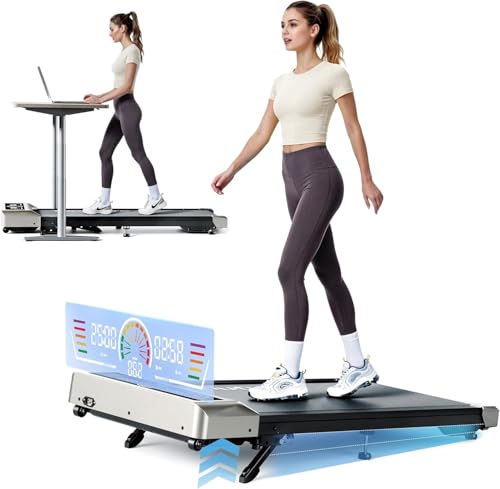
Our top pick: TOPUTURE TP7. The TOPUTURE TP7 is our pick for a walking pad with incline because it combines 0%, 5% and 10% manual settings with an adjustable handle bar. The second card is the YPOO M5038, a slimmer pad with 14% manual incline and a 9 cm base. Both are on Australia's electrical equipment register, and How we checked sets out the evidence and dates for each. These are our two picks, plus five more walking pads compared below.
Start with the job you want the pad to do. For an office walking pad, compare the lowest speed, the usable belt area and the dimensions of your desk space. The TP7 manual gives a speed range of 1 to 12 km/h and a running surface of 400 x 1000 mm. The M5038 manual gives 0.8 to 6 km/h; its Amazon AU listing states a running area of 93 x 38 cm. Keep those sources distinct when comparing the numbers. If the walking pad sits under a desk, our desk mats sized for a keyboard and mouse list each mat's size from its listing.
Measure before choosing a shape. The TP7 folds to 1200 x 630 x 135 mm according to its manual, while the M5038 manual gives a product size of 108.8 x 52 x 9 cm. Check your intended storage space for length, width and height, then measure the route between storage and the desk. For desk use, check where the pad, desk legs and controls would sit. A laser measure for checking room space can give the length of that route and the gap behind the machine in one press.
For an under-desk setup, check the operating footprint, the gap between desk legs, desk height while standing on the belt, access to controls and the clearance required by the manual; the M5038 manual asks for at least 39 inches (99 cm) behind the machine. Keep storage measurements separate from operating measurements.
Choose incline by the settings you will actually use. The TP7 has manual levels of 0%, 5% and 10%; the M5038 listing specifies 0%, 10% and 14%. Both offer a flat setting. Both are adjusted by hand, so plan a position where you can reach the incline mechanism. A higher advertised percentage should not replace a check of the belt dimensions and your available space.
Keep the weight recommendation separate from motor power. The TP7 listing states a maximum weight recommendation of 130 kg and its manual specifies a 2.5 HP motor. The M5038 listing states 158 kg. Use each model's published limit as your starting point and stay within it. Do not choose between them using an assumed relationship between horsepower and service life.
For calls, examine what a noise feature actually controls. The TP7 listing says its one-touch mute button switches off beeping. Treat that as a control feature when comparing pads, and ask about sound during walking if calls are central to your day. For storage, use the manual dimensions rather than a photo that makes the machine look small.
Finish with care instructions. The TP7 manual ties lubrication to weekly hours of use, while the M5038 manual covers belt centring, slipping and cleaning, so compare each routine with how often you plan to walk.
Include a seated option when planning the workspace; our office chair guide can help with that part of the setup.
Best walking pads in Australia 2026: quick comparison
The comparison below covers our two picks and the other five walking pads. It uses the maker manuals for speed and dimensions on the two picks, with listing claims identified where needed. Ratings are a listing snapshot, separate from our editorial choice.
| Pad | Type | Speed | Incline | Max user weight | Running area | Folded size or thickness | Rating (count) |
|---|
| TOPUTURE TP7 | Foldable pad with adjustable handle bar | 1 to 12 km/h | 0%, 5%, 10% manual | 130 kg maximum weight recommendation, listing | 400 x 1000 mm, manual | 1200 x 630 x 135 mm folded, manual | 4.6 out of 5 (226 ratings) |
| YPOO M5038 | Slim under-desk pad | 0.8 to 6 km/h | 0%, 10%, 14% manual, listing | The listing states 158 kg | The listing states 93 x 38 cm | 9 cm base, listing; 108.8 x 52 x 9 cm product size, manual | 4.5 out of 5 (64 ratings) |
| TOPUTURE TP8 | Under-desk pad, no handle bar | 1 to 10 km/h, listing | 1%, 5%, 10% manual, listing | The listing states 130 kg | 100 x 40 cm, listing | 112 x 43 x 12 cm, listing | 4.4 out of 5 (557 ratings) |
| TOPUTURE TP6 | Alloy folding pad with adjustable handrail | 1 to 12 km/h, listing | 1%, 6%, 12%, listing | The listing states 130 kg | 100 x 40 cm, listing | Not stated in the feature text | 4.5 out of 5 (384 ratings) |
| TOPUTURE TP4 | Folding pad with handle bar display | Up to 12 km/h, listing | 9%, listing | The listing states 130 kg | 40 x 16 inches, listing | 50 x 23 x 4.5 inches folded, listing | 4.6 out of 5 (354 ratings) |
| MERACH walking pad | Under-desk pad | 2.0 to 6.0 km/h, feature text | None in the feature text; 9% in the specification row | 120 kg in the feature text | Not stated | 110 x 47 x 11.5 cm, listing | 4.2 out of 5 (326 ratings) |
| WalkingPad X21 | Double-fold walking and running treadmill | 1 to 12 km/h, listing | Not described in the listing | The listing states 110 kg | 120 x 46 cm, listing | Not stated in the feature text | 4.3 out of 5 (296 ratings) |
The M5038 rating is shared across listing variants, so it is not an assessment of the M5038 alone. The MERACH listing groups four variants, and the reviews shown on the listing did not say which variant they cover, so its rating may be shared across them too. The size column gives a folded measurement for the TP7 but an overall product size for the M5038, because the M5038 manual gives no folded figure.
We also checked a CURSOR folding pad with side handrails and a 16% incline and left it out of this table and the guide. The reviews shown on its listing describe a pad with nothing to hold onto, not the handrail model on sale, so its rating would not tell you how that pad performs.
How we checked these walking pads
This guide is based on desk research: Amazon AU listing data, the maker manuals for both models, Australia's EESS register and customer photos on the listings. We checked the first two pads and their product and electrical details on 1 October 2026, the Australian brand and government sources on 2 October 2026, and the five pads added on 5 October 2026. Read the TP7 manual, the listing-linked M5038 manual and the EESS Level 1 guidance.
Walking pads are in-scope electrical equipment under Australia's EESS, and equipment not classed Level 2 or 3 falls into Level 1. EESS says Level 1 equipment must be linked to a registered responsible supplier and marked with the Regulatory Compliance Mark, or RCM. Equipment registration itself is voluntary for Level 1, so a model search and a supplier search answer different questions.
Each of our two picks rests on one of two evidence paths. The TP7 pick rests on an Australian Type I plug shown in an Australian customer photo dated 28 June 2026, the maker manual's AU line of AC 220 to 240 V at 50 Hz, and its register records. Equipment record E2025021698 names the TP7 model code and was current to 24 December 2026, and Ermenegildo Smart Pty Ltd's responsible supplier registration was active to 20 November 2026. The register lists the supplier country as New Zealand, and the plug photo is customer evidence rather than a maker photograph of the supplied plug.
The M5038 pick rests on the RCM mark photographed on the unit by an Australian reviewer, the listing-linked manual's 220 to 240 V specification and its register records. Equipment record E2026013402 names the M5038 code and runs to 21 July 2027, and Kagan Pty Ltd's responsible supplier registration runs to 25 October 2026; the register trade name is YPOOS rather than the listing's YPOO. The RCM is the Regulatory Compliance Mark that EESS requires on Level 1 equipment. The RCM photo is customer evidence rather than a maker photograph, and the 50/60 Hz figure comes from the register rather than the manual.
We added five walking pads, compared below rather than as picks, after checking each on Amazon AU for stock and the seller: the TOPUTURE TP8, TP6 and TP4, a MERACH pad and the WalkingPad X21. We searched Australia's EESS register for the five. We found no record we could match by brand and model code for the TOPUTURE TP8, TP6 or TP4, and none by brand for the MERACH pad, whose only MERACH record is for a vibration plate. The WalkingPad X21 model code TRX21F appears on a record that expired on 28 February 2026, and a current record lists the TRX21F PLUS instead. Walking pads are Level 1 equipment, where model registration is voluntary, so a missing record is a disclosure, not a finding of non-compliance. Supplier registrations lapse on their stated dates, so re-check both before buying, starting with the M5038. We distinguish a documented feature from a performance judgement: the specifications support this shortlist, while our research does not establish a quietest model or a lifespan ranking.
The CURSOR pad was checked and left out because the reviews on its listing describe a different configuration.
Best overall: TOPUTURE TP7, our top pick with incline
Budget walking pads: what to check before you buy
Choose a budget walking pad by what its documents show. Start with a readable model code, a manual for the offered unit and a clear specification for your intended use. Decide which features matter to your setup before comparing the asking amount: desk fit, a suitable speed range, manual incline, control options and storage dimensions. If you work from a laptop at that desk, our guide to laptop stands that lift the screen to eye level compares lift, laptop size and weight limit.
Work at that desk often means paper too, and our desktop scanner comparison for searchable PDFs sets out six models by speed, capacity and connection.
Separate the measurements you need. A running area describes the belt space available to use, while overall dimensions describe the machine's footprint. A folded measurement describes a particular storage configuration. Write each measurement alongside its source, and avoid substituting an overall width for a belt width when comparing listings.
Look at what comes in the box and what the paperwork covers. The TP7 manual describes a remote and a 6 mm Allen key for belt alignment, and the M5038 manual describes remote operation and a hex tool for belt adjustment. Before comparing asking amounts, list whether each budget pad includes a remote, an incline setting, the tools its manual calls for and a written warranty.
- Compare manual specifications with listing claims before choosing.
- Measure the intended desk space and storage opening.
- Read the model's care instructions and the written warranty terms.
- Check that the model code on the listing matches the manual.
Quiet walking pads for apartments and calls
For a quiet walking pad in Australia, ask what sound the advertised feature actually addresses. The TP7's one-touch mute turns off beeping according to its listing. Treat that as a specific control benefit, and keep the separate question of sound during walking open when deciding whether it suits calls or an apartment.
When comparing a decibel figure, ask for the conditions behind it: speed, user load, measuring distance and the surface used. Look for like-for-like information before treating two advertised numbers as a ranking. For a desk setup, ask whether the figure describes a person walking or an empty machine, and whether it covers the speed you intend to use.
Our desk research does not establish which of these pads will be quietest in your room. If video calls determine the purchase, ask the seller for a recording of the pad running at your walking speed and confirm the written return conditions before ordering. Keep mute controls, operating sound and your workspace requirements as separate points on the comparison sheet.
Storing a walking pad under a bed or sofa
Measure the storage opening and the full space behind it before choosing a pad. The TP7 manual gives a folded size of 1200 x 630 x 135 mm, equivalent to 120 x 63 x 13.5 cm. For the M5038, the manual gives a product size of 108.8 x 52 x 9 cm, and the listing describes a 9 cm base.
Those measurements describe different things: a folded TP7 and the M5038's product size. Use the stated length and width as well as height when checking a bed or sofa. Measure the narrowest opening and plan how you will move the machine into position, rather than assuming a low base guarantees a fit.
The TP7 manual gives a net weight of 23.9 kg; the M5038 listing states 17 kg. Include moving and storage in your decision if you intend to put the pad away after each session. The M5038 manual prohibits upright and sideways storage, so plan flat storage for that model.
Check the storage location against each manual's instructions. The TP7 manual says to avoid damp environments. Keep the manual's folded dimensions available when measuring, and do not treat a marketing photograph under a sofa as proof that the pad will fit yours.
Walking pad or under-desk treadmill: is there a difference?
The names overlap in these listings. The TP7 is marketed as a walking pad and a desk treadmill, while its maker manual calls it a home treadmill. The M5038 listing uses walking pad treadmill and under-desk treadmill, and its manual calls it a walking treadmill. Search both phrases, then compare specifications rather than buying on the category name. For a striding machine instead of a belt, see our elliptical cross trainer guide.
A label alone does not tell you the speed range, belt size or storage shape. The TP7 manual gives 1 to 12 km/h, a 400 x 1000 mm running surface and a folded height of 135 mm. The M5038 manual gives 0.8 to 6 km/h and a product height of 9 cm. Its 93 x 38 cm running area comes from the listing. Those differences are more useful for this comparison than deciding which product name sounds more compact.
Foldable also needs a specific measurement beside it. The TP7 has a manual folded-size entry; the M5038's manual provides overall product dimensions and prohibits upright and sideways storage. Read the storage instructions alongside the measurements before planning a cupboard, bed or sofa space.
For an under-desk treadmill in Australia, make a checklist around your desk and the offered unit: operating space, control access and intended speed. For a room that also holds other exercise equipment, map the pad's storage position into your home gym setup. Record the model code alongside each dimension, and choose the machine by what its manual and listing document. A remote, a fold and an incline are features to confirm on the page, not assumptions that come with either name.
Walking pad vs treadmill: which do you actually need
Choose by your intended use and the machine's instructions. The M5038 manual gives a 0.8 to 6 km/h range and calls it a walking treadmill. The TP7 manual gives 1 to 12 km/h and its safety notes address running, for example by prohibiting barefoot running, so the TP7 should not be described as walking-only merely because its listing also calls it a walking pad. For the rest of the day on your feet at home, see our guide to thongs with arch support.
What to compare first for each use| Use | Compare first |
|---|
| Desk walking | Lowest speed, belt area, desk clearance and reachable controls |
|---|
| Separate exercise sessions | Intended use, usable deck, handle arrangement and controls |
|---|
| Storage after each session | Storage dimensions, machine weight and permitted storage orientation |
|---|
For desk walking, start with the lower speed, belt measurements and how the pad would fit beneath your working setup. For running, compare the intended use, usable deck, controls and care requirements in our treadmill guide. Do not infer a running specification from a folding label or a maximum speed alone.
The TP7 manual warns against prolonged high-load operation and specifies home use. Keep those instructions in the decision if you expect extended demanding sessions. Write down whether desk walking or separate exercise is your priority, then compare the documented settings and dimensions against that purpose.
If you also want to compare a seated exercise machine for a separate session, see our exercise bike guide.
A candid note on motor longevity
Do not choose a walking pad using a promised lifespan derived from its horsepower. The TP7 manual specifies 2.5 HP, but its relevant durability guidance concerns operation and maintenance: it warns that prolonged high-load use can damage the motor and controller and accelerate ageing of the bearings, belt and running board.
The same manual explains that a belt tightened too far increases motor load and risks damage. It also gives lubrication checks and usage-based intervals. Those are specific instructions to follow; they do not establish how many years a particular unit will last in your home.
For the M5038, keep the listing's oil-free belt claim separate from the manual's E08 reference to basic lubrication. Treat lubrication on that model as an open question rather than a settled maintenance-free feature. A comparison based on documented care is more useful than assuming one motor description proves a longer service life.
Keep your usage pattern in mind when reading the manual, and retain the model's written warranty terms. The TP7 manual describes 12 months of cover for home use, while the M5038 manual describes a one-year limited warranty.
Walking pad maintenance: belt, lubrication and cleaning
Use the instructions for the model you own. The TP7 manual says to check the centre underside of the running belt after a period of use: an oily feel means lubrication is unnecessary, while a dry feel calls for lubricant. Follow its oil-port procedure rather than applying an assumed schedule from a different treadmill.
The TP7 procedure specifies 5 to 10 ml of silicone oil through the oil port, followed by 10 minutes of operation to distribute it. Its interval table says once every five months for less than three hours of weekly use, once every two months for four to seven hours, and once a month for more than seven hours. The manual warns against excess lubricant because it can cause slipping.
For TP7 belt tension, the manual says to adjust both rear screws equally, clockwise in half-turn increments, if the belt slips or hesitates underfoot. It warns that excessive tension increases motor load. Its belt alignment instructions use the supplied 6 mm Allen key, with adjustment on the side towards which the belt has moved. Follow the full procedure in the manual when making an adjustment.
The M5038 manual gives its own belt centring and slipping procedures. A left-drifting belt calls for a quarter-turn clockwise on the left idler roller screw; its slipping procedure uses half-turn clockwise adjustments to both screws. It tells users to remove nearby debris before maintenance and use the supplied hex tool.
For M5038 cleaning, the manual specifies a soft, damp cloth for the frame and console, with no acidic or caustic detergents. It says not to clean the underside of the walking belt. The listing's oil-free wording sits alongside an E08 troubleshooting instruction that mentions lubrication, so do not assume lubrication can be omitted indefinitely.
Walking pad brands in Australia: what you see in shops versus on Amazon
Compare Australian walking pad brands model by model, not by assumptions about where a brand is sold. Our two picks are the TOPUTURE TP7 and YPOO M5038, and the other five pads are compared above; the WalkingPad X21 is one of them. The other models below provide context from confirmed Australian maker pages; they are not additional product picks, and a maker page does not mean a nearby shop has a demonstration unit.
Kingsmith WalkingPad's Australian site lists C2, Z1, R1 and X21 among its models. The C2 page gives 0.5 to 6 km/h, a 100 kg weight capacity, a 1200 x 400 mm walking area and a folded size of 825 x 518 x 136 mm. The Z1 page gives 1 to 6 km/h and 110 kg. Use those exact names when comparing specifications, and keep the C2's documented folding measurement separate from a general claim that a pad is compact.
The R1 page lists an adjustable handrail, a maximum speed of 10 km/h and a 110 kg weight capacity. The X21 page gives 1 to 12 km/h and a 110 kg weight capacity. These examples show why a brand comparison needs a model code and a specific speed range. Compare the individual product page and manual before extending a feature from one model to another.
Everfit's maker pages include walking pads identified by SKU. For example, TMILL-380-PAD is listed with a 380 x 1000 mm belt, a 110 kg capacity, speeds of 1 to 10 km/h and rated voltage of 220 to 240 V. Everfit also lists a 3 in 1 Walking Pad Treadmill family with 12% incline, coded TMILL-400-2INC. Keep the full SKU in your notes when checking a colour or incline variant.
Lifespan Fitness lists the V-FOLD Treadmill with SmartStride, WalkingPad M2 and adidas Run-Pad. The V-FOLD page gives a maximum of 12 km/h with the handle up and a 6 km/h limit with the handles down. The M2 page gives 0.5 to 6 km/h, a 100 kg load rating and folded dimensions of 82.2 x 51.8 x 12.5 cm. Compare those use modes and measurements with your own intended desk and storage arrangement.
York Fitness Australia's Walking Pad Treadmill is identified as SKU YRK51161. Its page gives 0.8 to 6 km/h, a 1200 x 420 mm running area, a 110 kg maximum user weight and an included remote control. Those are confirmed specifications to use in a model comparison. The page also gives a 1.25 hp motor and a 25 kg product weight.
For a retailer example, BLACK LORD Treadmill Walking Pad Foldable Black is listed at Bunnings. We confirmed that product page. The practical next step for someone who wants to see a pad in person is to ask the retailer whether it can arrange a demonstration of that model. A product page alone does not answer that request.
Use the same checklist across these channels: model code, belt area, operating and storage measurements, controls and care instructions. Request the manual for the unit offered rather than relying on a brand-wide description.
A note on availability in Australia
The Sperax 4-in-1 is not one of the cards in this guide. All seven cards are Amazon AU listings, so stock, sellers and delivery times can change; the product cards show the current listing details.
Warranty support differs by maker. The TP7 manual gives 12 months of cover for home use and asks owners to register at warranty.toputure.com. The M5038 manual describes a one-year limited warranty under which replacement parts for defects in materials or workmanship are supplied free of charge, and it excludes use beyond normal home use. Keep the order details with the manual so a claim can be matched to the unit. The manuals list toputure_service@outlook.com as the TP7 warranty contact and support@ypoo.au for the M5038.
For a retailer enquiry, BLACK LORD is listed at Bunnings, while the maker sites above provide other model specifications. Ask about the offered model directly and confirm its documentation before deciding.
Our verdict
The TOPUTURE TP7 is our top pick for the combination of 10% manual incline and a handle bar adjustable from 89 to 109 cm; its maker manual carries an AU-specific voltage line, which is part of the evidence set out in How we checked. Its documented 1 to 12 km/h speed range and folded dimensions give you concrete information to compare with your intended setup. Measure the 1200 x 630 x 135 mm folded footprint before planning storage. Neither of our two picks needs the app for everyday control, and neither has a motorised incline.
The YPOO M5038 is the second card for its 9 cm base and 14% manual incline. Its manual specifies 0.8 to 6 km/h and a 108.8 x 52 x 9 cm product size. Treat the listing's 158 kg recommendation and 93 x 38 cm running area as listing claims.
One reminder: the M5038 supplier's EESS registration runs to 25 October 2026, so confirm it is current before buying. Choose between the cards using the documented dimensions, speed settings, incline, controls and maintenance routines. The other five pads widen the choice, from the lighter TOPUTURE TP8 to the double-folding WalkingPad X21, but their figures rest on listing text rather than maker manuals.
Frequently Asked Questions
Are walking pads worth it?
Yes, if you want a compact machine for planned walking at a desk and its dimensions suit your setup. Australia's physical activity guidelines on health.gov.au advise breaking up prolonged periods of sedentary behaviour as often as possible, although that guidance does not specifically endorse walking pads. Compare the TP7's documented incline and handle adjustment with the M5038's slimmer base, then include the care requirements in the decision. Keep a seated option in your workspace plan too, and review your desk arrangement before ordering.
Can you run on a walking pad?
It depends on the model: the TP7 manual specifies 1 to 12 km/h and its safety notes address running, prohibiting barefoot running, so describing it as walking-only would be inaccurate. Its manual also warns against prolonged high-load operation and says the machine is for home use. The M5038 manual calls it a walking treadmill and specifies 0.8 to 6 km/h, so do not infer the same running specification from the shared walking pad label. If running is your priority, compare the intended use, deck dimensions, controls and maintenance instructions for the machine you are considering.
How loud are walking pads for apartments and video calls?
This desk research does not establish which card will be quietest in your apartment or during a call. The TP7 listing says one-touch mute switches off beeping, which answers a different question from sound while a person walks on the belt. When asking about noise figures, request the speed, user load, measuring distance and floor surface so you can compare the conditions. If calls are central to the purchase, ask the seller to demonstrate the pad at the speed and in the configuration you expect to use, and confirm the written return conditions before choosing.
How fast do walking pads go, and what is a good walking speed?
The TP7 manual specifies 1 to 12 km/h, while the M5038 manual specifies 0.8 to 6 km/h. Choose a desk-walking setting around your ability to use the machine's controls and carry out your intended task, rather than treating either maximum as a target for working. Begin with the model's instructions and a low setting, then assess whether the arrangement suits the activity you planned. For the TP7, the manual also requires the safety key clip to be attached to clothing during use and prohibits jumping on or off while it is moving.
Can you use these walking pads without an app?
Yes, for the everyday functions. The TP7 manual describes start, pause, stop and speed controls on both the remote and the console, with a remote range of 2 to 5 metres. The M5038 manual describes remote operation for starting the belt and changing speed in manual mode. The apps (Fitshow or KINOMAP for the TP7, YPOOFIT for the M5038) are optional for those documented functions. For the other five pads, check each listing's controls; the WalkingPad X21 listing, for example, says it has no remote and sets speed by app or dial.
What is the difference between a walking pad, an under-desk treadmill and a folding treadmill?
These names overlap: the TP7 listing uses walking pad and desk treadmill, while its manual calls it a home treadmill. Compare the actual speed range, running area, handle arrangement and storage dimensions rather than assuming the label defines the machine's intended use. The TP7 has a manual folded size of 1200 x 630 x 135 mm; the M5038 manual gives product dimensions of 108.8 x 52 x 9 cm and prohibits upright or sideways storage. For desk use, measure your working space and read the manual before choosing.
How much weight can walking pads hold?
The TP7 listing states a maximum weight recommendation of 130 kg, while the M5038 listing states 158 kg. Both figures come from the listings; neither manual's specification table gives a user weight limit. The TP7 manual also tells users not to exceed rated capacity, so stay within the listed figure for the unit you order. The M5038's 158 kg figure also appears in its listing title. Compare usable belt dimensions and the machine's instructions alongside the weight figure when deciding whether it suits your requirements. Among the other five pads, listed limits run from 110 kg for the WalkingPad X21 to 130 kg for the three TOPUTURE pads; the MERACH's feature text gives 120 kg, while its specification row says 16 kg.
Do walking pads need maintenance or lubrication?
Follow the manual for your model: the TP7 has lubrication checks, an oil-port procedure and intervals tied to weekly usage. Its manual specifies 5 to 10 ml of silicone oil and warns that excessive lubricant can cause slipping, while its belt tension instructions warn against tightening too far. The M5038 listing calls the belt oil-free, but the manual's E08 row mentions basic lubrication, so do not treat lubrication as unnecessary. For M5038 cleaning, the manual specifies a soft, damp cloth on the frame and console and prohibits cleaning the belt's underside.
Can you leave a walking pad running throughout the working day?
Do not assume either model is intended for uninterrupted all-day use. The M5038 manual says manual mode stops automatically after 100 minutes. The TP7 manual warns against prolonged high-load operation, and its automatic modes run for 5 to 99 minutes. An automatic stop time is not a recommended session length, so plan breaks and follow each manual's maintenance schedule.
What is the best brand of walking pad in Australia?
Our top pick is the TOPUTURE TP7 model, based on its documented 10% manual incline and adjustable handle bar. For brand context, the confirmed Australian maker pages include Kingsmith WalkingPad C2, Z1, R1 and X21, Everfit SKU-coded walking pads, Lifespan Fitness V-FOLD and M2, and York Fitness Walking Pad Treadmill YRK51161. Compare each model's speed range, usable deck and storage dimensions rather than extending one specification across a brand. The YPOO M5038 is our second card, with 14% manual incline, a 9 cm base and a 0.8 to 6 km/h speed range in its manual. Capacities also differ by model: Kingsmith's C2 page gives 100 kg, while the York Fitness pad gives 110 kg.
Where can you buy a walking pad in a store in Australia?
BLACK LORD Treadmill Walking Pad Foldable Black is listed at Bunnings. Contact the retailer to ask whether that model can be viewed or demonstrated locally before you plan a visit. Australian maker pages also provide model information for Kingsmith WalkingPad, Everfit, Lifespan Fitness and York Fitness, but a web listing does not establish local display arrangements. Ask about the model code, manual and written purchase terms for the version you would buy, and compare those answers with the desk and storage measurements you need. If a demonstration is not possible, read the written return conditions before ordering so you know what applies if the pad does not suit your space.
Can you use a walking pad on carpet?
Read the placement instructions for your model before deciding on that setup. The TP7 manual specifically prohibits use on heated carpets and identifies uneven floor placement as a cause of belt misalignment; the M5038 manual prohibits use on uneven ground. Those instructions do not establish approval for the carpet in your room, so ask the seller about your surface and follow the model's placement instructions. Keep the floor question separate from storage fit. Do not assume a mat removes the need to check the maker's directions, and confirm any mat arrangement with the seller before placing the unit on your carpet.
What is a walking pad?
In these listings, a walking pad is a compact motorised treadmill marketed for walking and under-desk use. The term covers different specifications: the TP7 manual gives 1 to 12 km/h and a 400 x 1000 mm running surface, while the M5038 manual gives 0.8 to 6 km/h and product dimensions of 108.8 x 52 x 9 cm. The M5038 listing states a 93 x 38 cm running area, which is a separate measurement from the whole machine. Search walking pad and under-desk treadmill, then compare each model's intended use, controls and dimensions, including how you would move it between your desk and the chosen flat storage position.
How much does a walking pad cost in Australia?
Use the current product cards to compare the amount for each pad, then check the exact unit and purchase terms before ordering. Decide which documented features you need first, such as the TP7's adjustable handle bar and 10% manual incline or the M5038's 9 cm base and 14% manual incline. Read the written warranty and care instructions alongside that comparison, and measure the intended desk and storage spaces. Rather than selecting by the asking amount alone, identify the model code on the written order so your specification comparison matches the unit you receive.
Is a walking pad better than walking outside?
Choose according to whether you want an indoor machine for desk walking or an outdoor walk; this desk research does not establish that either delivers a better health outcome. Australia's physical activity guidelines on health.gov.au advise breaking up prolonged periods of sedentary behaviour as often as possible and undertaking a variety of physical activities at different intensities. Those guidelines do not specifically endorse walking pads, so treat a pad as a purchase decision about your space and intended routine. Compare the model's dimensions, settings, care requirements and placement instructions before choosing an indoor setup, and plan where the pad will sit between sessions.
What are the downsides of using a walking pad?
Include floor placement, storage and maintenance in your decision. The TP7 manual warns against prolonged high-load operation and provides lubrication and belt adjustment instructions, while the M5038 manual prohibits upright and sideways storage. The M5038's oil-free listing claim also sits awkwardly with the basic lubrication step in the manual's E08 row. Measure the working and storage spaces before buying, and note that the M5038 manual says manual mode stops automatically after 100 minutes.
What is the best walking pad with incline in Australia?
The TOPUTURE TP7 is our top pick for its documented 0%, 5% and 10% manual incline and handle bar adjustment from 89 to 109 cm. Its manual also gives 1 to 12 km/h and a folded size of 1200 x 630 x 135 mm. The YPOO M5038 is the second card with a steeper 14% manual setting and a 9 cm base, and its manual lists a 0.8 to 6 km/h speed range. Both models change incline by hand rather than with a motor.
Do these walking pads have automatic incline?
Not our two picks: both use manual incline. The TP7 manual gives settings of 0%, 5% and 10%, changed by moving the incline block pin; the M5038 listing gives 0%, 10% and 14%. Of the other five pads, the TP8 listing describes manual incline levels of 1%, 5% and 10%, the WalkingPad X21 listing describes no incline, and the MERACH listing conflicts, with no incline in its feature text and 9% in its specification row, so check each listing. App support does not mean the incline is motorised.
Do walking pads work as well as treadmills?
Walking pads and treadmills have overlapping labels, so compare the exact model's intended use, speed range, running area and controls. The TP7 manual gives 1 to 12 km/h and its safety notes address running, while the M5038 manual calls it a walking treadmill with 0.8 to 6 km/h. This guide does not establish equal performance across the categories.